Time of the Flies by Claudia Piñeiro tr. Frances Riddle

Women in Translation Month

15 years after killing her lover Ines is released from prison. A dark, intelligent mystery with a surprise collective voice

I read Claudia Piñeiro’s latest novel for #WITMonth. It is from the Charco Bundle 2024, a subscription where they send you nine titles, the best of contemporary Latin American fiction they are publishing throughout the year. It’s one of my absolute favourite things, an annual literary gift to me, surprise books that I haven’t chosen myself. And they are so good!

Also, it’s August. Women in Translation month. So I’m prioritising books in that category, another of my favourite things. World travel and storytelling through literature.

Claudia Piñeiro is fast becoming one of my favourite Latin American authors. This is her third book I have read. Elena Knows was Shortlisted for the International Booker Prize 2022; it was intriguing, but the next one, A Little Luck was even better. More engaging emotionally, full of suspense, an immersive read.

Review

Time of the Flies has it all. The more I consider it, I find it is literary brilliance.

A past crime, a slow burning mystery, a complicated mother daughter relationship, a developing friendship between women who are used to not trusting anyone, unwanted motherhood, a dilemma that might be an opportunity or a trap. A sociological commentary on the lives, loves, wrath and resentments of women and thought provoking references to other works of literature, from classic mythology to contemporary feminism.

Female Friendships, Fumigations and Investigations

Inés, the mother of Laura ( a role she is trying now to deny) has been released from prison 15 years after killing her husband’s lover. She has set up a pest fumigation and private investigation business with fellow friend and ex inmate Manca.

FFF (flies, females and fumigations) a business run by women for women. Non-toxic pest control.

The two friends and business partners work separately but they consult each other when a case requires it, although Inés knows more about autopsies, fingerprints, and criminal profiles than Manca does about cockroaches.

A new client makes Inés an offer that might be an opportunity or a trap, she considers whether to pursue the opportunity and Manca, her friend and business partner investigates the client and becomes suspicious when she finds there is a connection between this woman and someone Inés knows.

She curses her fate and whatever recommendation or flyer that landed her at Susan Bonar’s house in the first place to be confronted by a part of her past that she does not deny but prefers to forget.

The Collective Voice, And Medea

Then there is a collective voice of feminist disharmony that enters the narrative every few chapters to opinionate on what just happened, if there is an issue that women might have an opinion on.

It’s never a consensus, it illustrates the difficulty of any collective voice that doesn’t resonate together, and demonstrates the aspects being considered on a topic. Other voices are quoted that challenge:

“There are many kinds of feminism in the world, many different political stances within the social movement and different critiques of our culture.” Marta Lamas Acoso. I don’t agree. Me neither. I do.

Each of these chapters begins with an epigram from Medea by Euripides (a Greek tragedy/play from 431 BC), that sets the tone for the theme that will be discussed. Like our protagonist Inés, Medea too, took vengeance against her philandering husband Jason, by murdering his new wife and worse, her own two sons.

This quote below precedes a discussion on the issue of one woman killing another woman, whether that is femicide. Equally interesting quotes from Rebecca Solnit and Toni Morrison are also referred to in the text.

Medea by Euripides A Greek Tragedy, Time of the Flies Claudia Pineiro Collective voice of women feminist issues

Chorus:

‘Unhappy woman, 

Feu, feu [Ah, ah] unhappy for your miseries.

Where will you turn? To what host for shelter?’

Once you realise what the collective voice is doing, it provides a pause in the narrative and allows other voices to engage with the reader. In case you missed that a significant issue had just appeared in the text you’re going to be confronted with it here. It doesn’t distract from the story (well, yes it does initially), however the chapters are only a couple of pages long. It adds depth to the narrative making this more of a literary novel, it pushes the reader to consider the issues, which some readers may not appreciate, but it is likely they will remember.

What About Those Flies

Inés sees a fly. In her eye. It comes and goes, it is a part of her. The doctor has checked it out and explained it away, but for her, it is significant. She understands the brain’s suppression mechanism that will make it disappear.

If she had to define it, she’d say it’s the feeling that there’s something fluttering around her head that she can’t catch, that there’s something right in front of her eyes that she can’t see. But it’s definitely not a fly.

Flies ascend in the narrative, they have a champion in Inés and we will even come across numerous literary references to them, some that hold them more in esteem than others. They are also that niggle that she feels, something that wants attention that she is not seeing.

Even Manca made a contribution to my literary education. IN her efforts to encourage me to write, she gave me a novel (I don’t read novels Manca); Like Flies from Afar, by one Kike Ferrari. Manca doesn’t read either, not even the instructions on how to use her appliances, but she went to the bookstore and asked for ‘one about flies’, and the bookseller said: ‘The fly as a methaphor, right? I’ll bring you one of the best crime novels of the year.’

(…)
(…)
The novel has its central mystery that is slowly unravelled, while it explores the complexity of the mother daughter relationship, the effect of abandonment and absence and the promise that a new generation can bring to old wounds.
(…)
(…)
(…)

So, Those Ellipsis’s

Though it was a slow read for me, it really got me in its grip and there was so much to consider beyond the mystery, like the collective voice, which makes the reader consider issues from different points of view.

Then there are the ellipsis’s. The pause, things left out, the reader’s imagination engaged, what are they? Pause for thought indeed. Usually present when there is dialogue, they make the reader consider why they are there. Are parts of the dialogue unimportant? Are they an invitation to imagine what was said in between? Whatever the intention of the author, the effect is to awaken the reader to their presence and make you think about the why.

By the time I finished this, I absolutely loved it, for everything. For its central storytelling, its reflective invitation, the literary references, the collective voice and its ability to keep me entertained and interested and intrigued. A quirky, enticing, novel that praises flies and finds all these intriguing literary references to them. It is a cornucopia of elements amidst great storytelling.

Further Reading

Read an Extract of Time of the Flies by Claudia Piñeiro

Actualidad Literatura: The Time of the Flies <<El tiempo de las moscas>> reviewed by Juan Ortiz

Author, Claudia Piñeiro

Born in Burzaco, Buenos Aires in 1960, Claudia Piñeiro is a best-selling author, known internationally for her crime novels.

She has won numerous national and international prizes, including the Pepe Carvalho Prize, the LiBeraturpreis for Elena Knows and the prestigious Sor Juana Inés de la Cruz Prize for Las grietas de Jara (A Crack in the Wall). Many of her novels have been adapted for the big screen, including Elena Knows (Netflix).

Piñeiro is the third most translated Argentinean author after Jorge Luis Borges and Julio Cortázar. She’s also a playwright and scriptwriter (including popular Netflix series The Kingdom). Her novel Elena Knows was shortlisted for the 2022 International Booker Prize.

January by Sara Gallardo (1958) tr. Frances Riddle, Maureen Shaughnessy (2023)

January is a slim novella, considered to be a revelatory, pioneering masterpiece about a short period in the life of a 16-year-old Argentine girl living in a rural area, whose life trajectory is radically changed in a day. Now, for the first time, translated from Spanish into English.

Breaking the Silence, Exploring the Consequence

With echoes of Edith Wharton’s Summer , this radical feminist novel broke the silence around abortion to reshape the way women’s bodies and rights were perceived in 20th-century Argentina.

A radical feminist text, January was the first Argentine novel to represent rape from the survivor’s perspective and to explore the life-threatening risks pregnancy posed, in a society where abortion was both outlawed and taboo.

They talk about the harvest but they don’t know that by then there’ll be no turning back, Nefer thinks. Everyone here and everyone else will know by then, and they won’t be able to stop talking about it. Her eyes cloud with worry; she slowly lowers her head and herds a small flock of crumbs across the worn oilcloth.

A 16 year old girl in a predicament, not of her own making discovers she is pregnant, but not by the young man she dreams of. She is the daughter of peasant farm workers and has limited options, but will pursue them all the same, in order to try and avoid the inevitable, forced outcome that awaits her once her secret becomes known.

A pregnant teenager imagines death rather than forced marriage
Photo F.Capetillo Pexels.com

She is just of an age where she begins to notice and feel something for someone around her, but her virtue is stolen by another. Instead of imagining love, she imagines death, and wonders if this might be when her will finally see her.

She no longer cares about anything besides this thing that consumes her days and nights, growing inside her like a dark mushroom, and she wonders if it shows in her eyes as they remain fixed on her worn-out espadrilles, two little gray boats on the tile floor, or in her hands crossed in her lap, or in her hair burned by the perm.

The novella follows her panic, her attempt to find resolution without support, her symptoms, her desperation to seek absolution, her confession, her realisation of the terrible consequence, the life sentence, the marriage plot.

This thought floods her with a tide of anxiety as she remembers her secret. A sense of impotence rises to her throat, as if time has become something solid and she can almost hear its unstoppable current conspiring with her own body, which has betrayed her, tossing her to the mercy of the days.

She lives in rural Argentina, a conservative catholic environment, an unruly place for a young girl.

What will happen to her in this place that reveres the cloth, that judges and shames girls regardless of their innocence?

Further Reading

The New York Review of Books: Nefer’s Mission by Lily Meyer

The New Yorker: The Abortion Plot: A newly translated novel by the Argentinean writer Sara Gallardo provides a missing link in the history of abortion literature, by S. C. Cornell

Sara Gallardo: Recently rediscovered Argentine writer by Jordana Blejmar (University of Liverpool) & Joanna Page (University of Cambridge).

it is perhaps her abiding concern for the ‘Other’ – marginalized, solitary characters, women, animals, monsters, even elements of nature – that gives Gallardo’s literature its most powerful political dimension…

Author, Sara Gallardo

Sara Gallardo was born in Argentina in 1931 to an aristocratic Catholic family. She became a journalist in 1950 and was twenty-seven years old when her powerful debut January was published in 1958.

She grew up in Buenos Aires in a family of men so famous there are streets named after them all over Argentina (all key figures in the constitution of the Argentine nation): her grandfather Ángel Gallardo was a civil engineer and politician; her great-grandfather Miguel Cané was a journalist, senator, and diplomat; and her great-great-grandfather Bartolomé Mitre was president of Argentina from 1862-1868.

By the time she died in 1988 she had published more than a dozen books, including collections of short stories and essays. Gallardo has been compared to Lucia Berlin or Shirley Jackson.

January is considered required reading across Argentina.

Why Did You Come Back Every Summer by Belén López Peiró (Argentina) tr. Maureen Shaughnessy

It’s been a good couple of weeks for Charco Press, with Not a River by Selva Almada (translated by Annie McDermott) on the shortlist for the International Booker Prize 2024 and Of Cattle and Men by Ana Paula Maia (translated by Zoë Perry) winning the Republic Of Consciousness Prize 2024.

An Unforgettable Summer

social legal justice #metoo voices silenced

This week I picked up Why Did You Come Back Every Summer from the 2024 Bundle, originally published in Spanish in 2018 as Por qué volvias cada verano and published in English for the first time in April 2024.

What a book.

A young woman experiences sexual abuse by a family member when she is a teenager. Some years later she reveals what happened. And there are all kinds of responses, reactions, accusations, procedures and legal processes.

Testimony or Treason

In this lucid text, a chorus of voices speak. Often they are speaking to her, only we do not hear her voice. We hear one side of conversations. We hear what they have all said. We see what they are all doing. We understand the selfish human inclination to protect one’s own. We become witness to observing a victim in need of love and support being hung out to dry.

In between the commentaries, are the affidavits. Short, streamlined, neutral texts presented in old fashioned type that all begin and end the same way, with their two or three salient points contained within.

Photo by Suzy Hazelwood on Pexels.com

The voices that speak are presented on the right hand page, the left hand page remains blank. It gives the text momentum, the pages pass quickly. The voices say so much more, they incriminate.

The legal texts are more dense, no white space between paragraphs and they cover consecutive pages. There is no space for reflection or consideration, as we read we can hear the sound of the keys typewriter striking the ribbon.

#MeToo Movement and the Sharing of Stories

The process for pursuing justice, rather than protect or bring about resolution, too often results in making the lives of women even worse. To pursue justice threatens exposure, judgement, scorn, rift, ostracism, it brings shame. It reached a tipping point in 2017 with the #MeToo movement. Frustrated, women began to share their stories, it was the only thing left to do and when it was done as a collective, it created community and support, if not justice. Long buried trauma rose to the surface, if not for justice, to begin to heal a wound of womanhood.

Reading Why Did You Come Back Every Summer reminded me of the recent documentary You Are Not Alone: Fighting the Wolf Pack, a Spanish feature film about a young woman seeking justice after a terrifying ideal at Spain’s iconic ‘running of the bulls’. Produced in secret, the film is told through the words of the victim survivors and recounts the mass protests the case sparked on account of the injustice experienced.

More than a million women and girls took to the streets chanting “Sister, I do believe you” and broke their silence on social media with #Cuéntalo (“Tell Your Story”).

There are many ways to share a story and Belén López Peiró has created a work of art that honours an experience that changed a young girls life forever, putting it into a form that has already become a literary, social and political phenomenon in her country and beyond.

It is a justice-seeking oeuvre narrated through a cacophony of voices that gives power to the unsaid, that allows the quiet to echo resoundingly, that shines a light on yet another shadow of humanity.

Highly Recommended.

Author, Bélen López Peiró

Belén López Peiró studied journalism and communication sciences in Buenos Aires University and has recently completed an MA in Creative Writing at the Barcelona’s Pompeu Fabra University. She currently coordinates non-fiction writing workshops with a gender perspective. 

Why Did You Come Back Every Summer is her debut novel. In 2021 she published her second book Donde no hago pie (Nowhere to Stand) which narrates the legal process the author went through to bring her abuser to justice.

Not a River by Selva Almada (Argentina) tr. Annie McDermott

Not a River has just been shortlisted for the International Booker Prize 2024.

Opening Lines and Book Covers

International Booker Prize longlist 2024 Argentinian literature Spanish translation

I read the opening line and let it tell me as much as possible about the story I am about to read.

“Enero Ray, standing firm on the boat, stocky and beardless, swollen-bellied, legs astride, stares hard at the surface of the river and waits, revolver in hand.”

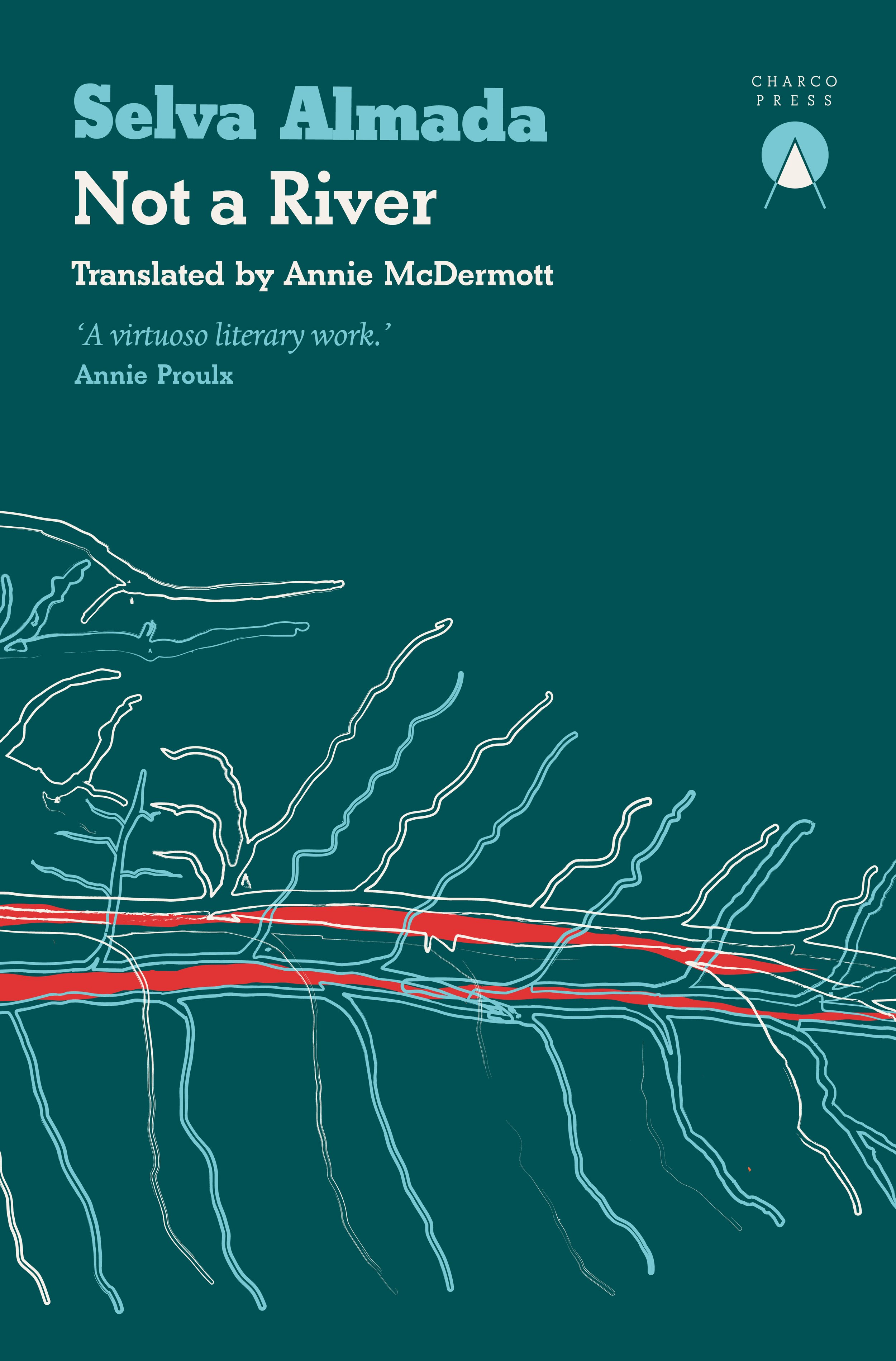
It’s a Charco Press title, so there is always a thought provoking abstract image on the cover, that never fails to contribute to the understanding of what the book has to say. This one shows twin rivers, fed by tributaries, running red.

It is clear that will be blood, death, perhaps menace and/or violence – and more than one episode. Just as the water of the smaller channels has no choice but to flow into the main river, so too the intent of a man standing firm, awaiting his prey. But who/what else will the river claim?

To Understand Any Story We Circle Back

Not a River tells a story, not in a linear way, but in a circular fashion, beginning with two men El Negro and Enero and a boy Tilo, on a fishing trip; circling back to a previous trip when Eusubio was with them, slowly revealing the memory that is acting on both men and what happened to their friend. The fishing trip is further disturbed by a visit from ‘a local’ whose questions unsettle the trio.

The second tributary/narrative follows Siomara and her two daughters Lucy and Mariela. The girls are entering womanhood, the mother is becoming more protective.

Photo V. Bagacian Pexels.com

Siomara was in one of those phases she sometimes went through, when she was grouchier than usual. Saying no to everything and dealing out punishments and bans for no reason. All because she could see how the two girls were growing, how little by little they were slipping away, how sooner or later they were going to leave her as well.

She lights fires as a way to deal with her emotions, she has done so since she was a girl. She seems to be lighting them a lot recently.

Sometimes she thinks the fire talks to her. Not like a person does, not with words. But there’s something in the crackle, the soft sound of the flames, as if she could almost hear the air burning away, yes, something, right there, that speaks to her alone…
Come on, you know you want to.
It says.

Again the story turns on itself, something has happened here too, sometimes the mother is living in the past, the present too much for her. The girls hear about a dance and plan to go.

Lucy wants to be a hairdresser. She wants to give other woman those moments of peace her mother seems to feel when she is doing her hair.

The narrative moves back and forth like the tide, people in the community are connected and affected by events that occur at the river. Paths cross, fates intertwine. It is necessary to let go of needing to know whether we are in the past or the present. If certain events happened before or after others. We accept each part of the story’s mosaic, see how they fit together, until all the pieces have been laid.

A summer like this one. Twenty years back, a summer like this one. The same island or the next one along or the one after that. In the memory it’s all just the island, with no name or exact coordinates.

The longer the men stay in the forest, the more uneasy they feel about what they have done, what has happened in the past and how unwelcome and out of place they feel. Invited to a dance, they leave their campsite for the evening.

Dreams and a Queue for the Healer

Photo by Pixabay on Pexels.com

Enero has a disturbing dream, twice.

Eusubio looked at him and thought for a moment.
We need to go see my godfather. He knows about this stuff.
He said.

Mariela also has a dream, she tells her sister Lucy about it.

And what happened in the dream?
I don’t know, like I say I just had a kind of flashback. It was weird, there were lights and sirens.

There is a sense of the repetitive cycles of the generations, girls hide from their families, they grow up to become a mother who can’t help but try and prevent their child from repeating the same mistakes. To keep them safe.

She pretends not to hear. Still just about strong enough to resist. But for how much longer.
One day, she knows she will answer the fires’s call.

In less than 100 pages, Not a River depicts disparate elements of a broken community, marginalised families, their efforts to bond, heal, escape, punish, revel and cope with the aftermath of it all.

Selva Almada’s paragraphs are like brushstrokes on a canvas, each one contributes to the story and is necessary in order to see beyond it.

The characters in my novel, men and women who live on what the river can provide, are a reflection of what the neo-liberalism of the 1990s has done to Argentina: impoverishing it, condemning a significant part of its citizens to poverty and marginalization.

Selva Almada

Highly Recommended for fans of thought provoking literary fiction.

Further Reading

Tony’s Reading list – review of Not a River

Booker Prize Website: Q & A with Author & Translator

My review of The Wind that Lays Waste

Selva Almada, Author

Selva Almada is considered one of the most powerful voices of contemporary Argentinian and Latin American literature and one of the most influential feminist intellectuals of the region.

Compared to Carson McCullers, William Faulkner, Flannery O’Connor, Sara Gallardo and Juan Carlos Onetti, Almada has published several novels, a book of short stories and a book of journalistic fiction. She has also published a film diary, written on the set of Lucrecia Martel’s film Zama, based on Antonio di Benedetto’s novel.

She has been a finalist for the Medifé Prize, the Rodolfo Walsh Award and of the Tigre Juan Award. Her work has been translated into French, Italian, Portuguese, German, Dutch, Swedish and Turkish. 

Not a River (shortlisted for the Vargas Llosa Prize for Novels) is her fourth book to appear in English after The Wind that Lays Waste (Winner of the EIBF First Book Award 2019), Dead Girls (2020), and Brickmakers (2021).

Elena Knows by Claudia Piñeiro tr. Frances Riddle

With A Little Luck now available in English, I’m catching up by reading the word of mouth sensation Elena Knows, which was shortlisted for the International Booker Prize in 2022 and won the Premio Pepe Carvalho Prize for crime fiction in 2019. According to the newspaper La Nación, Claudia Piñeiro is the third most translated Argentinean author, after Borges and Cortázar.

Claudia Piñeiro does seem like an interesting author to watch, taking the convention crime fiction genre and giving it a shake up by focusing on social issues and ethical questions, in particular related to the way women’s bodies have been and are used and abused.

Also reading this for #20booksofsummer23 and getting a head start on August’s #WITMonth, reading women in translation, because that’s my favourite corner of the reading world to be looking for literary gems!

What Does Elena Know That No One Else Seems to?

Elena has just learned her daughter Rita is dead. That it occurred on the same afternoon she booked Elena into her boyfriend’s mother’s salon for “the works”.

It was a rainy afternoon and this is the main reason Elena knows there was foul play. Because her daughter was afraid of lightning and because a mother just knows.

No one knows as much about her daughter as she does, because she’s her mother, or was her mother. Motherhood, Elena thinks, comes with certain things, a mother knows her child, a mother knows, a mother loves.That’s what they say, that’s how it is.

A Rigid Point of View

We see everything from her ‘eyes cast downward’ viewpoint, as she heads out one day to get answers from someone she hasn’t seen in 20 years.

Elena’s body is debilitated by Parkinson’s, so in between pills, she can move more easily.

Photo by RAFAEL QUATY on Pexels.com

Rita was there when he first explained the disease. Rita, who’s now dead. He told them that Parkinson’s was degradation of the cells of the nervous system. And both she and her daughter disliked that word. Degradation.And Dr Benegas must’ve noticed, because he quickly tried to explain. And he said, an illness of the central nervous system that degrades, or mutates, or changes, or modifies the nerve cells in such a way that they stop producing dopamine. And then Elena learned that when her brain orders her feet to move, for example, the order only reaches her feet if the dopamine takes it there. Like a messenger, she thought that day. So Parkinson’s is Herself and dopamine is the messenger.

The novel is told over the course of one day, in three sections: Morning (second pill), Afternoon (third pill) and Evening (fourth pill). The absence of the first pill in the narrative is a reminder as to how dependent she is on the medication and how controlling it is over her every movement, how it restricts her freedom, her vision, her ability to do anything. She is enslaved to those pills and that body.

As the pill begins to wear off, the risk of her becoming stuck increases, as her body becomes less manageable, there is no room for error or miscalculated judgement, if she is to make the journey she has planned. There are moments when she has to wait for the pill to take effect, these must be carefully timed.

Proprietary Attitudes Over Humans

She is off to get help in her attempt to investigate her daughter’s death, thinking she can use the ‘able body’ of someone she sets out on this day to meet. There is a reason why she believes that this person will help her, where no other can, and she will go to all kinds of lengths, despite the debilitating obstacles of her own body, in order to have an audience with them.

She won’t be able to do it by herself because she doesn’t have a body. Not now that the dethroned king and Herself are in charge. Even if she uses all the tricks in the book, she won’t be able to uncover the truth unless she recruits another body to help her. A different body that can act in her place. That can investigate, ask questions, walk, look directly into people’s eyes. A body that will obey Elena’s orders.

The novel explores this idea of how people impose or claim agency over another’s body and what they sentence them to, in so doing; or how they believe they “know” another just because they gave birth to or mothered them, or that God gave them some kind of right to be so knowing.

Elena’s body is in the end stages, but in her mind, she is still coming-of-age.

Claudia Piñeiro, Author

Claudia Piñeiro is best known for her crime novels, which are bestsellers in Argentina, Latin America and around the world. Four of her novels have been adapted and made into films.

As an author and scriptwriter for television, Piñeiro has already won numerous national and international prizes, among them the renowned German LiBeraturpreis for Elena Knows and the prestigious Sor Juana Inés de la Cruz Prize for Las grietas de Jara (A Crack in the Wall).

Her 8 episode series The Kingdom (2021) currently showing on Netflix, sparked controversy in 2021 for its portrayal of the Evangelical church in Argentina.

More recently, Piñeiro has become a very active figure in the fight for the legalisation of abortion in Argentina and for the legal recognition of writers as workers. Her fiction stems from the detective novel but has recently turned increasingly political, taking a broader, more critical gaze at corruption, injustice, community divisions and other dysfunctions of contemporary society. 

Further Reading

What’s On My Bookshelf: Claudia Piñeiro talks of books that inspired her career including The Little Virtues by Natalia Ginzburg, Fierce Attachments by Vivian Gornick, The Story of a Shipwrecked Sailor by Gabriel García Márquez, To the End of the Land by David Grossman, A Room of One’s Own by Virginia Woolf and The Buenos Aires Affair by Manuel Puig.

International Booker Prize Interview: Claudia Piñeiro, ‘I’ve always been very rebellious’

“I always begin writing my books with an image that acts like a trigger. I allow this image to steep in my mind, the characters then begin to speak, to reveal their conflicts. It’s like a tangled ball of wool that I unwind bit by bit. In the case of Elena Knows this image was a woman, a woman in her kitchen at home, sitting bent over in a chair waiting for the pill she’s taken to take effect so she can get up. This was the trigger image. I should also acknowledge that this diseased body of the character Elena is inspired by the body of my mother, who suffered from the same illness, Parkinson’s.  Claudia Piñeiro

The Wind That Lays Waste by Selva Almada tr. Chris Andrews

Evangalising Across the Argentinian Countryside

A reverend and his teenage daughter break down in the middle of nowhere on a steaming hot dry day, after he ignores her advice to get the problem checked before they left the last town (his home town). A visit that caused her to feel both sorry for  her father.

But her sympathy didn’t last. At least he could go back to places full of memories…Leni had no lost paradise to visit. Her childhood was very recent, but her memory of it was empty.  Thanks to her father, the Reverend Pearson, and his holy mission, all she could remember was the inside of his car.

Leni, now 16, hasn’t seen her mother since the Reverend dumped his wife and her suitcase on one of their road trips.

This happened almost ten years ago. The details of her mother’s face have faded from Leni’s memory, but not the shape of her body: tall, slim, elegant. When she looks at herself in the mirror, she feels that she has inherited her bearing. At first she believed it was just wishful thinking, a desire to resemble her. But since becoming a woman, she has caught her father, more than once, looking at her with a blend of fascination and contempt, the way you might look at someone who stirs up a mixture of good and bad memories.

The Lone Garagist

The Wind That Lays Waste Selva Almada

Photo by cottonbro on Pexels.com

A truckdriver tows them to ‘the gringo Brauer’s‘ garage, a man raising his teenage son Tapioca alone, the boy abandoned there by his mother when he was 8 years old.

Tapioca’s memories of his mother are vague too. After she left him, he had to get used to his new home. What interested him most was the heap of old cars. The dogs and that mechanical cemetery were a comfort in the first weeks while he was adjusting. He would spend all day among the car bodies: he played at driving them, with three or four dogs as co-pilots. The Gringo left him to it, and approached the boy gradually, as if taming a wild animal.

The father hadn’t finished school himself, his son could read, write and do sums so didn’t see why the boy needed to keep up with it. He decided Tapioca could learn by working and observing nature.

It might not be scientific, but nature and hard work would teach the kid how to be a good person.

Seeing the Light

Storm Thunder Wasteland

Photo by Johannes Plenio on Pexels.com

The Reverend sees good in the boy and sets his righteous missionary sights on him. Leni sees what’s happening but doesn’t intervene.

Leni had conflicting feelings: she admired the Reverend deeply but disapproved of almost everything her father did. As if her were two different people. Earlier, she had told him to leave Tapioca alone, but if she had joined them on the porch now, she too would have been captivated by his words.

Brauer doesn’t appreciate the Reverend putting ideas in his son’s head, the tension mounts and none of them know yet that there’s a storm coming.

It’s a slow build-up, getting to know the characters, two men set in their ways, with children who rarely question their authority. They are used to being in charge. It’s a short, tense, reflective novella of these two unorthodox families whose lives intersect and cause a disruption, just as the storm breaks a long period of dry.

Die, My Love by Ariana Harwicz tr. Sarah Moses, Carolina Orloff

Usually I read books because I am drawn to them by the premise, by the cultural setting, by an author’s intriguing background and experience which suggests to me they may have interesting insights to explore within a novel.

I hesitated about whether to read Die, My Love because of what I perceived as its intensity, I thought it might be depressing. The reviewer whom I expressed this too, responded:

I would say razor-sharp and brutally honest rather than depressing. No punches are pulled.

She was reviewing it, along with all the other titles long listed for the new Republic of Consciousness literary prize created by novelist Neil Griffiths to acknowledge and celebrate “small presses producing brilliant and brave literary fiction” published in the UK and Ireland.

When it was short listed for this prize and simultaneously long listed for the Man Booker International 2018, I decided to read it and find out, despite the earlier hesitation, similarly to the feeling I had about reading Meena Kandasamy’s When I Hit You: Portrait of the Writer as a Young Wife.

We meet a young woman, a university educated foreigner, living in the French countryside with her husband and their small child, another on the way. She is lying in the grass, in 35°C (95°F) summer heat, thinking disturbing, violent thoughts against those around her, while expressing an acute, brutal self-hatred alongside an intense uncontrollable desire.

Blonde or dark? Whatever you’re having, my love. We’re one of those couples who mechanize the word ‘love’, who use it even when they despise each other. I never want to see you again, my love. I’m coming, I say, and I’m a fraud of a country woman with a red polka-dot skirt and split ends. I’ll have a blonde beer, I say in my foreign accent. I’m a woman who’s let herself go, has a mouth full of cavities and no longer reads. Read, you idiot, I tell myself, read one full sentence from start to finish.

It’s written in an urgent stream of consciousness narrative, focused on the minutiae of her day, much of it spent waiting for her husband to return from work, observing herself by turn, in her acts of taking care of and neglecting the needs of her helpless son, fantasizing about harming herself.

I throw out the heavy nappy and walk towards the patio doors. I always toy with the idea of going right through the glass and cutting every inch of my body, always aiming to pass through my own shadow. But just before I hit it, I stop myself and slide it open.

It’s a rendition of spiralling out of control, sometimes playing the part of mother, in front of friends on the odd occasion they’re invited to a birthday party or playing the daughter in law at a family gathering, but not too hard, because it is impossible, the insanity too close to be able to sustain any form of denial for too long a period of time.

When my husband’s away, every second of silence is followed by a hoard of demons infiltrating my brain.

If she’s not going crazy from the silence, she’s targeting the weak, aggressing the overweight nurse who comes to tend to the neighbour, acting haughty with the women working in the supermarket, the pizza delivery men, the manicurists.

I yell at them in public. I like to make a scene, humiliate them, show them how cowardly they are. Because that’s what they are: chickens. How come none of them have tried to fight me? How come none of them have called the authorities to have me deported?

As a reader, I can’t help asking questions, like, what is this? Is this postpartum depression? No, this was a pre-existing condition that started before she gave birth, that continued afterwards and seems never to have ended.

Is this the result of leaving her education, her intellectual self behind? Of embracing motherhood? Of being separated from her country, culture, her family, the way of her own people? Those things are never ever mentioned, never alluded too, never missed, there is no nostalgia for the past, only a visceral disgust for the present, a desire for a future where she is taken out, extinguished.

We were only just waking up from the weekend and already we were fighting. At half past eight I let out the first scream, at nine-twenty I threatened to leave, and at nine-fifty I said I’d make his life a living hell. By ten past ten, I was standing like a ram in the middle of the road with my straw hat on, suitcase in hand and flies in my eardrums.

She reflects that even were she to get hit and killed, it would unlikely gain her sympathy, that would be saved for her poor child, left without a mother.

No one grieves for the wretched woman with scarred arms who was consumed by the misery of life.

She blames desire, calls it a destructive hunger, an alarm, ferocious.

Not even digging a hole, a pit, would be enough. It needs to be thrown into the desert and devoured by wild beasts. Desire that is.

I waver between wondering if this is something a woman would experience if the circumstances are created that deprive her of the things she needs for sustenance, or is this a woman creating what she perceives as art, an art form that is designed to shock, to provoke a response in its audience.

In an interview by Jackie Law at Never Imitate, when asked about her inspiration, Ariana Harwicz responded:
Motherhood as a form of prison, a trap, an ordinary destiny. Writing the novel was a chance to escape that.

When asked about herself:

I always say that I was born when I wrote Die, My Love. Before then, I was alive, in the same way that everybody is alive, yet for me that is not really being alive. I had recently had a baby, I had moved to live in the countryside next to a forest. I would watch the thunderstorms, I would go horse-riding, but that was not life for me. And then I wrote Die, My Love, immersed in that desperation between death and desire. Die, My Love comes from that. I wasn’t aware I was writing a novel. I was not a writer, rather, I was saving myself, slowly lifting my head out of the swamp with each line.

In a podcast with the London Review Bookshop, she expressed interest first and foremost in the question ‘What is it, to be an artist?’, her response to her own question illuminating:

An artist, is someone is willing to break tradition, convention and transgress outside the norm

This is what she succeeds in doing in Die, My Love. She pursues it with intellectual vigour, with a bold, unapologetic, Argentinian energy that busts out of convention, leaves the old form of language and expression behind, takes her literary weapons into the forest and wreaks havoc on the page and in the mind of the reader.

Note: Thank you to Charco Press, independent publisher of contemporary Latin American literature, for providing an e-book.

Buy a copy of Die, My Love from Charco Press

Kamchatka by Marcelo Figueras tr. Frank Wynne (Spanish, Argentina)

KamcahtkaKamchatka is a novel by the Argentinian writer Marcelo Figueras set in 1976, one year during a disturbing era of Argentinian history under military dictatorship, often referred to as The Dark Ages, a time when speaking out against the establishment gave rise to a terrible number of “Disappeared”.

Ordinary people vanished without trace, neither arrested nor imprisoned, there was no record of their detainment, they simply disappeared, believed to have been disposed off.

In an interview with Stu a huge reader of translated fiction who reviews at Winston’s Dad, Marcelo Figueras said this about his own experience as a child growing up in those years, words that are clearly an inspiration for the novel he has written:

“On the one hand, I was the typical boy on the verge of adolescence: shy, introspective, living in a bubble made of books ,music, comics, TV and movies. I played Risk a lot. I watched The Invaders. I enjoyed Houdini, the movie with Tony Curtis and Janet Leigh, but rejected its sad, sad ending. I fell in love every day. I danced alone.

But on the other hand, I lived in fear. I knew nothing about what was happening, my family had always been apolitical. In spite of that, I sensed something awful was going on: it was everywhere, even in the air, atoms of fear mixed with oxygen and nitrogen.

That was one of the main ingredients of the military Junta’s perversity: they tried to keep the appearance of normality, Buenos Aires’ streets were calm and orderly (and filled with policemen), as if nothing out of the ordinary was really happening. But people were being kidnapped in the dark, locked in dungeons, tortured and killed, and their bodies hidden in massive, anonymous graves or dropped into the sea. So something wicked was indeed happening. And my nose picked it up somehow.”

The author goes on to say that the subject has been written about by many authors and in his opinion many of those stories follow a similar trajectory of a romantic young man or woman, their involvement in politics, a kidnapping occurs, torture, death and the law courts follow.

He wanted to do something different, to write about what those who were not kidnapped endured, a different horror. By making a 10-year-old the narrator of his novel, he puts the reader right into this fearful and confusing situation of sensing being in danger and yet understanding nothing about where that fear is coming from.

HoudiniEarly on in the novel, our narrator and his younger brother, whom he affectionately refers to as The Midget, are pulled out of school abruptly by their mother and they go on what she describes as a holiday, to stay in a safe house.

The boys are told to choose a name for themselves, to change their identity and after finding a book about Harry Houdini on top of a cupboard, our narrator calls himself Harry and decides he wants to become an escape artist, something he goes to great lengths to tell us is very different to being a magician.

“Since the uncertainties of the present weighed heavily on me, I had been spending a lot of time thinking about my future. The idea of becoming an escape artist struck me as clearly as a vision: once the notion was firmly planted in my brain, all my worries  disappeared. Now I had a plan, something that would, in the near future, make it possible to tie up the loose ends of my circumstances. I imagined that Houdini himself had done much the same thing. ”

Risk Map

The ‘Risk’ Map of the World

The stay doesn’t feel like a holiday to Harry, however he passes his time doing the things he enjoys, playing Risk with his father, a post colonial game of strategy to take over the territories of the world. Harry wants to conquer but he never does, his father believes it is important he learns how to win through continual practice, not to have victory handed to him.

Finally the match occurs where Harry begins to win, he pushes his father back, gaining all but one last territory, that last bastion of strength, Kamchatka. He fails to take it and from that moment on his fortune turns.  Kamchatka is this place on the map that few have heard of, but it contains a hidden strength and it is both a figurative place Harry will return to in later years and a physical landscape of extraordinary elements that he will also visit.

Our Harry is very curious and intelligent and the book is structured into sections like lessons from a day at school. In each of these parts he reflects on philosophical ideas, covering subjects the book is divided into, biology, geography, language, astronomy and history. These reflections were one of the magical parts of the book for me, I recognise that beautiful curiosity of a young mind, trying to make connections between what he knows and what he thinks might be, growing his brain on the page.

“Sometimes I think that everything you need to know about life can be found in geography books. The result of centuries of research, they tell us how the Earth was formed…They tell us about how successive geological strata of the planet were laid down, one on top of the other, creating a modem which applies to everything in life. (In a sense too, we are made up of successive layers. Our current incarnation is laid down over a previous one, but sometimes its cracks and eruptions bring to the surface elements we thought long buried.)”

Most of the narrative takes place in this suburban exile for the period that the two boys are with their parents, during that time they invite their Grandmother to visit, a formidable woman who doesn’t get on with her daughter and whom The Midget plays a deathly trick on.

There is  a swimming pool and often the boys find a dead toad floating within it, so they devise a method for the toad to escape, hoping to improve the genetic selection of toads, as only the intelligent will figure out how to escape. It is a child’s game invested with hope.

And Kamchatka?

“The last thing Papa said to me, the last word from his lips, was ‘Kamchatka’.”

I thought this book was incredibly well told, the voice of the child narrator was so authentic and believable, his curiosity, frustrations and fear penetrate the pages and make the reader feel it all. You can’t help but read the book with a certain amount of tension, not knowing what the outcome will be. I was left wanting to read a sequel, to know how Harry coped and lived in the teenage years that would have followed, when life must have been so different to everything he and The Midget had known up until then.

A 5 star read for me, highly recommended.

The book was short listed for the Independent Foreign Fiction Prize in 2011.

A Note on That Place Called Kamchatka

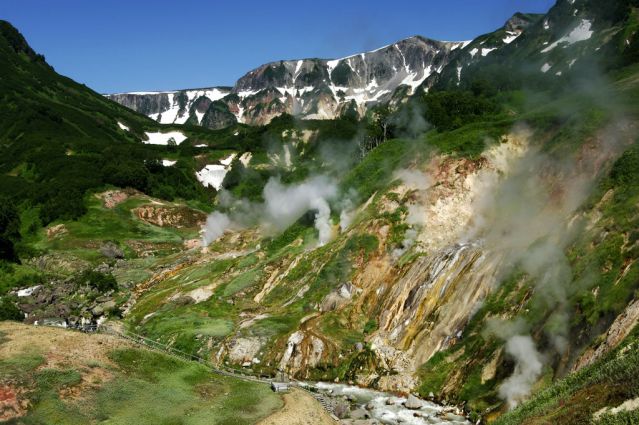
Kamchatka landscapeIn the easternmost region of Russia, eight time zones from Moscow, closer to Japan than most of Russia lies the region and peninsula of Kamchatka. A land of legends and a kingdom of bears. The region is stunning to look at and sees all the elements come together, snow topped hills, ramblings brooks, luscious greenery and volcanic vapours, yes there are frequent volcanic eruptions and earthquakes.

I realised some days after finishing this wonderful book that I knew about Kamchatka because some months ago my son made me go with him to see a stunning documentary at the cinema called ‘Terre des Ours’ which is set right on the heart of Kamchatka, a territory that is the home of brown bears, who only come out of hibernation for 3 months of the year and during that time they leave the snow topped mountainous regions and traverse the lava fields and go down to the river and lakes which are heaving with salmon. They must eat enough to get them through the next hibernation and the female bears have an even more challenging role as they have to catch enough for themselves and their offspring, while fending off the attentions of the lone male bears.

Below is a one minute trailer that show you a little of that magical world. The film is brilliant, sadly I don’t think it is available in English, the voice over is done by Marion Cotillard. But do watch this snippet, its magic.