There’s No Turning Back by Alba de Céspedes tr. Ann Goldstein (2025)

Every novel I’ve read by Alba de Céspedes has been excellent and this controversial debut (at the time of its original publication in Italy, 1938) brims with the seeds of what was to come from her work, starting with this excellent, collective coming-of-age, of eight, twenty-something year old women in pre-war Rome.

I pre-ordered this novel, as she is a favourite author, of whose work I want to read everything, sharing now for WIT Month (Women in Translation).

Literature and Morality

Feminism Journal writing Womens Rights Italian Literature

In the informative translator’s note at the beginning of the book, Ann Goldstein shares some of the historical context within which the book became an immediate and immensely popular bestseller, despite the authorities finding the novel’s breaking of female stereotypes and suggestion of other possible pathways for women offensive.

“By the time the novel was published the fascist dictator Benito Mussolini had been in power for more than a decade. His government promoted the idea that the proper place for women was to be at home and to bear children; sposa e madre esemplare (exemplary wife and mother). While there is no overt mention of Mussolini or fascism in the novel, none of the young women conform to this female ideal. In fact, in their different ways they are challenging it, even if not intentionally or even consciously.”

Selected to win the prestigious Viareggio Literary Prize in 1939, a government order stopped it and attempted to block further editions from being published, claiming it went against ‘fascist morality’. As Margarita Diaz points out in a recent article ‘An Immoral Endeavour‘:

Vague accusations of ‘immorality’ have been, and continue to be, used by dominant institutions, governments and autocratic regimes to stifle free expression and to censor legions of books and artworks. 

Women at a Turning Point

Alba de Cespedes debut novel Theres No Rurning Back translated by Ann Goldstein from Italian

Set in Rome 1936-1938, the novel focuses on eight young women in higher education, most studying at university, who live together in convent boarding house in Rome. They have greater freedoms than school girls, with restrictions deemed appropriate for unmarried single women.

From different backgrounds they have different issues, desires and ideas about life, which they share with each other as they progress through the year and one by one prepare to leave the premises.

On the cusp of “no turning back”, concluding their theses, each must make a decision about what to do next and none of them are thinking, acting or passively accepting the route that tradition has dictated.

The mere consideration of other life avenues and the outward expression of those thoughts, the girls’ discussions with each other, in this safe and open, female community, demonstrate an important processing step in their being better informed, while equally often challenged by their peers, at this formative moment in their lives.

“In all her novels de Céspedes investigates women’s attempts to both deconstruct and construct their lives and gain a sense of themselves, as she investigated her own life.”

A Year In the Life

Photo by cottonbro studio Pexels.com

Throughout that year, the girls will learn more than just the subject of their thesis as they share and navigate the issues that arise, including their reactions to things some have kept secret. They attend mass and adhere to the curfew, then gather after lights out to talk about everything deemed pressing.

Their conversations and reflections often lead to scenes from the past, as the reader gains insight into each of the circumstances that lead each young woman to this place.

Xenia is the first to present her thesis and to leave and she does so under cover of night, severing her connection with the girls, choosing the least conventional path, allowing an older businessman to arrange a job for her and accommodation, introducing her to a different circle of associates. Her desires are revealed in one of the early exchanges with the girls:

“Some nights a kind of yearning grips me: I can’t close my eyes and I get worn out thinking how I’m caged in this cloister of nuns, while outside life is flowing, fortune passing by – who knows? – and I can’t take advantage of it. You have to jump into life head-long, grab it by the throat. I won’t ever go back to Veroli, anyway.”

No Two Paths

If Xenia’s failure and disappearance shakes the girls up, the fate of quiet Milly, who writes letters in braille to a blind organist rocks their world even more.

As soon as Papa found out about our meetings, he made me come to Rome. But I’m not unhappy here: I can play the harmonium and write to him with that device there, which is all holes, in the braille alphabet, made just for blind people. By now I can write well, and he reads my letters by running his fingers over them, like this, see?

Silvia is a high performing literature student, a favourite of the Professor, who asks her to do research on his behalf, which he presents to great acclaim, telling her she will go far.

Silvia had on her face the expression of servile gratitude typical of those who are accustomed to submission from birth. Who were her parents, after all? Scarcely more than peasants. Someone had always taken possession of their work without even saying “Thank you, well done.” Confused by that praise, Silvia would have liked to promise : “I won’t take my eyes off the books professor, I’ll even work at night”; but at that moment Belluzzi’s wife came in, carrying a cup of tea.

Mirroring and Reflecting

a woman holds a mirror a reflection
Photo by Tasha Kamrowski on Pexels.com

Emanuela has told everyone her parents are travelling in America, disappearing every Sunday to visit her five year old daughter she has told no-one about, just like her father had written to the Mother Superior of the boarding school she attends, saying his daughter was abroad.

Though she does not study, she is drawn into the literature group, who appreciate her vigilant, intuitive faculty:

which revealed and illuminated, in those who approached her, only the aspect of the self capable of inspiring a mutual sympathy. So each saw her own image reflected, as in a mirror; and although the mirror had many faces, it projected only the one that it animated. And this game of reflections was a continuous revelation for Emanuela, too, who saw rising from the depths of herself, and appearing on the surface, constantly new and until then unknown aspects of her personality. Illuminated from the outside, exposed by the contact with others, her true physiognomy emerged gradually, and in a surprising way, from the shadows.

Women as Masters of Themselves
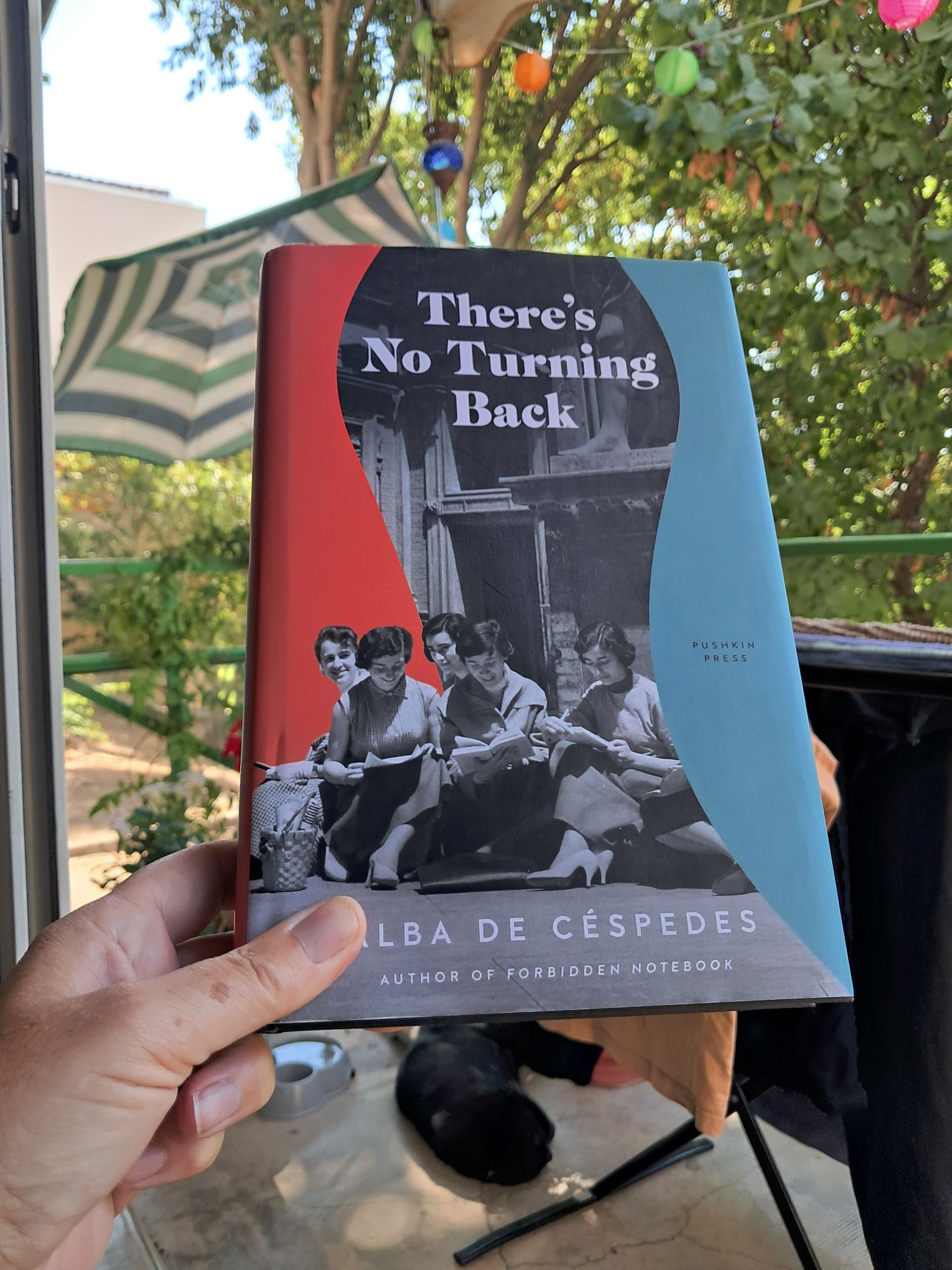
Debut novel by Italian author Alba de Cespedes Theres No Turning Back, banned by Mussolini challenged female stereotypes in 1938 Italy

Augusta is enrolled in classes but doesn’t plan to sit the exams. She stays up late writing novels and sending them out. When Emanuela asks her how long she plans to stay, she replies:

Until I’ve done something. I go back to Sardinia only for a month or two, in summer. By now, one can’t go home anymore. Our parents shouldn’t send us to the city; afterward, even if we return, we’re bad daughters, bad wives. Who can forget being master of herself? And in our villages a woman who’s lived alone in the city is a fallen woman. Those who remained, who passed from the father’s authority to the husband’s, can’t forgive us for having had the key to our own room, going out and coming in when we want. And men can’t forgive us for having studied, for knowing as much as they do.

Vinca is from Spain and during her time with the girls, she learns from the newspaper that Spain is at war and that the young man she has been seeing will go and join the fight. These and subsequent events change her trajectory.

One by one, they have their experiences and they make their own decisions, no two the same, yet all of them having been through the process of living together and sharing their developing ideas, strengthening their positions and coming to some kind of resolution about how they will live their lives.

It’s another brilliant read by this fabulous author and one can just imagine how this book would have been devoured by many women in the era it was published, providing them insight and a form of company to their own thoughts, or provoking them in their solitude as they lived out those traditional paths and dreamed of something else.

Highly Recommended.

“Emanuela took her head in her hands. “I think that at a certain point you have to stop searching and accept yourself. Find the courage not to count on others anymore, to separate from childhood even at the cost of solitude;”
“It’s all a matter of courage, in life. If you have it, you do well to leave,” Augusta murmured, tapping the ashes from her cigarette.”

Further Reading

Cleveland Review of Books: An Immoral Endeavor: On Alba de Céspede’s “There’s No Turning Back” by Margarita Diaz, August 7, 2025

The Guardian: Resistance fighter, novelist – and Sartre’s favourite agony aunt: rediscovering Alba Céspedes by Lara Fiegel, Mar 2023

My reviews of Alba de Céspedes Forbidden Notebook and Her Side of The Story

Author, Alba de Céspedes

Alba de Céspedes (1911-97) was a bestselling Italian-Cuban novelist, poet and screenwriter.

The granddaughter of the first President of Cuba, de Céspedes was raised in Rome. Married at 15 and a mother by 16, she began her writing career after her divorce at the age of 20. She worked as a journalist throughout the 1930s while also taking an active part in the Italian partisan struggle, and was twice jailed for her anti-fascist activities.

After the fall of fascism, she founded the literary journal Mercurio and went on to become one of Italy’s most successful and most widely translated authors.

After the war, she accompanied her husband, a diplomat to the United States and the Soviet Union. She would later move to Paris, where she would publish her last two books in French and where she spent the rest of her life. She died in 1997.
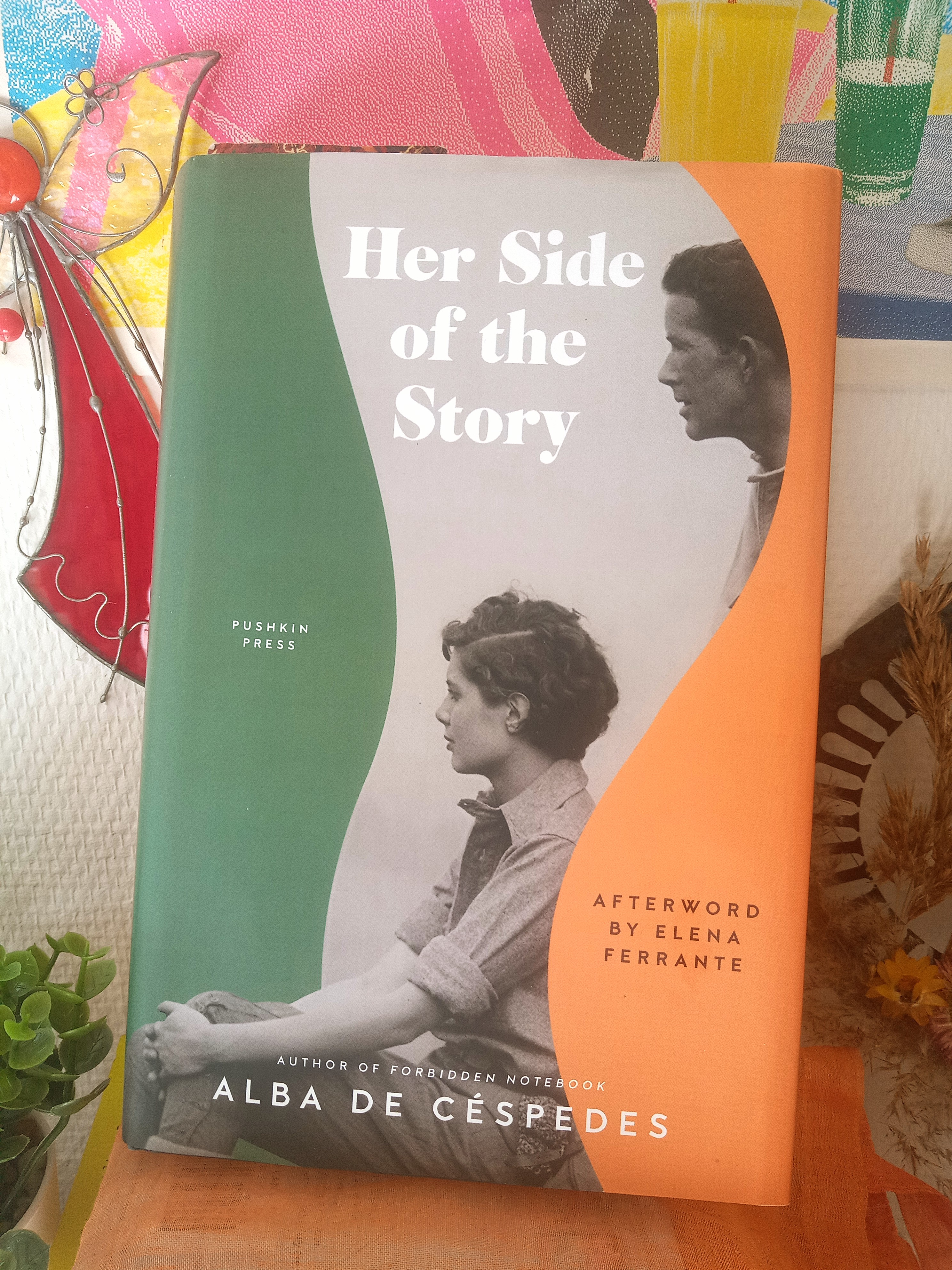
Her Side of the Story by Alba de Céspedes tr. Jill Foulston

Stunning.

I thought The Forbidden Notebook which I read in 2023 was excellent, but this novel is in a category of its own. This is probably the title in 2024 I was looking forward to the most and it exceeded my expectations.

Originally published in Italian in 1949 as Dalla parte de lei, this captivating new English translation by Jill Foulston was published by Pushkin Press in 2024.

Women’s Partisan Struggle in 1930’s -1940’s Italy

Alba de Céspedes (1911-1997) was a bestselling Italian-Cuban novelist, poet and screenwriter who worked as a journalist throughout the 1930’s while also taking an active part in the Italian partisan struggle and was twice jailed for her anti-fascist activities.

After the fall of fascism – Rome, considered the heart of fascism under Mussolini, was liberated in June 1944 and many felt the country had lost its basic values after 20 years of fascist government – Alba de Céspedes founded a literary journal called Mercurio, publishing many great names of Italian literature and politics, as well as Katherine Mansfield, Jean-Paul Satre, Ernest Hemingway.

Due to a lack of funding it would close in 1948, and in its final issue she published an essay by Natalia Ginzburg entitled ‘On Woman’, alongside a letter she was inspired to write in response to it. Certainly, she would have been working on the novel Her Side of The Story, at the time this essay (discussed below), was published.

Women Writing From the ‘Well’

Photo by ArtHouse Studio on Pexels.com

Ginzburg had written of an affliction unique to women – at a time when they were often confined to the home and not considered equal under the law – that she described as “a continuous falling down a deep dark well“, a terrible melancholy typical of feminine disposition that likely originated from the age-long tradition of subjection and subjugation.

In her open letter, de Céspedes confesses that she also writes from the ‘well’ Ginzburg theorises. Despite that, de Céspedes believed women’s freedom consisted of being able to go down those emotional and psychological wells, which were for her a strength, rather than a curse. ‘Every time we fall down a well’, de Céspedes wrote, ‘we descend to the deepest roots of our being human; when we come back to the surface, we carry such experiences with us that enable us to understand everything men never will — since they never fall into any well’.

In the same issue of Mercurio, de Céspedes published La donna magistrato’ (‘The Woman Magistrate’), an essay by Maria Bassino, one of the most important criminal defense lawyers at the time, addressing women’s rights to become magistrates. In her letter to Ginzburg, de Céspedes explained that those two essays were published together to denounce the injustice done to women when they were tried by magistrates who cannot understand women’s reasons to ‘kill, steal, and commit other humiliating actions’; referring to men who never experienced the depth of wells.

If we are not sure of the depth and character of the mid twentieth century well, then by the time we finish reading Her Side of The Story, we most certainly have a greater understanding of it.

The Review: Her Side of the Story

Photo via Pexels.com

An expansive coming of age tale of love and resistance, this feminist, social novel explores a young woman’s attempt to break free from society’s expectations and live life on her own terms. Amid great storytelling, it is a fearless condemnation of patriarchy and rejection of fascist ideals in a society on the cusp of witnessing social change for women.

Alessandra grows up in a bustling apartment block in 1930’s Rome with a shared courtyard, where everyone knows everyone, spending most of her time alone in the apartment in the care of Sista, while her father is at his office and her mother is out teaching piano lessons. She adores her quiet, delicate mother, who keeps to herself and treats her daughter like a friend, while despising a father she believes doesn’t deserve an elegant, cultured woman like her mother.

The women felt at ease in the courtyard, with the familiarity that unites people in a boarding school or a prison. That sort of confidence, however, sprang not so much from living under a common roof as from shared knowledge of the harsh lives they lived: though unaware of it, they felt bound by an affectionate tolerance born of difficulty, deprivation, and habit. Away from the male gaze, they were able to demonstrate who they really were, with no need to play out some tedious farce.

Alessandra looks back and recounts her childhood, adolescence and marriage, describing her experience of them all, her inner world view and how it was shaped by what she observed happening around her, everything she thought and how she responded to it all.

Though she spends much time alone, she rarely keeps her thoughts to herself, allowing the deepest parts of herself to be exposed, challenging what she does not agree with, determined to take charge of her life and live it according to her own desire, against convention.

A Rare and Faultless Admiration of Mother

The first section is focused on the mother-daughter relationship, on Alessandra’s blind faith in everything her mother is and does, including her obsession with the Pierce family, their friendship with Lydia and her daughter Fulvia upstairs and sessions with the medium Ottavia who visits the apartment block on Fridays. Invited to play at a private concert with the Pierce son Hervey joining on violin, the celebratory event witnessed by her husband, becomes a turning point.

The depictions of life in the apartments, the details of the women’s lives, the absent husbands, the affairs, the way daughter’s follow mother’s examples, the witnessing of each other’s lives, the door porter who sees and knows all, the desire for privacy and impossibility of it are all brilliantly depicted. Alessandra’s mother is a romantic with dignity, she is not interested in an affair, but is vulnerable to kind attention.

After a near expulsion from school for hitting a boy for his psychological cruelty towards another girl, she confesses what happened to her mother and worries about her father’s response.

“We can’t tell him everything. Men don’t understand these things Sandi. They don’t weigh every word or gesture; they look for concrete facts. And women are always in the wrong when they come up against concrete facts. It’s not their fault. We’re on two different planets; and each one rotates on its own axis – inevitably. There are a few brief encounters – seconds, perhaps – after which each person returns to shut him- or herself away in solitude.”

Alessandra spends a lot of time reflecting, examining the depths of her thoughts, actions and observations and how they may have come about. From her parents certainly, but she recognises something restless in herself, that seeks retribution.

I could reproach her for having subjected me to that climate of perpetual exaltation, which, above all, made me completely devoted to the myth of the Great Love and thus unintentionally led to the painful situation I find myself in today. I could reproach her, perhaps, if she hadn’t already paid for her ambitions. And now that I am forced to write about her and look into the most intimate and dramatic moments of our life together, it’s not really to accuse her of having made me what I am but to explain those of my actions which would otherwise be clear only to me.

Allesandra, sono io, I am Alessandra

Photo by Piotr Arnoldes on Pexels.com

It is Sandi’s story but it is also the story of many ordinary lives of girls and women, growing up in discordant families, with the weight of expectations, the allure and (false) promise of love, the desire to be educated, to participate in something greater than ‘the home‘, to be heard, respected and taken seriously.

“…Alba de Céspedes intended to act as the defender of women. Like Flaubert, she could say of her protagonist: Alessandra, sono io, I am Alessandra.

Rural Idealism Enforced by The Matriarch

In the second section, Alessandra is sent to live on a farm with her paternal grandmother Nonna, a grand matriarch of a traditional, religious family who surround her with examples of duties expected of her and demonstrate how they will act to facilitate them. She enjoys the natural environment and complies to a certain point, but insists on her right to further her studies, rejecting the suggestion of a well aligned matrimony.

Though this section was originally cut from the first English translation (1952) of the novel, it is restored here. The rural setting represents tradition and a connection to the land, the roots of family, hard work and lineage. Mussolini’s regime focused on rural regions to uphold goals of self-sufficiency, free Italy from “the slavery of foreign bread” and control the agricultural sector. Propaganda praised this lifestyle, much of it targeted at women and upheld by women. Nonna exemplifies and encourages the virtues of sacrifice for the greater good and giving up one’s selfish desires.

Bewildered, I observed these grave, taciturn people who had been strangers to me a few hours before, but who now embraced me within a mechanism so robust I sensed it could easily overwhelm a person.

War breaks out, she returns to Rome, to her studies, to employment, to living again with her father and meeting Francesco, the man she would truly love and believe she could have a different kind of life with. And it might be said that that is where her troubles really begin.

Love, Marriage, War – the struggle

There is so much that could be said about Alessandra’s wartime and matrimonial experience, that is better left for the reader to discover.

There is no stone left unturned in her dissection of the relationship she has with the older anti-fascist Professor, a charismatic man with a sense of justice who stands up for his beliefs, the only man she will ever truly love and her attempts to talk to him about the things that unsettle her, that she feels could be easily resolved, if only he took the time to listen. Once married, he is barely aware of or able to respond to her feelings, while she continues to try to make him understand, slowly unravelling in her persistent attempt.

The most misleading virtue of marriage is the ease with which one forgets, in the morning, everything that happened the night before. Encouraged by the clear colour of the sun’s first rays and the energy and rhythm of everyday gestures, I was always the first to turn back towards Francesco.

The novel tracks the attempt to rise above expectation and the subsequent decline into acceptance, focusing on the effect of this repression, the mental deterioration of generations of women for whom the burden of that ordinary life, of a woman’s limited lot, and the inaccessibility of how (here) she imagines it might have been, become too much to bear. She wants the reader to understand this very well, effectively making you live it alongside her.

Intense, compelling and set against that backdrop of wartime Rome and Italy coming out of a long repressed fascist era, I found it utterly riveting. Her Side of the Story is a powerful, intimate and insightful exploration of the female psyche, of the desire to be, and do, more than meet long outdated representations of women in families, society and relationships. Unputdownable, one of the best of 2024 for sure. Fans of Natalia Ginzburg and Elena Ferrante will likely enjoy this. Expect to feel unsettled.

There’s No Turning Back

Delighted to learn that her debut novel There’s No Turning Back translated by Ann Goldstein will be published in February 2025.

Highly Recommended.

Further Reading

Natalia Ginzburg’s essay ‘Discorso sulle donne‘On Women’ translated by Nicoletta Asciuto, The Fortnightly Review

Jacqui’s Review at JaquiWine’s Journal, April 2024

Chicago Review of Books: The Prescience of Alba De Céspedes’s “Her Side of The Story” by Margarita Diaz November 24, 2023

Author, Alba de Céspedes

Feminism Journal writing Womens Rights Italian Literature

Alba de Céspedes (1911-97) was a bestselling Italian-Cuban novelist, poet and screenwriter.

The granddaughter of the first President of Cuba, de Céspedes was raised in Rome. Married at 15 and a mother by 16, she began her writing career after her divorce at the age of 20. She worked as a journalist throughout the 1930s while also taking an active part in the Italian partisan struggle, and was twice jailed for her anti-fascist activities. After the fall of fascism, she founded the literary journal Mercurio and went on to become one of Italy’s most successful and most widely translated authors.

After the war, she accompanied her husband, a diplomat to the United States and the Soviet Union. She would later move to Paris, where she would publish her last two books in French and where she spent the rest of her life. She died in 1997.
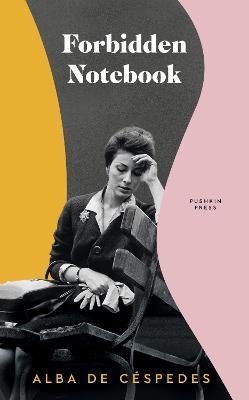
Forbidden Notebook by Alba de Céspedes (1952) tr. Ann Goldstein

I absolutely loved reading this, what a discovery! And brilliantly translated by Ann Goldstein.

Transgressive Writing

Italian feminist writing classic 1940s 1950ssValeria Cossati is a 42 year old Italian working wife, married with two children; one Sunday she is drawn to want to purchase a notebook in a local grocery store, a shop that is only permitted to be open on a Sunday, to sell tobacco. This purchase is her first act of transgression, the shopkeeper will allow it, but insists she hide the notebook in her coat.
The FORBIDDEN NOTEBOOK.

As if tainted by this scurrilous act, the notebook becomes something she must hide, for within its pages, she reveals her innermost thoughts, something she has not shared with anyone for years.

A Drawer Of Her Own, A Name of Her Own

From the first day she has the notebook in her home, she no longer feels safe, her husband, or one of her children might find it. She realises there is no place in her home that is private to her. In front of the family she tells her daughter she disapproves of her having a drawer she keeps locked.

Mirella responded energetically that if she studies so much, it’s because she wants to start work, to be independent, and to leave home as soon as she’s of age: then she’ll be able to keep all her drawers locked without anyone being offended.

Asking why she might want a drawer, at the suggestion that perhaps she too might like to keep a diary, the family laugh at her:

“What would you write, mamma?” said Michele.

Michele, her husband, since his mother died, he has started to call Valeria Mamma, a habit she enjoyed at first but increasingly resents.

Now I see it was a mistake; he was the only person for whom I was Valeria.

In Solitude I Meet Myself, A Stranger

For

Photo by Pixabay on Pexels.com

She writes late at night or at a time when the family aren’t at home, she wills them to leave (buying them tickets to a football match saying it was a gift from clients), so she can have time with her thoughts on the page.

Through her journal entries we discover that the words she speaks aloud to her family are often the opposite of what she is thinking. She never admits to resting, upholding the image of hard-working mother and wife.

I never confess it. I’m afraid that if I admitted I’d enjoyed even a short rest or some diversion, I would lose the reputation I have of dedicating every second of my time to the family. No one would remember the countless hours I spend in the office or in the kitchen or shopping or mending but only the brief moments I confessed I’d spent reading a book or taking a walk.

She criticizes and judges her daughter’s behaviour. Mirella is almost finished her law degree and starts working part time for a prominent lawyer, she is seeing an older, successful and sophisticated man – still a minor, she is reminded so by her mother – yet in the notebook, Valeria admires the independence her daughter is developing, the confidence she exhibits.

Mirella challenges her mother, when Valeria makes her take dinner to her brother who must have been tired after studying all day, she reminds her that they too have been working all day.

When she returned, she said “That is what disgusts me mamma. You think you’re obliged to serve everyone, starting with me. So, little by little, the others end up believing it. You think that for a woman to have some personal satisfaction, besides those of the house and the kitchen, is a fault, that her job is to serve. I don’t want that, you understand? I don’t want that.” I felt a shiver run down my spine, a cold shiver that I can’t get rid of. Yet I pretended indifference to what she said. I asked her ironically if she wanted to start being a lawyer in her own home.

I Am My Own Worst Enemy

In contrast, the lazy son Riccardo, who wants to go to Argentina, who neglects his studies, who speaks to his girlfriend in an authoritative manner, can do no wrong. When he makes an error of judgement, his parents laugh it off. Valeria is resentful when she realises her son is gaining a form of strength from his girlfriend that she couldn’t give him.

I wonder how – with her meager words, her motionless face – she can have bestowed on him such happy confidence…Michele says it’s always like that: the only thing that can spur a man is love for a woman, the desire to be strong for her, to win her.

Meanwhile, when her daughter displays the strength she yearns for in her son, she will have the opposite reaction.

I had to intervene, as when they were children, but, as then, I had the impression that Mirella was the stronger, and for that reason alone I would have liked to hit her.

The Cage Opens, My Inner Self is Overpowering Me

denial silence inability to express forbidden

Photo by Kat Smith on Pexels.com

The manner in which she writes begins to affect her appearance to others, for it injects an atmosphere of fear into her life, it is as if this activity of daring to write her feelings is highly subversive.  For someone usually so cool on the outside, so conformist to what a wife and mother in the 1940’s is perceived to be, the act of writing ignites a disturbing consciousness raising of a deep, inner, feminist desire for expression. Daily, she will explore this on the page, it will morph into an increased awareness, understanding and ultimately change her behaviour.

Her domestic discontent, the suppression of her innermost thoughts, having awakened and found a dangerous outlet, will escape their rigid enclosure and infect everything. She will become at odds with herself.

A Slow Rebellion, A Feminist Awakening

It is compelling and strange, the act of writing begins to have an effect on her relationships at home and at work, it precipitates a kind of mid-life crisis. The stirring up of long suppressed emotions and the witnessing of how a new generation of youth are entering adulthood, awakens a wave of desire and revolt that she both resists and can’t hold back, as her dissatisfaction with her life creates a restlessness that threatens to disrupt and erupt their imperfect equilibrium.

It is a subject explored by Virginia Woolf and others, a subject equally important today, the need for a safe space, time, a notebook – for women to connect to that aspect of themselves that isn’t in service to others, to their inner creativity, expression, joy – to arrive at the place of realising that they too deserve that.

Highly Recommended.

Alba de Céspedes, Author

Feminism Journal writing Womens Rights Italian LiteratureAlba de Céspedes (1911-1997) was a bestselling Italian-Cuban novelist, poet and screenwriter. The granddaughter of the first President of Cuba, who helped lead Cuba’s fight for independence, she was the daughter of a Cuban diplomat and his Italian wife, raised in Rome, Italy. She kept alive her family’s political commitment, often running afoul of Italy’s Fascist regime.

Married at 15 and a mother by 16, she began her writing career after her divorce at the age of 20. She worked as a journalist throughout the 1930’s while also taking an active part in the Italian partisan struggle and was twice jailed for anti-fascist activities, in 1935 and in 1943 after she had joined a resistance radio program, broadcasting from Bari under the pseudonym Clorinda.

By the 1950s, she was known throughout Italy. For years she wrote a popular advice column, tackling questions about marriage, infidelity and love with meditations on art and philosophy. These columns steered readers toward a modern, more secular morality, one that stressed women’s equality.

After the fall of fascism, she founded the literary journal Mercurio and went on to become one of Italy’s most successful and widely translated authors.

The New York Times reviewer called de Céspedes “one of the few distinguished women writers since Colette to grapple effectively with what it is to be a woman.”

Forbidden Notebook was longlisted for the Warwick Prize for Women in Translation 2023.

Further Reading

New York Times Review, Jan 2023: The Transgressive Power of Alba de Céspedes by Joumana Khatib

Washington Post Review, Feb 2023: ‘Forbidden Notebook’ is a slyly subversive novel by a writer once banned by Roxana Robinson

“While I am writing, I confine myself to occasionally reading books that keep me company not as entertainment but as solid companions. I call them books of encouragement, like those by Alba de Céspedes.” Elena Ferrante

N.B. Thank you to the publisher Pushkin Press for providing me with a review copy.