Daughters Beyond Command by Véronique Olmi tr. Alison Andersen

Daughters Beyond Command is a wide ranging chronicle of 1970’s France, seen through the eyes of the Malivieri Catholic family with three daughters, living in an apartment in Aix-en-Provence. It traverses issues of family, feminism, worker’s rights, class, animal rights, amid the rapid transformation of society in the 19070’s France.

Family saga set in France against social political context of May 68 to the May 81 election

While the story follows the changing lives and events, in particular of the daughters and the mother (we don’t learn too much about Bruno, the father), it also demonstrates the shifts in society and of generations that occur through the way these daughters seek their independence. It contrasts with the way their mother harbours secrets and makes other complicit when she does share what she would prefer to hide.

Regardless of their ages or circumstances, the country and the world is changing and attitudes and behaviours are shifting and everyone is forced to reckon with the changes as they impact them in different ways, raising consciousnesses and often unable to maintain previous ways of being .

Sabine, the eldest wants to work in theatre and acting and will do everything she can to pursue that dream in Paris. Fiercely independent, she has developed an irritation around comfort and conformity.

She watched as Maria set the table under Michelle’s authority. She looked at the framed photographs of her cousins who had not yet come home.Happy times on horseback, in cars, on boats. It was like a huge advertising campaign. It filled her with rage. There had to be something behind this publicity for the life she was being shown, both here and at home, in the silver frames of photographs, or poor people’s kitchens, behind the slogans like Moulinex Sets a Woman Free, the injunctions to promote progress, comfort, and the frenzied pursuit of happiness, luxury, and family life, there was something else. Which could be neither bought nor sold.

The second sister Hélène has been seduced by the trappings and comfort of this sophisticated Parisian family. Sabine can’t understand why she chooses to spend so much time with them, a family that lives in a way beyond anything they have ever experienced. Hélène spends most of her holidays with the family who don’t have daughters; the Uncle who has taken a particular interest in her. That regular proximity changes some of her habits, including the way she speaks.

It was a betrayal of the Malivieri clan, and Sabine was astonished that her sister could flaunt her bonds of dependence so naturally.

Hélène will also leave home early and pursue an education Paris, supported by her Uncle. She is less outspoken but equally passionate, affected by moral question around the protection and rights of animals.

As time passed, a breach had come between Hélène and her parents; adaptation upon her return required quickly taking stock of her loved ones. She saw her father, whose kindness and altruism for everything he could not lavish on his family financially. She saw her mother, hard-working and attentive, doggedly managing her household, and the rare moments she seemed to cast off her condition as a housewife, when she really seemed to be her true self, were when they visited Laurence on Saturday afternoons at her bastide.

Photo by Alotrobo on Pexels.com

The student riots of May ’68 had an impact on the nation and caused both fear and admiration in these adults trying to figure out how to parent their daughters, growing up surrounded by influences they could not control.

As the lives of the daughters changes, so too does the outside world. Simone de Beauvoir and Gisèle Halimi found the movement Choisir la cause des femmes (Choose the Cause of Women) in 1971 to decriminalise abortion in France, riot police storm the Lip watch factory that had been occupied by workers for three months, forcibly removing them; there is talk and images of the horrors of Vietnam, of the desire for freedom, respect for the proletariat, and the lyrics of the Bob Dylan song The Times Are A Changin’, the death of the President Georges Pompidou.

Sabine told her his name was Bob Dylan and that his song said, more or less, that the world was changing, you had to keep your eyes open,and the parents had better watch out, their sons and their daughters were beyond their command. It was a political song.

As time passes and events happen the sisters find a way to strengthen their bond despite their differences, separating from each other and then coming together in solidarity, while their parents seem stuck in time. Agnes, the mother is unable to stop changes happening to her, which will bring about a crisis, one the two older girls question but are again met with silence.

While the novel isn’t necessarily about resolving any of the issues presented, it encapsulates the impact of changing times on the various members of the family in a way that I found interesting, having lived in France for around 19 years, but not during the era mentioned. So much of the landscape was familiar, and some of the references, but many were not.

I appreciated the story for the depiction of what it might have been like to be part of an ordinary family growing up in this town in the 1970’s and learning about the significant events that challenged and affected people’s thinking, seen from the perspective of inside France. It is these changes in the background of the family lives and the adept writing that maintains the narrative pace.

It might be set in the 1970’s but it feels as relevant today in many respects as it did for that era of change.

Further Reading

My review of Véronique Olmi’s novella Beside the Sea (2015)

Listen to Bob Dylan’s The Times They Are A Changin

Kirkus Reviews: The personal is political for Olmi’s finely drawn characters.

Litro Magazine Review: Daughters Beyond Command by Monica Cadenas

Author, Véronique Olmi

Véronique Olmi was born in 1962 in Nice and now lives in Paris. She is an acclaimed French dramatist and her twelve plays have won numerous awards. Olmi won the Prix Alain-Fournier emerging artist award for her 2001 novella Bord de Mer (beside the Sea). It has since been translated into all major European languages.

Map of Another Town by M.F.K. Fisher

Essays on Aix en Provence

While I usually steer clear of memoirs set in France, M.F.K.Fisher (1908-1992) is a writer I’ve long intended to read. She was an American nonfiction writer whose wrote about food, considering it from many aspects: preparation, natural history, culture, and philosophy.

Since no-one can visit Aix-en-Provence right now, here is another way to visit the town, through the imagination and evocative style of this talented writer, a specialist in evoking the senses.

Fisher lived in Dijon for a few years as a young bride, but now it is 1954 and she is a widow with two young daughters spending a year in Aix-en-Provence at a time when France is still reeling from the effect of the second world war. Fisher too is recovering from raw emotional wounds.

While being in Aix makes her feel alive, a sense of frustration seeps through the pages as she describes feeling largely invisible and worse, looked down upon.

She is keenly aware that the grand dames consider her an ‘outlander’, an emissary from a graceless, culture-less people.

Living here has given her a thick skin, a confidence and an extra sense with which to navigate the world.

Over the years I have taught myself, and have been taught, to be a stranger. A stranger usually has the normal five senses, perhaps especially so, ready to protect and nourish him.

Then there are the extra senses that function only in the subconsciousness. These are perhaps a stranger’s best allies, the ones that stay on and grow stronger as time passes and immediacy dwindles.

It is with these senses that she creates her map of the town, Aix-en-Provence.

Le Cours Mirabeau

She finds just the right words to describe the near indescribable, whether it’s the cafes, the main street or the people, and though all of the characters she writes about have long gone, the edifices remain and it is easy to imagine how this place we live in was back when she inhabited it. In reality, little has changed, except that today it is a ghost town.

After reading the initial chapters, I stopped reading for a couple of months just after the chapters The Gypsy Way and The Foreigner, which were somewhat xenophobic. Then I picked this up again and was relieved to find the next essays as delightful as the debut and way more humorous. I found that Fisher was more entertaining when observing herself than she was observing others.

My favourite essay ‘A Familiar’ didn’t even take place in Aix, it’s a stream-of-consciousness narrative of six hours spent in the train station of Lucerne after being sold a ticket for a non-existent train. Refusing to allow herself to venture outside, she orders a vermouth-gin in the station restaurant to ease her awkwardness.

I would have liked to order at least two more,  but although I had to laugh at myself I was afraid that the maid, already somewhat alarmed at my ordering such a potion … a woman alone … would report me to the police who must be somewhere handy in the enormous station.

And in the essay ‘The Unwritten Books’, she visits a cake shop, asking the pastry chef to make a cake, one drawn by her young daughter, a cross cultural hilarity, not to mention the proprietors constant refusal to hear her other request, to provide her with a calendar of culinary events, for which there is only ever one reply, an(other) invitation to visit the calisson factory? Priceless!

A must read certainly if you know and love Aix-en-Provence, this is an outsiders insight into the old city, one who has fallen for its charm, cursed by her inability to meld completely into it. Humorous in some parts, cringworthy in others, overall a delight and superbly descriptive.

This new edition with an introduction by Lauren Elkin, was re-released in 2019 by Daunt Books. Thank you to the publisher for sending me a review copy.

Death in the Vines by M.L.Longworth

Death in VinesMystery, murder and mayhem among the vineyards of Rognes, a quiet Provençal village about 15 kilometres from Aix-en-Provence and one of the settings for this third in the Verlaque and Bonnet Provençal mystery series for M.L.Longworth, one time resident of Aix-en-Provence, who has herself decamped to one of the smaller villages of Provence, no doubt set to inspire more enticing destinations in future adventures of her detecting duo.

I reviewed her first mystery Death at the Château Bremont last year, when the author visited the book club I participate in. Since then there has been a second book Murder in the Rue Dumas and now we pick up with Judge Verlaque and his law professor amoureuse Marine Bonnet, in the third book, with as many gourmet references as we have come to expect previously.

CIMG3088

Château Paradis, Puy Sainte Reparade

The story begins in Rognes, with a wine theft and a missing persons report, a suspected walkabout. Some of the Bonnard winery’s best wines have disappeared, although the key to the cellar remains where it has always been and tensions are running high among family members, all of whom have become potential suspects.

Back in Aix, Madame Pauline d’Arras appears to have gone walkabout without her dog, most unusual according to her fretting husband Gilles, who has never gone a day in forty-two years of marriage without his wife preparing lunch for him by twelve-thirty. He is concerned as she has been exhibiting signs of possible early dementia.

In the village of Éguilles, a young woman leaves work early and is found later by a colleague in a bad state having been assaulted, she is taken to hospital and will soon become the subject of a suspected murder investigation.

Longworth has fun with not one, but three mysterious incidents and in particular some of the false leads which allow the Judge and us readers to go on various jaunts around the countryside, cross a famous bridge and dine in celebrated locations  he would otherwise have had to wait to indulge in his own time.

Knowing the routes they take, this book offers more than just a tale of mild suspense, it is like an invitation to explore more of Provence, to imagine sampling its wines, observe its pastimes (boules) and picture the lives of its villagers and long-established wine cultivating families.

TGVtrainJust as the region itself is changing, the TGV(train à grande vitesse or high-speed train) line attracting more Parisian commuters and foreigners wishing to invest in the continuation of artisan expertise in the French vineyards; so too is the city of Aix changing, an entire new quartier of modern buildings housing cultural centres of opera, dance, music, a new shopping area, an upgraded bus station with Europe’s longest living wall, showing off the architectural stamp of Kengo Kuma, a name more at home in Tokyo, New York or Beijing. This town is ensuring it will continue to attract visitors interested not just in its intriguing and ancient past, but that it can show itself worthy of contemporary interest also.

However the long-established, multi-generation residents don’t always embrace the new and Longworth allows her characters to despise the new developments in the way of a local population and national character that loves nothing more than a good long debate, although she doesn’t indulge them quite that far.

The Mayoress of aix en Provence  Maryse Joissains-Masini

The Mayoress of Aix-en-Provence
Maryse Joissains-Masini

The changes reflect a 21st century renewal and political statement, the creation of a legacy by a Mayoress who isn’t afraid to spend big on infrastructure during a recession and to court the popular vote. She spends with the frenzy of a woman who sees the finishing line in her sights. Will she survive the mayoral elections in 2014? It will be an interesting campaign to watch.

Overall, an entertaining and enjoyable light read that is all the better for allowing the reader to dwell among the vines and villages of a beautiful region.

Any book that allows one to travel when circumstances dictate that it not possible to physically go there, is the next best thing in my book.

Note: This book was an Advance Reader Copy (ARC) provided by the publisher via NetGalley.

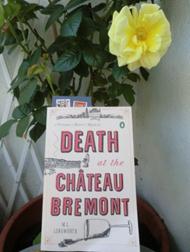
Death at the Château Bremont

There is a shelf in our local bookstore dedicated to books crossing numerous genres that have a connection with France, you will find nonfiction travelogues such as Sarah Turnbull’s ‘Almost French’ or David Sedaris’ vignettes in ‘Me Talk Pretty One Day’, funny, true, yet never denigrating the country that has become like a second home to him. You will also find English translations of popular French authors like Jean Giono and Michel Houellebecq and novels set in France.

Death at the Château Bremont fits into latter, not only set in France, but here in Aix-en-Provence. I first became aware of the title thanks to a review by Lynne at Aixcentric, an excellent and informative blog I read regularly to know what’s happening in and around the area where I live.

Just yesterday I read that tonight is the annual Nuit des Musées when the town’s museums are free and open from 8pm until 1am. We love this annual late night out.

Not long after that mention, the book-club that I read along with nominated it as their May read and the author M.L.Longworth who lives here in Aix-en-Provence, was invited to join us. So, a fascinating insight into the gestation of this, first in the ‘Verlaque and Bonnet Mystery’ series, which follows the lives, dramas and intrigues of Judge Antoine Verlaque and Professor Marine Bonnet, his sometime amoureuse.

It’s a mystery and in order to keep the mystery alive, I will only reveal that Étienne de Bremont falls to his death from a Château window, an investigation is requested and after some drama involving clandestine affairs, jealous siblings, polo players, Russian millionaires and a New York suicide, all will slowly be revealed.

What makes Longworth’s mystery unique is the journey. It is far from dark and gory, realms she has no apparent appetite for, however she will take you on a gastronomic excursion through the towns, vineyards and countryside of the region, visiting suspects while piecing together the connections and clues to the lives of those involved in this conspiracy. So not just a book for aficionados of mystery’s, but one for food and wine lovers and anyone who has ever dreamed of living and working in a city of culture and gastronomy in the South of France.

M.L.Longworth with Claire McAlpine

No tourist visit, this literary journey is the real thing and so agreed the group of eight women who were present to discuss the book, all sharing their favourite parts, confirming the locations the book visits and even suggesting others for the third book, which the author is working on, all suggestions were gratefully received and noted.

M.L. Longworth’s second book in the series, ‘Murder in the Rue Dumas’ will be published on 25 September 2012.