
Claire Keegan is an Irish writer who writes atmospheric, slice of life novellas on an aspect of Irish life. I read her novella Foster some years ago, a touching and eerie story of a girl caught between two sets of parents, that is unsettling, though never quite reveals the source of this tension, that is left somewhat to the reader’s imagination.
Small Things Like These is set in an Irish town in 1985 in the lead up Christmas. Bill Furlong, a father of five daughters is a coal merchant, raised by a single mother who was a housemaid for an upper class woman who allowed her to keep her son with her. The story recalls an event that occurs at the nearby convent, when Bill is making his deliveries and we observe different members of the community’s reaction to that.
 I admire the way Claire Keegan creates atmosphere and a sense of place, I could well imagine the small Irish town they lived, the cold, the workplace, the river – although I had to keep reminding myself it was the 1980’s and that there was electricity. Bill’s deliveries of wood and coal and the way the women made it feel like a much earlier era, though I don’t doubt it was freezing then as few could afford to heat their homes by other means.
The character of Bill Furlong was interesting and held potential, both due to the unique circumstance of his upbringing, which made him an empathetic character, and the fact that his wife and other women in the community had a different opinion or perception to his, regarding the situation that he will be confronted with.
The blow was cheap but it was the first he’d heard from her, in all their years together. Something small and hard gathered in his throat then which he tried but felt unable to say or swallow. In the finish, he could neither swallow it down nor find any words to ease what had come between them.

Photo by Mikhail Nilov on Pexels.com
Furlong was one of very, very few babies born to a woman out out wedlock who got to stay with his mother, due to the generosity of his mother’s employer.
When we meet him he is a grown married man with daughters, with his own business, though still struggling and not able to imagine a time when that might change. There is something in him that is unsettled despite his circumstance, something slowly revealed that he seeks liberation from.
On making a delivery to the nearby convent, where his daughters are at school, he becomes aware of the fact there are other young women there, who work with the nuns and provide the community with laundry services.
It is a subtly consciousness raising novel yet somewhat ironic and convenient to this reader that the empathetic character is a working man with daughters. While the story conveniently sidesteps the significant issues, it takes a provocative stance in choosing to instill empathy in a character, who represents generally, the one we never look at – the boy involved, the father or brother who punished their daughter/sister, or the decision maker’s of the institutions (church and state) that carried out the punishment of these young women. In this respect, the premise of the novel feels totally unrealistic, a Disney-like fantasy. The reality is that it is very likely no one ever did was Bill purports to do here.
 It made me recall another character, Albert, from the film Made in Dagenham, who was initially the only man who supported a group of female factory workers fighting for equal rights at the Ford Dagenham factory in 1968 – the reason he supported them was because he had been raised by a single mother – perhaps there is something to be said for the development of a deeper empathy in men who’ve been raised by single mothers.
One of the other things that did stand out was the prevalence and contribution of community gossip to the development of judgement and insinuation. He is warned by the woman running the café where his men eat lunch.
‘Tis no affair of mine, you understand, but you know you’d want to watch over what you’d say about what’s there?’
Those that listen to and contribute to gossip are of a different kind than those who respond to an injustice that was right in front of them, despite it being none of their business. Bill was of the latter.
Overall, I felt like this novel had only just begun and then it was over; it left me with too many questions and felt like it was set in a time that was decades earlier than the 1985. It read more like a promising beginning, than a complete novel. Deliberately provocative perhaps.
N.B. Thank you to the publisher for providing an ARC via NetGalley.
Warning: Likely to trigger adoptees or any woman coerced by society, to give up a child to adoption.
What Were The Magdalene Laundries?
 From the foundation of the Irish Free State in 1922 until 1996, at least 10,000 girls and women were imprisoned, forced to carry out unpaid labour and subjected to severe psychological and physical maltreatment in Ireland’s Magdalene Institutions. These were carceral, punitive institutions that ran commercial and for-profit businesses primarily laundries and needlework.
After 1922, the Magdalene Laundries were operated by four religious orders (The Sisters of Mercy, The Sisters of Our Lady of Charity, the Sisters of Charity, and the Good Shepherd Sisters) in ten different locations around Ireland. The last Magdalene Laundry ceased operating on 25th October, 1996.
The women and girls who suffered in the Magdalene Laundries included those who were perceived to be ‘promiscuous’, unmarried mothers, the daughters of unmarried mothers, those who were considered a burden on their families or the State, those who had been sexually abused, or had grown up in the care of the Church and State.
Confined for decades on end – and isolated from their families and society at large – many of these women became institutionalised over time and therefore became utterly dependent on the relevant convents and were thus unfit to re-enter society unaided.
Further Reading
Guardian Interview: The acclaimed Irish writer on writing short works, the Magdalene Laundries and her new hobby, horse training by Claire Armistead
Article: How Ireland Turned ‘Fallen Women’ Into Slaves
Book: Ireland and the Magdalene Laundries: A Campaign For Justice by Katherine O’Donnell – Sept 2021 – a devastating and vital account of life behind the high walls of Ireland’s institutions, featuring original research and testimony + the continued campaign for justice for victims and to advance public knowledge and research.
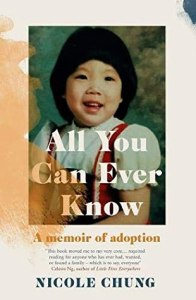 While every adoptee’s experience is different, there are so many aspects to the experience and responses to them that resonate with other adoptees, that reading a memoir like this can be very helpful, sharing experiences helps us understand.

 It is a very personal account and kudos to the author for having the courage to share it and inviting readers to go along on the emotional roller coaster of a journey it must have been.
 My curiosity was peaked by a mini review over at
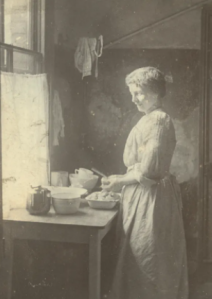
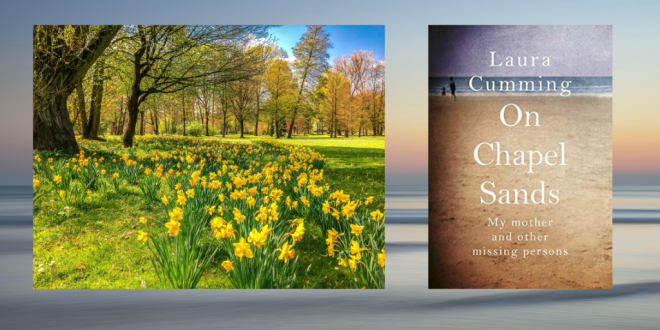
 A Memoir of Finding Home Across the World
 Eventually she finds a way to navigate the two selves by turning the focus outward, towards helping others, addressing the ache of having had to suppress her true self for so long.
 Immediately removed from everything familiar, home, school, church and community, she is sent in disgrace to her father’s new household and ordered to never go outside or if there was company, to remain in silence upstairs.
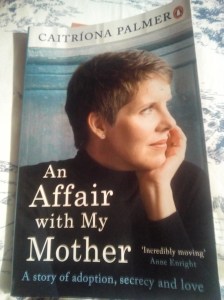 It’s set in Ireland, a country reluctant to let go of old ways, still in throe to a traditional family culture that shamed, blamed and punished young women for being the life-bearers they are – insisting they follow a code of moral behaviour documented by a system of domination, upheld by the church, supported by the state – a system that bore no consequence on men – young or old – who were equally responsible for the predicament of women.

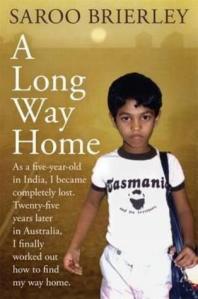 I saw the film when it was on at the cinema about a year ago and like everyone who has seen it, I thought it was extremely moving. If you don’t know the story, it’s about a 5-year-old boy who is out with his teenage brother, who has told him to wait for him at a quiet train station near their home, and feeling tired, he climbs into an empty carriage, falls asleep and when he awakes, it is moving, the carriage locked and he will be transported, far, far from his home, which he won’t see for another 25 years.
 When Saroo really becomes intent on tracking down his family, (another element that is much more vividly portrayed in the film) no one except his girlfriend knows how obsessed he has become, he has had periods of searching in the past, spurred on by meeting other students who grew up in India, who’d make guesses as to where he might come from based on his memories, but when, with the help of Google maps and tracing railway lines out of Calcutta, he began to spend hours every night doing his research, he kept it to himself, in ways and for reasons many adoptees will recognise.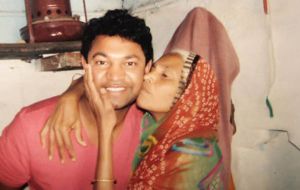
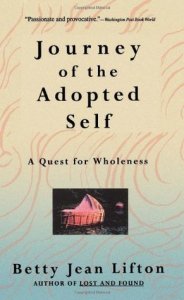
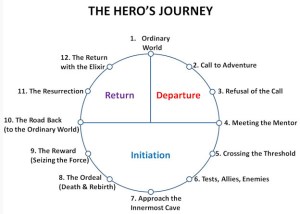 Journey of the Adopted Self, follows that traditional quest, and for each element in the journey, the responding to the call (the decision to search), the departure (actively seeking), meeting the mentor (finding help) crossing the threshold (making contact), the challenges + the ordeal (dealing with the aftermath), the reward (unravelling the mystery), the road back (the new ordinary life) and the elixir (the transformation and the life lesson) the authors discusses a range of issues that can arise and gives examples in brief snippets from the many case studies she has had access to as an adoption counsellor.
 According to the Austrian psychoanalyst and contemporary of Freud, Otto Rank in his book

 In The Heart’s Invisible Furies, a title taken from a quote by Hannah Arendt, the German-born American political theorist:

 Written as a reflection on the death of her daughter at 39 years of age, the book begins as Didion thinks back to her daughter’s wedding seven years earlier, which then triggers other memories of her childhood, of family moments, of people and places, numerous hotels they have frequented.
 Although the main theme of the book is her daughter’s premature death, nowhere does she analyse or obsess about what actually happened in the way we vividly remember she did about her husband in My Year of Magical Thinking. Rather, the book appears to be as much an acknowledgement of her own ageing and decline, recognising and facing up to her own ‘frailty’, her obsession with her own health scares, recounting every little malfunction or symptom of a thing that never shows up on any of the numerous scans or tests she has. It is as if she writes her own denouement, to a death that never arrives, as the multitude and thoroughness of all the tests she has show how very much alive and in relative good health she is, despite herself.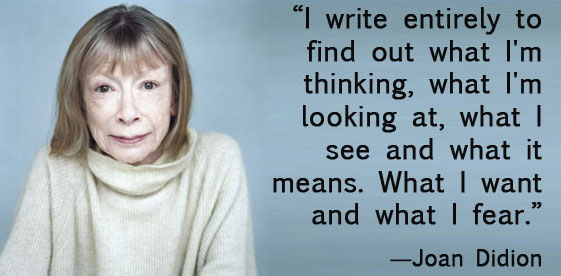
 Word by Word