Mrs Robinson’s Disgrace – The Private Diary of a Victorian Lady by Kate Summerscale

Kate Summerscale likes to take ordinary people who have been noted for doing some extraordinary thing, though not usually something to be admired – and shares their story in a way that reads like compelling fiction.

Her previous book The Suspicions of Mr Whicher or The Murder at Road Hill House reads like a detective novel and coincided historically with the introduction of the adapted role of a certain type of police officer – that of the detective.  This person was required to use specialist skills to investigate suspicious deaths, such was the case with Mr Jack Whicher of Scotland Yard, assigned to investigate the gruesome death of a young family member of a supposedly respectable household in a quiet Wiltshire village, putting all members of the family under suspicion and creating an unprecedented public sensation.

Now she has turned her pen and research skills towards the diary and letters of a Victorian lady, Mrs Isabella Robinson, an impulsive, intellectual woman, widowed young and remarried to an uninterested man who seemed to require nothing more of her than to keep house and children in order, a role she fulfilled, but was not content to be limited to and thus her attentions strayed towards the happily married Dr Edward Lane.

Throughout most of her diary entries he appears not to return her amorous feelings, but Mrs Robinson has the skills of Flaubert (who was prosecuted in the late 1850’s for corrupting public morals with Madame Bovary – a novel considered ‘too repulsive’ for publication in Britain) in expressing both her angst and sexual frustration and perhaps even her fantasies (were they?) with regard to certain men hovering in her vicinity – certainly, as with Flaubert’s prose, there were pages deemed unsuitable and unfit for the eyes of anyone outside the court and the media banned from laying eyes on it for fear of corrupting the public.

Her dramatic verse, which employed few filters would prove to be her undoing and became the sensation of a highly publicised court case, which also straddled a moment in history, when divorce laws were changed to make them easier to obtain, particularly as the law discriminated against women and allowed some terrible situations to endure as a result.

The law stipulated that to secure a divorce, a husband needed to establish just his wife’s infidelity, whereas a woman needed to prove that her husband was not only unfaithful but also guilty of desertion, cruelty or sexual misdeeds such as bigamy, incest, rape, sodomy or bestiality.

Ironic, in that no one questioned Mr Robinson concerning his mistress and two illegitimate children, clearer evidence of infidelity than anything penned by his errant wife.

Queen Victoria

Allowing these situations to be resolved through the Court created a predicament with the population concerning reportage in newspapers, an issue to which even Queen Victoria was said to have addressed.

On 19 December, Reynold’s Weekly, observed that the cases in the Divorce Court ‘seem to indicate that among the high, the moral, the respectable, and the Christian classes…adultery is in a highly flourishing, if not exceedingly rampant, condition.’ A week later Queen Victoria wrote to Lord Campbell, the chief designer of the Divorce Act, to ask if he could suppress some of the stories coming out of the court.

It seems the Queen had no power to stop the presses and received a reply indicating that they were unable to limit the newspaper stories.

Overall, an interesting read and historical context and no doubt opinion continues to be divided on whether Mrs Robinson was hard done by or plain foolish to have committed such desires, whether fantasy or fact to paper.  A woman fifty shades before her time perhaps.

Note: This was an Advance Reader Copy (ARC) provided by the publisher via NetGalley.

In the Shadow of the Banyan

Early morning in Hanoi, Vietnam

The countries, culture and people of Vietnam, Cambodia, Burma and the surrounding area interest me. Vietnam was the first country I travelled solo in and while I was there, in addition to the cultural immersion, I also enjoyed reading the works of two local authors, which I purchased from a street vendor, Bao Ninh’s The Sorrow of War and Duong Thu Huong’s Paradise of the Blind, both of which are excellent.

We learn a little how they live, what they eat and how a soldier deals with the aftermath of war. These occasional books translated into English provide an important insight into real experiences and a way of thinking that cannot be portrayed by any other than those who were raised there. Their experiences often cause us to question our own perspective, our knowledge, and beseech us to see things from another point of view. It is a joy therefore to come across a publisher of who said:

When I came to S&S, I told everyone here I wanted to publish books that deepen the cultural conversation and take readers to places they couldn’t otherwise go. – Jonathan Karp, Simon & Schuster

This is certainly the case with Vaddey Ratner’s In the Shadow of the Banyan, narrated from the perspective of 7-year-old Raami, a girl whose experiences reflect the author’s own, though she has chosen to fictionalise her story.

 It isn’t so much the story of the Khmer Rouge experience, of genocide, or even of loss and tragedy. What I wanted to articulate is something more universal, more indicative, I believe, of the human experience our struggle to hang onto life, our desire to live, even in the most awful circumstances. – Vaddey Ratner

Lest we forget, Hanoi, Vietnam

The daughter of royalty, although a failed, corrupt democracy ruled, she and her family were evicted by the revolutionary Khmer Rouge, a marginal guerrilla group – whose leaders were from the same intellectual class as Ratner’s well-educated father, however who held radical ideals to transform the social fabric by destroying traditional family, social and wealth connections and creating an experimental collective.

Their revolution took the form of putting the population into work camps in living conditions worse than peasants. Whether driven by fear, paranoia or disillusionment, they ruthlessly continued to seek out and judge people as the enemy, a definition that moved and changed like the current in the Mekong itself until through murder, disease or starvation scholars estimate that as many as a third of the population (1-2 million) died. The regime was finally overthrown by the Vietnamese military in January 1979.

Ratner tells the story of Raami, physically challenged from a polio defect which shortened one of her legs, her experience during the period of exile with her parents and sister, how she survived the extreme living and working conditions and what it taught her along the way. She remembers the stories and poems that her father shared with her and they continue to be a source of strength for her throughout her life.

“Do you know why I told you stories Raami?” he asked. I shook my head. I knew nothing, understood nothing.

“When I thought you couldn’t walk, I wanted to make sure you could fly.” His voice was calm, soothing, as if it were just another evening, another conversation.

“I told you stories to give you wings, Raami, so that you would never be trapped by anything – your name, your title, the limits of your body, this world’s suffering.”

It is a humbling story and frightening to perceive, yet dealt with by Ratner in a way that allows us to acknowledge and attempt to understand something of the seemingly never-ending cycle of oppression, idealism, revolution and the dangers inherent when revolutionary intent is hijacked by power, destroyed by paranoia and becomes tyrannical, while preserving the few special moments that continue to pass between people despite the danger posed by their selfless acts.

Terrible as it is and damaged as they are, it is those who survive and who are still able to maintain some belief in the human spirit and humanity that bring one of the few gifts that such terror evokes. It is a price no person would ever wish to pay.

For all the loss and tragedy I have known, my life has taught me that the human spirit, like the lifted hands of the blind, will rise above chaos and destruction, as wings in flight.

The author has succeeded in taking this sad chapter in her country’s history and showing us some of its beauty and culture, sharing memories and thoughts that can never be erased and putting them into a new form, this literary work, which we are privileged for it to be shared in English.

In a sense it leaves us puzzled and perplexed, just as witnessed in Aminatta Forna’s The Memory of Love, yet another tyrannical regime that loses its way to the detriment of its people. The stories can be shared and passed on, but they also represent a kind of grief for a way of life now lost to future generations.

Note: This was an Advance Reader Copy (ARC) provided by the publisher via NetGalley.

The Memory of Love by Aminatta Forna

When I was gifted my kindle by my kind, book-loving Aunt,  Aminatta Forna’s The Memory of Love was one of the preloaded titles I looked forward to reading.

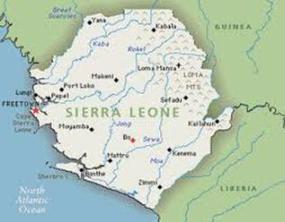
Aminatta Forna was born in Scotland and raised in Sierra Leone, the country where most of this story takes place. She is the daughter of a former Sierra Leonean cabinet minister and dissident, murdered by the state in 1975. She has written the story of three men, whose lives intersect briefly, and who come into contact with each other at the Freetown Central Hospital.

Dr Adrian Lockhart, recently arrived from London has responded to a request to an overseas posting for a government-sponsored psychologist specialising in PTSD (post-traumatic stress disorder), his thoughts and actions suggesting he may be in the midst of a midlife crisis, needing some distance from his life to see it for what it really is. Life in Sierra Leone may allow but doesn’t appreciate such self-centred indulgences and Dr Kai Mansaray, a young local surgeon gives him an honest portrayal of just how people like him are perceived, lacking sufficient equanimity to see it for himself. Despite the frankness, the two become friends and seek out each other’s company with increasing frequency.

Both men experience love and its aftermath, its vulnerability, its brief joy, its destruction and the memory of it, as if it were real, even when it no longer exists.

 For death takes everything, leaves behind no possibilities, save one – which is to remember. He cannot believe with what intensity one can continue to love a person who is dead. Only fools, he believes, think that love is for the living alone.

In addition to his post at the hospital, Adrian helps out at the mental hospital and recognises Agnes, one of his former patients (one visit patients – they visit once and never return).

The people his colleagues sent to him were outpatients mostly, the ones with whom the doctors could find nothing wrong. And afterwards each of his new patients made the same request for medicines, to which Adrian explained he was not that sort of doctor. A nod of acceptance, rather than understanding. None of them ever returned.

Agnes is discharged before Adrian sees her and he becomes intent on trying to resolve the cause of her illness, a fugue, or temporary amnesia, and in doing so he will come too close to the sick, ugliness of the country’s past conflict where sometimes amnesia may be the only respite one has from a brutal reality.

We also meet Professor Elias Cole, an old history professor who taught at Freetown university before and after the 1969 coup, his position afterwards, somewhat elevated than it was previously. He has an obsessive fixation on Saffia, the wife of another Professor, whom he befriends and becomes caught up with unknowingly, leading to an interrogation and a spell in prison, which will change both their lives. He encounters Adrian in the hospital, near the end of his life, seeking an audience to share his story before it is too late. Adrian listens and realises there is more to Professor Cole’s story than he is letting on.

This is a multi-layered story that reveals itself with each encounter, that hints at the traumatic events and psychological destruction of a nation, depicting the constant struggle for survival in a post-war era and the love it’s citizens have for their country despite the difficulties and horrors of the past. There is sacrifice in staying and pain in leaving; there is no real escape, both will suffer, albeit in different ways.
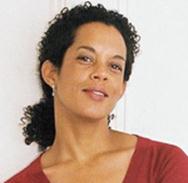
The author, Aminatta Forna

I really enjoyed this book, it was a pleasure to read and consider its characters and what they represented, I loved it for the questions it posed in the mind of the reader, leaving us to come to our own conclusions, for every question could have had an equally valid, if opposite answer, such is life and the characters who inhabit our own reality, there are those who will stand up even it means they will be sacrificed and those who will remain quiet and flourish.

It is as if there are no answers, there are just the decisions we make, that both we and the generations that follow then need to live with and understand.

I recommend listening to this powerful discussion between the BBC’s Bola Masuor and Aminatta Forna on the BBC World Service talking about both The Memory of Love and The Devil that Danced on the Water, the book she wrote about her search for the truth of her father’s fate after he was seized by secret police and later killed.

When you do nothing, what do your children inherit?

*

The plain fact of the matter is that any group will remain potentially conscienceless and evil until such a time as each and every individual holds himself or herself directly responsible for the behaviour of the whole group – the organism of which he or she is part. We have not yet begun to arrive at that point. – from the work of M. Scott Peck, People of the Lie

Buy The Memory of Love via Book Depository


Dinah, her Mothers and a woman named Ruth

Aix Yoga Center Teachers

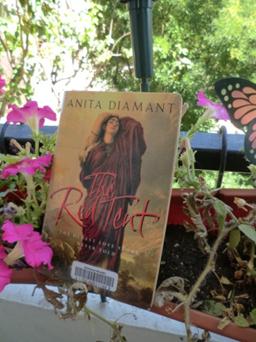
‘The Red Tent’ was published nearly 15 years ago but only came to my attention a couple of weeks ago through one of those wonderful connections that sometimes occur out of the blue when you are least expecting it.

The hilltop village of Villeneuve

Recently I met Jaci, an Aix Yoga Centre teacher, who organised a day at her home in Villeneuve, two hours of yoga in the morning, a shared lunch and aromatherapy massage in the afternoon. The first lady who came to see me for a treatment wasn’t doing yoga, she arrived with her well-used hiking poles, out of the hills of Forcalquier, having decided that a 90 minute walk before a 90 minute massage would be a good idea.

Yoga in a Mongolian yurt in Villeneuve

And so I met Ruth, a wonderful free-spirited woman with long flowing blonde dreadlocks, originally from Tuscon, Arizona, living in a farmhouse up in the fertile hills of Provence, where she lives with her French husband and two daughters.

As I worked away, I casually mentioned my very dear friend and book buddy CKC, who also comes from Tuscon and had she by any chance read Nancy E. Turner’s excellent trilogy ‘These is My Words’, a story about the author’s grandmother Sarah Prine, pioneer woman from the same area?

Well, from there we traded book titles and discovered we loved the same books and both went away with a “you MUST read” recommendation, mine to her being Sandra Gulland’s trilogy on the life and sorrows of Josephine Bonaparte and hers to me, Anita Diamant’s ‘The Red Tent’, “My daughters and I loved that book” she said.

The Red Tent

Dinah is the only daughter of Jacob, who fathered 12 sons by four wives who were sisters. It is from her perspective that we are told her mother Leah’s stories, her own story in the land of her birth and her exile in Egypt.

 “If you want to understand any woman, you must first ask about her mother and then listen carefully. Stories about food show a strong connection. Wistful silences demonstrate unfinished business.”

Aromatherapy Massage in ‘The White Tent’

And in ‘The Red Tent’, that place set aside for women to inhabit during their monthly cycle, secrets of womanhood were shared and passed down the generations, the clan of Jacob.

The book is epic, taking us through the joys and sorrows of births, miscarriages, barrenness, jealousies, betrayals, the vivid and revelatory dreams of sisters seeking insight and forgiveness.

We meet Rachel, whose presence was as powerful as the moon; it was her beauty that lured Jacob into the family fold, her body emitting the scent of fresh water, filling the dusty hills where they live with the promise of life and wealth.

Leah, Dinah’s mother and herself mother to seven sons, her twin coloured eyes, generous height and fertile womb giving her unique status.

Zilpah, daughter of an Egyptian slave, a few months younger than Leah, milk-sisters and playmates since childhood, who said she remembered everything that happened to her, including her own birth.

Bilhah, last born of the sisters, another daughter of a slave who ran off when she was young – tiny, dark, the silent one.

It is the women we come to know and understand and whose stories we follow, as they navigate life, love, marriage, heartbreak, living in a caravan of tents with a father they no longer respect, now creating their own large family, trying to better themselves until one tragic episode arrives to undo it all.

And for that, if you haven’t done so already, you will just have to find a copy of this ambitious, riveting tale of the lives of these women living in ancient times.

“If you sit on the bank of a river, you see only a small part of its surface. And yet, the water before your eyes is proof of unknowable depths. My heart brims with thanks for the kindness you have shown me by sitting on the banks of this river, by visiting the echoes of my name.”

Thomas Jefferson – Lessons from a Secret Buddha

This is a delightful and simple novella that views the life and achievements of one of America’s great role models through the principles of Buddhist thought, a man who wished only to be remembered for three achievements, author of the Declaration of American Independence, of the statute of Virginia for Religious Freedom and Father of the University of Virginia. He was President from March 1801 – March 1809.

Suneel Dhand has created a Buddhist guru whom he connects to Jefferson’s mother, and who then begins to correspond with the young man when he is a discontented, overweight child. The letters introduce him to seven ancient principles of Buddhism and the Eastern way of life and we then witness Jefferson’s own lifestyle change as he becomes vegetarian, more interested in books and develops a greater awareness of how thoughts, actions and behaviours position a man.

When we take an in-depth look at all of his lifestyle practices we see that Tom practiced very Eastern ways of living, different from his fellow countrymen. In many ways he was a well-being guru, centuries ahead of his time.

Most of my knowledge of the role Thomas Jefferson played in American society comes from having seen the excellent HBO TV series ‘John Adams’ and the awe with which he was regarded by both John Adams and Benjamin Franklin as they encouraged him to pen the Declaration of American Independence.

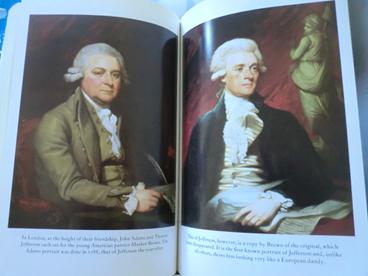
Portraits of John Adams and Thomas Jefferson by American painter Mather Brown 1788

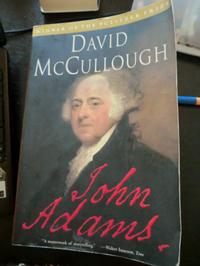
The series is based on David McCullough’s Pulitzer prize-winning biography ‘John Adams’, a volume I have on the shelf and will one day set to and read as well.

As Abigail Adams would confide to Jefferson, there had seldom been anyone in her husband’s life with whom he could associate with “such perfect freedom and unreserve” and this meant the world to her.  If you haven’t seen the series, here are some of Jefferson’s greatest moments played by the British actor Stephen Dillane.

A surprising little book, one that is full of good sense and relevant to today while reminding us of the extraordinary man Thomas Jefferson was and the major contributions he made not just to American history but also to humanity.

Today millions continue to be inspired by Thomas Jefferson, the genius who galvanized his people to freedom. A truly enlightened soul indeed – and that, without ever requiring any lessons from a Secret Buddha.

Note: This is an Advance Reader Copy (ARC) provided by the publisher via NetGalley.

The Coward’s Tale

Laddy Merridew comes to spend time with his Gran in an old Welsh mining town in Vanessa Gebbie’s ‘A Coward’s Tale’. Not happy with his lot, lost in the in-between, here where he doesn’t feel like he belongs so starts skipping school and there, the home he has come from that is breaking apart and will never be as it was and what’s worse, is requiring him to make decisions he feels incapable of making.

Laddy comes to the town statue outside the public library to listen to the local beggar Ianto Jenkins tell and trade stories for a coffee or a bite to eat and this part of his day passes pleasantly for hearing and learning about the descendants and ancestors of the town, all of whom have in some way been touched by the tragedy at the Kindly Light coalmine one September morning back then.

 ‘We’re meant to be doing coal mines in history.’

‘History, now, is it?’

‘They make it boring though. Not like your stories. You make it like it is still happening, in your head anyway.’

And the beggar shakes that head. ‘It is. And sometimes Maggot, I wish it wasn’t.’

Ianto Passchendaele Jenkins narrates the stories that link present day inhabitants back to their ancestors, two generations previous, showing that one is rarely ever completely free of the past and the sins of the fathers are often witnessed albeit in a new form, in the actions of those living today. From Baker Bowen to the Woodwork Teacher, Halfwit and the Deputy Bank Manager, the Deputy Librarian and the Undertaker and the Piano Tuner, Ianto shares their tales with warmth and compassion until finally one of his characters, the Collier, Peter Edwards share’s the beggar’s story, ‘The Coward’s Tale’.

Like young Laddy who no longer knows whether what his parents say is true or not, so too with the beggar’s tales, which captivate cinemagoers waiting in the queue, keeping him talking by topping up his coffee supply, the author making use of the words may and will to imagine what people may do and if so what that means they will do. Only Laddy searches for clarification, the others are happy to be mesmerised and encourage him with edible gifts.

‘For my breakfast? I will tell a story for breakfast? An egg. How about a nice egg?’

Once I got into the tales and understood the framework, I enjoyed the book, but I admit it took three attempts before the stories managed to carry me away with their rhythmic, poetic prose. However they are splendid tales and told with a unique captivating voice that puts the reader right in that square with all the other listeners, empathizing with each of the characters that the adored Ianto Jenkins brings to life for them.

Finally I am reminded of another set of tales of life in a small French village in Julia Stuart’s The Matchmaker of Perigord, which was a favourite a few years back, which I also recommend as a compelling, humorous summer read.

Note:This book was an Advanced Reader Copy (ARC), provided by the publisher via NetGalley.

Frieda’s Unlikely Inheritance

Suzanne Joinson’s A Lady Cyclist’s Guide to Kashgar, is a novel that intertwines the lives and stories of Frieda, in modern-day London and Eva, part of a missionary group with her sister Lizzie and their companion Millicent in 1920’s Kashgar, in the western part of China.

“Why do you want to bring it?” Lizzie asked, but I don’t think I answered her. I did not tell her that it was my shield and my method of escape; or that since the first time I pedaled and felt the freedom of cycling, I’ve known that it is the closest I can get to flying.

Eva has taken her bicycle and is penning a guide to cycling which seems to interest her more than missionary activities, excerpts of which grace the beginning of each Kashgar chapter and whose meanings could be interpreted to have wider meaning than just cycling.

What the Bicycle Does: Mounted on a wheel, you feel at once the keenest sense of responsibility. You are there to do as you will within reasonable limits; you are continually called upon to judge and to determine points that before have not needed your consideration, and consequently you become alert, active, quick-sighted and keenly alive, as well to the rights of others as to what is due yourself.

Eva and her companions have travelled to the ancient Silk route city of Kashgar in the hope of converting lost souls, but seem to find only trouble, not helped by the questionable motivations of each of the individuals that make up the group. Tolerated but unwelcome, they find themselves ostracized and seen as bringing bad luck during a time of political and religious unrest.

In London Frieda lives a solitary existence, her work demanding her to travel constantly which keeps her from becoming too involved in any social sense when she is at home – that and her choice of relationship which assists in putting a halt on her progression. But two things occur that may offer not just distraction, but a divergence in her life, with which she has a growing frustration and sense of wanting to change. The arrival of a young Yemeni artist on her doorstep with skills in drawing birds like the long-tailed variety he draws on her wall and the arrival of a letter informing her of her responsibilities regarding the death of a person who has named her next of kin.

The letter prompts her to consider making contact with her mother whom she has not seen since she was seven years old and Tayeb, the young artist is able to help her decipher the Arabic script in a notebook she finds that now belongs to her. He also knows how to take care of an owl that seems to have fallen into her care.

The book wasn’t quite what I was expecting, perhaps due to the title and the mention of the Silk Road, these things are mere markers which entice our interest while the story takes us on another journey altogether, the bicycle more of a metaphor for a journey and the things one is likely to encounter and is required to consider. I enjoyed the story and in particular the contemporary story which provides the framework.

Here the birds’ journey ends, our journey, the journey of words, and after us there will be a horizon for new birds. – extract from Mahmoud Darwish’s poem ‘Here the Birds’ Journey Ends’.


Note: This book was an Advanced Reader Copy (ARC), provided by the publisher via NetGalley.

Lucretia and the Kroons

Unsure quite I was pre-approved to read Lucretia and the Kroons’, published in July 2012, I was however curious to read Victor Lavalle’s novella, described by Gary Shteyngart as a master of literary horror.

After reading an audio transcript of an interview between Lavalle and Amy Minton on Narrative Voice, I decided to download his book and find out what it was all about, it being good to read outside what one would ordinarily choose.

It’s an adolescent literary horror of the tame kind and might even be considered magic realism depending on how you interpret it.  The world Lucretia enters can be seen as a metaphor for that which we either witness as an observer or experience as one who is mortally ill – that place somewhere between the living and the dead. Lavalle’s flourishing imagination takes two girls to a place that may or may not exist on an adventure of a zombie-ish kind.

Lucretia celebrated her 12th birthday without her best friend Sunny because she was too ill to attend. Lucretia is determined to spend time with her friend to make up for it and so arranges with much difficulty for Sunny to spend an afternoon with her, convincing her mother to leave them unsupervised for two hours.

Just before Sunny’s imminent arrival, Lucretia’s brother Louis tells her a story about the Kroons, the people who used to live two floors up and relishes warning her, as only older brothers can do, of the horrors that can happen to children. Lucretia is afraid for herself and especially for Sunny, who lives one floor up, so decides to take matters into her own hands with the intention of rescuing her friend.

The experience of reading Victor Lavalle is a little like Murakami for teenagers, unique multi-layered interpretations of reality or non-reality which require the reader to let go and read with an open mind. I found myself looking for and finding many parallel meanings, not necessarily those the author intended, but that is the magic of the book, that her entrance into this other worldly place can be interpreted in different ways. It did leave questions which a successfully written magic realism story inevitably does about what really did happen and the answer I find is always best when left to the reader’s interpretation rather than dictated by the author.

The author does offer an alternative interpretation in the final pages of the book, which really I almost prefer to ignore, because it was not required and added nothing to the story and might only serve to confuse younger readers and make it less likely to be something they could relate to.

The Tragedy of Lucretia Sandro Botticelli ca.1500-1501 via Wikipedia

I think this book and others like Neil Gaiman’s Coraline are interesting for young people who are drawn towards the much more imaginative, often dark, transformational kind of oeuvres. It is not what I read as a child, but it is what my daughter likes to read and create (graphic novels included) characters that are different from the norm, semi-gothic at times, avant-garde (not even sure of an apt word to describe it) and wonderful in a kind of ghoulish way, though the troubles they must overcome are no different to many others, who might read about them in a more conventional way. I think Lavalle is onto a good thing.

Note: This book was an Advanced Reader Copy (ARC), provided by the publisher via NetGalley.

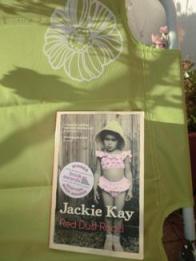
Red Dust Road by Jackie Kay

I discovered Red Dust Road after reading a feature about Jackie Kay in the Guardian’s A Life in Writing series coinciding with the release of her short story collection Reality Reality. Upon reading the interview I learned that she had also recently published a memoir focusing on the story of her adoption by a Scottish couple and her subsequent attempt to find her Scottish birth mother and Nigerian birth father. I ordered both books, keen to discover this writer’s work, particularly as she is also a renowned poet and I am drawn to writers who already have poetry resonating within their voice, and I couldn’t wait to jump into the memoir, more for personal reasons, since I have been on a similar journey myself.
While her brother Maxie said he couldn’t remember not knowing he was adopted, for Jackie, the realisation was one she remembered clearly after watching a cowboy and Indian film and feeling sad because the Indians had lost again and she wanted them to win. After observing that the Indians had her colouring which was not the same as her mother, she asked why. The revelation that followed came as a shock, she cried and worried that ‘not real’ meant her mother was somehow going to disappear or dissolve. But she had been gifted with a loving and sensitive mother, an honest, straightforward and intelligent woman, who clearly loved both her children unconditionally as Jackie Kay displays in her warm, appreciative depiction of the characters involved in this remarkable and exhilarating story.

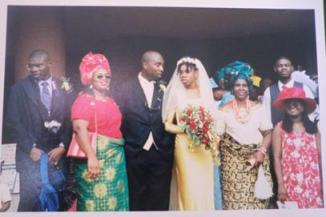
My Friend’s Wedding in Lagos

‘Betrothed’, she told me ‘your father met your mother in the Highlands of Scotland and they fell in love. He was from Nigeria – look, here it is in the atlas – and she was from the Highlands – look, here’s where she was from, Nairn. They were madly in love and they made you, but he was betrothed and had to return to Nigeria to marry a woman he maybe had never met. They do that there, you know. Hard, Jackie, must have been hard’.

In no rush to piece together the puzzle, but knowing that she will, Jackie finds occasion with her work to be in certain places where she can do a little investigative work, she visits Nairn, where he birth mother grew up and Milton Keynes where she lives now; Aberdeen where her father was at university and Nigeria, that supposed foreign land of her ancestors that she had no connection to in her daily life, but has dreamed of and imagined and experiences a kind of coming home when she visits the ancestral village of her father.

Recounting her visit to the village and in particular meeting one of the family members, left pools of liquids in my newly prescribed reading glasses, tears of joy and recognition as acknowledgement is realised. I don’t want to say too much, because there is too much good in reading this for the first time and not knowing what will occur, but this is a wonderful story, narrated without sentimentality, putting the reader right in her shoes, almost experiencing it first-hand.

Hanging Out in Lagos, Nigeria

Like so many adoption stories and as depicted so well in Mike Leigh’s ‘Secrets and Lies’, there remains much mystery and secrecy around so many of the stories. For those who have buried that episode in their lives somewhere deep, there is a reluctance to risk the turbulence they perceive it may cause, and even when acknowledged by the parent adoptees are often kept from the rest of the family. This can be one of the greatest risks of pursuing genetic ties, the risk of rejection as an adult with full consciousness, unlike that of a baby; although much research suggests that a baby does indeed have awareness of the separation.

Many doctors and psychologists now understand that bonding doesn’t begin at birth, but is a continuum of physiological, psychological, and spiritual events which begin in utero and continue throughout the postnatal bonding period. When this natural evolution is interrupted by a postnatal separation from the biological mother, the resultant experience of abandonment and loss is indelibly imprinted upon the unconscious minds of these children, causing that which I call the “primal wound”. Nancy Verrier, The Primal Wound, Understanding the Adopted Child

The balcony from where the children sang to me

I laughed when she talked about the experience of being called Oyibo (white person) in the village, causing quite a sensation with her paler skin. She mentions returning to Lagos which she describes as more cosmopolitan and where one is unlikely to hear that word.

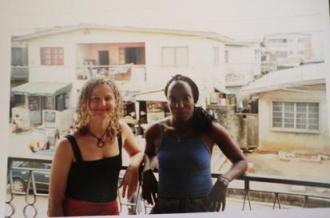
I have to say that I too know that word, from my visit to Lagos in 1999, when I visited for marriage of a very dear friend. In the quarter where I was staying, I was a bit of an anomaly and not only did the children come to stand outside the house in case they caught a glimpse of the Oyibo, they even had a song they sung, which my friend laughed at, remembering she too used to sing it as a child, something about ‘white man, eat more pepper (the very hot pepper soup for breakfast), make your face go redder’, I guess it’s true, we do have an unusual capacity to change the colour of our face when eating something very hot or becoming embarrassed!

There are so many extracts I could paste and talk about from Red Dust Road, the reaction of her own son, the discovery of names, the reading through old archives, visiting buildings from another past, the importance of the imagination and the importance of a true friend, but I would prefer that you read the book and enjoy your own journey and reactions to this wonderfully humane and important story that we are privileged to share.

*

Below, I share a few photos from my visit to Lagos, Nigeria in 1999, an unforgettable experience it was indeed.

Preparing for the Native Ceremony, bride wearing her family ensemble

View from a rear window

Bride with her brother, wearing an outfit from the husband’s family

The theatrical Native ceremony in full swing

Wild

Let me start by saying, I really enjoyed ‘Wild’ and admire the way Cheryl Strayed shared her story. It’s not exactly exciting to spend months hiking a trail, but the author writes about her journey in a way that is as gripping as any novel without being overly melodramatic. I was a little wary before starting, with the shoe falling off the cliff, wondering if she was some ill-prepared novice on a suicide mission, but that is not the case at all, the thing about the shoe probably the only time she does use an anecdote for overly dramatic effect, and to sell a book, why not – it worked.

Cheryl Strayed considers herself a bit of a stray. She changed her name in the process of finalising her divorce, gaining an apt description for how she felt at the time and profiting from the otherwise sad demise of her marriage by being able to offload a hyphenated name she held no sentimentality for.

Born in 1968, clearly intelligent and showing she had potential from a young age, ironically – getting married at the age of 19 was something of a rebellious act. Nineteen, an age of youthful idealism, where if not wary, we risk being fooled into taking the intensity of our feelings seriously and wind up wed. Or am I being just a tad cynical?

It’s a classic coming of age theme, girl with an absent father finds a wonderful man – and Strayed’s first husband Paul is a remarkable individual, who accepts the amicable divorce which Strayed sought by instinct more than knowing, missing a part of herself that she was fast learning couldn’t be fulfilled by another.

Being near Tom and Doug at night kept me from having to say to myself I am not afraid whenever I heard a branch snap in the dark or the wind shook so fiercely it seemed something bad was going to happen. But I wasn’t out here to keep myself from having to say I am not afraid. I’d come, I realised, to stare that fear down, to stare everything down, really – all that I’d done to myself and all that had been done to me.

The death of her mother at 45, knocked her off her straight and wedded course setting her on a side road to self-destruction, though fortunately something inside, perhaps the ever-present loving spirit of her mother (and a few of her sensible genes) mapped out an escape route from her self-destructive self by planning to hike the Pacific Crest Trail (PCT).

Despite the indulgent descent, she doesn’t come across as an addict, more a period of avoidance, indulging in destructive behaviour to avoid looking inward. This is a story of a woman heading towards a healing crisis, someone who needed to commit to a challenge in the extreme to provoke it.

The Pacific Crest Trail zigzags its way 2,650 kilometres from Mexico to Canada through California, Oregon and Washington, crossing desert country, passing forestland, mountain terrain and volcanic lakes. Strayed started her hike in Mojave, California, bypassed a section of the Sierra Nevada mountain range due to exceptional snow condition (very sensible) and ended it at The Bridge of Gods in Oregon.

Crater Lake by MBessey, Wikipedia

Strayed articulates with honest clarity all that brought her to the wilderness and the experience of being there. Writing a journal as she travelled, makes the day by day account as fresh as if it were a recent trip, subsequent years clarify her view, now a 44-year-old woman and mother herself, she recounts her 26th year with the wisdom of hindsight.

As difficult and maddening as the trail could be, there was hardly a day that didn’t offer up some form of what was called trail magic in the PCT vernacular – the unexpected and sweet happenings that stand out in stark relief to the challenges of the trail.

Bridge of the Gods by Cacophony, Wikipedia

As she walked, she was surprised at how the demands of the physical challenge and overcoming them become her sole focus, how she’d imagined dealing with her grief and loss, with days and days of free thinking time was nothing like the reality. On the trail, lapses in attention were on occasion broken by a rattle, warning her of a coiled predator on the path. It wasn’t necessary to think her way towards resolution, but to stride it out fully present allowing nature to knit together the broken bits inside.

Nature is a glorious healer and reading about it second only to getting out there in it. This book is a testament to that and the moments when the author fully embraces it and is filled with the wonder and energy of the natural environment are a pleasure to share. She epitomizes the reward of those who first conceived the idea of a nature trail in the wilderness for the public to provide “a lasting curative and civilising value” and I only hope this book, not only gets widely read, but inspires many others to get out on a nature trail themselves.

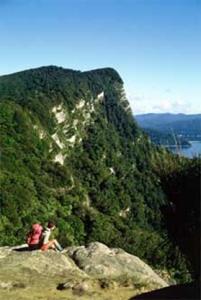
Panekiri Bluff, Lake Waikaremoana

Personally, I can recommend the hike around Lake Waikaremoana, in the North Island of New Zealand, I walked this with my family (there were 7 of us) when I was 14 years old, it is extreme wilderness and I’ll never forget the very fit Peruvian we met on the first night who asked us where the nearest shop was! He became the 8th member of our group and could shuffle a pack of cards like magic. We finished the trail in 5 days and took our new friend whom we all loved home to work as a willing farm hand, he stayed a couple of months until a letter arrived from a girl and off he went to follow her as free spirits do.

*

It was the thing that had compelled them to fight for the trail against all the odds and it was the thing that drove me and every other long-distance hiker onward on the most miserable days.