Patasana: Murder at an Archaeological Dig by Ahmet Ümit tr. Amy Spangler

Patasana

Visiting another country is an opportunity to be introduced to new authors, to read outside one’s preferred genre and to gain new historical perspectives.

So while I am already a fan of the more well-known in the English language writers, Orhan Pamuk and Elif Shafak, Ahmet Ümit was completely unknown to me and while mystery isn’t my preferred genre, a book that introduces us to new places and offers insights into other cultures and their way of life is certainly appealing.

Books from the Basement

I asked in the bookshop in Istanbul for A Memento of Istanbul, another book written by Ahmet Ümit, but it wasn’t available. The only book they had in English by him, had to be retrieved from the basement. I’m not sure if that is significant or not, although having got to the end of the book and knowing the controversy surrounding the treatment of the Armenian population within Turkey, allowing his characters to thrash out their opposing views, may have courted controversy.

In 2012 France tried to make denial of the Armenian Genocide a criminal offence, souring relations between the two countries, however the draft law was struck down.

Review

HIttites
Ancient Hittites

Patasana was the son and grandson of a palace scribe, who wrote his story and that of his father and grandfather onto tablets that were then sealed and are now being uncovered 2700 years later.

Each alternate chapter is a translation of one of the tablets, so while we follow the contemporary story of the archaeological dig of an antique Hittite settlement in southeast Anatolia and it’s team members, we also learn what Patasana lived through, the confessions of a young scribe, his life, love and regrets.

The Hittites

Hittite Chariot
Hittite Chariot

“He was the chief scribe of the palace, a very important government position among the Hittites. These men were extremely well-educated. They knew several languages. Their duty was to compose texts as dictated by the king, not to write down their own feelings, thoughts and memories. But that didn’t keep the scribe Patasana from writing down his own story. That’s why the tablets are so important….We believe what we have here is the earliest documentation of humankind’s non-official history….We think he’s telling the story of the ancient city’s final days. And together with the history of the city, his own personal history as well.”

Unsure whether it is related to the dig or not, a local elder is discovered dead, having fallen, or been pushed from the minaret of the mosque, a man in monks clothes seen fleeing the scene. Esra, the leader of the team is paranoid about upsetting locals and having her first dig cancelled before they have uncovered all the tablets and participated in an important press conference being held to satisfy their funders. Her insistence on knowing everything and getting close to the police captain makes her just as suspicious as virtually every character who at one time or other she imagines as a suspect.

Euphrates River, Anatolia

Whilst it could have done with some editing down, it is an enjoyable and I believe popular book.

It is interesting that the author was born in Gaziantep, southern Antolia and while on a family picnic near the Euphrates River saw an excavation site, an old Hittite city, prompting him to immerse himself in researching the area, its people and customs and then write this book.

Ahmet Ümit, Author

Ahmet Ümit himself sounds like an interesting character straight from a novel and it is clear that his own life has inspired many of the stories and characters he has written. As a young man he was a revolutionary political activist and a member of the Turkish Communist Party and he illegally attended the Academy for Social Science for a while in Moscow.

In an interview with Maria Eliades in Time Out Istanbul in 2011 he said:

“In this land, there’s a problem with history. The Turks came here 1,000 years ago but the land has a history that is 200,000 years old. Generally, the government believes that history began 1,000 years ago. They do not count the history of people who were not Muslim. In my novels, I’m trying to show how these people influenced the history and where their position was. I’m trying to emphasize how the Hittites, the Romans, the Byzantines, the Armenians, Greeks and all the different groups affected it. Turkey needs this: an independent view of people, regardless of their race or religion. That’s the basis of my books. The detective part of the story is a catalyst for explaining the untold part of the stories.”

Istanbul Memories of a City by Orhan Pamuk

IstanbulAlthough I carried the book  to Istanbul and back, there was no inclination to read it while I was there, I started it on the return plane journey, the appropriate occasion to do so, for Pamuk’s Istanbul is laced with more melancholy than the city I visited and I realise with hindsight, the importance of constructing my own unfettered impressions, free of this philosophical consequence of the decline of a grand empire and the inclination of its progeny to feel somewhat bereft at missing out on an era when their prominence was that much greater than it is today.

However, I remain as intrigued about the author now as I did before I started the book, it is a unique form of memoir, more of a nostalgia trip through selective memories of his childhood and his city, sharing anecdotes from both that formed him into the writer he is today.

The imagination features large in Pamuk’s  life from a very young age, when he was five-years-old he was sent to stay with an Aunt on his own and she used to point at a picture of a child and say it was him. He came to know him as the other Orhan and while he knew it was not him, this shadow of himself never left him behind. Neither did he ever leave the city of Istanbul in the fifty years up to writing this book.

CIMG4275“But the ghost of the other Orhan in another house somewhere in Istanbul never left me. Throughout my childhood and well into adolescence, he haunted my thoughts.”

Though he never left the city, he read many works by writers and poets who published impressions of Istanbul, Gustave Flaubert, the poet Gérard de Nerval, Théophile Gautier, Pierre Loti, Edmondo de Amici and laments that in the same period they were writing about the city,  little was written or painted by its own artists and writers, therefore, whilst the work of others is familiar, it remains an outsiders perspective and does not quite capture the essence of how the Istanbullus see themselves.

Pamuk often visualises the city in black and white and throughout the book on nearly every page are photographs depicting the city in monochrome. He spends an entire chapter describing Hüzün, the Turkish word for melancholy explaining how if differs from sadness and finishes by almost convincing the reader that it is something close to a virtue, absorbed with pride and shared by a community.

“the hüzün of Istanbul is not just the mood evoked by its music and its poetry, it is a way of looking at life that implicates us all, not only a spiritual state, but a state of mind that is ultimately as life affirming as it is negating.”

“… hüzün brings us comfort, softening the view like the condensation on a window when a tea kettle has been spouting steam on a winter’s day.”

CIMG4331

Entrance to the Grand Bazaar

I did not come to Istanbul expecting to see sultans, dervishes or crystal chandeliers, though there are traces of them all if you seek them out. I came to see a city that comfortably exists while straddling two sides of a significant divide.

Bosphorus

The Bosphorus with the Castles of Europe and Asia by Thomas Allum

The Bosphorus, that deep channel of powerful surging water and current that separates two continents is deceiving. The reasonably short distance from one side to the other, only 2 to 3 kilometres, the fact that it embraces one city reminds us that there is less than we might think between the people who inhabit each continent.

A deep and powerful separation of continents, yet humanity passes across it with ease. Great divides can indeed be overcome.  The streets of shops and the Grand Bazaar attest to that passage of traders and pilgrims who have entered and passed through the city over hundreds of years.

It takes until the very last chapter before we meet the more mature Orhan who will become a writer, because unlike many born to write, his first love was painting and he shares much through his observation and study of artists who painted his city, something he practiced prolifically in his youth. The demise of this early calling occurred not long after his teenage muse was packed off by her family to Switzerland, his mother’s relentless cautions against pursuing the life of an artist transforming his rebellion against completing his architectural studies into announcing:

“I don’t want to be an artist.” I said. “I am going to be a writer.”

CIMG4495

“I was, as I had begun to discover even then, the sort who could always wear the same clothes and eat the same things and go for a hundred years without getting bored so long as I could entertain wild dreams in the privacy of my imagination.”

A treat for admirers of Orhan Pamuk’s work and those who have had the good fortune to visit his wonderful city, which is not nearly as melancholic to the visitor as it is to a philosophical resident.

Next up, murder at an archaeological dig! Time to leave Istanbul and travel inland with Ahmet Umit.

Ottoman Distractions

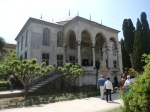
Sultanahmet (Blue Mosque)

Sultanahmet (Blue Mosque)

Greetings from a vibrant and bustling Istanbul.

There is too much opportunity to observe, appreciate, participate and marvel at this wonderful city situated where Europe meets Asia and where on every corner there lies evidence of humanity’s incredible vision going back many hundreds and thousands of years, one must put down the books and just dwell in its presence.

So no update on reading, though I do have some reading related pictures to share and I have bought two books to add to my Turkish literature collection. Not far from Sultanahmet (the Blue Mosque) is a bookshop with an enticing window showing off its collection of English translated works, works by Turkish authors written in English and any writer, whose work focuses on the area.

The owner’s brother was quick to recommend Louis de Bernières Birds Without Wings, which I told him was already in my top all-time favourite reads and of course Elif Shafak and Orhan Pamuk’s works are all there.

Portrait of a FamilyHe then handed me Portrait of a Turkish Family and promised with stalwart confidence that this little masterpiece would replace my current favourite. Sales-speak or the truth, I shall soon find out.

PatasanaI was actually looking for a copy of A Memento of Istanbul, by Ahmet Ümit, a writer I have not read before, master of the Turkish thriller and after Turkey’s profile at the London Book Fair, watch out for more from this author. I was interested in this particular book as it is said to highlight seven significant attractions introducing something of the city’s rich culture and history. They only had one book left in English by this writer, Patasana, so A Memento can wait, this is where I shall start. Thrilled already!

Istanbul is a fabulous city to visit and the children and I have totally fallen for the historic part of town. I am sure we will be back and would recommend it to you all if you ever have the opportunity to visit.

Some of the highlights:

The Burgess Boys by Elizabeth Strout

Like many readers, having enjoyed Olive Kitteridge, Strout’s previous book that won a Pulitzer Prize in 2009, I was looking forward to reading her next work. Rather than referencing Olive Kitteridge, which this book has very little in common with, The Burgess Boys arguably has more connections with Strout’s own life, growing up in small towns in Maine, studying law and moving to New York city.

The Burgess BoysJim and Bob Burgess also have little in common except that they both studied law and moved to New York, one achieving notoriety, the other not. Their younger sister Susan never left Shirley Falls, Maine; they are now all late middle age, the trajectory of their lives influenced early on in childhood when Bob(4) and Jim(8) witnessed the death of their father as the car they were in, with their younger sister in the back, rolled forward down the family driveway and killed him.

Two thirds of his family had not escaped, this is what Bob thought. He and Susan – which included her kid – were doomed from the day their father died.

The two boys leave their hometown to pursue careers in New York city and have little to do with their sister, until a thoughtless act by her teenage son Zach, lands him in trouble with the police and the law and looks set to incite racial tension among the citizens of Shirley Falls and their Somali immigrant community.

He thought of all the people in the world who felt they’d been saved by a city. He was one of them. Whatever darkness leaked its way in, there were always lights on in different windows here, each light like a gentle touch on his shoulder saying, Whatever is happening, Bob Burgess, you are never alone.

Prior to the family drama Jim’s star was in the ascendant, he could do no wrong, however an indulged ego wins few favours long term and his good fortune risks changing course.

It is a story of family ties, separation, isolation, of fear and its consequence and the challenges of an evolving community, how newcomers don’t always bring out the best in their hosts, requiring as they do, new understanding and acceptance.

It was an uncomfortable start for me I admit, taking on a story that portrays a small town’s varying and little embracing of an immigrant community and the committing of a disrespectful act against it’s religious beliefs is fraught with danger in itself. Topical perhaps, but difficult to accurately or sufficiently portray balanced points of view.

Somali USStrout presents the family dilemma and while giving them an audible voice, keeps somewhat at a distance from the community Zach Burgess has upset, though at least she does not go so far as to incite the aggrieved community to inflame their response. But the story lacks something for having touched on a community in such an indignant way and failing to give them much of a voice,  the one exception stretching the imagination in authenticity a little too far.

Abdikarim, who had attended only because one of Haweeya’s sons came running to get him, saying his parents insisted he come to the park, had been puzzled by what he saw: so many people smiling at him. To look him straight in the face and smile felt to Abdikarim to display an intimacy he was not comfortable with. But he had been here long enough to know it was the way Americans were, like large children, and these large children in the park were very nice.

Not knowing much about Somali immigration to the US, I found these two articles helpful, particularly the former in it’s comparison between US and European immigrants.

What Makes Somali’s So Different? – an interesting article by Michael Scott Moore on the subject of Somali immigrants to the US.

A ray of hope – Somalia’s Future – an analysis by The Economist in Feb 2012 on the future within Somalia itself.

Note: This book was an Advance Reader Copy (ARC) provided kindly by the publisher via NetGalley.

And the winners are…

Two digital copies of Niki Tulk’s mesmerising Shadow & Wings will soon be winging their way to…..

S&W winner

Susan  and  Lovinghomemade

Thank you to everyone who entered, I do hope you all have the opportunity to read this wonderful book eventually.

And….

Congratulations to Kimberly!

Meb4U

Meb4U winner


You have won a printed copy of Jojo Moyes  Me Before You
Thank you again to Penguin for offering this book.

I will be in touch to let you know how to receive your prize!

Thank you so much to you all for reading and commenting on Word by Word, it is very much appreciated.

Claire

Me Before You Giveaway

It’s the week for giveaways!

me b4 youThe publisher Penguin is kindly offering a printed copy of Jojo Moyes Me For You to readers based in the US.

If you haven’t read the review, click here.

*

Just leave a comment below to let me know if you are interested in participating.

And if you are interested in Niki Tulk’s Shadows & Wings, click here to read the review and enter the draw.

I will announce the recipients of both giveaways at the end of the week.

Me Before You by Jojo Moyes

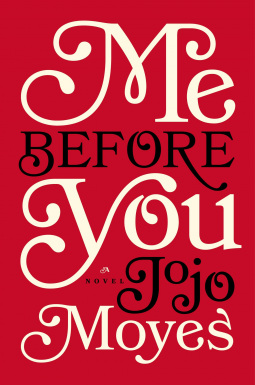
Me Before You US cover

Me Before You US cover

We can’t always judge a book by its cover, but when we do, it’s more likely that we are actually guessing a publishers intention, as they surely are well aware of the stereotypes they buy into when choosing one cover over another.

It’s something I discussed in the review of Elif Shafak’s Honour, a book I was put off reading initially and then tempted again when I saw the US cover. You only have to put a number of books of the same genre together side by side to witness a flash of recognition that it is a certain type of book or genre.

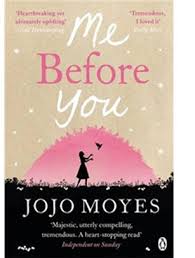
Me Before You UK cover

Me Before You UK cover

The UK cover of Me Before You suggests to me popular, light fiction, something I generally only turn to on holiday or when unable to find my reading mojo. Otherwise my reading inclination steers me towards something that might offer a unique use of language, new words, creative metaphor, unique structure, insight into a foreign culture or hopefully, evoking that elusive transporting magical sense,  something not easy to describe but utter bliss to experience.

So what about the US cover? I think it suggests that readers are already familiar with the author, it’s a bold confident move to use only text.

Maya Angelou’s recent autobiography that I read earlier this month Mom & Me & Mom had a similar text only cover (US version), and one can understand why she is beyond needing to lure readers through an enticing cover. Does this suggest that Jojo Moyes is more of a household name in the US perhaps?

Ultimately I chose to read Me Before You in order not to read too narrowly and because I am sure there will be many people who will be interested to learn more about this much talked about gripping novel.

Lou has worked in the same job for six years serving locals in a café and is more than content with her small life and daily ritual. Things change when her boss closes the café and moves away. Unable to find a suitable job she settles for a six month contract as a companion to Will, a 35-year-old quadriplegic with a number of issues since his accident almost two years previously.

Lou and Will are people who paths would not normally have crossed had they not reached such turning points in their lives concurrently and the six months they spend in each other’s company will allow them both to experience something unique and life-affirming. Well almost.

“Don’t you think it’s actually harder for you…to adapt, I mean? Because you’ve done all that stuff?

“Are you asking me if I wish I’d never done it?

“I’m just wondering if it would have been easier for you. If you’d led a smaller life. To live like this, I mean.”

“I will never, ever regret the things I’ve done. Because most days, if you’re stuck in one of these, all you have are the places in your memory that you can go to.”

It is difficult to say much about the plot without giving it away, however it is unputdownable read once started, both characters are in some way stuck and need something or someone in their lives to move them on from where they are currently.

Will’s issues are clear, though he is a stubborn, somewhat arrogant patient and Lou seems only to be sticking it out because she has to work to support her parents (her Dad has lost his job), her younger sister has a young child out of wedlock and the alternative employment for Lou would have been in some kind of vile chicken factory. Meanwhile her ever distant boyfriend of six years has become obsessed with training for the Xtreme Viking triathlon and shows signs of becoming jealous of a quadriplegic.

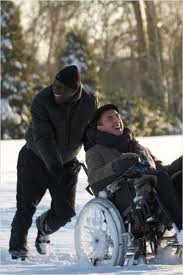
IntouchablesIf you’ve seen the excellent French film Intouchables which was a worldwide hit in 2012, knocking the popular Amelie off its pedestal for most successful French film, and is now to be remade in Hollywood (not enough Americans saw the subtitled version, the US accountable for only $13 million of the $440 million it has made so far) then you may also enjoy Me Before You.

And if you haven’t seen Intouchables, based on a true story, then make sure you see it in the original French version, before it gets done over Hollywood style! It’s brilliant.

Intouchables1The Intouchables – click to watch the trailer (make link)

Me Before You Giveaway – click to enter the giveaway (US residents only)

Note: This book was an ARC (Advance Reader Copy) provided by the publisher via NetGalley.

Shadows & Wings Giveaway

Niki_Tulk_ShadowsAndWings

Niki Tulk
Author of Shadows & Wings

Thank you to author Niki Tulk for offering to provide two readers with a digital version of her debut novel Shadows & Wings.

Synopsis:

Tomas, a cellist and dreamer, denies the devastating changes happening in 1930’s Germany—until he is drafted into Hitler’s Wehrmacht. Many years later, having emigrated to Australia, he raises his granddaughter Lara to love music and birds. He also chooses to hide from her a terrible secret.

When her beloved Opa dies, 22 year-old Lara receives a shadow box of mysterious ornaments that force her to confront his past. Seeking to understand his years of silence, and to find a way through her own grief, she travels to Germany—the objects her only guide.

Shadows & WingsShadows & Wings is a novel of cyclic journeys between hemispheres, the connections between ourselves and those we can never know, and the haunting power of art, love and dreams.

*

If you haven’t seen my review, click here to read it.

If you would like to be in the draw for one of the two digital copies, please leave a comment below.

The draw closes on Saturday 4th May.

Shadows & Wings by Niki Tulk

Shadows & WingsLara’s father works abroad and early on in the story when Lara is seven, she and her sister learn he isn’t coming back home to Australia. She is close to her grandfather Opa, though realises a little late that there is much about his life that she doesn’t know, questions she never asked him, a subject her mother won’t speak of.

At his death, her great-aunt passes her the contents of an old wooden box, objects wrapped carefully and put away, never to be looked at; they will prompt her to travel to Germany to uncover his role in the second world war.

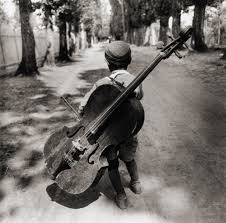
celloAt this point, we go back to the 1930’s to a small village in Germany where Tomas (Opa) and his friend Gustav live, Tomas’ father repairs violins, cellos and similar musical instruments and although initially Tomas doesn’t wish to play, when Gustav becomes interested and starts taking lessons, Tomas’ rekindles his love for the cello and will pursue music with the same determined passion his father had wished he would pursue a profession.

In school they are wary of the bullying Hans and his troop of followers and avoid them as much as they can, observing as they become teenagers their joining up a young Nazi youth group, something Tomas and Gustav avoid, but as 1939 approaches it will become impossible not to join their country’s ranks.

The story of the boys in their youth reminded me of David Mitchell’s excellent novel Black Swan Green and Niki Tulk successfully captures that essence of survival developed by children on and off the playground, only here for many, those playground antics would escalate to being drafted into Hitler’s Wehrmacht, and a war with repercussions and psychological consequences that would continue into subsequent generations.

Lara’s grandfather arrived later, a thin half-man on a ship that emptied its human cargo unsympathetically into a bright and bristling land. Here, not long enough after the Second World War, those who bore in their eyes another hemisphere were received with cool politeness. It was not their accents so much as their eyes – they held a silence that made others who had grown up here suddenly feel they needed to defend themselves. Tomas had discovered Lara’s grandmother like a familiar face in this country.

Lara’s search into her grandfather’s past and meeting Anton and friends in Berlin brings those repercussions forward to the present day. Lara’s own fragility and insecurities threaten to undermine her search and if it weren’t for Anton, her patient guide and new-found friend, we are left with the impression that her endeavour may quite well have failed. Her journey seemed at times so realistic, she seemed so ill-prepared and at times insensitive to what she might encounter by knocking on the doors of strangers, that it felt as if I were reading non-fiction. Unnerving yet totally believable.

The book falls into three main sections, Lara growing up in Australia with her mother and grandparents, Tomas as a boy and young man in Germany and finally Lara at 22-years-old on her extended visit to Germany.

albatross

An albatross in flight Photo: Wikipedia

Interspersed throughout the third person narrative, is Tomas’ journey on the boat between Europe and Australia and these short entries of a page or two entitled The Gift of Birds, The Gift of Time, Memory and Dreams provide some of the more poignant passages, they are the pages I returned to and reread a second time, some even a third.

They are written in the first person, at times focused on the present,  on the passage across the ocean and the words of a man making the same voyage who is knowledgeable about birds and their habits, and at other times they describe remnants of his dreams, regrets, the past, all that he intends to leave behind him when he disembarks. They provide a reflective counterpoint to the harsh reality of daily life in Germany as a young man, a life which drove him towards an activity he had no ambition for. These pages rebuild hope and show us the man he was.

“The cycle of the ages is the foundation.”

The man who loves birds stares into his fingers, deep in thought. “They recede, they advance… and the pattern of migration adjusts and adapts over many thousands of years. They are,” he adds, “in tune with the ages, whereas we consider only our own lifetimes. We are short-term thinkers, unfortunately.”

It is a thought-provoking story of the depths to which we go to protect our loved ones from the horrors of the past and suggests that silence isn’t always the route towards salvation, that memories and guilt often live on in subsequent generations, that a deprivation of family knowledge can lead to an obsession to fill in the gaps.

It reminds us that our elders are a source of great learning and that we shouldn’t wait until after they have gone to understand what life has taught them. It cautions us not to judge that which we haven’t experienced and to beware of what we might find when we go digging into the past of those who have tried to bury deep the horrors that return to them only in their sleep.

Thank you Niki for providing me with a copy of your book, not only a great story, but beautifully printed and music to accompany composed together and played by Niki on cello and her husband Mark on piano.

Shadows & Wings – the 5 track EP.

Giveaway – enter the draw to win one of two digital copies of Shadows & Wings

Australian Literature Month – April is Australia Literature Month,  visit Reading Matters to find out more.

Flight Behaviour by Barbara Kingsolver

Flight Behaviour (2)Barbara Kingsolver’s novel Flight Behaviour started off for me with a sense of déjà vu. There is something about the young character walking up into the forest, the sense that it may be a life changing moment, that evoked a memory of her earlier novel Prodigal Summer. There is something similar between the character of Dellarobia, a young mother of two children, and Deanna, the older wildlife biologist living in the forest, keeping an eye on the threatened coyote species.

Rereading the first line of my review of Prodigal Summer, the connection is obvious:

Animal nature, human nature, bugs and insects, forest life, their dependence and interdependence, habits good and bad and how the balance is affected when death, destruction or any kind of change is introduced; how species adapt, how human beings cope – or don’t – all of this we find in the juxtaposition of creatures assembled from the thoughtful poetic pen of Barbara Kingsolver in Prodigal Summer.

caterpillar-emergingHer latest story tracks another of nature’s creatures whose pattern of migration has changed, attracting scientists, environmentalists and believers. The events of this winter period coincide with Dellarobia’s realisation of what lies beneath her inclination to engage in behaviour likely to destroy her family. She is given the opportunity to work with the scientists and comes to understand that there is an alternative path to changing her life, one that will cause less suffering than the impulsive gesture she was intent on in the first pages.

Flight Behaviour also reminded me a little of Ann Patchett’s State of Wonder, they are both works of literary scientific fiction, stories that follow a particular ‘what if’ scenario. Kingsolver starts with the facts and then creates a hypothetical scenario, which science is trying to prove is related to climate change.

Just as history is sometimes more appealing to absorb through a well-researched historical novel, so too are certain scientific suppositions. And then there are the reactions of the population and how they sort themselves into like-minded categories, less about the science and more about community, faith, belonging and the short-term survival of families whose basic living may be at odds with the conservation of another of nature’s species.

Kingsolver looks at what motivates humanity to take positions against each other, the tendency to seek only those positions that support their belief system or corporate sponsor, regardless of evidence to the contrary, the challenges of the outsider and the blind acceptance of those who accept their lot without question, living in the present on account of mistakes they’ve made in the past.

coyote runningAn enjoyable novel, though slow going for me, there was something about Prodigal Summer that was urgent and compelling, while this book meandered; comparing the experience of these two books is a little like a reflection of the speed of the creatures in their midst.

Flight Behaviour has been short listed in the Women’s Prize for Fiction 2013, Barbara Kingsolver was a recent winner of the prize in 2010 for her excellent novel The Lacuna, one of the first novels reviewed here on Word by Word.