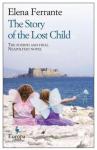
The Story of the Lost Child by Elena Ferrante tr. Ann Goldstein

The final book in the Neapolitan Novels tetralogy that began with Elena Ferrante’s My Brilliant FriendThe Story of the Lost Child continues the saga of two compelling woman, Elena and Lila, childhood friends and now single mothers, back living in the neighbourhood of their humble origins.

At the end of Book 3 Those Who Leave and Those Who Stay, Elena was in the midst of a crisis, unable to think or act in anyone’s best interests, rather, she was lead by the wild palpitations of a lust driven heart and appeared to be prepared to risk all she had fought so hard and for so long to rise above and gain.

Now with everything collapsing around her, she returns to her roots, where things are as likely to be in disorder and chaos, but in a place where she feels safe, it is familiar, known.

Elena’s daughters must adapt to a less pampered life, although their mother wishes that they, like her, acquire sufficient education to allow them choices about where and how they might live. Elena and Lila’s children present them both with significant challenges, causing them to move closer together in some respects and further apart when tragedy strikes hard.

As with the previous books, Elena is never quite sure of Lila’s intentions, questioning her motives when she appears helpful and suspicious of her intentions when she informs her of gossip. It is a characteristic of their friendship that has existed since the beginning, an aspect Elena never fully unravels and keeps her always on guard.

‘I went home depressed. I couldn’t drive out the suspicion that she was using me, just as Marcello had said. She had sent me out to risk everything and counted on that bit of fame I had to win her war, to complete her revenge, to silence all her feelings of guilt.’
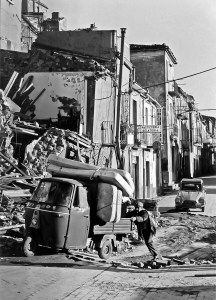
Naples Earthquake 1980It is the 1980’s and one of the turning points in Lila’s deterioration is the earthquake that occurred on November 23, 1980 killing 3,000 and rendering 300,000 of Naples inhabitants homeless. It is used as a powerful metaphor for the destabilisation that occurs in Elena and Lila’s lives.

‘It expelled the habit of stability and solidity, the confidence that every second would be identical to the next, the familiarity of sounds and gestures, the certainty of recognising them. A sort of suspicion of every form of reassurance took over, a tendency to believe in every prediction of bad luck, an obsessive attention to signs of the brittleness of the world, and it was hard to take control again. Minutes and minutes and minutes that wouldn’t end.’

Elena has always sought her independence and intended to create a career as a writer, it is only when she moves back to the neighbourhood that she realises with greater urgency that she must be autonomous.

‘It was then that a part of me – only a part – began to emerge that consciously, without particularly suffering, admitted that it couldn’t really count on him. It wasn’t just the old fear that he would leave me; rather it seemed to me an abrupt contraction of perspective. I stopped looking into the distance, I began to think that in the immediate future I couldn’t expect from Nino more than what he was giving me, and that I had to decide if it was enough.’

Book Four brings the girls full circle into the adult world where the relationships of childhood and dramas of their youth play out in a more dangerous playground, where boyhood pranks have evolved into criminal activities and the annoying habits of children transform into the damaging actions of adults with far-reaching and destructive consequences.

They are no longer observers of the world around them, they are perpetrators of events and circumstances that will affect the next generation, their children. Though they never wanted it and put all their energy into trying to prevent it, in many ways, they have begun to resemble the already departed, those they worked so hard not to become.

Book Four brings Elena and Lila’s stories back to where it all began, reacquainting us with the story’s beginning, of memories and possessions that have endured, that contain within them that sense of unease alongside the familiar, the two coexist and can not be separated, even in maturity. It is a conclusion of sorts, as thought-provoking as we have come to expect previously, not quite giving in to that alternative literary tradition of tying things up neatly.

I read the first three books in close proximity, each volume adding to the compulsion to want to re-enter their lives and discover what would happen next.  The longer gap in awaiting this final novel meant it took a little longer to pick up the pace, suggesting it might be a series best read consecutively.

If you haven’t read Elena Ferrante yet, here are links to reviews of the first three books in this series:

The Neapolitan Novels Reviewed

Book 1: My Brilliant Friend

Book 2: The Story of a New Name

Book 3: Those Who Leave and Those Who Stay


Note: This was an Advance Reader Copy (ARC) thank you to the publisher Europa Editions for kindly providing me with a review copy.


The Pollen Room by Zoë Jenny tr. Elizabeth Gaffney #GermanLitMonth

The Pollen Room was written by the Swiss writer Zoë Jenny when she was 23-years-old and became an international bestseller, translated into more than 27 languages and invitations to speak to readership audiences in Japan, China and the US among others.

Pollen RoomIt is interesting to write about this story after having just read Toni Morrison’s God Help the Child, this novella yet another version of what Morrison demonstrates.
It is the memory of childhood without maternal love and its after-effect. It is not dramatic, nor a traditional story, it is a narrative that sets the reader up to feel something of the isolation and vulnerability of the protagonist and follow her forward as she tries to plug the gap, looking for that nourishment as if it were something tangible she could use to plug the abyss it created by its absence.

Jo stayed with her father when her mother left. There is no explanation, just significant and detailed memories of insignificant events, noises that communicate the beginning of her father’s daily routine, signals that provoke anxiety, nameless visitors, the one he married Elaine, who eventually left too.

‘At night I would fall into a restless slumber. Fractured dreams floated past my sleeping eyes like scraps of paper in the raging torrent of a river. Then I would hear a clatter and find myself wide awake. I looked at the spiderwebs on the ceiling and knew that my father was in the kitchen…

There came a series of muffled rustling noises and a moment of quiet. My breath quickened. A lump rose in my throat and swelled to enormous proportions as I watched my father put on his leather jacket and pull the door quietly closed behind him.’

After initial weekly visits, her mother soon moves on to a new life and there is no contact for 12 years. Eventually Jo goes in search of her, however being reaquainted doesn’t bring her companionship or stability, it brings responsibility, creates concern, disquiet. She seeks solace in the company of others, those who appear to live in the semblance of a home, acquaintances short-lived, consequences that won’t leave her.

 Author Zoë Jenny

Author Zoë Jenny

The prose is spare, observant, it infiltrates your mood and makes the reader suffer alongside the protagonist.

Brilliantly conceived, it is not a book to read if you are feeling sad or vulnerable. There is dialogue, interaction, and a great swathe of stream-of-conscious thought as Jo observes each encounter and responds in her inward-looking, sensitive way to it all.

Unfortunately I read this without realising that and so didn’t appreciate it’s best qualities as much as I might have done, had I read it at another time. I read it at a time of being acutely aware of the fragility and vulnerability of youth and couldn’t see past the neglect and narcissism of those around Jo and spent the entire book worrying that something even more terrible was going to happen to her and just felt great relief when it was all over and we were safe.

I was recommended this title by Vishy and I would highly recommend reading his review, which celebrates the beauty and artistic merit of the novella, showing us just how great it can be, when we choose the right time to read it. It was one of his favourite reads of 2015.

Vishy’s Review of The Pollen Room

And it’s German Literature Month, thanks to Caroline at Beauty Is a Sleeping Cat and Lizzy at Lizzy’s Literary Life

Follow the hashtag #GermanLitMonth on twitter, or click on the links to see what they’ve been reading, and what great works in translation there are out there for us!

German Literature Month


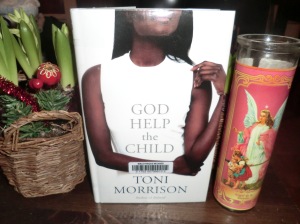
God Help the Child by Toni Morrison

Toni MorrisonBride is young, in her twenties, but has learned early the importance of a word, a gesture, a look that can change people’s perception of you, as long as you stick to it, you become known for it, unforgettable, and that one thing can change your world.

God Help the Child is mostly told through the life experience of Bride, a name she chose for herself as she launched herself into a successful and glamorous career in the perfume/fashion world.

It is far from the memory of neglect and disapproval that was her constant companion throughout childhood, channeled through the eyes, words and gestures of a mother unable to move beyond the disappointment of the blue/black tone of her daughter’s skin.

‘I told her to call me “Sweetness” instead of “Mother” or “Mama”. It was safer. Being that black and having what I think are too-thick lips calling me “Mama” would confuse people. Besides, she has funny-coloured eyes, crow-black with a blue tint, something witchy about them too.’

Before her second interview for the job she covets, she consults a designer called Jeri, who convinces her to only ever wear white, accentuating both her new name and because of the effect it had on what he described as her licorice skin.

‘At first it was boring shopping for white-only clothes until I learned how many shades of white there were: ivory, oyster, alabaster, paper white, snow, cream, ecru, Champagne, ghost, bone.’

Bride waits in a prison parking lot for a convicted felon to emerge on the last day of their sentence. She comes with a gift and a different form of naivety than that she possessed when her testimony put this person away for 20 long years.

Her current boyfriend Booker has just left her, and now this. She excels in acquiring knowledge to help her scale the ladder of success, but there is a gaping hole within that pushes her to put all else aside and find answers to questions she can barely articulate to herself.

On a whim, she tries to track down the man who disappeared without a goodbye and after a car accident and injury, finds herself living with a couple and a girl in self-imposed poverty; a stark contrast to her lifestyle. As she pursues those unclear questions, strange but noticeable things begin to happen to her body, as if it is regressing towards childhood.

Each subsequent part tells of an encounter of someone she meets or has met previously and although their stories differ there is a common thread that ties them all and demonstrates in various ways the effect these childhood experiences have on a person subsequently, how they shape who we become, how we react to things, how they affect one’s perception.

Toni Morrison

Toni Morrison

The characters enthrall, each one introduced fleetingly, intriguing and hinting at the depths that their own stories have led them to become. Morrison makes us wait and slowly reveals those experiences for the select few deemed important to the narrative. It is perhaps through this hinting at and omission, that much is left to the reader to contemplate, but then Morrison isn’t known for having to spell it all out or writing sagas, and there is enough divulged to create a balance and equal contribution between the four parts of the novel.

It is a thought-provoking, evocative novel that deserves more than one reading, demonstrating the ease with which Toni Morrison and her narrative skill are able to skate into the 21st century, to pick up and explore the nuances of another of society’s dysfunctional aspects, that the things you do and say to children in their early years really matter and will impact their adult perceptions, actions and relationships. However, there are moments, that if grasped, can and do lead one out of that.

Brilliantly told, subtle and yet powerful, Morrison’s final words at the end of the book, reminded me of the closing words of Maya Angelou in an interview she gave to the BBC near the end of her life, after a lifetime of addressing issues that manifest throughout life, her final words too, speak of children.

“Exercise patience with yourself first, so you can forgive yourself for all the dumb things you do. Then exercise patience with your children.” Maya Angelou

All Our Names by Dinaw Mengestu

All Our NamesFinding a book like this on the English language shelves of our local French library, is one of life’s small pleasures in a world that offers few escapes these days from tragic reality.

A book like this, by an author named Dinaw Mengestu, winner of the Guardian First Book Prize for his debut novel Children of the Revolution, chosen as one of the 20 best writers under 40 by The New Yorker in 2010, born in Ethiopia and raised in the suburbs of Chicago – well I cast all other reading plans aside and jumped right in, relishing the feel of the hardback, admiring the simplicity of such a striking cover and anticipating a joyous, literary ride.

The title All Our Names, reminded me immediately of Zimbabwean author NoViolet Bulawayo’s  We Need New Names, hers a reference to the move to America, while Mengestu delves further back and makes us realise just how deep and far-reaching the naming ritual is.

“On the bus ride to the capital, I gave up all the names my parents had given me. I was almost twenty-five, but by any measure, much younger. …I tried to think of myself as a revolutionary in the making, though I had come to the capital with other ambitions.”

Library Entrance

The Library Where This Book Lives

Ill-prepared for the world that awaited him, he assumed the few Victorian novels he had read would prepare him for studying literature, having been inspired by reading of a conference of a group of African writers and scholars in a newspaper that had belatedly arrived in his village.

“No one I met believed I was a revolutionary, and I didn’t have the heart to claim I wanted to be a writer.”

Right from the opening pages, when he meets the young man who tells him his name ‘for now is Isaac’, we are made aware of the significance and dispensability of names.

“Isaac” was the name his parents had given him and, until it was necessary for us to flee the capital, the only name he wanted. His parents had died, in the last round of fighting that came just before independence. “Isaac” was their legacy to him, and when his revolutionary dreams came to an end, and he had to choose between leaving and staying, that name became his last and most precious gift to me.

UgandaThe story is narrated in alternate chapters, one entitled Isaac, the other Helen. Isaac takes place during a short period in the life of the male protagonist after he has left the family village somewhere in Ethiopia, planning never to return, arriving in Kampala, a city in Uganda where he hopes to study at the university.
It is there he meets the young man named Isaac, recognising in him a similar ambition and humble origins, though in his presence he is also aware of an undercurrent of fear and trepidation, not yet realising, but intuiting the dangerous depths Isaac is capable of descending  into in order to achieve that ambition.

The Helen chapters take place in a small midwest town in the US, Helen is the social worker assigned to him when he arrives from Africa; she installs him in accommodation and helps him to adjust to the new life as a foreign exchange student.

The relationship becomes complicated when boundaries are breached, as the two offer each other something of an escape from their very different pasts.

It is a simple story possessing its own undercurrent that pulls the twin narratives along, the emotional pull in Helen’s story, her struggle to navigate the space between her feelings for him and society’s expectations and in the Isaac chapters, a mounting tension as student protests and harmless revolutionary activities turn sinister and violence becomes the shortest and most effective negotiating tool to obtaining power.

Set in the 1970’s during the Ugandan post-colonial revolt, this novel was hard to put down and offered a unique insight into one example of the kind of experience that might have occurred to any refugee fleeing a violent uprising. Equally, it aptly depicts the discomfort of even the most liberal, unjudging character, raised in a quiet, conservative town, whose wavers between ignoring and following her instinct to abandon all she knows in order to follow her heart.

“I wonder whether, if before meeting Isaac I had tried to challenge the easy, small-time bigotry that was so common to our daily lives that i noticed it only in it extremes. I might have felt a little less shame that evening. It’s possible that I might have been able to release some of it slowly over the years, like one of those pressure valves that let out enough steam on a constant basis to keep the pipes from bursting. It’s also equally possible that such relief is impossible, that, regardless of what we do, we are tied to all the prejudices in our country and the crimes that come with them.”

The Burgess BoysIt reminded me a little of Elizabeth Strout’s The Burgess Boys (read and reviewed in 2013), which I was a little disappointed by, this is the kind of book I was expecting, but understandably, she wrote it from the perspective of the Burgess boys, whereas Dinaw Mengestu gives us both perspectives and the story is all the more powerful for it.
Mengestu writes in an engaging and flawless style, his storytelling and insights are enough to convince me I will definitely be reading more of his work soon.


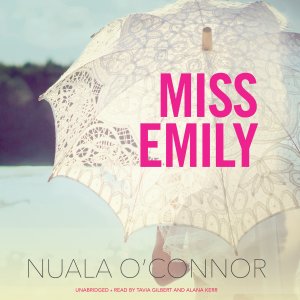
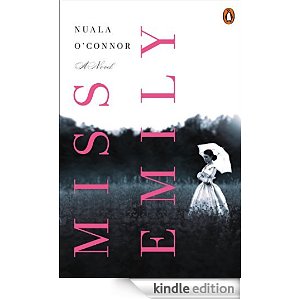
Miss Emily by Nuala O’Connor

Nuala O’Connor is the Irish author I discovered in 2014 thanks to the Irish Times Book Club.

You may remember last year, I read and reviewed her novel The Closet of Savage Mementos which she wrote under her Irish name Nuala Ní Chonchúir. That novel was about an Irish girl who left Dublin for a Scottish seaside town after the death of her boyfriend and to escape her mother’s dramas. In Scotland she encountered her own drama and was forced to make a life-changing decision.

Emily Dickinson and an Irish Maid

Now, writing as Nuala O’Connor for US and UK  readers, she pens the story of another Irish woman, the feisty but hard-working Ada, who also leaves Dublin, destined to become housemaid to the Dickinson family. It is a fictional account of the friendship between the Irish maid and the poet Emily Dickinson.

Ada Concannon, the eldest of 7 children, possesses an energetic zest for life that was unappreciated by her previous employer; upon being demoted to scullery maid she decides to seek her fortune elsewhere, taking a passage on the boat to New England where her Aunt Mary, Uncle Michael and a couple of not too friendly cousins reside.

She lands on her feet with the job at the Dickinson household, a family of four with their spinster sisters Vinnie and Emily, neighbours to their gruff brother Austin and his wife Sue, whom Emily appears to (not very convincingly) pine for.

The American Frugal Housewife

The Frugal Housewife

Emily is reluctant to leave the house, preferring words to company and attaches herself to Ada, the kitchen being one of her preferred refuges, thus friendship with the housemaid most important.

Her friendship with the maid flouts convention and is a kind of quiet rebellion within the home that the poet rarely steps out of.

“When I talk too much, everything I think and feel is wrung from me. I have nothing to write about when all is spent. It takes me so long to restore myself. It is as if I must heal a wound after each party where all is chitchat and glances and fun.”

Ada is adept in the kitchen, devoted to the family and the book The Frugal Housewife that Mrs Dickinson has lent her.

“Think of this as your second Bible,” she said.

Ada is charmed by the quiet and unassuming Daniel Byrne, her stay marred only by the creepy presence of the nephew of Daniel’s boss, Patrick Crohan.

Chapters alternate between Miss Emily’s and Ada’s perspective to reveal brief but eventful encounters in the kitchen and rooms of the Dickinson home, between Ada, Miss Emily and those around them.

Although Ada is outgoing and attractive, she still has something of the Irish reserve and tendency to silence when there is trouble. And trouble there will be. Ada and Emily must attempt to navigate the narrow space between their classes to deal with the trouble, without compromising their reputations.

Miss Emily is a lively, charming read, she brings her characters to life, especially the Irish and creates a world we can quickly imagine and inhabit. There is something comfortable and reassuring in her prose and novels that makes you want to abandon all else until the last page is turned. Just as she did with Savage Mementos, so too she achieves with Miss Emily. My only regret is that it all ends too soon, I’m still wondering about Ada and could easily follow after her into a sequel.

“For now I need the solace of words. Words bracket silence. That quiet gives propulsion to the words and all that they say. Words smoulder, they catch fire, they are volcanic eruptions, waiting to explode. I like to start small. With the fewest words I can manage. If the words run away, I trip them up and pull them back – they are elastic. If they do not cooperate, I obliterate them.”

Miss Emily audio

The Readers of Broken Wheel Recommend by Katarina Bivald, tr. Alice Menzies

Readers of Broken WheelSometimes, these are the only books that will do. That rare breed of literature that entertains, uplifts and demands little in return, the books we read when we are fed up with thinking and wondering why certain things are the way they are.

Sara has always been seen by her family as wanting, harbouring a mild disapproval of her predilection for staying in and reading, her acceptance of a job in a quiet bookstore. Now that she is doing something out of the ordinary, leaving their sleepy Swedish town to travel to small town Iowa, they’re still not happy.

“It wasn’t clear which was worse, the tediousness or the risk of bumping into one of the many serial killers hiding in every nook and cranny… Honestly though, what do you know about people? If you didn’t have your nose in a book all the time…”

The bookshop Sara worked in has closed down and her world seems to have diminished to books and the lives within them. 

“Her little sister Josefin worked as a trainee lawyer for the district court on Södertälje. Eventually, she would be a solicitor, a socially viable profession carried out in suitability expensive suits. Sara, on the other hand… A bookshop. In a suburban shopping centre. That was only marginally better than being an unemployed former bookshop assistant like she was now. And now that she had finally gone abroad? She had chosen to go to a little backwater in the American countryside, to stay with an elderly lady.”

Broken Wheel SierraSara has been writing letters to Amy for the last two years, they are bookish pen pals who share a love of literature and enjoy the uninterrupted conversation of a letter. Amy invites Sara to visit, she arrives in the small, dilapidated town of Broken Wheel, most-likely it first and only ever tourist, only to find that the person who invited her didn’t tell her something VERY important that will affect her two month stay.

The Readers of Broken Wheel Recommend takes a melancholic bunch of characters from a declining town in Iowa and puts the introverted, bookish Sara into its midst.

Though it is a small town, with not much going for it, it is an adventure for Sara to leave Sweden and travel to meet her bookish friend.

She discovers the important thing that Amy left out of her letters on her very first day and it will have an effect on the rest of her 2 month stay, where we meet a cast of fabulous, quirky characters and observe the transformation of a depressing little town.

The residents of Broken Wheel are not avid readers, they are not readers at all and don’t see things the way Sara sees them.

‘People are better in books,’ she muttered. She said it so quietly she didn’t think he could have heard her, but when she stole a glance at him, she thought she could see one of his eyebrows twitch. ‘Don’t you agree?’ she asked defensively?

‘No,’ he said.

Sara decides to convert Amy’s empty shop in the deserted town of Broken Wheel despite the fact the residents claim not to be readers. Slowly the wheel begins to turn…

Broken WheelA light-hearted, uplifting story that should be in the section of the bookstore or library entitled “guaranteed to lift or lighten your mood”.

It reminded me of that same feeling created by the author Antoine Laurain in The Red Notebook and was an absolute delight, just what I needed, a literary, bookish pick me up!

Note: This book was an ARC (Advance Reader Copy) kindly provided by the publisher.