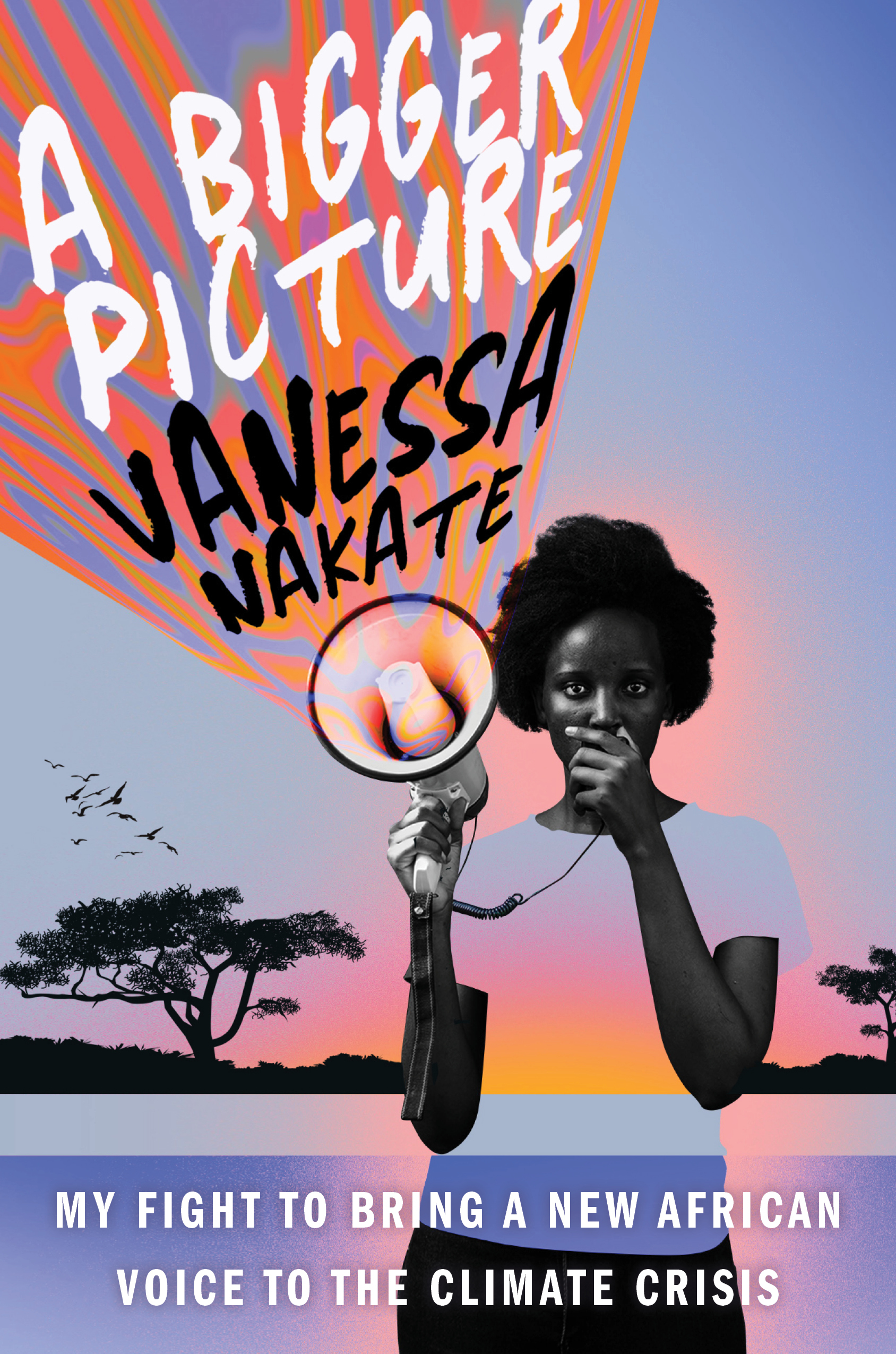
A Bigger Picture by Vanessa Nakate

My Fight To Bring A New African Voice To The Climate Crisis

Vanessa Nakate is a young Ugandan woman who became concerned about the effect of climatic conditions and change on her country and in particular the knock on effect floods, crop destruction would have on women and girls, disproportionately affected, as explained in her book.

Alternative Learning Experiences for Children
climate change literature Kenya African Voices

She decided to organise a strike, just herself, her two younger brothers (14 & 10), two visiting cousins (11 &9) and another cousin her age. It would be the six of them, holding up a few placards they made, and they would stand in four busy locations in Kampala, moving from each place after 30 minutes when her alarm went off.

“What shall we write?” Varak, the nine-year-old asked.
I wanted us to express something positive, and to ensure that my younger family members held placards they themselves would understand. We decided to pick slogans we thought wouldn’t be too threatening, and so wrote several, in English.
Trees Are Important For Us
Nature Is Life
When You Plant A Tree, You Plant A Forest
Thanks For The Global Warming (that was our sarcastic one) and
Climate Strike Now
We also drew some trees next to the letters.

Nothing dramatic happened, no one told to stop, but it was the beginning of an interest, of a young woman finding her cause and taking an action, that would lead her to learning and discovering more, to connecting with others, to finding local solutions and developing a presence and a new voice, on an international stage.

One woman stopped and told them of some trees being cut down to make way for a school, that they should be stopped. Each time Nakate went out and had the opportunity to engage or had a response on social media, it would often lead her to the next idea, it would put her in touch with others who genuinely wanted something to be done, their voices to be heard.

How One Exclusion Can Lead to Greater Inclusion

It is an excellent read, because it follows her personal journey, as a young person with little knowledge about activism and from this small spark of quiet daring (despite her anxieties, insecurities and fear of judgement), she shares her perseverance, her growing knowledge, the first invitations to attend international conferences and events, to a tipping point, when many more (including me) would hear about her – after she was cropped out of a photograph of young climate change activists including Greta Thunberg at Davos, Switzerland during the WEF (World Economic Forum) in January 2020.

My message was, and is, straightforward: People in Uganda, in Africa, and across what’s called the Global South, are losing their homes, their harvests, their incomes, even their lives, and any hopes of a livable future right now.

The Quiet Methodical, Cooperative Approach

What makes her message and her actions all the more interesting is that she takes a quiet methodical approach to doing things in her own authentic way, in a country where she is aware of both dangers and expectations, so does nothing foolhardy, acting responsibly.

However, when there is the opportunity for advancement of her cause and for manageable solutions she can implement herself, she steps up to those and has helped make life more amenable for many families already, while continuing to pursue the wider message, especially to young people, future leaders, for whom it will be better if they encounter this knowledge through their early education, than as adults already fixed in their opinions or influenced by position or power.

Since I’m always looking for solutions that reflect reality and the need to get the message out, I decided that instead of suggesting that students walk out of classes, I’d try to take the climate strikes into schools – where they could form part of the curriculum in a way that I’d wished climate change had been when I was a young girl.

The first school she approached in this way was open to this collaboration, the teachers assembled 100 students inside the compound, Vanessa Nakate gave a short speech explaining what the strike was about, in a way that could relate to and then lead them in a chant, the teachers encouraging the children to chant even louder.

What do we want? Climate justice. When do we want it? Now.

Genuine Efforts and Action Do Get Noticed

In 2019 she received an email from the UN Secretary General’s office in New York, an invitation to attend the Youth Climate Summit. Understandably, she and her parents didn’t think it was real, but it was, she would be the first person in her family to travel outside of Uganda and that would signify a new beginning in her self-appointed role.

The first half of the book is about the development of her role, the logistics of trying to attend events and to becoming involved in meaningful solutions at home, such as the Vash Green Schools Project (supports the installation of solar panels and building clean cooking stoves in primary schools) and to realising the need for self-care due to overwhelm.

Role Models and Inspiration, Making Connections

The second half gives a bigger picture of the wider issues, sharing information from others she interviewed and has been inspired by, including the late Wangari Maathai, the inspiring Kenyan woman who created the Green Belt Movement and made much progress (often hindered by men in power) who was the first African woman to win the Nobel Peace Prize in 2004 for ‘her contribution to sustainable development, democracy and peace’. Read my review of her autobiography Unbowed here.

Coincidentally COP28 is happening right now in Dubai and Vanessa Natake is there with others trying to get their message across to world leaders who have the power to phase out fossil fuels and support equitable and safe renewable energies. Her article appearing in today’s Guardian below.

I really enjoyed reading this book and learning more about how Vanessa Natake became a voice for her country and continent and inspired so many youth and adults to both learn and do more to try and halt the destruction that is affecting them all.

Highly Recommended.

Further Reading

The Guardian Opinion: At Cop28 it feels as if humanity’s shared lifeboat is sinking by Vanessa Nakate

Author & Activist, Vanessa Nakate

Vanessa Nakate is a Ugandan climate justice activist. She grew up in Kampala and started her activism in December 2018 after becoming concerned about the unusually high temperatures in her country. Inspired by Greta Thunberg to start her own climate movement in Uganda, Vanessa Nakate began a solitary strike against inaction on the climate crisis in January 2019. She founded the Youth for Future Africa and the Africa-based Rise Up Movement and spearheaded the Save Congo Rainforest campaign.

She has addressed world leaders at multiple climate summits and appeared on the cover of TIME magazine in 2021 (featuring on the Time100 Next list in 2021). She was appointed a UNICEF Goodwill Ambassador in 2022.

Nakate and her work have been featured in the New York Times, the Guardian,Yes!,Vox, Vogue, the Huffington Post, the International Women’s Forum, and the Global Landscapes Forum, and on globalcitizen.org, greenpeace.org, CNN, the BBC, PBS, and United Nations media. She lives in Kampala, Uganda.
The First Woman by Jennifer Nansubuga Makumbi

Brilliant. I absolutely loved this novel and it will definitely feature in my Best Reads of 2021.

Best African Women Writers UgandaThe First Woman might even have surpassed her debut novel Kintu which was fabulous and my outstanding read of 2018.

Firstly I am a huge fan of literature that takes us elsewhere, into the storytelling traditions of other cultures, seen from the inside, told in a way that doesn’t alienate a reader from outside that culture, but has both a particular and universal message. And secondly, when a novel has all the essential storytelling elements.

Jennifer Makumbi’s storytelling has all the elements – great, unforgettable characters, a ‘moving at pace’ plot, a little bit of mystery, a whole lot of feminism plus controversy, multiple perspectives, mini dramas and the wise counsel of women who’ve had enough of past injustices.

Rural, Urban – Past, Present

Then there is the contrast of the rural life and upbringing versus an urban existence, the striving for and effect of education on girls and the natural way that local Ugandan folklore and ancestral stories are interwoven throughout their way of living, learning and coming of age. They create a sense of belonging and help young people navigate their concerns, sorrows, strange feelings and unanswered questions in a thought provoking and entertaining way

In Kintu, Makumbi set part of her story in the pre-colonial 1700’s and other parts in modern times; colonial interlopers had left their imprint, but it was not their story nor a story of their influence and so too The First Woman belongs to and is born of its people, whose existence grows and evolves from their unique origins, belief systems and traditions. Their challenges come from within their culture and again Makumbi focuses on what is uniquely Ugandan.

Family Secrets and Lies

The narrative begins when Kirabo is a teenage living with her grandmother, she develops a curiosity to know who her mother is, she is awakening to a perceived deficit in her life and notices that those closest to her are unwilling to talk about it. So she seeks out Nsuutu, who some refer to as the witch, intuitively knowing she may have knowledge, visiting her in secret.

Though Nsuutu was practically blind, behind her blindness she could see. But Nsuutu was not just a witch – she was Grandmother’s foe. Their feud was Mount Kilimanjaro. Apparently, Nsuutu had stolen love from the family.

The First Woman, the Original State

Nsuutu tells Kirabo that she has “the original state” of the first woman inside her. This explanation and story is shared over various visits and sets up an extremely compelling narrative, as Kirabo learns from this wonderful, empowered but ageing feminist. However, she is warned her not to go looking for her mother, an instruction that feeds her obsession, making it all-consuming.

‘We changed when the original state was bred out of us.’ Kirabo looked at her hands as if to see the change. ‘Was it bad what we were? Is it what makes me do bad things?

‘No, it was not bad at all. In fact, it was wonderful for us. We were not squeezed inside, we were huge, strong, bold, loud, proud, brave, independent. But it was too much for the world and they got rid of it. However, occasionally that state is reborn in a girl like you. But in all cases it is suppressed. In your case the first woman flies out of your body because it does not relate to the way this society is.’

Narrative Structure

The First Woman Ugandan LiteratureThe story is divided into five sections; The Witch (Nattetta, Bugerere, Uganda 1975), The Bitch (Kampala 1977), Utopia, When The Villages Were Young (Nattetta 1934) and Why Penned Hens Peck Each Other (1983).

After Nsuutu’s wise counsel, Kirabo’s life is upended when it is announced she will go to Kampala to live with her father Tom, about whom she has never been curious. She has seen him on and off over the years as he visited the clan in the village where she lives, but now she will go and live with him in the city, where it becomes clear that much more had been hidden from her.

Nsuutu held both her hands. ‘Don’t judge the women you met too harshly.’

‘I won’t.’

‘Often, what women do is a reaction. We react like powerless people. Remember kweluma?’

‘When women bite themselves because they are powerless.’

‘Tell me that whatever happens, you will not make another woman’s life worse.’

‘I won’t, Nsuuta!’ Kirabo was miffed that Nsuutu would ask.

‘Remember, be a good person, not a good girl. Good girls suffer a lot in this life.’

Utopia‘ is when she is sent to St Theresa’s, a girl’s boarding school. An education, a world without men, though interrupted by war and expulsions that occur elsewhere, having the effect of changing the balance of power and perception among the girls as well, many will leave and a new influx will arrive. It is also the period where her friendship with Sio develops.

St Theresa’s was a safe space for them to develop their talents without intimidation, interference or interruption. They owed it to themselves, and to all other girls who did not have their privilege, to excel and to change the world. ‘Our job is to arm the girl child with with tools so she can live a meaningful life, for herself and for the nation.’

Historical Influence

The narrative then returns to the past, to 1934 when her grandmother Alikisa and Nsuutu were children and fills in the backstory to their friendship, a pact, their very different aspirations and the effect of the community on how their lives play out. Much of this section is told through letters they write to each other while Nsuutu is at nursing school and Alikisa is at home, having abandoned her plans to become a midwife, encouraged by her father towards teaching.

Finally, a family tragedy brings the entire clan together, and opinions are aired, grievances followed through, threads come together, some rifts are healed, others not, but there is the opportunity to break new ground, and move on from the past, without significant loss.

The First Woman is bold, empowered, authentic storytelling of the highest order, that embraces its cultural origins and exposes the reader to universal emotions, questions, conflicts, shame, friendships, love and humanity it shares.

It is both a story and an act of courage that provokes men and women to consider their roles and the effect their decisions have on others, to consider alternatives, seeking a kinder, more just way of being, rather than repeating the same patters that have existed.

Highly Recommended.

Jennifer Nansubuga Makumbi, Author

The First Woman KintuA Ugandan fiction writer, her first novel, Kintu, won the Kwani? Manuscript Project in 2013. Her second book is a collection of short stories, titled Manchester Happened (2019) for the UK/Commonwealth publication and Let’s Tell This Story Properly (US/Canada). It was shortlisted for The Big Book prize: Harper’s Bazaar.

Her third book, titled The First Woman (2020) UK/Commonwealth and A Girl is a Body of Water (US/Canada) was the Winner of the Jhalak Prize – Book of the Year by a Writer of Colour (2021), shortlisted for The Diverse Book Awards 2021, for the Encore Prize 2021, and the James Tait Black Prize 2021 and longlisted for the Aspen Words Literary Prize 2021.

Makumbi was a recipient of the Windham-Campbell Literature Prize 2018. She won the Global Commonwealth Short Story Prize 2014 for her short story, Let’s Tell This Story Properly. She is a Cheuse International Writing Fellow (2019) and KNAW-NAIS residency (2021). She has a PhD from Lancaster University and has been a senior lecturer at several universities in Britain.

Further Reading

My review of Kintu

Guardian Review: A girl longs for her absent mother in this frank, witty tale about power and gender roles by Alex Clark

Article, Johannesburg Review of Books : A Triumph of a Novel: The First Woman Jennifer Nansubuga Makumbi’s answer to people who like to defend patriarchal power by claiming that feminism is ‘not African’, writes Itumeleng Molefi.

Kintu by Jennifer Nansubuga Makumbi

When I look back at my absolute favourite book of the year in recent years, there is a common theme running in which an author has written a story that comes from deep within their cultural heritage; it’s there in my favourite book of 2017 Homegoing by Yaa Gyasi, a book that reaches back to the author’s Ghanaian heritage, in Simone Schwartz-Bart’s The Bridge of Beyond and in Jamaica Kincaid’s The Autobiography of My Mother. It’s even there in Eowyn Ivey’s The Snow Child.

This is what appealed to me immediately about the prospect of reading Jennifer Nansubuga Makumbi’s Kintu. It promises to do the same thing, to take the reader from where we are at today in a culture and link it back to the past, from modern day Uganda to the era of when the region was ruled as a kingdom. And it succeeds brilliantly, in a way rarely seen in literature in the UK/US published today.

Kintu was discovered when a project called Kwani? launched a manuscript competition in 2012 to discover the best unpublished novels  by writers from across Africa, and to publish them for readers there. Ayòbámi Adébáyò’s excellent Stay With Me, was one of seven manuscripts shortlisted, it also went on to make the shortlist of the Women’s Prize for Fiction in 2017.

About the Kwani? project, one of the judges, Ellah Wakatama Allfrey said:

What we looked for as judges were manuscripts that told stories from the inside without the burden of focusing on how an imagined ‘West’ would view them.

As a result of winning that prize Kintu was published by Kwani Trust (in Kenya) before being offered to international publishers. It was published in the US (Transit Books) and the UK (One World Publications) and in March 2018 Jennifer Makumbi learned she was a recipient of a prestigious Windham Campbell Prize for Literature worth US$165,000. She is working on her second novel.

My Review:

1750 Buddu Province, Buganda

Kintu is the name of a clan, the original clan elder Kintu Kidda fell in love with Nnakato, an identical twin (the younger) and her family refuse to allow him to marry her unless he married her sister Babirye first. He refused. They resisted. He relented.

Kintu’s mind lingered on the primal conflict that led to a soul splitting into twins. No matter how he looked at it, life was tragic. If the soul is at conflict even at this remotest level of existence, what chance do communities have? This made the Ganda custom of marrying female identical twins to the same man preposterous. It goes against their very nature, Kintu thought. Twins split because they cannot be one, why keep them as such in life? Besides, identical men did not marry the same woman.

Babirye gave him four sets of twins while Nnakato was unable to conceive. When the twins, raised as if they belonged to Nnakto were adults, Nnakato finally gave birth to a son Baale. They adopted a baby boy Kalema, from Ntwire a widower who was passing through their lands, who decided to stay in gratitude to Kintu and Nnakto for raising his son in their family.

When tragedy occurs, Kintu tries to conceal it, Ntwire suspects something and places a curse on Kintu, his family and their future descendants.

The novel is structured into Book One to Book Six, the first five books focus on different strands of the Kintu clan, the first book being the original story of Kintu Kidda and his family in the 1700’s (pre-colonial era) and the latter stories are set in modern times, colonial interlopers have left their imprint, however this is not their story nor a story of their influence, except to note the impact on the kingdom.

After independence, Uganda – a European artefact – was still forming as a country rather than a kingdom in the minds of ordinary Gandas. They were lulled by the fact that Kabuku Mutees II was made president of the new Uganda. Nonetheless, most of them felt that ‘Uganda’ should remain a kingdom for the Ganda under their kubuka so that things would go back to the way they were before Europeans came. Uganda was a patchwork of fifty or so tribes. The Ganda did not want it. The union of tribes brought no apparent advantage to them apart from a deluge of immigrants from wherever, coming to Kampala to take their land. Meanwhile, the other fifty or so tribes looked on flabbergasted as the British drew borders and told them that they were now Ugandans. Their histories, cultures and identities were overwritten by the mispronounced name of an insufferably haughty tribe propped above them. But to the Ganda, the reality of Uganda as opposed to Buganda only sank in when, after independence, Obote overran the kabuka’s lubiri with tanks, exiling Muteesa and banning all kingdoms. The desecration of their kingdom by foreigners paralysed the Ganda for decades.

Each beginning of the six parts/books however narrates over a few pages, something of the story of a man named Kamu Kintu, who is seized from his home, hands tied behind his back and taken away for questioning by a group of local councillors. Overhearing someone mutter the word thief, an angry mob of villagers menace him without knowledge of the reason for his being detained and he is killed, left for dead on the road, the men who’d requested he come with them fleeing. What subsequently happens to every one of those councillors is equally mysterious, creating a thread of mystery that both links and separates the family stories that make up the novel.

We don’t find out who Kamu Kintu is or how he is connected to the families we encounter in each part, until Book Six, where the threads that tie the clan together begin to connect in the enthralling homecoming.

Throughout each family and over the years certain aspects replicate throughout the families, the presence of twins, premature death, as if the curse that was muttered so long ago continues to reverberate through each generation. Some of them are aware of the curse, remembering the story told by their grandmothers, others haven’t been told the truth of their origins, in the hope that ignorance might absolve them.

Her grandmother’s story had intruded on her again. All day at work, the story, like an incessant song, had kept coming and going. Now that she was on her way home, Suubi gave in and her grandmother’s voice flooded her mind.

Some are haunted by ghosts of the past, thinking themselves not of sound mind, particularly when aspects of their childhood have been hidden from them, some have prophetic dreams, some have had a foreign university education and try to sever their connections to the old ways, though continue to be haunted by omens and symbols, making it difficult to ignore what they feel within themselves, that their mind wishes to reject. Some turn to God and the Awakened, looking for salvation in newly acquired religions.

It’s brilliant. We traverse through the lives of these families, witness their growth, development, sadness’ and joys, weaving threads of their connections together, that will eventually intersect and come to be understood and embraced by all as the clan is brought together to try to resolve the burden of the long-held curse that may have cast its long shadow over this clan for so many generations.

One of the things that’s particularly unique about the novel, is the contrast of the historical era, 1750’s with the modern era, the historical part shows the unique way of life before the arrival of Europeans, in all its richness and detail, how they live, the power structures, the preparation for the long journey to acknowledge a new leader, the protocols they must adhere to, the landscapes they traverse. An article in The Guardian notes twin historical omissions and concludes that the novel is the better for it:

Makumbi mostly avoids describing both the colonial period, which so often seems the obligation of the historical African novel, and Idi Amin’s reign, which seems the obligation of the Ugandan novel. Kintu is better for not retreading this worn ground.

It reminded me of the world recreated by the Guadeloupean-French-African writer, Maryse Condé, in her epic historical novel Segu, another African masterpiece, set in the 1700’s in the kingdom of Segu.

I hope the success of Kintu encourages other young writers from within the vast storytelling traditions of the many African countries to continue to tell their stories and that international publishers continue to make them available to the wider reading public, who are indeed interested in these lives, cultures, histories and belief systems of old that continue to resonate in the modern-day, despite political policies and power regimes that seem to want to change them.

Jennifer Nansubuga Makumbi: Image from Martin Harris Centre via BrittlePaper.com

Further Reading

Brittle Paper: Essay – When We Talk about Kintu by Ellah Wakatama Allfrey

Africa In Words: Review – Jennifer Nansubuga Makumbi’s ‘Kintu’ Made Me Want to Tell Our Stories by Nyana Kakoma

The East African: Article – Kintu’s ‘Africaness’ pays off for Jennifer Makumbi by Bamutaraki Musinguzi

The Guardian: Kintu by Jennifer Nansubuga Makumbi review – is this ‘the great Ugandan novel’? by Lesley Nneka Arimah


Buy a copy of Kintu via BookDepository

Note: Thank you to the UK Publisher One World Publications for sending me a copy of the book.