
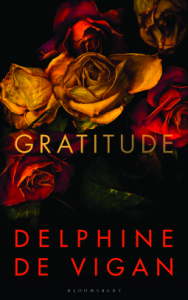
 I’ve read one other novel by Delphine de Vigan, which was auto-fiction and delved into lives affected by a bi-polar parent. A later novel also sat on the edge of fiction and real life, a novel of suspense where a friendship becomes obsessive and perhaps dangerous.
Gratitude feels like a departure from that style of writing, there’s nothing haunting or tense here, no tactics to turn the page faster.
More reflective, it considers the dilemma of ageing on three people: childless, unmarried Michka who was orphaned at the age of seven, near the end of her life; Marie, a young woman who lived upstairs, who has become like family to her; and Jérôme, the resident speech therapist who visits and is touched by Michka’s way of being, as he attempts to retrain her mind to find the lost words.
It’s a relatively simple tale told from the perspective of two people, one whose connections go back many years, the other who meets her for the first time in the care home. Both are equally important, reminding me of the beginning of that saying…
People come into your life for a reason, a season, or a lifetime. When you figure out which it is, you will know exactly what to do.
How To Express Gratitude
It is Marie who in the opening pages questions what it means to have gratitude and how to show it to someone who has been important in one’s life. She reflects on Michka’s life and their final interactions, in search of evidence of her gratitude. Jérôme wishes there was a forewarning system, to let us know when someone’s time is imminent, even though he works with the elderly, he suffers from the shock of their departure.
 The narrative switches between the two as first Marie recalls the day everything changed, when Michka lost her independence and then moments are shared while she is in care, Michka’s conversation affected by her aphasia, the impairment of her use of language, other words jump ahead pushing out the one she wishes to say.
The admission interview for the nursing home demonstrates the terror and horror of entry, as if going for a job interview for a job you never wanted in the first place, made to feel like you might be rejected. The director reminds her that it’s the same with everything in life – whatever you do, there are tests, interviews, competitions, exams, assessments, evaluations, grading. It is necessary to show your dedication, commitment, motivation and determination.
In the second half as more and more words disappear or malfunction, a sense of urgency arises.
Attaining Completion, Resolution
It is a slice of life and a look into that part of it that is imperfect, that part when some have to be at the mercy of others, in a facility that diminishes the end, possibly brings it on more quickly.
Michka has an unresolved matter to deal with and in her sessions with Jérome, which she often sabotages to question him about his father, she tells him of her regret, the thing she is unable to do for herself. Time is running out.
Gratitude is a life-affirming read, even if there are sad undertones, showing there exist all manner of souls around, those that want to hurry us along, and those that without expectation of reward, are willing to go out of their way to help another. And the importance of fulfilling those wishes for another.
My Review Of:
Nothing Holds Back the Night by Delphine de Vigan
N.B. This book was an ARC ( Advance Reader Copy) with thanks to Bloomsbury Publishing provided via Netgalley.
 The first woman who came to mind and whose book I want to recommend is Wangari Maathai’s Unbowed, One Woman’s Story. Kenyan and one of a group of young African’s selected to be part of the ‘Kennedy Airlift’ , she and others were given the opportunity to gain higher education in the US and to use their education to contribute to progress in their home countries. Maathai was a scientist, an academic and an activist, passionate about sustainable development; she started the The Greenbelt Movement, a tree planting initiative, which not only helped save the land, but empowered local women to take charge of creating nurseries in their villages, thereby taking care of their own and their family’s well-being.
 Henrietta Lacks is perhaps one of the most famous women we’d never heard of, a woman who never knew or benefited from her incredible contribution to science and humanity. A young mother in her 30’s, she was diagnosed with an aggressive form of cancer and despite being eligible for and receiving medical care at the John Hopkins hospital in Baltimore, a medical facility funded and founded to ensure equal access no matter their race, status, income or other discriminatory reason, she died soon after.
 Vera Brittain was a university student at Oxford when World War 1 began to decimate the lives of youth, family and friends around her. It suspended her education and resulted in her volunteering as a VAD (Voluntary Aid Detachment) nurse. Initially based in a military hospital in London, events would propel her to volunteer for a foreign assignment, taking her to Malta and then close to the front line in France for the remaining years of the war.
 Maya Angelou is best known for her incredible series of seven autobiographies, beginning with I Know Why the Caged Bird Sings (1969), narrating her life up to the age of 17. She became a writer after a number of varied occupations in her youth.
 Diana Athill OBE (born 21 Dec 1917) is someone I think of as the ordinary made extraordinary. She was a fiction editor for most of her working life, forced into earning a living due to circumstance, for while her great-grandparents generation had made or married into money, her father’s generation lost it. She clearly remembers her father telling her ‘You will have to earn your living’ and that it was something almost unnatural at the time.
 Word by Word