Postcard Stories by Jan Carson

Epistolary Treasures

Jan Carson Author Northern Ireland FictionI just love the concept of these works of flash fiction, postcard size stories, that have a geographic connection to a street or location in Northern Ireland, that originated as a story written on the back of a postcard – an alternative restriction to the usual one when writing flash fiction, of keeping it to 100 -150 words – and that the postcard was both sent and retained, a gift and an accumulated collection.

This not quite Ireland proper/ is not the Mainland/ is certainly not Europe in the Continental sense.

When I first picked it up, a little while ago now, I looked at the contents and went to read a few entries from the locations that were familiar to me, Belfast International Airport, Newtownards Road, Holywood Road, Linenhall Street, Holywood, Ormeau Road, but of course that was me thinking of my own story, so it didn’t make much sense. I was looking for something that wasn’t there.

Removing Expectations

So now I read it again, this time from the beginning and just allow it to tell me its own story, its bite sized exercise in writing, the awakening of imagination, the sharing of the craft, its way of thinking of others while being in the act of creation.

The book is thoughtfully illustrated by Benjamin Phillips. You can view the images from the book via the link provided through his name. They are truly evocative.

Postcard Stories Jan Carson Ireland

Photo by Ylanite Koppens on Pexels.com

I read, am entertained and wonder what it must have been like to receive one of these. Is there a connection between the story and the recipient, is it random, did they reply, did they understand the motivation of the author, did it matter? How did you get to be one of the recipients? Does she really have that many friends whose addresses she knows, a database perhaps, or is the postcard sending a fiction in itself?

Here she is practicing using the second person narrative voice from Week 6, February 5th, 2015, Cathedral Quarter, Belfast from a postcard sent to Claire Buswell.

When you were seven years old you threw a dart at a black-haired girl, running away in the garden. The dart lodged and stuck just below her shoulder blade. She fell forward in the grass. The flight on the dart was red and black and white. These were also the colours of the duvet cover in your parents’ bedroom. This was the 80’s. Afterwards the dart came away clean as needles. No harm done. You did not tell and neither did she.

I’ve read Jan Carson’s novel The Fire Starters, I know she is a fan of absurdist fiction. I also know that she works in the community arts sector and has taught creative writing skills to people to help build empathy, using storytelling to show how we can imagine being in the shoes of another. I remember being reassured by this knowledge, because the protagonist in her novel completely lacks empathy, and that is a frightening thing.

Cafés and Markets, Happiness or Disappointment

Susan Picken receives Week 45’s November story from Victoria Square, Belfast:

‘If your drink doesn’t make you happy, we’ll make you another,’ I read aloud, pointing to the sign above the barista’s head. It’s been there, right behind him, with the toastie machine and the coffee syrups, for so long now that he’s forgotten all about it.

melancholy free coffee happy unhappyIt turns out there are only so many free coffees a person can drink before realising a hot beverage cannot cure loneliness, grief or melancholy.

The collection ends in Week 52  at St George’s Market on a sorrowful note, that makes me think I ought to take my own aromatherapy potions to the Christmas market, offering an antidote to the melancholy nature of some of this population.

Every year during the month leading up to Christmas, Eleanor takes a stall at St George’s Market and sells disappointment in small, hand-made bottles…She stocks any number of different disappointments: the disappointment of an unsupportive parent, the disappointment of a homely child, the disappointment of being alone or not nearly alone enough, the disappointment of cats, good wine, box sets and religion, the dry disappointment of Christmas Day evening which is easily the most popular product on her stall.

I have Postcard Stories 2, so I will be hoping that perhaps, as we wander more streets in the year that followed Postcard Stories, there might be reason for more optimism and perhaps we might learn how to get on the postcard list.

Further Reading

Irish Times Interview: Jan Carson – girl from the north country by Ruth McKee

Jan Carson, Author

Northern Ireland Author Fiction

Jan Carson by ©Jonathan Ryder

Jan Carson is a writer and community arts facilitator based in Belfast. Her debut novel Malcom Orange Disappears (2014) was published to critical acclaim, followed by a short-story collection, Children’s Children (2016), and two flash fiction anthologies Postcard Stories (2017) and Postcard Stories 2 (2020).

Her second novel The Fire Starters (2019) translated into French by Dominique Goy-Blanquet as Les Lanceurs de Feu, won the EU Prize for Literature, was shortlisted for two prestigious French literary awards the Prix Femina and Prix Médicis in 2021 and was also shortlisted for the Dalkey Novel of the Year Award.

The most recent book The Last Resort, a collection of ten linked short stories set in a fictional caravan park, was published in April 2021.

Her work has appeared in numerous journals and on BBC Radio 3 & 4. She runs arts projects and events with older people especially those living with dementia.

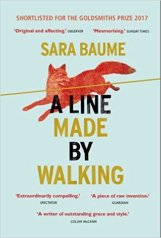
A Line Made By Walking by Sara Baume

I was hesitant to start this knowing it was the last of Sara Baume’s books I had on my shelf to read. I find her work so nourishing and unique, she’s quickly become one of my favourite authors. So what joy, part way through reading this, to learn there is a novel due out in Apr 2022, Seven Steeples.

Navigating the In-Between

Irish literary fiction Visual ArtistA Line Made By Walking takes place over one summer when 26 year old Frankie quits her Dublin bedsit and returns briefly to her parent’s home, before deciding to move temporarily into her grandmother’s slightly decrepit cottage that has long been on the market, since her death over a year ago.

It is a place where she can wallow and wait out a period of depression, create something meaningful, take walks, cycle and test herself on works of art. Her art school days are over, but finding meaning through artistic expression, looking for and noticing it around her, remains important, necessary.

“Why must I test myself? Because no one else will, not any more. Now that I am no longer a student of any kind, I must take responsibility for the furniture inside my head. I must slide new drawers into chests and attach new rollers to armchairs. I must maintain the old highboys and sideboards and whatnots. Polish, patch, dust, buff. And, from scratch, I must build new frames and appendages; I must fill the drawers and roll along.”

Art Creates Structure

Each chapter is titled with a different roadkill or animal species (not living) she has encountered nearby. Everything in the vicinity, plus her stream of consciousness thoughts, link together to create a seamless narrative, like the ripples of a stream bubbling over stones, moving around obstacles. Separate but part of something whole.

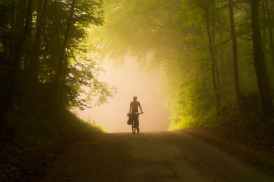
Sara Baume Irish literature Bicycle Cycling Ireland

Photo by Bogdan R. Anton on Pexels.com

Though she is not herself at this time, Frankie creates purpose in each day, and while not under observation, makes slow progress. Her mother worries, but allows her the freedom she needs. She resists conventional treatment and takes quiet charge of her own healing.

My parents did not want me to come here to stay. They are, like everybody, fearful of being completely alone and suspicious of people who choose to be. They hesitate, like everybody, to understand how it could heal me, as I believe it can. I believe: I am less fearful of being alone than I am of not being alone.

She fixes the bicycle in the shed and establishes a routine and purpose, an affirmation of the natural order of things, that all life passes. Her grandmother, the dog, a robin, rabbit, rat, mouse, rook, fox, frog, hare, hedgehog and badger. Her photographs grace each chapter.

“Here is another rule for my project: no pets, only wild things. So it can be about the immense poignancy of how, in the course of ordinary life, we only get to look closely at the sublime once it has dropped to the ditch, once the maggots have already arrived at work.”

Artwork Word Association

Though it possesses the barest of plots, I loved it’s meandering style and waymarker structure through an incredible recollection of over seventy art installations, like rabbit holes the reader can burrow into, something Baume encourages us to do.

I urge readers to seek out, perceive and interpret these artworks for themselves.

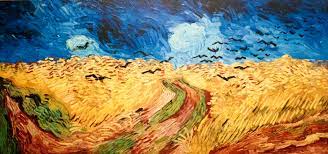
A Line Made By Walking Sara BaumeThe line made by walking crops up three or four times in the novel, in reference to artworks, the first time in Van Gogh’s Wheatfield with Crows (1890) and represents the division between the field and sky, the sadness inherent in life. It was his final painting.

Having left the city behind, the narrative is as much immersed in the observations of nature around her, in the discoveries to be made on a walk, a cycle, a drive, a visit somewhere; her poetic voice making even the mundane mesmerising.

Again, the novel reads for me, as if the author is speaking, I forget there is a fictional protagonist, after reading her nonfiction Handiwork and listening to Sara Baume talk about her own art making projects, her presence is always there, lurking within the brush strokes of her characters.

Absolutely loved it.

Further Reading/Listening

Universidade de Santiago de Compostela, Spain : “An artist, first and foremost”. An Interview with Sara Baume by Margarita Estévez-Saá

Guardian Interview: Sara Baume: ‘I always wanted to be an art monster’ Feb 2017, Alex Clark

Sara Baume, Author, Visual Artist

Sara Baume Irish AuthorSara Baume, born in 1984, was raised and now lives in County Cork, after having studied Fine Art at Dun Laoghaire College of Art, and Design and Creative Writing at Trinity College, Dublin.

Her fiction and criticism have been published in anthologies, newspapers and journals such as Irish Times, the Guardian, the Stinging Fly and Granta.

She has published two critically acclaimed novels, spill simmer falter wither (2015) winner of the Geoffrey Faber Memorial Prize and A Line Made by Walking (2017) shortlisted for the Goldsmiths Prize and a work of creative nonfiction Handiwork (2020).

“Baume’s protagonists in both her novels and short stories are solitary people, misfits of our society, mostly representatives of those human beings who find it difficult to adapt themselves to contemporary standards and conventions and who look for different ways of living or rather try to establish alternative communities of life.”

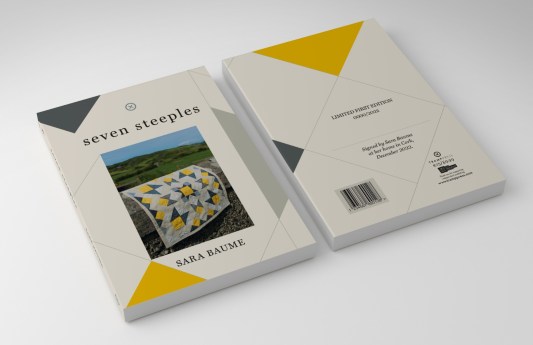
Pre-Order Seven Steeples

If you are interested in the forthcoming novel, it’s available to pre-order as a Limited Edition here

It is a novel about a couple that pushes against traditional expectations, moving with their dogs to the Irish countryside where they embed themselves in nature and make attempts to disappear from society.

Seven Steeples Sara Baume

The Doctor’s Wife by Brian Moore (1976)

Brian Moore 100

2021 is the centenary year of his birth for Northern Irish writer Brian Moore (1921-1999), academically celebrated at Brian Moore 100 and by interested readers in the year long Brian Moore ReadAlong. I have read and reviewed two titles, Lies of Silence (1990) and The Lonely Passion of Judith Hearne (1955) and I have The Magician’s Wife (1997) plus No Other Life (1993) still on the shelf.

A Distrustful Reader

Brian Moore 100 Northern Irish Literature literary fictionI enjoyed Lies of Silence, however was completely wound up by his treatment of the character in The Lonely Passion of Judith Hearne, a feeling of indignation in his treatment of the female protagonist that was expounded on by Colm Tóibín who admitted:

“that Moore clearly knew that you could achieve certain effects by writing about a woman in the Ireland of his time which you could not achieve in writing about a man, the same behaviour would not bring disgrace, pity perhaps, tolerance certainly, humour most likely, incarceration – never”

I came to The Doctor’s Wife, another novel in which Moore again takes on the voice and attempts to get into the mind of a female protagonist, with significant caution and a not unreasonable dose of distrust.

The Plot: Awaiting her husband’s arrival on holiday in France, Sheila Redden, quiet, middle-aged doctor’s wife from Northern Ireland, suddenly finds herself caught up in an illicit affair with a young American ten years her junior.

The novel was shortlisted for the Booker Prize in 1976.

To Prelude or Not

Brian Moore The Doctor's Wife Paris Hotel

Photo by cottonbro on Pexels.com

In a short prelude to the first chapter, Shelia’s brother arrives in Paris and from what we glean Shelia has disappeared and there is a letter waiting for her at a friend Peg’s apartment, from a T. Lowry in the US. Shelia’s brother phones this man in America; he says is he is sorry, he can’t help.

The prelude creates an element of intrigue, an unnecessary addition reading it in 2021, though it may have affected readers differently in 1976, by what it implied. That no one knows where she is. That we know where she is not.

Backing Up to the Beginning

Due to his commitments as a Doctor, Shelia’s husband delays his departure for their holiday, they are returning to the Mediterranean  where they honeymooned sixteen years ago. Sheila travels on alone to Paris.

Staying in Paris with her friend Peg, Sheila’s emotions are overwhelmed by the mix of frustration at her husband and the nervous excitement of being in the city with her confident friend, who introduces Ivo, her lover four years younger than herself. Sheila is in awe of Peg’s way of life, the result of having continued her education, pursued a career, travel.

She lives like a man, free, having affairs, travelling, always in big cities, whereas, look at me,  stuck all these years at home, my M.A. a waste. I don’t think I could even support myself anymore. ‘You know’, she said to Peg, ‘it’s working and travelling that keeps a person young. It’s sitting at home doing nothing that makes you middle-aged in your mind. I was just thinking about it the other day. It’s as if the only part of my life that I look forward to now is my holidays. There’s something terribly wrong about that.’

It is through Ivo she becomes acquainted with Tom, the two keep each company while waiting for Peg. Tom is taking a year after his Anglo-Irish Lit studies at Trinity in Dublin to think about his next step. Sheila enjoys being able to talk with Tom on a subject she is virtually forbidden to elsewhere; speaking animatedly about literature to a man at a party has being the cause of reprimand by her husband in the past. Trying to engage with her husband in conversation fails every time these days.

While initially petulant and annoyed with her husband for putting his work ahead of their holiday, at a certain point Sheila begins to will him not to come. The distance and solitude heightens her feelings towards everything. She is at the beginning of developing a kind of resistance, even if that shows itself through what appears to be recklessness. Eventually she will embrace it, learn from it and change.

Before anything is even hinted at with this young man, while still in that isolated wonder of being alone in Paris, with her friend, engaging in a social life, and interesting conversation, she asks herself:

What about those men you read about in newspaper stories who walk out of their homes saying they are going down to the corner to buy cigarettes and are never heard from again? This is Paris. I am here. What if I never go back? page 42

Looking back at this now, it is clear that this thought indicated a turning point for Sheila, who throughout the novel is referred to as Mrs Redden, unless represented in dialogue when she is Sheila. From here she departs Paris to Cap Ferrat, knowing she has at least a few days until her husband may or may not join her. As she gets out of the hotel bath, the telephone rings.

The Objectification of a Man

Love Entrapment Escape The Doctors Wife Brian Moore

Photo by Andrew Neel on Pexels.com

The rest of the story portrays Sheila’s continued attempts to resist what is occurring, until she doesn’t. The focus is always on her, on her thoughts, her decisions, her mind. It is not a novel that looks into the mind of a 27 year old man.

Ironically, the young man is objectified, something more common to woman characters, but here Brian Moore diverges and flips the coin, reducing HIM to an object of sexual pleasure and gratification. Though he doesn’t go so far as to emasculate him, he risks the character of Tom being perceived as inauthentic, for the very reasons Tóibín above, referred to.

Men too, were expected to behave in certain ways, even while conducting illicit affairs. However, Tom is a post-war baby, a baby boomer, he is of a different generation and from another culture, it is quite normal that his behaviour will be perceived by some as childish, ill-considered, unrealistic. Personally, I could believe it. Sheila was born before the war, she was indeed a Traditionalist. In a sense then, her behaviour and responses are the more radical.

Moore however is clear, he elicits only her thoughts, provoking her to express them aloud, to hear herself speak. What she has to say is far more interesting.

‘I don’t know’ she said. ‘Some people never want to go outside the place they were born in. And others seem to want to run away from the day they’re old enough to walk.’

‘And which are you?’

‘A runaway.’

‘But you didn’t leave, did you?’ 

When it becomes clear what Sheila is contemplating, the men in her life, her husband and her brother will resort to the kind of tools that men in power, medical men were able to use to exercise control over what they considered a wayward woman. There’s a history of mental illness in Sheila’s family, something her husband doesn’t hesitate to consider using to his advantage. It is a scary moment.

Understanding Women

It is to his credit, that Brian Moore takes a different approach twenty years after writing about Judith Hearne. This time he pursues other perspectives, making thought provoking choices that engage the reader. 

Female empowerment Women

Photo by Jill Wellington on Pexels.com

It reads like a kind of thriller because she acts so out of convention and the longer she does so, the more likely it seems there is a possibility she might indeed be upending her life.  The reader can feel she is hovering between two choices. The detail with which her encounters are shared and the response of her family to them, increase this duality.

I really enjoyed this, perhaps because I did read it with that level of distrust and was therefore surprised to see how much the author’s perception of a woman character had developed. Although, here too, I had a sense of the author almost writing this in collaboration, I imagined him discussing and arguing this premise with his women friends, or was he reflecting on his own doomed affair? Who knows, but he left me wanting to know more, wanting to pursue Sheila further in her adventure towards liberation.

This one I definitely recommend!

Have you read any Brian Moore this year?


The Lonely Passion of Judith Hearne by Brian Moore (1955)

Brian Moore at 100

This is my second read for the year long read along of Brian Moore novels organised by Cathy at 746 Books. Previously I read Lies of Silence, which I very much enjoyed and next up for the month of May will be The Doctor’s Wife.

Review

Brian Moore at 100 Northern IrelandAll I can say is thank goodness that’s over and wonder what I can read to mitigate the toxic absorption of reading it and being amidst a pack of inhumane characters and a main character set up for incarceration due to her having had her way in life taken from her after the prolonged and dutiful care of an unappreciative and domineering Aunt.

We meet Judith Hearne as she is moving into yet another boarding house, having lost her youth and employment prospects to the years of caring for her Aunt in the postwar years, despite her initial resistance.

Her only connection to family, she places a framed photo of her in view, a symbolic gesture of creating a sense of home. Judith is capable and talented, but worn down by those lost years, anxious about her dwindling prospects and bitter in her thoughts on account of suppressed resentments.  Despite regular religious observance, she is discovering that faith too has abandoned her.

“Miss Hearne had always been able to find interesting happenings where other people would find only dullness. It was, she felt, a gift which was one of the great rewards of a solitary life. And a necessary gift.”

She turns towards three people and a vice, the landlady’s brother Jim, recently returned from decades of living in New York, her local priest and her family friend Moira. The novel explores these encounters and Judith’s deterioration as she seeks solace and loses control with alcohol.

Men Writing Women in the 1950’s

From the opening pages I couldn’t shake off the fact that this 40 year old woman is being created by a man, that the mind looking out from behind her eyes isn’t a woman, but a man living in exile with grievances to bare and an unconscious bias, by virtue of being part of and conditioned by the dominant sex/race of an Irish Catholic flavour.

Written in an era where if women hadn’t been subdued by marriage, tamed by employment, shipped off or upholstered in the habit, they were indeed on a slippery slope towards disillusionment, realising that society did not value them outside certain roles, and by this age had indirectly cast them aside, or put them on a shelf, as the saying went, perpetuating the cultural myth. 

The Outsider(s)

I could believe she might momentarily look upon the returning emigrant Jim Madden with interest, curious about his life elsewhere, but the gaze of them all upon her, as if her considering him a possible suitor were an abominable thought, the weight of all that judgement – it is a world portrayed that lacks care or empathy, disapproves of adventure, lacks imagination and excitement and instead lures the lonely towards oblivion, thus destroying the few threads of potential that have kept this one woman going till now.

The one light of hope comes from her friend Moira, in whom we find thankfully, a small thread of humanity, kindness and consideration.

The Bottle and the Cloth

brown wooden upright piano in shallow focus lens

Photo: Maria TyutinaPexels.com

I found the extreme indulgence in her whiskey bottles totally unrealistic. She was so straight-laced and God fearing, that one bad experience surely would have been sufficient, but the heavy hand of the author deeply imprinted on her back pushed her onward. He had a beef with the church and by God he was going to make his victim confront it. And then have her put away, as they did with any woman who acted with impropriety and lacked a moral (or male) sponsor.

I think Judith was unjustly portrayed, if she were to write a first person account of her story, we would see a more nuanced character, disillusioned yes, but a more perceptive perspective from within, than those who depict her from without, and a society ready to discard her. 

I went looking for Moore’s inspiration, certain that Miss Hearne was not just a creature of his imagination and discovered that he had cherry picked parts of her character from a family visitor Miss Keogh, asking his obliging sister for memories and details. Colm Toibin writes:

“However, he disregarded most of what he was told. (The original Miss Keogh had a job, for example.) He used merely the ‘speech and mannerisms’ of the original and he surrounded them with something else, elements of his own isolation as a non-achiever in a family obsessed with achievement, and as an emigrant in Canada. His own loss of faith becomes hers, and his memory that his original had ‘a little weakness for the bottle’ becomes her alcoholism.” Colm Tóibín

He  also admits that Moore clearly knew that you could achieve certain effects by writing about a woman in the Ireland of his time which you could not achieve in writing about a man, the same behaviour would not bring disgrace, pity perhaps, tolerance certainly, humour most likely, incarceration – never.

Dis Empowerment

Judith Hearne never found her passion, it was conditioned the hell out of her, ensuring she’d never yearn for, seek or ever become aware of how she might empower herself above or out of her situation. 

“In a society that was merely half-formed and had no sense of itself, a society in which the only real choice was to leave or live in a cowed internal exile, the failure to create a fully-formed male character in fiction was emblematic of a more general failure.” Colm Tóibín

Further Reading

Article: Gaelic Gloom by Colm Tóibín


Constellations by Sinéad Gleeson

Reflections From Life

constellations-sinead-gleesonAn excellent collection of essays, of life writing with a particular connection to the body and how women negotiate life when part(s) of it malform and interrupt the ordinary course of a life, making it something extraordinary.

Extraordinary it is, that Gleeson went through all she has until now and managed to create a family and birth this wonderful book, not to mention curating The Glass Shore and The Long Gaze Back, two anthologies that celebrate Irish women writers.

Just as the cover displays the image of a body with numbered sections, inside the book the chapters are labelled with small diagrams that represent a key to the constellations, adding another layer of metaphor and meaning for the reader to ponder.

The Many Diagnoses and A Commitment

As a young girl, the author was diagnosed with monoarticular arthritis, rare to discover in a young person, it would mark the beginning of a lifetime of interventions, all of which might have had more devastating consequences, but Gleeson possesses a remarkable ability to rally, recover and live life on her own terms, despite the heavy price her body puts upon her.

The essays share the struggles, the shame, the hopes and disappointments, of bones, of blood, of hair, of children, of grief, of witness to a deteriorating mind, the many varied experiences that might represent weakness in the body, however they have all contributed to creating and moulding a psyche of great strength and perseverance. An activist. A voice. A woman standing in the light, seen, heard, inspiring.

On the night of her leukemia diagnosis, not being able to face telling her parents she asked the nurse to break the news and then prepared herself to see them.

“I will never forget their faces, their incomprehension and tears. Amid all the wrongness of that moment, I knew something was required of me. To hide my fear and offer them a glimpse of a future none of us knew had any certainty. I have no memory of this but my mother told me years later that I looked into her face and said, ‘I’m not going to die, I’m going to write a book.’ To commit to writing, or art, is to commit to living. A self imposed deadline as a means of continued existence. It has taken me a long time to write that book and here I am, so very far from that awful night.”

A Wound Gives Off Its Own Light

The essay I found the most moving comes near the end is named after an Anne Carson poem ‘ A Wound Gives Off Its Own Light’ which explores the relationship with art and creativity as a way to channel or express what is being felt. She is moved by the work and motivations of Frida Kahlo, Jo Spence, Lucy Grealy.

“Kahlo, Grealy and Spence were lights in the dark for me, a form of guidance. A triangular constellation. To me, they showed that it was possible to live a parallel creative life, one that overshadows the patient life, nudging it off centre stage…That in taking all the pieces of the self, fractured by surgery, there is a rearrangement: making wounds the source of inspiration, not the end of it.”

Art Creativity The Body Compromised.jpg

The Body Compromised by Allia Jen Yousef (2001-2019)

Spence’s medium was photography; an ageing, sick, working class woman, she sought representation, visibility, her series Phototherapy, focused on the intersection between arts, health and well-being, combining comic and feminist ideas, outward expressions to promote inner healing or peace, disruptive to the viewer, soothing to the artist.

“Representing a diagnosis – in art, words or photos – is an attempt to explain to ourselves what has happened, to deconstruct the world and rebuild it in our way. Perhaps articulating a life-changing illness is part of recovery. But so is finding the kind of articulation that is personal to you.”

I was reminded while reading of Maggie O’Farrell’s I Am, I Am, I Am memoir that I read in January, it similarly tracks events (seventeen brushes with death) and turning points in a life that invite pause and reflection, some more dramatic than others.

I read Constellations as part of #ReadingIrelandMonth21. Have you read any good Irish non fiction this month?

Sinéad Gleeson

A writer of essays, criticism and fiction, her writings have appeared in Granta, Winter Papers and Gorse. Constellations won Non Fiction Book of the Year at the Irish Book Awards in 2019.

Further Reading Irish Nonfiction

A Ghost in the Throat by Doireann Ni Ghriofa

Handiwork by Sara Baume

An Affair With My Mother by Catriona Palmer

Tangleweed and Brine by Deirdre Sullivan

Reading Ireland 2021

During March every year Cathy at 746 Books runs a Reading Ireland Month, inviting other readers to participate, so it’s a good time to check what’s sitting on the shelf, to read in the company of others on something of a common theme.

I’m already participating in her year long Brian Moore at 100 ReadAlong and when Doireann Ni Ghriofa’s nonfiction book A Ghost in the Throat became my Outstanding Read of 2021, I began to seek out more titles by Irish Women Writers.

So I can also recommend my recent reads by Sara Baume, her beautiful work of creative nonfiction Handiwork that tracks the course of a year as she writes and sculpts small birds and vainly attempts to lure a few passing migratory species into her small garden. So entranced by her words, I ventured into her fiction and loved Spill Wither Falter Simmer and still have one more, A Line Made By Walking to read.

This week the focus was on short stories, so I chose to read Tangleweed and Brine and next week nonfiction, so I have two titles lined up Constellations by Sinéad Gleeson, which I am currently reading and Thin Places by Kerri ní Dochartaigh a story of a wild Ireland, a mix of memoir, nature writing and social history, which looks very promising.

Disruptive Feminist Retellings of Classic Fairy Tales

I picked up Deirdre Sullivan’s two books for a change of genre and due to the intrigue of what her work promised. In 2020 I read Savage Her Reply a retelling of the Children of Lir, a fairy tale I wasn’t familiar with, but thoroughly enjoyed, not just the storytelling but the use of calligrams, poems and the language of Ogham, morsels on the side but subjects that a reader can get quite carried away with, inspiring one’s own creativity, as I found out, collecting small branches, twigs and leaves to adorn the word poems.

Tangleweed and Brine
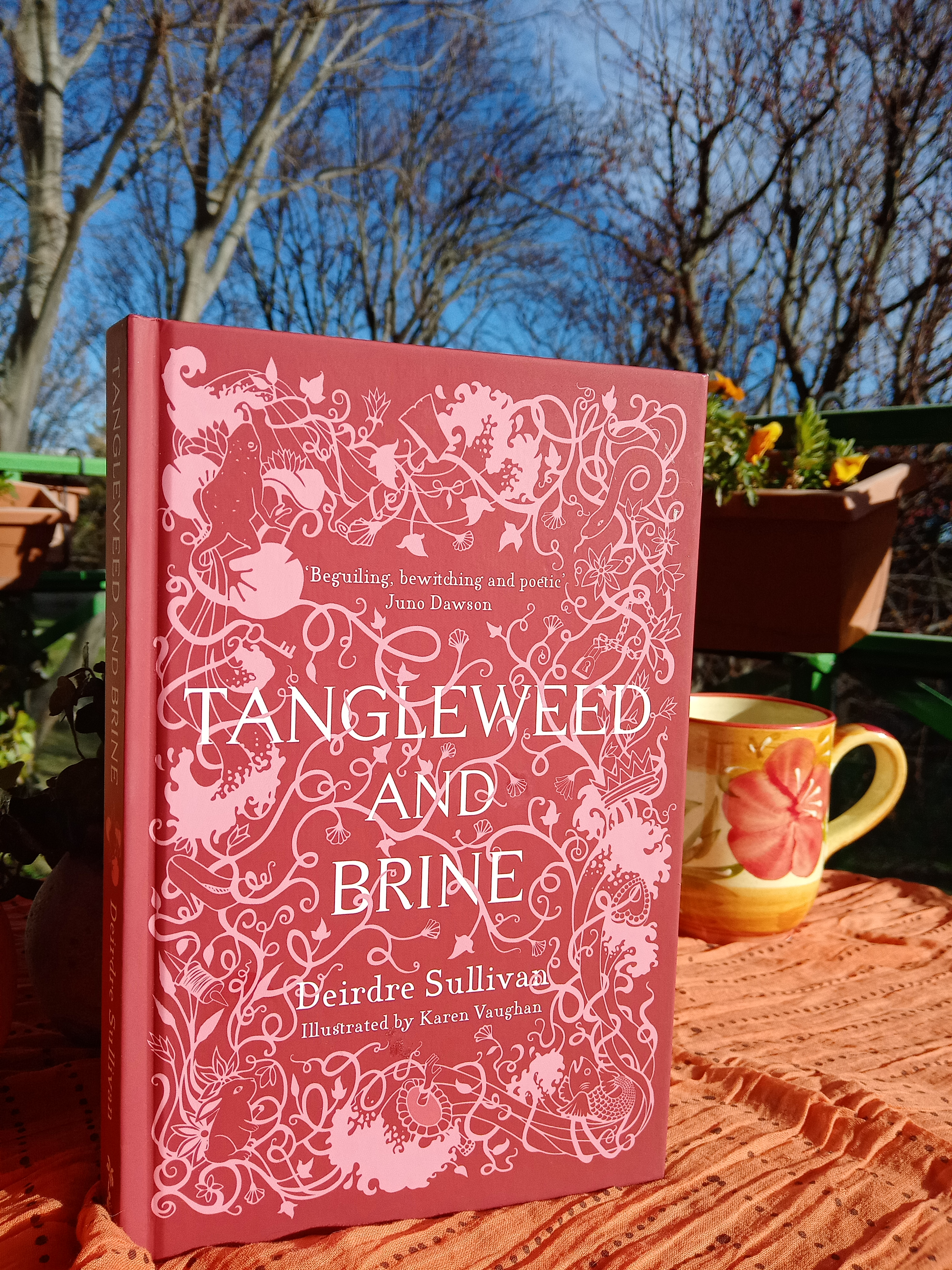
Tangleweed and BrineWhile Savage Her Reply was a long version of just one tale, in Tangleweed and Brine, we have an entire collection, cleverly separated into seven tangled tales of earth, and six salty tales of water. They can be dipped in and out of and are best read over a period of time, because they demand our attention, require reflection and strip the old tales of their illusory inclinations, suggesting quite frankly what really was going on with Red Riding Hood and her fellow heroines.

It helps to be familiar with the tales before reading, because they aren’t told as they might be to a child. These stories are narrated by the author, often in the second person “you” voice, acknowledging and bearing witness to our heroine, recounting what she experienced back to her and to us, the reader – we who thought we knew, because you know, we read those stories or had them read to us – we now sit back and read in shock, the harsh reality of these women’s lives. Sullivan is paying homage, setting the record straight, we must not turn away. No longer.

So which tales are twisted, those that glorified these heroines lives and made us believe in Prince Charming, bad witches and vicious wolves or these tales that tell of brave and resilient heroines, surviving betrayals, neglect, judgement, cruelty, abandonment and finally have their stories told by the courageous, intuitive teacher, seer, Ms Sullivan.

Part One – Tangleweed

Slippershod (Cinderella)

Cast thoughts aside of which slipper she wears and what she dreams of, Cinderella has a different destiny and the memory of a truer love, she is resourceful and retains her inner self-worth; She is patient and knows when to act.

“Stretching on the bed, with soft bread in your mouth, the taste of butter, you wonder what they are doing at the ball. Who the prince will dance with. The love he’ll choose, the girls he will discard. There’s nothing gentle in that kind of power. You close your eyes. There is a different world. Where people do things, make things. Carve them out. You breathe the thick, soft air. It smells of hops. You smile and square your shoulders. Sometimes love is something more like rage. It makes you fight. You feel the future, wide and bright around you, kicking in your gut as though a child. The night spread wide and you have flown, you’ve flown.”

The Woodcutter’s Bride (Red Riding Hood)
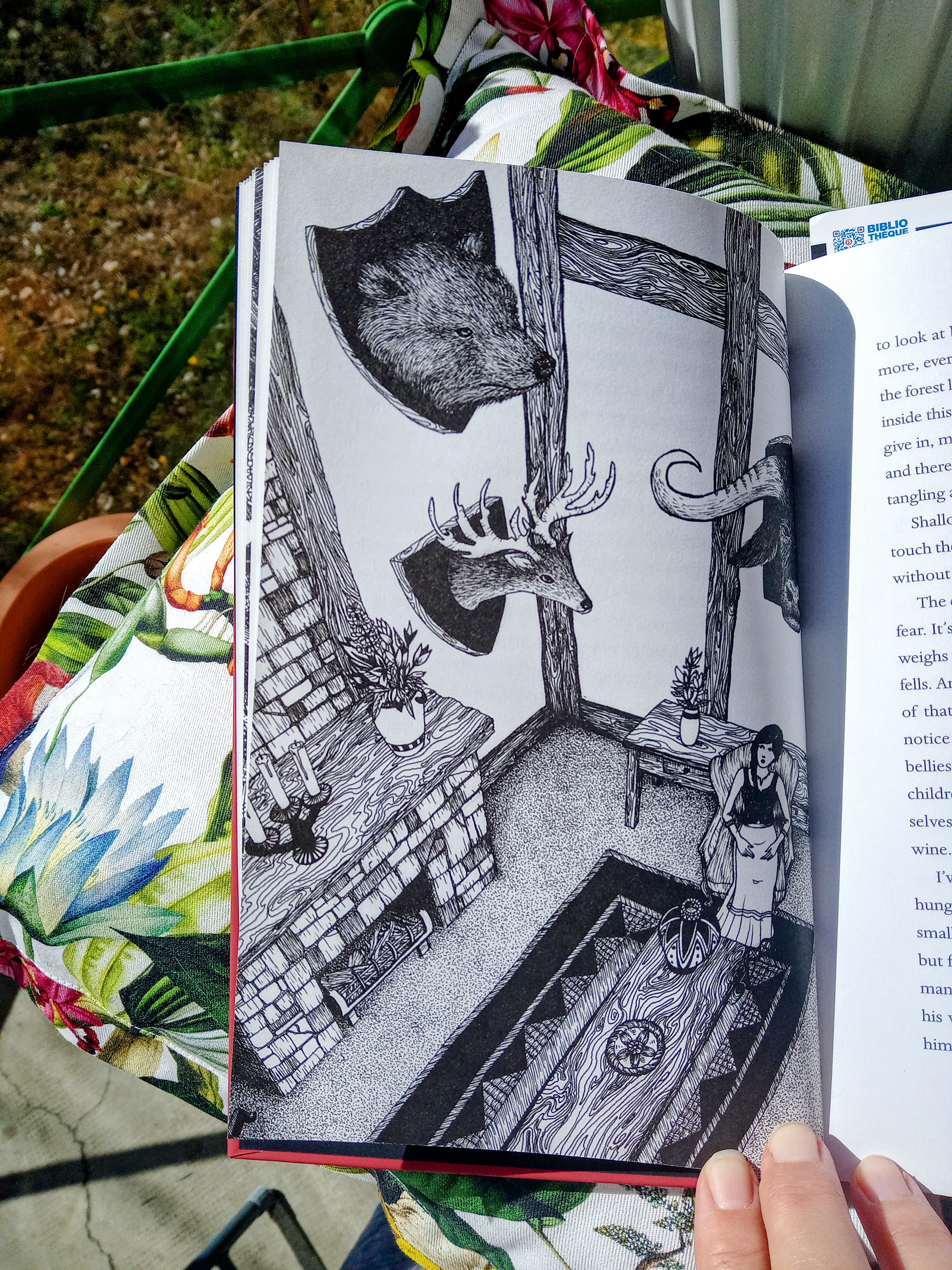
Tangleweed and Brine Deirdre SullivanThis tale can be told by the title and beautiful illustration by Karen Vaughan. There is one picture for every story and within them often lurk clues. As I read the opening paragraphs and saw the illustration, the reality of who really was the wolf, the colour of that cape, hit me like a punch. The horror of those trophies. 

“When I was a small girl something happened to me in the forest. I can’t recall exactly what it was. It’s hard to trust tales from the lips of grandmothers; they come out wrong, too dirty or too clean. Since then I have not felt the same about the forest, I liked it once I think or I think I think. It’s beautiful but on its inky edges  something stirs to fidget with my gut. It’s getting dark; my husband will be home soon. I bite down on my lips to make them red.

Come Live Here and Be Loved (Rapunzel)

“Your husband’s face afraid when you inform him. A happy sort of fear.  To grow a person is no little thing. It isn’t like a turnip or a spud. It’s not so simple, weaving vein and bone. Your sense of smell wolf-sharp and, oh, the hunger. You ache with it.  It gnaws at you, untrammelled through your gut. The pang of it so sharp, like teeth, like fury. A starving ache that cannot be suppressed.”

You Shall Not Suffer (Hansel and Gretel)

She lives in a world that discards the weak easily, she prefers to save lives, to nurture, or at least try to save them. She doesn’t fit the mould of what is expected, so she chooses another way, another life, a way to be herself, a house in the woods. When they abandon their litters now, they blame the witch in the woods, yet still they come to her for help, seek her healing powers.

“You grew up soft, but still you learned to hide it. Piece by piece. The world’s not built for soft and sturdy things. It likes its soft thing small and white, defenceless. Princesses in castles. Maidens waiting for the perfect sword. You grew up soft, and piece by wounded piece you built a carapace around your body. Humans are peculiar little things.

Sister Fair (Fair, Brown and Trembling)

This is an Irish fairy tale of three sisters, that was unknown to me, one of jealousy, betrayal and redemption.

“It’s not about being sensible, or strong. It’s not about being kind. It’s not about the  soft touch and the kind heart.  Beauty and a womb. That’s all you are.”

Ash Pale (Snow White)

coniferous trees covered with snow in sunny winter day

Photo by Maria Orlova on Pexels.com

This story turns the classic tale on its head and Snow White uses skills Her mother taught her to ensure she isn’t dispossessed of her place, when her father remarries. 

“You look at her the same way you always did. Perhaps a little kinder. Now that she’s disappearing. Not a threat. You can see her folding into herself like crumpled parchment. Changing who she is to please him.”


Part Two – Brine

Consume Or Be Consumed (A Little Mermaid)

This was actually the first tale I read, especially after finishing Jan Carson’s The Fire Starters in which we are led to believe that one of the protagonists is seduced by a siren. Here the mermaid spends time among humans and sees what it is to be a woman, the sacrifice.

“These things with half of you on pairs of legs. They don’t look right.  There’s something off about it.  You often stare. Sometimes you close your eyes. So many of them. So much of this world.

On land, a woman doesn’t matter much.  You miss it. Or you used to. Your skin is slightly tinged with subtle blue.  They think that makes you lady-like. The colour of a person matters here. Who were you once, and what was done to you. They speculate. A quiet thing is often seen as docile. They say their secrets, spew out all their bile as you sit silently beside the window. Staring at the waters, lapping out. Everything is still here, always, always. And it should move. You long for it to move.”

Doing Well (The Frog Prince)

woman wearing crown holding frog figurine

Photo: Susanne JutzelerPexels.com

A terrible tale of a princess born into bondage, to a frog, she has no choice, no say, no rights. She belongs to this slimy amphibian and must do his bidding, worse than a slave.

“You have been marked from birth for just this purpose. Cloistered with the others. Secret spaces deep within this space where girls are trained. But there are passageways to keep you safe.”

The Tender Weight (Bluebeard)

Originally a French folktale, this story is given a different twist, though the inevitability of its outcome remains. A story of repetitions, of a curse, of an attempt to break it, of an unfounded reputation, a desire to break free.

“You do not have to ask him what he did.  You know that it was nothing. There doesn’t have to be a reason here The world will steal what little crumbs you grasp. The loves you have can die and be reborn.The memory of pain will cling. Will cling. And you will never let yourself forget. That this has happened.”

Riverbed (Donkeyskin)

two brown donkeys

Photo by chris carroll on Pexels.com

Another French fairytale originally from 1695, in which a daughter has to resort to extremes to protect herself from her father’s indecorous intentions. In this retelling,rather than hide and wait for him to come to his senses and she retain her good virtue, the young woman is uncompromising, will time her strike, will be as effective and more virtuous in her rule. And pay homage to the innocnet hard-working, long-suffering donkey.

“There is a soft rebellion to a donkey. It is a working thing. But it resents. I am fond of this. When I am cold or lonely in the castle. When I’m afraid, I often find myself around the stables, stroking them as long as they permit. Which is a goodly time. They trust me now. I earned it. Growing up, and being gentle, kind.”

The Little Gift (The Goose Girl)

Another from the Brothers Grimm collection, originally this story tells the tale of a maid servant who turns on her princess when they are travelling and forces her to swap places, making an oath never to tell. The princess becomes the maid who cares for the geese, until the prince learns of what took place and tricks the false princess into choosing her punishment. In the retelling, we learn whose idea it was to change places, the reneging on a promise, betrayal. What some will do for love, the selfishness of the entitled.

“A goose can try its best to be a swan. Conceal the ruddy beak, the grating honk. But swans as geese? The air cries out to them. It’s not enough. They want clean sheets and gold. The softer life. And when I visit and stroke her face, I see her clear blue eyes upon my jewels. She does not see their weight, only their lustre. She knows they should be hers. She wants them back.”

Beauty and the  Board (Beauty and the Beast)

The death of the mother leaves Beauty vulnerable, but there is a presence she can contact through the board, invite in for her protection, to deal with the ever present danger. She becomes they.

“You are a thing. A beast without a home. I know that, how it feels. And I would have you share a place in me.”

Further Reading

Article: What Will Build and Break a Girl: Tangleweed and Brine by Deirdre Sullivan

Tangleweed and Brine is a book about women within fairy-tales. And their internal lives, as they realise their place in the world. How trapped they are. Some of them rebel, and some retreat. I wanted to write about different sorts of women, quiet ones and strong ones, women with different shaped bodies, different shaped brains. I wanted to take the stories of my childhood, and put the things we learn early on into a world where marrying a stranger is seen as a happy ending, and pride is something women shouldn’t feel.

The Fire Starters by Jan Carson

Having recently read another novel without realising it was of the gothic genre, I think I’ve gone and done it again, this time, a contemporary Belfast gothic novel, because right from the first chapter, there is the overwhelming sense of something sinister going to happen, and it’s not the series of summer fires that are plaguing the city though they are equally troubling. I discovered having finished the book that Jan Carson is also a fan of absurdist fiction. Another clue.

Contemporary Irish Fiction Empathy EU Prize for LiteratureIn that first chapter we meet a father, Jonathan, who has a strange perception of his baby daughter, who he is caring for alone. He desperately wants to care for her, but he feels that part of his role in doing that is to remove the aspect of her that she has inherited from her mother, who he believes is a siren.

His own childhood was one of being provided for, but unloved, his parents (who never wanted children or grandchildren) abandoning him at the age of 16 to a boarding school, leaving the country. He becomes a Doctor, and of no surprise, lacks any form of empathy.

We meet Sammy, also a father, an ex loyalist paramilitary, who is becoming increasingly anxious, having reason to suspect that his son Mark, who lives in their attic and rarely comes out, may be involved in sinister activities, fearing he has inherited his own thirst for violence, a tendency he had no control over in youth and even today, has to quell the feeling inside.

I found the depictions of both these men terrifying, both are planning some kind of intervention and up until the last pages, we can’t quite believe that they may follow through, and they too wrestle with their instinct and question, whether they ought to proceed.

Then there is the background of a hot summer and the approach of the Orange parades of the Eleventh Night on every 12th of July, an Ulster Protestant tradition where large, towering bonfires are lit, accompanied by street parties and loyalist marching bands.

The bonfires are lit to celebrate (1688) the victory of Protestant King William (Billy) of Orange over Catholic king James II at the Battle of the Boyne (1690), which began the Protestant Ascendancy in Ireland. – Wikipedia

When the rain finally arrives, people begin to smile, there are fewer angry people on the streets, they no longer have the numbers for a decent riot, the air of festivity is extinguished. Protesting soon makes way for the football season.

This is how it has been in Belfast every summer since the Agreement. The same hot anger rises at the end of June and and goes stamping up and down the little streets. Stamping and shouting and raising Cain all the way through July until, by August’s end, the energy’s gone right out of it.

My Truth is Not Your Truth

And the various versions and perceptions of truth and history that exist, depending on who is doing the telling, where they live, what day it is, demonstrated in this opening chapter This is Belfast.

This is Belfast. This is not Belfast.
Better to avoid calling anything a spade in this city. Better to avoid names and places, dates and second names. In this city names are like points on a map or words worked in ink. They are trying too hard to pass for truth. In this city truth is a circle from one side and a square from the other. It is possible to go blind staring at the shape of it. Even now, sixteen years after the Troubles, it is much safer to stand back and say with conviction, ‘It all looks the same to me.’

And following this are two paragraphs, one that begins with ‘The Troubles are over now’ and the other begins with ‘The Troubles have only just begun.’

Deidre Sullivan Tangleweed and Brine Jan Carson The Fire Starters

Sirens from Deidre Sullivan’s Tangleweed and Brine

Jonathan (Dr Murray) is obsessed with silencing his daughter, and even employs a deaf nanny to look after her. She is a loving, nurturing soul, providing one of the few notes of relief in an otherwise tense narrative, as these men ponder their responsibility as fathers and fear of what their children may become.

There is a third brief narrative, an omniscient voice that shares the story of a few of the Unfortunate Children of Belfast, children of parents who belong to a support group, that Jonathan attends once, they are children born with deformities and powers and it is here, that I realise there is an element of magic realism in this tale, that perhaps his perception of his daughter as a siren isn’t an aspect of his own mental health problem.

The novel is a blend of politically charged social and magic realism, though it feels realistic in its reading; dealing with the trauma of legacy’s, a parent’s legacy to a child and the community’s complicated legacy of the political troubles of Northern Ireland. It is set in East Belfast, where the author lives and from listening to the interview, I learn that she is an accomplished eavesdropper, that many of the words in these pages have been inspired by overheard conversations.

On Developing Empathy for Those Living Segregated Lives

Interested to understand the motivation behind the novel, I listened to an excellent interview with Nicky Bull in which she shares something of her role as a community arts facilitator and the role this can play in healing rifts, bringing people together, using the creative process to help develop empathy, she talks about the ability of storytelling to help develop this.

The community arts sector in Northern Ireland has played a huge role in the peace and reconciliation process. Primarily it brings people from both communities together into a shared space but I also think it has also taught people soft skills that have been missing from Northern Irish culture.

It’s very, very hard for people here to practice empathy because quite often we grow up segregated, so how are you supposed to understand what life is like if you don’t have any friends who aren’t from the same background as you, the skill system is still largely segregated,and government housing and things.

So these conversations around learning how to empathise, which I think the creative act, particularly writing fiction, you’re putting yourself in the shoes of another character, even when you read, it’s an act of empathy, those skills can be taught and then transferred into the social realms that we’re working in Northern Ireland at the moment, that people can imagine a life that isn’t theirs, it’s much more difficult to hate and to segregate when you have the ability to empathise with other people.

It’s an incredible and deeply disturbing novel, yet despite the discomfort I learned a lot from reading it and especially from taking the opportunity to listen to the author speak, that helped me understand the motivation behind it and that incredible candour around the very real problem of how the creation of segregated community’s causes a lack empathy and how the creative arts can help provide a practical humanist solution.

It’s Saint Patrick’s Day and #ReadingIrelandMonth21, have you read a good Irish book this month?

Lies of Silence by Brian Moore

Brian Moore at 100

Lies of Silence was the January read for the Brian Moore at 100 year long read along hosted by Cathy at 746 Books, which I introduced and will link my reviews back to here. A political thriller, it was originally published in 1990 to much acclaim and shortlisted for the Booker Prize, losing to A.S. Byatt’s excellent novel Possession.

Northern Irish Literature Booker Prize shortlistedIt is the story of a disenchanted man, a man who reluctantly returned to Northern Ireland from London with his wife Moira, who was keen to return. Now he is the manager of a hotel, a job he doesn’t particularly like, having left his poetry aspirations far behind him, following in the footsteps of his father, a man he feels resentment towards.

Unsurprisingly, his personal life has become entangled and just as the unspoken issues simmering below this relationship are about to boil over, he and his wife are taken hostage in their own home, he to be used as a pawn in what unfolds as a complex, thought out plan.

In the midst of the initial drama Michael sees his neighbour, a retired bank manager leave with his dog for a walk, seeing in him the average, everyman and woman who just wants to get on with life without interference from “men in woolen masks”.

Watching him go off with his dog, Dillon felt anger rise within him, anger at the lies which had made this, his and Mr Harbinger’s birthplace, sick with a terrible illness of bigotry and injustice, lies told over the years to poor Protestant working people about the Catholics, lies told to poor Catholic working people about the Protestants, lies from parliaments and pulpits, lies at rallies and funeral orations, and, above all, the lies of silence from those in Westminster who did not want to face the injustice of Ulster’s status quo. Angry, he stared across the room at the most dangerous victims of these lies, his youthful, ignorant, murderous, captors.

Under threat, as he moves towards doing what has been asked of him, he faces an excruciating moral dilemma, and a situation that spirals him into further confusion and deliberations over what the “right thing to do” is.

It’s something of a page turner, while not holding back on expressing the tensions and opinions of various characters in this complex, often not well understood political environment.

The Freedom of Self-Imposed Exile

There are also subtle hints to Moore’s own yearning for places beyond the hills of home, as seen in this passage, as he gets off the telephone from his American boss:

Brian Moore Lies of Silence Belfast City Northern Ireland

Cave Hill Mountain Overlooking Belfast City towards Belfast Lough

Dismissed from Keogh’s busy, money-breathing world, Dillon stood looking out at the mountain which reared up like a stage backdrop behind the city. Long ago, in school, daydreaming, he would look out of the classroom window and imagine himself in some aeroplane being lifted over that grey pig’s back of mountain to places far from here, to London, New York, Paris, great cities he had seen in films and photographs, cities far away from the dull constrictions of home.

It’s also clear that Moore was as keen on seeking revenge with his pen, as much as his characters do with whatever is at their disposal, his distance from the home country giving him a freedom and inclination to provoke, inform and stir the troubled pot, so to speak. In particular, the denouement.

Further Reading

You can read recent reviews here: Cathy at 746 Books, Ali at HeavenAli, Lizzy’s Literary Life, Kim at Reading Matters

February’s novel was Moore’s 1957 novel The Feast of Lupercal, whose pragonist is a 37 year-old teacher at a Catholic boarding school run by priests in Belfast during the 1950s.  I don’t have this one, though it sounds excellent according to these enticing reviews, which you can read here: Cathy at 746 Books, HeavenAli.

In March, they will be reading Fergus (1970).

I will join in the reading in:

April with The Lonely Passion of Judith Hearne (1955)

May with The Doctor’s Wife.

I hope more of you might be able to join in this next one, which is one of his more well-known and popular titles.

Brian Moore Read Along 2021

#BrianMoore100

During 2021, Cathy at 746Books, the team at Brian Moore at 100 and Northern Irish author, playwright Jan Carson (whose latest book The Last Resort will be published on April 1st) join forces to celebrate the work of one of Northern Ireland’s enigmatic writers and wanderers, Brian Moore, in his centenary year.

Northern Irish Connections

I have a personal interest in Northern Ireland, having discovered in my twenties that my biological father (unknown to me at the time) was born there. I spent some years doing my own private research that resulted in discovering a whole line of family, so reading a variety of literature from this part of Ireland is a form of distant connection for me.

When I looked at what Cathy was proposing reading for the year (see the list below), I looked up Brian Moore was interested in what I learned and managed to source about 5 of the suggested 12 novels. Another of the reasons I decided to participate, was the intrigue and recognition evoked by a statement Moore wrote shortly before his death:

“There are those stateless wanderers who, finding the larger world into which they have stumbled vast, varied and exciting, become confused in their loyalties and lose their sense of home. I am one of those wanderers.”

Brian Moore, Irish Author (1921 – 1999)

Brian Moore 100 Northern Irish

The Young Author & Wanderer Brian Moore

Brian Moore was born into a large, middle-class Catholic family, the fourth of nine children, in Belfast, Northern Ireland. His father was a surgeon and lecturer, and his mother had been a nurse.

In 1940 he became an Air Raid Warden, their role to enforce blackouts and report on bombing incidences, a role that would inspire the third in his ‘Belfast’ trilogies The Emperor of Ice-cream (1965). He also worked for the British Ministry of War Transport with postings to Algiers, Naples, Toulon and Marseille. After a period working for the United Nations in Poland he left Europe in 1948.

After following his lover Margaret Swanson to Canada, he would work for the Montreal Gazette, marry, become a Canadian citizen, begin to write stories for a weekend magazine and pulp novels for Harlequin under the pseudonyms Bernard Mara and Michael Bryan (1954-1957). Around this time, he wrote his first literary novel The Lonely Passion of Judith Hearne a story of an alcoholic Catholic spinster, set in a boarding house on Camden Street in Belfast.

Looking back, he said, “I was very lonely, I had almost no friends, I’d given up my beliefs, was earning no money and I didn’t see much of a future. So I could identify with a dipsomaniac, isolated spinster.”

Cross Genre Rule Breaker

Brain Moore 100 Northern Ireland

Photo by Lina Kivaka on Pexels.com

He wrote short stories, pulp novels, literary novels, screen plays and explored a wide variety of genres including magical realism, historical fiction, thrillers and social realism. The context of his writing covered World War II,  the Northern Irish “Troubles”, Second Wave Feminism, Vatican II and other shifts within the Catholic Church and the Cold War.

His early rejection of the Catholic church filtered into much of his work, and his experiences during the war likely contributed to a pessimistic view of humanity. His isolation and ‘outsider’ perspective gave him unique and provocative insights, perhaps without fear or care of consequence.

He wrote 26 novels over the span of 50 years, living most of his life in Canada and the US, writing at a distance from his native land. He was awarded the James Tait Black Memorial Prize in 1975, the inaugural Sunday Express Book of the Year award in 1987 and shortlisted for the Booker Prize three times. His first four (mainstream) novels were banned in Ireland.

Brian Moore at 100

Though his work makes such an important contribution to the historical era and commentary on issues, and received both critical and public success, much of it is now put of print, this project attempts to revive interest by reaching out to scholarly critics, readers and the general public. The project is run by Sinéad Moynihan and Alison Garden.

The Read Along Titles for 2021

Here are the books that have been chosen for the ReadAlong, as I read those that I have (in bold) I’ll link my reviews back to this page. I’ve just started Lies of Silence and it’s already gripping.

January Lies of Silence (1999)
February The Feast of Lupercal (1957)
March Fergus (1970)
April The Lonely Passion of Judith Hearne (1955)
May The Doctor’s Wife (1976)
June No Other Life (1993)
July Cold Heaven (1983)
August The Temptation of Eileen Hughes (1981)
September The Emperor of Ice-Cream (1965)
October The Dear Departed: Short Stories (2020)
November Catholics (1972)
December The Magician’s Wife (1997)

As a novelist, Moore was a shape-shifter who never seemed anchored to any specific nation or historical period; he only belonged to the characters he created on the pages you couldn’t stop turning. Scott Bradfield

Have you heard of Brian Moore or read any of his novels?

If you are interested, why not find one of these titles and join in the Read Along? You can also follow the project on twitter @brianmoore100

Northern Irish Author Canadian Brian Moore

Spill Simmer Falter Wither by Sara Baume

It is an interesting situation to have read an author’s work of creative nonfiction before reading either of her two novels, so I come to Sara Baume’s novel, knowing her as a sculptor of birds, an acute observer and thinker about bird migrations.

From Handiwork to Imagination

Sara Baume Ireland Dogs in Literature

I know she is someone who spends her mornings at her writing desk and her afternoons and evenings working with her hands, accumulating and gathering things around her, writing about objects, thinking about people, what they said and did, making things, a ponderer who crafts with their hands.

So when I meet the 57 year old man in Spill Simmer Falter Wither, it takes me a while to think of him as that man, because seeing through his eyes and listening to his inner conversation with OneEye, the injured, undisciplined dog he has just adopted, I see how this character too, has been sculpted with as much care and detail as one of the many birds in Handiwork.

I have to remind myself the narrator is an older man, not Sara Baume, because she is so present, looking out through her character’s eyes, all-seeing. Her rhythmic style of storytelling, the repetition of words are all giveaways. I love it.

Handiwork was such a sliver of a book, it was over so quickly, small morsels, often only a paragraph to a page, it was a delight to go on a fictional journey here, once she was able to get her protagonist out of the house.

She does so, by his act of taking in a homeless dog. We don’t know at the time how out of character that is for him. The dog gets him in trouble and they are coming for him, so he flees, but little do we know what he is really escaping.

Stream of Consciousness, Second Person Narrative, The Unreliable Narrator

Spill Simmer Falter Wither Sara Baume Dogs in Literature

Photo by Laura Stanley on Pexels.com

What great characters, what eccentricity gently portrayed, what clever use of the first and second person narrative, what a revelation, what tension, what joy that finally here is a relationship of unconditional love, even if it causes him such anxiety for much of the time.

I was wrong to tell you you were bold. I was wrong to try and impose something of my humanness upon you, when being human never did me any good.

A stream of consciousness first person narrative morphs into a second person narrative, the anxious man-child thinks and speaks in his mind to himself (I) and the dog OneEye (you). He even begins to dream he is a canine. This inner conversation cleverly hides his denial, rendering him an unreliable narrator.

Sometimes I see the sadness in you, the same sadness that’s in me. It’s in the way you sigh and stare and hang your head. It’s in the way you never wholly let your guard down and take the world I’ve given you for granted. My sadness isn’t a way I feel but a thing trapped inside the walls of my flesh, like a smog. It takes the sheen off everything. It rolls the world in soot. It saps the power from my limbs and presses my back into a stoop.

One Man and his Dog on a Road Trip

Spill Simmer Falter Wither Sara Baume

Photo by Ali KarimiBoroujeni on Pexels.com

The road trip is unsustainable, the two of them experiencing a kind of freedom they’ve not known before.

I expected it would be exciting;  I expected that the freedom from routine  was somehow greater than the freedom to determine your own routine. I wanted to get up in the morning and not know exactly what I was going to do that day. But now that I don’t, it’s terrifying.

He thinks about his father sometimes, but has no memory of his mother.

I’ve never looked through his stuff and I can’t explain exactly why it is I’m so incurious. I suppose there are clues about his life there in the shut-up-and-locked room, perhaps even some traces of my mother, but better to be content with ignorance, I’ve always thought, than haunted by truth.

The presence of the twist comes as a surprise, we hadn’t realised this was a mystery, its literary qualities create the expectation not to have expectations. The element of surprise when it comes is genuine.

The title, which is also the structure is brilliant, only a lover of words and perhaps a scrabble player or reader of the dictionary or thesaurus could have come up with four words that represent the four seasons and almost begin with same two letters,  suggestive of what the four parts of the book represent. Signs of the philosophical mind and playfulness of the artist at work.

An Irish Times review suggested “the Becketty title is a worry, because it begs to be misremembered”, but once I see that Spill  = Spring, Simmer = Summer, Fall = Falter, Wither= Winter and I think about the four parts of the narrative, I can never forget the title. It’s like playing a word game, remembering it, the author having fun with her readers, well – some of them.

In total awe.

Further Reading

My Review of Handiwork (2020) by Sara Baume

Irish Times Review: Spill Simmer Falter Wither, by Sara Baume: Greatness already evident by Joseph O’Connor