In Her Wake, Nancy Rappaport – exploring the mystery of a mother’s suicide #memoir

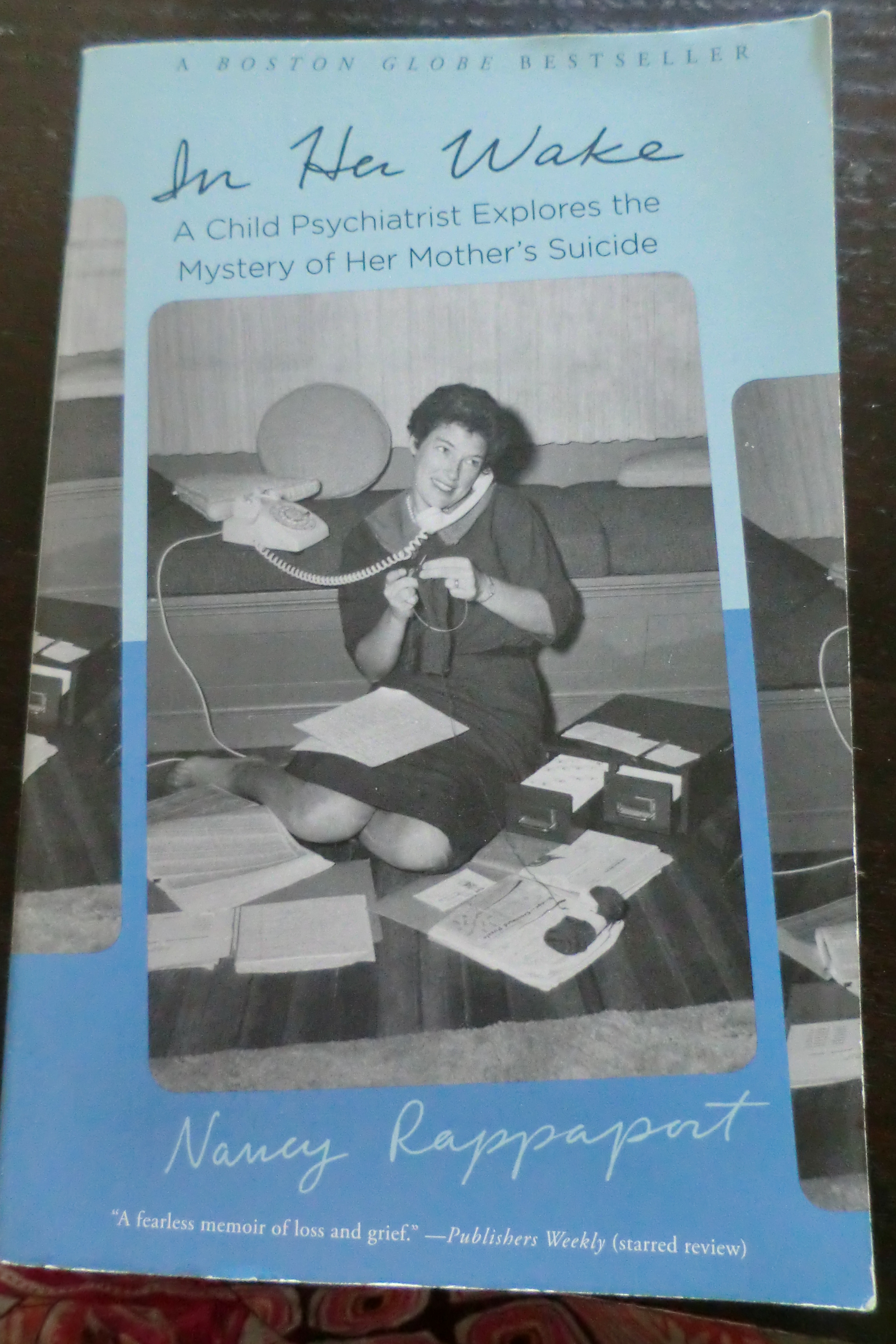
In 1963, Nancy Rappaport was 4 years old and the youngest of six children when her mother, an ambitious woman who balanced raising a large family, organising regular society events and political campaigning, committed suicide in the wake of a heart-wrenching custody battle.

Nancy now has three grown children of her own and has written this book both as a daughter needing to find answers and as a professional child psychiatrist, bringing together her education, experience, the wisdom of years and a compassionate perspective to narrate this compelling memoir of an extraordinary life whose end was sad and tragic.

From a childhood in which the nurturing love of a mother was ruptured so abruptly, through adolescence and early adulthood where the subject of her mother appears to have been taboo, it is extraordinary and something of a blessed gift that Nancy comes across a trunk of belongings that has virtually been in hiding or at best forgotten all these years. It is a credit to her father and stepmother that it wasn’t destroyed and so Nancy in her quest to know her mother better, gains access to lists, notes, notebooks, a journal and astonishingly, the manuscript of a complete novel. At last, she begins to gain a first-hand insight into who her mother really was, aside from all that had been written publicly and most importantly she begins to piece together how her mother was thinking in the time leading up to her death.
Rappaport follows leads like a master sleuth hesitating to question herself only briefly in pursuing her mother’s former lover, an estranged best friend and a former confidante of her grandmother, to unearth as much information surrounding the events of that period during her parents’ marriage and subsequent divorce. Little by little, she draws back the carefully drawn veil of secrecy, though not entirely without getting her fingers burnt.
It’s tempting to search for the villain and it could be said that each of the main characters in this true story are tried out and tested in that role, but none endure. Such is the faculty of being human, perhaps we all have the potential if pushed sufficiently but here we find few heroes or villains, just victims, bystanders and those trying to do their best under the circumstances.

It is a bold move to publish a family story when so many are touched by past events and family ties remain tenuous. Nancy suffers the expected consequences to a certain extent though she tries to navigate her way with compassion and empathy as much as she can. It’s a difficult and interesting topic, to write a version of the truth that recalls the faded memories of real life characters, while respecting those who wish to remain silent.

In my reading of this courageous memoir, some of the lessons come not from digging in the past or even from the professional perspective, but from Nancy’s own children, who are a constant reminder of the present that we live in and the role and responsibility of a mother to her children, doing her best, learning as she goes, loving them above all so that they have the best chance to be loving, caring and successful people themselves and that no matter what anyone says or does or whatever the circumstances, a mother will maintain that role whether she is fulltime, part time, at a distance or just a faded memory.

Why People Don’t Read Short Stories

Publishers have difficulty persuading readers to buy short story collections.  Many readers love them, but more readers avoid them, preferring the novel.  Why is this?  Fiction writer Tessa Hadley suggests it is because in our culture, readers have grown used to the habit of the novel, we can pick up a novel and put it down time after time, when it opens we re-enter its world, escaping our own for a while.  There’s something discontinuous about our reading relationship with short stories.  At the end of each story we are thrown out of that world created by the chosen words of the author enhanced by our imagination, back into our surroundings without leaving a thread; we then enter another story and begin to build a new picture of characters, place and situations.

Reflecting on this now, I wonder if that is why I liked Alice Hoffman’s ‘Blackbird House’ so much, because of the subtle connection between the stories which kept me wanting to go back for more.  Or was it the writer’s style? I love this book, a unique set of short stories that traces the lives of various occupants of an old Massachusetts house over a span of 200 years, witnessing change in each family through their loved ones and the lives they live inside Blackbird House.

I like reading short stories, especially in between reading novels or other more lengthy works of non-fiction.  There are some short stories in particular that I adore, like the Italian writer Italo Calvino’s ‘The Enchanted Garden’ from his collection of short stories ‘Difficult Loves’.  Giovannino and Serenella discover an opening in a hedge leading them into a quiet garden of flower beds, eucalyptus trees and gravel paths, it’s like a mini version of Frances Hodgson Burnett’s ‘The Secret Garden, still a favourite today.  And then there’s A.S.Byatt’sStone Woman’ from her ‘Little Black Book of Stories’ the haunting tale of a woman witnessing her own gradual metamorphosis into stone; befriending an Icelandic stone carver she returns to East Iceland, the place that will become her final resting place.

Mini-gateaux, Bechard, Aix en Provence by Maki

For me, an avid reader, short stories are like the contents  of extravagant chocolate boxes or the pick n mix gâteaux at Béchard on the Cours Mirabeau here in Aix en Provence.  When I’m into reading short stories, I don’t just take one collection, I take three or four and then read a story or two from each collection, so I sample more than one writer at a time.

Why do I do this?  Well firstly, because for me short story collections are like ‘1001 Nights’, I don’t want the collections to end, so I slow down the process to savour the stories.  Secondly, I like to sample writers from different countries, so today I might read from Nigerian writer Ben Okri’s collection Stars of the New Curfew’ set in the teeming street of Lagos, or ‘Sandpiper’ Egyptian writer Adhaf Soueif’s collection about women finding themselves in countries other than their own, where language, culture and love create confusion.

The collection I have now remind me that I love to travel through books both to foreign destinations and through the minds of writers from different countries and cultures as well as returning to the familiar vernacular of my country of birth.

In addition to those mentioned I might dip into Elliot Perlman’s (Australian) ‘the reasons I won’t be coming’, Alice Munro’s (Canadian) ‘Friend of my Youth’; Janet Frame’s ‘The Lagoon’, Keri Hulme’s ‘Stonefishand ‘The Stories of Frank Sargeson’ (New Zealand writers), Indian writer Chitra Banerjee Divakaruni’s ‘Arranged Marriage’ and Jhumpa Lahiri’s ‘Unaccustomed Earth’ or Raymond Carver’s ‘What we talk about when we talk about love’ which reminds me I want to read the Japanese writer Haruki Murikami’s ‘What I talk about when I talk about running’. Then there are the slim classics Dubliners’ by James Joyce who needs no introduction and Grace Paley’s ‘The Little Disturbances of Man’.  And I’m happy to say, I’ve almost managed not to finish any of them – except Hoffmann’s ‘Blackbird House’ which reviewers describe as “not quite a novel and not quite a short story collection’ so I guess that one doesn’t count.  And I plan to read it again anyway.

In this time pressed world, one would think that short story collections are poised for a revival; after all, what better antidote for the tired, overworked individual who remembers nostalgically the enjoyment they used to get from a good book – short stories are perfect!

As writer Jonathan Falla said “Good stories are not literary fast food, made on the cheap; they are intense with a flavour that expands to fill the mind.”  The short story allows us in a short space of time to understand and consider momentous things, grand dilemmas.  Short stories pull us into their world and shake us up.

Do you read short stories?  What’s your favourite collection?

www.theshortstory.org.uk

http://www.americanshortfiction.org/

Liebster Award

During our ‘dizaine de jour’ (12 day) hospital stay, my blog was nominated for a Liebster award by the inspirational Candyce who quit her job to Return To Writing and very kindly wrote a few kind words relating to my book blogging meanderings. Thank you Candyce.

So what is a Liebster? Both a word (German for dearest or beloved) and an honour, it is bestowed by those in the early stages of writing a blog (less than 200 followers) upon 3-5 bloggers they admire.

When nominated we should:

1. Link back to the blogger who awarded us.

2. Tag 3-5 blogs to receive the award.

3. Inform them of their nomination.

4. Display the Liebster Award image on our blog.

Recently I joined the SheWrites community of writers and since then I have had many thoughtful visitors to my blog who continue to leave kind and encouraging comments. So thank you also to all the SheWrite sisters out there, it’s wonderful to be part of the group.

I am enjoying journeying through blogsville connecting with wonderful, inspiring people, admiring the diversity of passionate interests and thought provoking musings of this growing community.

So my nominations are:

  1. The Spirit that Moves Me – A beautiful and insightful blog that uncovers and shares the sacred through creativity and the feminine. In a recent post called ‘Finding home’ she writes “Home is not a cottage, a house, or the city in which I live. It is the moment when I am fully present and fully alive. It is when I am aware of myself and the love that surrounds me, of where I come from and who I am.” I feel right at home with this spirit and happy to be following.
  2.  Speaking of Words and Quilts – Amy has started her blog to record and reflect her writing journey and often uses metaphors relating to her quilt making as well as the magnificent landscape that surrounds her. I’m no quilter, but I love her honest style and the way she finds insightful teachings through her scraps of fabric, even that beautiful, ugly quilt she’s not yet ready to show us.
  3.  Mishfit – Mish is a writer, a Mum and an inspiration to many women in Melbourne, Australia, where she runs a fitness and personal training service for Mums. She is the most knowledgeable person I know regarding female incontinence and can quote scary statistics that will make you take note even if you think that’s not me; most of all she empowers women to get in shape while making the children part of it, – yes, babies have supervised fun too!
  4. Wouldn’t that rip the fork out of your nightie?? – Aria writes from the heart, embracing all of the many aspects of her persona, she is inspirational, intuitive, funny, (whacked in her words), insightful, highly creative and prolific – she wakes at 4am and doesn’t sleep till late and is definitely making the most of those hours. Be careful, you could lose hours on this wonderful blog.
  5. Stories Are Good Medicine – Children’s doctor turned author, Sayantani muses on the writing process, yoga and the dharma, reviews interesting books and offers an alternative perspective. Healthy and thought provoking medicine indeed.

Secret Gardens and the Imagination

This week I find myself rereading an old-time classic out loud.  I am being reacquainted with Frances Hodgson Burnett’s ‘The Secret Garden’ as I read it aloud to my 9 year daughter while camping out for 10 days with her in the paediatric ward of the hospital.  My French is being elevated to yet another level as we undertake a rapid apprenticeship in living with Type 1 diabetes, which after a rushed call to the hospital, we discovered was the cause of her giant fatigue and unquenchable thirst.

Both of us seeking an escape, we embark on our journey towards the secret garden with 9 year old Mary Lennox, who finds herself removed from an exotic life in India and living with a rarely seen and allegedly cantankerous Uncle, in a grand old manor on the moors of England after both her parents succumb to cholera.

We are a couple of chapters into the book and my daughter is feeling a little deceived.  “There’s no secret garden” she says, “and what does it mean, gloomy”.  I have to admit that for a story chosen to perk up an ailing child, the first few chapters are somewhat gloomy indeed.

The Secret Garden in the daytime...

At this point my daughter decides to take the matter into her own hands and here you can see her first attempt at creating a secret garden of her own.  The joy and allure of a great book title, it inspires the imagination before we have even arrived at the promised treasure the book beholds.

Young Mary has been both pampered and neglected in her former colonial life so England is something of a shock, where staff speak to her as an equal and expect her to be somewhat independent.  But this newfound freedom will lead her to discover the enchanted garden and to make new friends, not just of the human variety.

Needless to say, this wonderful book is about transformation in many guises, the human spirit, the magic and healing power of gardens, the wonder of birds and animals and the joy that acts of kindness engender.  It worked wonders for us both.

The Secret Garden at night...

Hankyu Railway – A 15 Minute Miracle

Recently I was on a 12 hour flight contemplating what I thought would be an eternity of reading time which somehow did not come to pass.  I would still recommend Anthony Capella’s ‘Empress of Ice cream’ as good inflight reading, but on this occasion the only thing I could concentrate on, apart from my eight and nine year old companions was the Inflight magazine.

I read that magazine right through, but could I find a film that suited my mood when a book couldn’t?  Well, I admit I was hard-pressed; whether it was a book or a movie – both passive pastimes – what I really wanted was to get horizontal like my sleeping companions had somehow managed.  Nothing Hollywoodesque tempted me, so I found myself scrutinising the blurbs for the Korean, Chinese, Japanese and Singaporean films and found a wonderful gem ‘Hankyu Railway – A 15 Minute Miracle.’

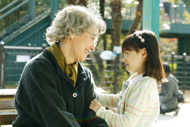
The Hankyu Railway, a 15 minute one way line, is what links the stories of a few characters as they navigate pertinent issues in their respective lives.  A young office worker learns of her fiancés infidelity and exacts revenge while trying to retain her honour; a grandmother with her granddaughter who never encroaches past the accepted boundaries of tolerance, decides to speak the words other have thought but never ventured and brings with it the wisdom and respect of her years.

Much is understood without ever needing to be said, but what is so beautiful about this film and these journeys is that each of these characters does decide to step beyond convention and say something that will make a difference.

The film is based on Hiro Arikawa’s bestselling novel ‘Hankyu Densha’ and it is a tribute to reaching out, to acknowledging another human being, acting on an instinct for the good of humanity.  It is about small acts of kindness, that a few words might somehow change the course of a fellow human being’s life for the better.

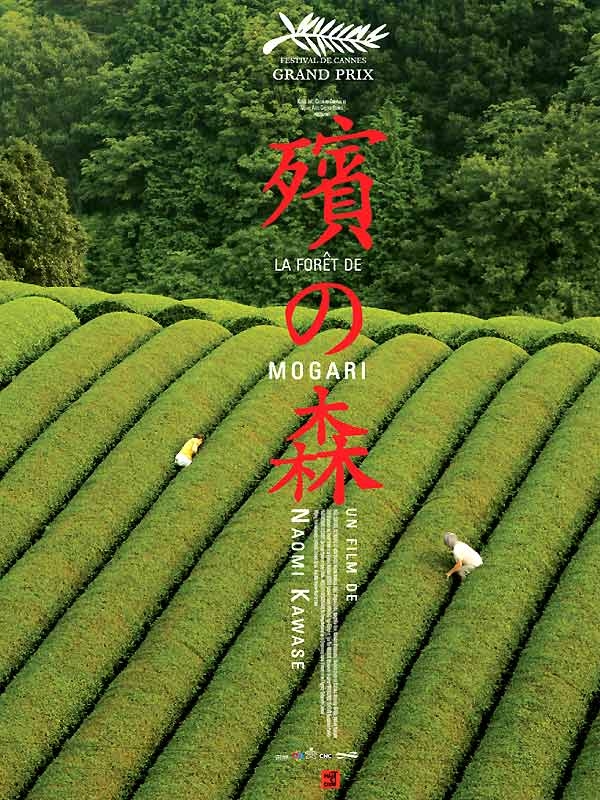
It reminds me of another favourite Japanese film, though they are very different.  ‘The Forest of Mogari’ relies less on dialogue and is a story of the human spirit, a meditation on life, death, grief and the necessity of letting go.

A London Love Affair

Being in London always gives me a kick of inspiration, it nourishes the creative spirit and wakes up certain senses that tend to be otherwise dormant .

One New Change

Revisiting the City of London

There is a feeling of doing, ideas aren’t just discussed, they move and become reality, its not a place to ponder, one has to act to keep up with the mad pace and survive. But you will be rewarded for it.

Daunt Books in Marylebone

Coffee in Marylebone and browsing in Daunt Books.

Bliss.

www.dauntbooks.co.uk