Small Worlds by Caleb Azumah Nelson

Cover of Small worlds by Caleb azumah nelson bestselling author of Open Water. The book sits on a piece of yellow, green gold Nigerian wedding fabric

What a brilliant novel this was. I loved it.

It might even be my Outstanding Read of 2025.

A meandering story-line, spanning 3 years, the introspective excavating of a young British-Ghanaian man’s soul and the situations he will encounter and confront, as he matures and grows into a version of himself that he likes.

I highlighted SO many passages.

Moments of Bliss, Small Worlds

Small worlds describes the way Stephen has learned to see things. It is his way of identifying and capturing certain moments, especially the loving, the poignant, the fleeting, the good.

A coming-of-age story set mostly in Peckham, London, it follows Stephen as he navigates the period in his life when he is separating from friends and his parents, from all that he knows. Simultaneously, he is moving from letting things happen to him and suffering, towards sitting with what is, reflecting, rejecting, embracing, understanding. A journey the evolves over three years.

the beats, the rhythm, the soul – A trio

Photo by Victor Freitas Pexels.com

Introspective and sensitive, music plays a large role in his mood, his management of his emotions, his friendships and the collective memory of Ghana, a country he is connected to but did not grow up in, a place that separates him from his family as much as it is a part of them all.

The novel is set over three years, written in three parts, like a jazz trio of piano, bass and drummer.

Part One – Two Young People in the Summertime (2010)

The summer after Stephen and all his friends have finished school and they are deciding what comes next. Stephen and his long-known friend Del are both applying to study music. This summer they start to look at each in a different way, to feel something, they are light-footed, beach going, feeling like something good is coming.

When Stephen’s path changes course, he deals with isolation and separation, unable to even find solace in his instrument, the trumpet, or music. His emotions run deep and he withdraws from them.

Part Two – A Brief Intimacy (2011)

Stephen is working with his friend Nam, training to become a chef. The owner Femi has split allegiances, a Ghanaian mother and Nigerian father mean they serve Ghanaian food and play Nigerian music, and they all know about the 1983 Nigerian Presidential executive order, the mandate of Ghana Must Go that affected an estimated 2 million people living in the country.

Rhythm returns to his life and he feels it everywhere. The observations of bits of daily life, poetic, vibrant, rhythmic and upbeat.

Back in Peckham, it’s here too, this rhythm happening everywhere, as I take my time to wander home: in the dash of four boys dressed in black, trying to beat the bus round the curve, soft socks in sliders slapping the ground. The song of a passing car, distant bass finding a home in my ears, the low, slow rumble calling attention the way thunder might ask you to check the sky for rain. The haggling taking place at the butcher’s and the grocer’s, the disbelief that it’s now three plantain for a pound, not four. In the sadness as I pass the spot where Auntie Yaa’s shop used to be, where she would make sure everyone was looked after. In the joyful surprise when I run into Uncle T, his mouth full of gold like its own sunshine. The couple I pass in the park, holding each other close, her head turned away from his, a smile on his face even as he pleads with her, babe, I didn’t mean it. In the distance she holds him, to see if he’ll come closer, because sometimes it’s not enough to say it, you have to show it too. In the conviction I share with many that this stretch, from Rye Lane to Commercial Way, is where our small world begins and ends. There’s rhythm happening, everywhere; all of us like instruments, making our own music.

But expectations, old trauma and shame linger and until they can be addressed, they undermine relationships, cause rupture, rigidity and regret. So much still to recognise, dismantle, overcome and heal. And Stephen explores it all.

I’m slowly taking myself apart, so I might build myself up once more. And as part of this undoing, I want to ask him, why?And then there are those aspects of the outside world, not so far away, that seethe with unresolved anger and hatred, that threaten to close in on them. A raising of public consciousness and a shift in perception.

Part Three – Free (2012)

Photo by Kh-ali-l i on Pexels.com

Stephen takes time off after the turn of events and pays a visit to Ghana. His trip heralds a reckoning.

Still, of late I’ve felt the urge for more. I’ve always had a decent grasp on who I am, or where I might find myself, but I’ve never really known where I’ve come from. This trip has started a shift. There are gaps which my father might fill, with his own story. I want him to tell me who he is, or who he was. I want to know who he was when he was twenty. I want to know what he dreams of, where he finds freedom.

Melody, discord, harmony and triumph – a story through music

As we read, there are songs Stephen chooses to accompany him. Often as I read, I stop to listen and look up the artist, reminding me of the enjoyment I had reading Bernice McFadden’s The Book of Harlan (reviewed here). It can add so much more to the experience, when music with a cultural influence is present, calibrating the reader’s imagination with the mood of the story.

The way the story comes full circle, when by the end, Stephen’s father accepts his son’s invitation to come with him, to share a meal, to listen to ‘Abrentsie’ by Gyedu-Blay Ambrolley, the book morphed into scenes of a wonderful film that I was simultaneously watching and reading. I wished I weren’t on the last pages, because it felt so good to witness the transmutation of emotion into a new way forward, that was something like the old, but different; accepted, something they will be able to nourish and grow from.

Highly Recommended.

I’m happy knowing I have still to read his debut, Open Water now being made into a BBC 8 part series.

Further Reading

Interview Guardian – Novelist Caleb Azumah Nelson: ‘there is a wholeness in living life not always afforded to black people’ – Apr 2023

Afreada – Caleb Azumah Nelson In Conversation – Interviewed by Nancy Adimora and Amanda Kingsley

Author Interview – 21 Questions with Caleb

Caleb Azumah Nelson, Author

Caleb Azumah Nelson is a British-Ghanaian writer and photographer living in south-east London.

His first novel, Open Water, won the Costa First Novel Award, Debut of the Year at the British Book Awards, and was a number-one Times bestseller. It was shortlisted for the Dylan Thomas Prize, the Sunday Times Young Writer of the Year Award, Waterstones Book of the Year, and longlisted for the Gordon Burn Prize and Desmond Elliott Prize. He was selected as a National Book Foundation ‘5 under 35’ honoree by Brit Bennett.

Small Worlds, his second novel won the Dylan Thomas Prize (2024) (a prize that celebrates exceptional literary talent aged 39 or under), cementing the 30-year-old British-Ghanaian author as a rising star in literary fiction. The judges had this to say:

 “Amid a hugely impressive shortlist that showcased a breadth of genres and exciting new voices, we were unanimous in our praise for this viscerally moving, heartfelt novel. There is a musicality to Caleb Azumah Nelson’s writing, in a book equally designed to be read quietly and listened aloud. Images and ideas recur to beautiful effect, lending the symphonic nature of Small Worlds an anthemic quality, where the reader feels swept away by deeply realised characters as they traverse between Ghana and South London, trying to find some semblance of a home. Emotionally challenging yet exceptionally healing, Small Worlds feels like a balm: honest as it is about the riches and the immense difficulties of living away from your culture.”

Transcendent Kingdom by Yaa Gyasi

Yaa Gyasi’s debut novel Homegoing was my One Outstanding read of 2017, and it was a book I initially avoided as it was the subject of much hype and expectation, which can cloud our ability to discern. However it was exactly the kind of book I love, thought provoking, taking the reader outside of their own culture but showing how the threads of an earlier culture have influenced where they are today.

wp-1631377083656.jpgIn a sense that too is at the heart of Transcendent Kingdom, a family from Ghana immigrate to the US, the mother, the father (who the narrator, the daughter Gifty, the only one of the family born in the US, refers to as Chin Chin man), and their son Nana. Though they leave their country behind, something of remains in them, and though they are determined to ascend in their new country, it comes at a price.

I wanted her stories to about her life in Ghana with my father to be filled with all the kings and queens and curses that might explain why my father wasn’t around in terms far grander and more elegant than the simple story I knew. And if our story couldn’t be a fairy tale, then I was willing to accept a tale like the kind I saw on television, back when the only images I saw of Africa were those of people stricken by warfare and famine. But there was no war in my mother’s stories, and if there was hunger it was of a different kind, the simple hunger of those who had been fed one thing but wanted another. A simple hunger, impossible to satisfy.

Gifty is a sixth year PhD student studying neuroscience, observing mice in order to better understand the role of the brain and neural circuitry in relation to the desire for and restraint of reward-seeking behaviour. In other words, the tendency towards addiction or depression.

To know that if only I could understand this little organ inside this one tiny mouse, that understanding still wouldn’t speak to the intricacy of the comparable organ inside my own head. And yet I had to try and understand, to extrapolate from that limited understanding in order to apply it to those of us who made up the species Homo sapiens, the most complex animal, the only animal who believed he had transcended his Kingdom…

The narrative moves back and forth in time, in the present she works in a lab, while at home her mother stays in bed all day. This is not the first time her mother has succumbed, so memories of the first time return and the events that lead up to the disappointment(s) that became too much. Only now their roles have reversed.

The question I was trying to answer…was: Could optogenetics be used to identify the neural mechanisms involved in psychiatric illnesses where there are issues with reward seeking, like in depression, where there is too much restraint in seeking pleasure, or drug addiction, where there is not enough?

medication pills on yellow background

Photo Anna ShvetsPexels.com

The novel also explores the controversial American opioid issue, how what begins in innocence can lead to devastating consequences. The inspiration behind the science of the novel comes from the work of Yaa Gyasi’s best friend as she shares in the acknowledgments and in the interview below.

‘At the time of writing, the opioid crisis was being reported on near-daily. I found the reporting to be very moving and willing to look at the effects, not only on the people with addiction but the families, too. It was the first time we were seeing an interrogation of the role of pharmaceutical companies in creating this crisis. I wanted to add my voice to the chorus but from the perspective of a black family.’

Though Gifty is focused on the science on what has afflicted her family, she is reluctant to observe or consider her own behaviour, her difficulty in forming relationships or allowing people to get close to her, the consequence of having lived through trauma.

While she pursues the science and looks for a logical answer to her question, she considers the role of faith. Because science doesn’t explain the feelings of shame, of anger, of hatred, self-loathing.

“What is prayer?” my mother asked?
This question stumped me then, stumps me still. I stood there, staring at my mother, waiting for her to give me the answers. Back then, I approached my piety like I did my studies: fastidiously.

It’s a thought provoking novel of seeking to understand human behaviour, of the propensity “to try to make order, make sense, make meaning of the jumble of it all” and to find a way to seek solace and refuge from it all.

Though it took me a little while to get into it, there was a turning point where it began to click and become more than just a story, where the interconnecting threads became apparent. An enjoyable read and follow up to her impressive debut.

Yaa Gyasi

Yaa GyasiYaa Gyasi was born in Mampong, Ghana and raised in Huntsville, Alabama. Her first novel, Homegoing, was a Sunday Times and New York Times bestseller, won the National Book Critics Circle Award for Best First Novel and was shortlisted for the PEN/Robert W. Bingham Prize for Debut Fiction.
In 2017 Yaa Gyasi was selected as one of Granta’s Best of Young American Novelists and in 2019 the BBC selected her debut as one of the 100 Novels that Shaped Our World. Transcendent Kingdom was shortlisted for the Women’s Prize for Fiction 2021. She lives in Berkley, California.

Further Reading

Women’s Prize Shortlist Interview + Reading: ‘I couldn’t imagine having a life where books weren’t important’: Yaa Gyasi on her Inspirations (Interview Begins at 27:30)

Interview : Paris Review: We Take Everything with Us: An Interview with Yaa Gyasi By Langa Chinyoka

U.S. Department of Health and Human Services: What is the U.S. Opioid Epidemic?

Homegoing by Yaa Gyasi

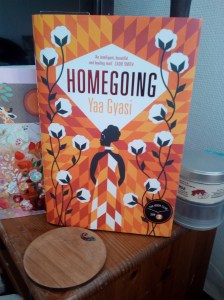
homegoing-yaa-gyasiAstonishing, a work of art, an interwoven tapestry of stories that weave across the generations to create something so beautiful, so heartfelt, the thing that connects them is so strong, even when it isn’t known by its characters, somehow Yaa Gyasi conveys that to the reader, so that by the end when something quite magical happens, there is a feeling of grieving for all that has passed and of relief that something new has been found.
I love, love, loved this novel and I am in awe of its structure and storytelling, the authenticity of the stories, the three-dimensional characters, the inheritance and reinvention of trauma, and the rounding of all those stories into the healing return. I never saw that ending coming and the build up of sadness from the stories of the last few characters made the last story all the more moving, I couldn’t stop the tears rolling down my face.

How to give it justice in a review, it is so much more than story, we are so much more than our own personal experience and the place(s) we have lived.

Novels That Ask Questions

Just as Han Kang, the South Korean author of the novel Human Acts wrote in consideration of two fundamental questions about humanity, Yaa Gyasi tells us in an article for the New York Times (referenced below) that she too began to write with a vague but important question that she put at the top of her blank screen: What does it mean to be black in America?

She further explains her inspiration in an article for the Observer (also below)

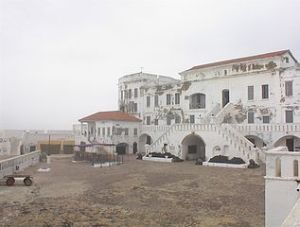
I began Homegoing in 2009 after a trip to Ghana’s Cape Coast Castle [where slaves were incarcerated]. The tour guide told us that British soldiers who lived and worked in the castle often married local women – something I didn’t know. I wanted to juxtapose two women – a soldier’s wife with a slave. I thought the novel would be traditionally structured, set in the present, with flashbacks to the 18th century. But the longer I worked, the more interested I became in being able to watch time as it moved, watch slavery and colonialism and their effects – I wanted to see the through-line.

The Legacy of Generations

Homegoing begins with the image of a partial family tree, with two strands and the novel will follow just one family member down each strand, the first two characters who begin these family lines are the daughters of Maame, Effia and Esi.

Effia, whom the villagers said was a baby born of the fire, believed she would marry the village chief, but would be married to a British slave trader and live upstairs in the Cape Coast Castle.

‘The night Effia Otcher was born into the musky heat of Fanteland, a fire raged through the woods just outside her father’s compound. It moved quickly, tearing a path for days. It lived off the air; it slept in caves and hid in trees; it burned, up and through, unconcerned with what wreckage it left behind, until it reached an Asante village. There, it disappeared, becoming one with the night.’

Effia’s father, Cobbe would lose his crop of yams that night, a precious crop known to sustain families far and wide and with it, through his mind would flit a premonition that would reverberate through subsequent generations:

He knew then that the memory of the fire that burned, then fled, would haunt him, his children, and his children’s children for as long as the line continued.’

Cape Coast Castle (a slave trading castle), Ghana

Cape Coast Castle (a slave trading castle), Ghana

Esi, whose father was a Big Man, in expressing her empathy for their house girl, would precipitate events that lead her to be captured and chained in the dungeons beneath that same castle, awaiting the slave trading ships that would transport them to their slave masters in America.

‘They took them out into the light. The scent of ocean water hit her nose. The taste of salt clung to her throat. The soldiers marched them down to an open door that led to sand and water, and they all began to walk out on to it.’

Symbolism

In these first two chapters of Effia and Esi, the recurring twin symbols of fire and water are introduced, something that each generation subconsciously carries with them and passes on, they will reappear through fears, dreams, experiences, a kind of deep primal scar they don’t even know requires healing, its origins so far back, so removed from anything that can be easily articulated.

Fire (yang) is like the curse of the slave trade, raging through the lives of each generation, even when they appear to have escaped it, as with Kojo’s story, a baby passed to the arms of a woman who helped slaves escape, whose parents are captured, but he will live freely, only to have one member of the family cruelly snatched, perpetuating the cycle yet again, orphaning another child, who must start over and scrape together a life from nothing.

‘They didn’t now about Jo’s fear of people in uniform, didn’t know what it was like to lie silent and barely breathing under the floorboards of a Quaker house, listening to the sound of a catcher’s boot heel stomp above you. Jo had worked so hard so his children wouldn’t have to inherit his fear, but now he wished they had just the tiniest morsel of it.’

Water (yin) to me is the endless expanse, the rootlessness, floating on the surface, feet never able to get a grip, efforts floundering. This symbol is carried throughout Essi’s family line, a cast of characters whose wheels are turning, who work hard, but suffer one setback after another.

The novel is structured around one chapter for each character, alternately between the twin sides of the family, the narrative perspective changing to focus on the new generation, through whom we learn something of what happened to the character in the previous generation, who’ve we left two chapters ago.

Importantly, because Yaa Gyasi decides not to write in the present with flashbacks, but writes from the perspective of each character in their present, the novel never falters, it doesn’t suffer from the idling effect of flashbacks, it keeps up the pace by putting the reader at the centre of the drama in every chapter. We must live all of it.

The irony of the structure is that we read an entire family history and see how the events of the past affect the future, how patterns repeat, how fears are carried forward, how strong feelings are connected to roots and origins, we see it, while they experience the loss, the frustration, the inability to comprehend that it is not just the actions of one life that affect that life’s outcome.

This book is like a legacy, a long legacy that revolves between the sadness of loss and the human struggle to move forward, to survive, to do better, to improve. And also a legacy of the feeling of not belonging that is carried within those who have been uprooted, who no longer belong to one place or another, who if they are lucky might find someone to whom they can ignite or perhaps even extinguish that yearning ‘to belong’.

‘We can’t go back to something we ain’t never been to in the first place. It ain’t ours anymore. This is.’ She swept her hand in front of her, as though she were trying to catch all of Harlem in it, all of New York, all of America.’

And in writing this novel, Yaa Gyasi perhaps achieves something of what her final character Marcus is unable to articulate to Marjorie as to why his research feels futile, spurning his grandmother’s suggestion that he perhaps had the gift of visions, trying to find answers in a more tangible way, through research and study.

“What is the point Marcus?”
She stopped walking. For all they knew, they were standing on top of what used to be a coal mine for all the black convicts who had been conscripted to work there. It was one thing to research something, another thing entirely to have lived it. To have felt it. How could he explain to Marjorie that what he wanted to capture with his project was the feeling of time, of having been a part of something that stretched so far back, was so impossibly large, that it was easy to forget that she, and he, and everyone else, existed in it – not apart from it, but inside it.

Yes, she achieves it through literature, through fiction. And this is literature at its most powerful and best.

This novel is going to win awards in 2017, undoubtedly.

*****

Yaa Gyasi

Yaa Gyasi was born in Ghana in 1989 and raised in the US, moving around in early childhood but living in Huntsville, Alabama from the age of 10. She is the daughter of a francophone African literature professor and a nurse and completed her MFA at the Iowa Writer’s Workshop, University of Iowa. She wrote this, her debut novel at the age of 26.

Further Reading

New York Times, Sunday Review – Opinion, June 18, 2016 – I’m Ghanaian-American. Am I Black?

Review, The Observer, January 8, 2017 – Yaa Gyasi: ‘Slavery is on people’s minds. It affects us still’

Click Here to Buy A Copy of

Homegoing via BookDepository