Tidal Waters by Velia Vidal (Colombia) tr. Annie McDermott

Women in Translation

Tidal Waters is my first August read for #WIT month. Reading Women in Translation.

What an original, good-hearted, open, vulnerable read. I’m not sure whether what I read was fictional or not, because much of what is described in the ‘letters to a close friend’ coincides with elements in the author bio inside the front cover of the book and the main character is Vel.

The Epistolary Novel

epistolary novel of letters, reading, literacy, poverty, Afro Colombian

An epistolary narrative, it is about the return to a place and finding new purpose, along with the motivation to pursue it and taking others with you – told through a correspondence that bears witness and though we don’t see the replies, we can tell that they encourage and support both the idea(s) and the woman pursuing it.

I don’t know if I mentioned this specifically, perhaps not in a letter, though maybe when we met up before I left to come and live here here for good, but part of what pushed me to make this radical life change was the need to feel that my existence had meaning, that I was spending each day doing something I cared about and could feel proud of at the end of my life. And that’s just what I found in being Seño Velia, the woman who has meetings with people about books, who tries to motivate children to love reading and books as much as she does, and who supports the teachers.

Finding Purpose and Motivation, In Community

The letters span 3 years from May 2015 and they track a significant change in Vel’s life as she decides to return to Choco (to the Afro-Colombian community she was raised in) to start a new venture to bring reading, literacy and a love of books to it. The correspondence exhibits the growth and expansion of her writing, the letter becomes a safe harbour and she tests it by taking her writing to another level, stretching into a more personal yet contained arena.

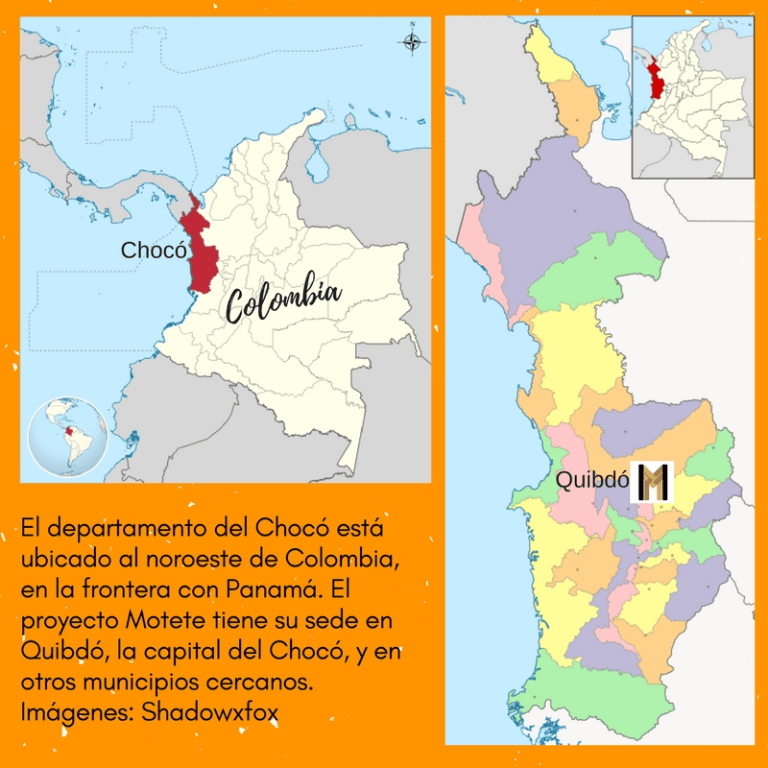
Tomorrow I start a diploma in reading promotion, and with it my project, Motete. We’ve chosen three areas of Quibdo where I’ll start running the workshops.

She is taking a risk starting a new venture, but believes in it and is surrounded by extended family and connections, which facilitate her ability to reach out even further into the community and invite everyone in, to be part of or benefit from her shared love of reading.

And so this project is coming together. This basket, this Motete, is filling up. The slogan for my project is ‘Contenidos que tejen’ – contents that weave – and every day I like it more. Every day I realise that these contents are weaving fulfillment and happiness within me…

The thing is, motetes have been used to carry food for the body: plaintains, bushmeat, fish. Our is to fill them with food for the soul: art, culture, books. And just as motetes are woven by hand, I thought these new contents would also form a fabric: the fabric of society, of community, the fabric of souls.

Letter Writing

Her unnamed friend that she writes to is someone she hasn’t known long, he occupies a space between the familiar and the unfamiliar that she claims as a freedom to express herself, to be vulnerable and open, someone who has mentored and shown her how to get funding. The range of things she will write to him of, span a wide spectrum.

We never see the replies but the continuation of her own correspondence displays her life, her dealing with health problems, the double bind of her wounding and love, of being raised by doting grandparents, while having complicated relationships with a teenage mother unable to mother her and an emotionally absent father. Her later sadness and depression, helped through therapy, tears and conversations, to ways of coping and healing. Her optimism for her venture, and the community connections she creates keep her going.

I grew a lot. I learned. But most of all I tried to weave a new way of relating to my father that hurt as little as possible.

The Sea, The Sea
One of the themes is the sea, the absence of sea, the way the river meets the sea and her relationship to it. She yearns for it when it has been absent for some time, just as she yearns for the letter writer and the relief that comes in the act of writing to him.

She describes herself in her current role as being like the sea at that place where it meets the river.

I’m like the Pacific Ocean, pressing at the river with its tides to make it flow the other way, or lapping at the land when its waters rise, when it feels like gaining inches of new ground. You need strong motivation to stick to this way of life, which isn’t exactly a fight against the world, but rather the certainty of forging your own path.

An Homage to Correspondence

I loved this slender book, it’s project and generosity, its intimate sharing and platform for expanding and learning and having the courage to venture into new areas. It made me think of an exquisite title I’d forgotten about, Leslie Marmon Silko’s slim book of correspondence The Delicacy and Strength of Lace: Letters Between Leslie Marmon Silko and James Wright.

That correspondence was written when Silko was 31 years old and Wright 51. They had planned to meet in the Spring of 1980, mentioned in letters of Oct/Nov of the previous year, not knowing he would be gone before then.

They discuss her novel, his poetry, language, his travels, her adventures with animals, their speaking engagements, their mutual challenges and experiences as university professors, and soon began to share more personal feelings, as she acknowledged the tough time she was having and he shared his own experience, expressing empathy.

Velia Vidal dedicates her book:

To my recipient,
simply for being there.

and when I read about her own projects in society, her love of the sea and shared readings and efforts to help move children and young adults out of poverty, it is all the more inspirational to read these letters, understanding the difference a letter can make, to see someone take a risk and pursue something that will help others from her community, while fulfilling her own dreams and aspirations.

Highly Recommended.

Velia Vidal, Author

Velia Vidal (Bahía Solano, Colombia, 1982) is a writer who loves the sea and shared readings. In 2021 she was a fellow at Villa Josepha Ahrenshoop, in Germany.

For her book Tidal Waters she won the Afro-Colombian Authors Publication Grant awarded by Colombia’s Ministry of Culture. She is the co-author of Oír somos río (2019) and its bilingual German-Spanish edition.

She is the founder and director of the Motete Educational and Cultural Corporation and the Reading and Writing Festival (FLECHO) in Chocó, one of the most isolated, complex and neglected regions in Colombia with the highest afro-descendant population density in the country.

Vidal graduated in Afro-Latin American Studies and has a Masters in Reading Education and Children’s Literature. She is also a journalist and specialist in social management and communication. In 2022 she was included in the list of 100 most influential and inspiring women in the world by the BBC.

She writes children’s literature, fiction and non-fiction, and poetry. Her work has been translated into German, English and Portuguese.

The Delivery by Margarita Garcia Robayo tr. Megan McDowell

The Delivery was next up to read from my 2023 Charco Press bundle and was published on 24 October. This year’s books have been so great, I couldn’t wait to get to this one. I haven’t read her previous translated book Fish Soup, but I had heard good things about it too.

Charco Press and Latin American Fiction On a Roll

One of the earlier Charco novellas I read this year, The Remains (see my review) by Mexican author Margo Glantz (translated by Ellen Jones) just made the longlist of the Warwick Prize for Women in Translation 2023. In the same week Two Sherpas (see my review) by Sebastian Martinez Daniell translated by Jennifer Croft was longlisted for the 2024 ALA Carnegie Medals for Excellence in Fiction and Ana Paula Maia’s Of Cattle And Men, translated from the Portuguese by Zoë Perry made the 2023 Cercador Prize Finalists ( a bookseller-led prize for literature in translation).

Warning: Don’t Ignore Your Packages – The Review

A young, unapologetically self-absorbed woman lives alone, away from her family. Though loathe to form attachments, she is hyper observant of all that goes on around her; the neighbour into whose apartment she sees, the doorman sweeping below, the mother with her young son, the unreliable babysitter.

A large package arrives from her sister who told her via one of their infrequent video-calls, that she was leaving with her family on a cruise. The sisters have a complicated relationship, one she ponders.

When she notices my silence she goes quiet and sighs. I guess she, too, gets fed up with the weight of incomprehension. I guess that on top of seeming like a sister who is detached, dejected and discourteous, I also come off as an arrogant person. Kinship isn’t enough for her, either, of course it isn’t. In cases like ours, getting along isn’t a question of magic or chemistry or affinity, but of tenacity, toughness and torturous toiling.

The package, the size of a large crate stays in the hallway for two days until neighbours complain, knock on the door and push it into her seventh floor apartment. She continues to ignore it.

It’s noon; my sister must be aboard her cruise ship by now. I can just see her gazing excitedly at the array of interactive screens showing maps of the ship marked with little flags: ‘…over twenty stations of international food.’
I wonder: When my sister isn’t there, who takes care of my mother?

Farming Cows Personality Animals The Delivery On Writing
Photo by Flickr on Pexels.com

Working from home as a freelance copy writer, she meets her boss once a week. Currently working on a piece about a cow, while procrastinating over completing a grant for a writer’s residency in Holland. Here she questions whether her choice to be a writer is another act of avoidance.

And although writing is something I have done every day for years now, I again get the feeling that this thing I call ‘my job’ is nothing but another avoidance strategy. Compared to all other professions, writing is like the effort a tick makes to feed and survive among predators. I climb onto a branch, wait a long time until the herd passes, calculate the least risky distance to drop onto a fluffy mass and drink a minuscule ration of blood, which will allow me to maintain this limited but sufficient life.

Her attempts to avoid human contact threaten to overwhelm her, as increasingly she is drawn in to life around her and made to be present.

I felt I had the right to not be a trustworthy person. It was good to make that clear, even if it worked against my professional future; from now on you should be aware that assigning me a job includes the possibility that I’ll quit halfway through. That was more or less how I put it. It was the closest I would come in this business to an outburst of dignity.

The novel follows a week or so in her life and the people (and a cat) with whom she interacts, both willingly and unwillingly. Encounters that awaken memories, that cause her to explore her own responses and thoughts on them all, she avoids closeness but each situation contributes to the growing relationships between them all.

Her efforts to keep a distance stall, fail and slowly make her see her own role in running from herself, the inclination to self-sabotage.

Sometimes I feel like two people live inside me, and one of those people (the good one) keeps the other in check, but sometimes she gets tired and lowers her guard and then the other (evil) one stealthily emerges, with a mad desire to wound just for the sake of it.

It’s both introspective and funny, as her avoidance and inattention to things leads to consequences that surprise her and because we see everything from her perspective, we too have a somewhat clouded view of reality.

Her philosophical considerations and snippets of conversation give pause for thought. It’s entertaining in a surreal yet banal way, knowing that life’s reality is likely to burst the bubble she lives in eventually, yet it doesn’t stop her from continuing to ponder and escape from it.

How quickly the shell of a routine is shattered.
Any routine, however solid it may be, is obliterated by the unexpected.

Margarita García Robayo, Author

Margarita García Robayo was born in 1980 in Cartagena, Colombia, and now lives in Buenos Aires where she teaches creative writing and works as a journalist and scriptwriter.

She is the author of several novels, including Hasta que pase un huracán (Waiting for a Hurricane) and Educación Sexual (Sexual Education, both included in Fish Soup), Holiday Heart, and Lo que no aprendí (The Things I have Not Learnt). She is also the author of a book of autobiographical essays Primera Persona (First Person, forthcoming with Charco Press) and several collections of short stories, including Worse Things, which obtained the prestigious Casa de las Américas Prize in 2014 (also included in Fish Soup).

Her books have been published widely and praised in Latin America and Spain and have been translated into several languages, including Chinese, Hebrew, French, Danish and Turkish. The Delivery is her third book to appear in English after the very successful Fish Soup (selected by the TLS as one of the best fiction titles of 2018) and Holiday Heart (Winner of the English PEN Award).

Infinite Country by Patricia Engel

Infinite Country opens with the thrilling escape of teenage Talia from a girl’s reform school in northern Colombia, pulling us into her story very quickly. Her escape is motivated by the desire to get home to her father who holds a plane ticket for her, a week hence, that will enable her to return to her birthplace, to her mother and two siblings whom she hasn’t seen since she was a baby.

Talia’s journey south threads throughout the narrative, like a serpent meandering towards its den. Confident in her ability to arrive at her destination, intuitively driven.

Colombian Literature Undocumented Refugee StoryThe story reverses and we learn how it came about that Elena and her children Nando and Karina are in America, while Mauro and Talia are in Colombia. How dreamer Mauro fell in love with contented Elena, in the market, their lives being played out on a small canvas until Mauro shared his dream and Elena facilitated it.

The dream becomes the nightmare of survival as their visas expire and they’re part of “the undocumented” moving from place to place in search of work until the day Mauro gets caught, and not long after swiftly deported. Elena becomes the sole bread winner for the family, leading to more heart-breaking events that unfold.

As I read their story, it held the echo of hundreds of couples, of families, split and fragmented by migration, exile, circumstance. This section is written in the slower form of a narrative summary, though equally compelling due to the feelings and questions it evokes in the reader as we read. And just as we begin to wonder where the action is, it shifts back to Mauro and we witness his tumultuous return to Elena’s mother Perla, who will raise his child, Talia.

Infinite Country Andean myths Culture MIt’s an interesting blend of narrative perspectives, the switch between Talia’s adventurous journey south and the backstory of how she came to be escaping to escape, including her parents story. Through Mauro and Talia we are also exposed to their cultural stories, the Andean myths of their people, of serpent, jaguar, condor and the one story that haunts Mauro, one he wished he’d never learned, that he will never tell.

Mauro appreciated that these stories offered explanations for his being, reminded him there was another land, a better one of divine logic wrapped inside this professed tierra de Colón, that he wasn’t pacing the earth blind as he often felt and Creation provided clues that made paths clearer, as simple as the blackbird song that announces oncoming rain and the whistles of the Andean sparrow that signal the clouds will soon part.

Near the end, it switches again to a second person “you” voice, and it’s Nando speaking to his sister Karina. For the reader, this is as abrupt as the deportation of the father, a seismic shift of sorts.

It switches again to the first person “I”, the quiet reassuring voice of Karina, and we learn it is she who has been telling us this story all along.

It’s a thought provoking story of one family that is reminiscent of so many, universal and yet particular to this one family, brilliantly showing the struggle not just to survive in a new country, but to survive leaving, to survive separation, to develop the strength required to hold steadfast to a dream and if not to the dream, to one’s family, who will change, evolve, split, fragment, become something other.

From an interview with Adrienne Westenfeld, Esquire Patricia Engel Captures The Interior World of Immigration

You write at the end of the novel, “Maybe there is no nation or citizenry.” What do borders mean to you?

PE: I think something that has always sparked my curiosity, as somebody who loves animals and nature, is how we can watch endless documentaries marveling about the miracle of migration when animals do it and how they know how to cross other lands in pursuit of resources.

What doesn’t occur to us are the ways that the human species is a migratory species, which has ensured its own survival, literally, because of the instinct to migrate. Borders are ever-changing things, as we’ve seen; countries often change them, rename themselves, and cede parts of their borders to other countries.

Borders are man-made, designed to serve special interests, and really are not natural. We shouldn’t be surprised by the ways they fall short of what human instincts and human needs require.

About the Author, Patricia Engel

Infinite Country Undocumented ImmigrantPatricia Engel has written a number of award winning, internationally acclaimed novels, including The Veins of the Ocean, It’s Not Love, It’s Just Paris and Vida, for which she was the first woman to be awarded Colombia’s national prize in literature, the 2017 Premio Biblioteca de Narrativa Colombiana. Her books have been translated into many languages, her short fiction widely published and her criticism and essays have appeared in The New York Times, Virginia Quarterly Review, Catapult, and in numerous anthologies. She currently teaches creative writing at Miami University.

Patricia Engel, herself the daughter of Colombian immigrants and a dual citizen, gives voice to Mauro, Elena and their children – each one navigating a divided existence, weighing their allegiance to the past, the future, to one another, and to themselves. Rich with Bogotá urban life, steeped in Andean myth, and tense with the daily reality for the undocumented in America, Infinite Country is the story of two countries and one mixed-status family for whom every triumph is stitched with regret and every dream pursued bears the weight of a dream deferred.

N.B. This book was an ARC (Advance Reader Copy) kindly provided by the publisher via NetGalley.