Eugene Onegin – Chapters Three & Four Alexander Pushkin

Elle était fille, elle était amoureuse.

Jacques-Charles-Louis Clinchamps de Malfilâtre

Tatyana Eugene Onegin

January 25 – The Feast of Tatiana

What better day to write about these chapters, January 25 being the feast day of Saint Tatiana in Russia, a symbol of women and celebrated as a student festival. Both the name and the day have become even more popular since Alexander Pushkin made her the love interest of his epic poem.

Chapters Three & Four

Eugene Onegin inquires as to how his friend the poet spends his evenings and thus finds himself invited to join him for a family evening at the home of Olga and Tatyana, where they receive warm, old-fashioned hospitality, though afterwards he cannot remember which girl was Olga and which Tatyana. While the evening failed to ignite significant interest in our hero, it did set tongues wagging among the locals.

Conjecture found unending matter:

there was a general furtive chatter,

and jokes and spiteful gossip ran

claiming Tatyana’s found her man;

The girl who spends her hours immersed in romantic novels let her imagination run wild and fell for the insinuations, if not the man himself, suffering from a love sickness of her own making, culminating in a letter (in French) to the imagined hero she has shaped from the form of Eugene Onegin. A baffled Onegin, clearly does not read the same literary genre.

Who taught her an address so tender,

such careless language of surrender?

Who taught her all this mad, slapdash,

heartfelt, imploring, touching trash

fraught with enticement and disaster?

I can’t help but laugh, it is perhaps the poetic form combined with the ignorance of the hero, this bringing together of polar beings, to create such a discordant clash of romantic versus pragmatic. And so we wait to learn what will pass, when by chance the two meet, and Tatyana must listen to the unfeeling hero speak from a detached but well intended heart, warning her against baring her soul so easily in future. Though it is true, he tolerates and listens easily to similarly themed devotions from his friend the poet, for whom such outpourings are his raison d’être.

But I was simply not intended

for happiness – that alien role.

Should your perfections be expended

in vain on my unworthy soul?

Saint TatianaAnd finally the long autumn and winter bore him and he agrees to a second visit, one that will fall on Tatyana’s name day celebration!

Impressions of Tatayana and Olga

Tatyana is distant and aloof socially, yet vulnerable to the roller coaster of emotions she reads and studies at length in her romantic novels. Her falling in love is not as such inspired by meeting Onegin or anything he says or does in their first encounter, it is by the idea of him inflamed by the wagging tongues of neighbours, that allow her, now that she has some distance from the man himself, to imagine herself in love. She has a need to express herself and because she hesitates to ever do so in person, pours her emotion into the written word – a letter.

Olga we only see through the eyes of the enraptured poet Lensky, he is always with her, walking with her, reading to her, writing poems about her, he gives and receives love easily and neither of them appear subject to the more tumultuous vagaries of passionate love.

Onegin’s Reaction to Tatyana?

An almost fatherly response, he was concerned that she should not respond in the same manner when next she looks for love, outwardly he shows little emotional response to her revelations, however there is a hint that the words may have affected him at a more sub-conscious level that has yet to make its way into his more intellectual self. Fortunately, he does show careful consideration for her feelings, by refraining at least from criticising her too harshly or outrightly rejecting her. Ironically, it is his constant boredom that will lead back to the warm hospitality of her family home.

Le Grand Meaulnes

Le Grand Meaulnes

How Does it Contrast With Another Classic Romantic Novel?

I can only compare it with the most recent classic romantic novel I have read, though it was written nearly 100 years later, Alain Fournier’s Le Grand Meaulnes whose male characters are more afflicted by romantic notions in the vein of Tatyana, than Eugene Onegin. In Fournier’s novel and in his own personal experience, it is the women who dole out the practical advice and suggest that the young man is too young, only for him to become completely obsessed with her.

Overall, these chapters are much more dramatic and throw us deep into the story, they entertain, they shock and delight. It is a pleasure to read and I am looking forward to what the next two chapters will bring.

Click here to read the follow up review of Eugene Onegin Chapters 5 & 6

The Lost Domain – Le Grand Meaulnes by Alain Fournier

Classics don’t feature too often on my list and when they do, I tend to be attracted towards the Russian and French classics, because they offer an element of the unknown and the unfamiliar. I like reading across cultures and am fortunate to live within a culture that provides me with learning opportunities every day, whether I read the literature or not. But reading it adds so much more to the experience and to interactions with local people.

West End Lane Books

West End Lane Books

I had come across references to Le Grand Meaulnes a few times and nearly brought it home with me after visiting West End Lane Books in London last October, leaving it behind on that occasion, but purchasing Brodeck’s Report, which I have since read and Alistair Grayling’s non-fiction work Friendship, of which I read a few pages and found it a little dense, not yet abandoned, but left for a rainy day.

Le Grand Meaulnes crossed my path again via NetGalley, where I learned of the centenary version below which coincides with the 100th anniversary of Fournier’s death.  This version translated by Frank Davison, published by Oxford University Press.

I decided – enough – stop reading ABOUT the book and READ the book!

The Lost DomainAnd then what joy, to find myself in the company of Hermione Lee who has written such a wonderful introduction filling us in on Alain-Fournier’s life, that I could almost write an entire post on the gems she shares her excellent essay. She writes of the unique captivation this book has held over generations of readers and the literary qualities that have allowed it to continue to survive as a modern classic.

“Alain-Fournier’s only novel maps an imaginary vision onto a real landscape. It is the story of his childhood, transformed into a romantic quest. It is set in real places which he had known all his life, with real names of villages and towns and shops and train stations, but it takes us on mysterious journeys to places that seem to belong to a fairy tale.” Hermione Lee.

The title itself and its translation present a dilemma, as it is not possible to translate all that it means in one expression, it is a play on words, for it is the nickname of one of the chief characters and a reference to an estate, a château that he will search for in vain.

For a man who died at 28, Alain-Fournier lead a full and dramatic life, making one wonder what more he may have accomplished had he not been killed tragically in 1914 shortly after being called up to fight in WWI. The drama continued after his death, as this one book that he wrote became a cult sensation and created a feud over his legacy, complicated further by the split between his parents, claims by his sister and her husband (Fournier’s best friend) and the married women Simone (whose husband he had ghost written a book for) whom he’d had an affair with, who aborted his unborn child.

Alain-Fournier_maison_natale

Birthplace of Alain_Fournier
La Chapelle-d’Angillon
Source: Wikipedia

One gets the impression having read Le Grand Meaulnes, that having addressed childhood, the author was just warming up for an entire litany of novels, drawing on the many experiences and emotions he had already encountered in such a short life.

“His longing for his childhood places and his desire to turn that emotion into writing was one of the fundamental impulses behind Le Grand Meaulnes.”

Beginning in the 1890’s, Le Grand Meaulnes is narrated by the quiet, unassuming Seurel, a boy whose life at the schoolhouse is relatively uneventful until Meaulnes, nicknamed Le Grand Meaulnes arrives and just as soon disappears, only to return again.

The arrival of Augustin Meaulnes at a small provincial secondary school sets in train a series of events that will have a profound effect on his life. Lost and alone, he stumbles upon an isolated house, mysterious revels, and a beautiful girl. Determined to find the house again, and the girl with whom he has fallen in love, Meaulnes is torn between his love and competing claims of loyalty and friendship.

It is a story of a childhood and adolescence told by one who observes, follows, understands and tries to assist, at the expense of living his own life to fulfilment. What happened to his friend in those few days he disappeared will obsess both boys thereafter, one because he wants to know what happened and the other because he wants to return there and cannot remember the way.

The books first pages are narrated when Seurel is five, the main story taking place when he is 15 and Meaulnes is 18 and will end when Seurel is almost 20. Whenever Meaulnes is present, there is an air of drama. Life and even his character take on a different aspect for Seurel when his friend is there, and when he is not, he mulls over what has passed and tries to make sense of it, and at times even do something about it.

“Meaulnes gone, I was no longer following in the footsteps of a visionary path-finder; I was once more a village lad like the rest of them – a status which demanded no effort and concurred with my own inclinations.”

alain-fournier

Alain-Fournier
Source: Wikipedia

It is a nostalgic read, somewhat melancholy, infused with an air of pending tragedy – and reminiscent of the life of the author. It creates an ambiance of short-lived joy and then loss, one that is repeated often. We don’t read for the destination, but for the journey and its distractions, for the differences between characters facing the same situations. In this, it is a microcosm of humanity on a small scale during one phase of life, youth.

It is symbolic, not just of the end of childhood and romantic notions, but the end of an era of narrative style, published at the same time as Proust’s Swann’s Way, hailed as something new and a sign of the way forward for French literature, part of the new modernist movement, whilst Le Grand Meaulnes represented the end of the romantic tradition.

Loved it.

Note: This book was an ARC (Advance Reader Copy) provided by the publisher via NetGalley.

Elizabeth and her German Garden, Elizabeth von Arnim

Elizabeth von ArminStaying overnight with friends in England just before Christmas, this book by Elizabeth von Arnim was placed on my bedside table and though there was no chance I would finish it, I was captivated and charmed by Elizabeth’s garden right from those first few pages.

May 7th – I love my garden. I am writing in it now in the late afternoon loveliness, much interrupted by the mosquitoes and the temptation to look at all the glories of the new green leaves washed half an hour ago in a cold shower. Two owls are perched near me, and are carrying on a long conversation that I enjoy as much as any warbling of nightingales. The gentleman owl says, and she answers from her tree a little way off,, beautifully assenting to and completing her lord’s remark, as becomes a properly constructed German she-owl. They say the same thing over and over again so emphatically that I think it must be something nasty about me; but I shall not let myself become frightened away by the sarcasm of owls.

I left without the book, only for it to land on my doorstep late January on my birthday, and in these cold harsh months when the comforts of a garden are not so easy to find, when I have been finding solace instead in the nature essays of Kathleen Jamie and the short stories of Tove Jansson (review to come), this novel was a welcome respite.

Elizabeth von Arnim

Elizabeth von Arnim

It is fiction, though reads very much like an autobiography and was initially published anonymously in 1898. The author (a cousin of Katherine Mansfield) is said to have been born in Sydney, in NZ and in England, I’m not sure about any of that, but her parents did leave Sydney and return to England where she was raised (while her father’s brother and family remained in New Zealand).

Katherine Mansfield

Katherine Mansfield

It seems likely that Katherine Mansfield spent time with these relations when she moved to England herself, I found one reference confirming this, a comment by the journalist (and relation of the two) Louise Ahearn, who is currently researching Elizabeth’s life and it is mentioned in the book that Katherine visited her cousin at the home she built Chateau Soleil, in Switzerland.

On a tour of Europe, while in Rome with her father when she was 23-years-old, her talented piano playing was overheard by Il Conte the German Graf Henning August von-Armin-Schlagenthin, who was travelling to help get over the death of his wife and child the previous year. After a persistent courtship they were married and soon settled into upper-class life in Berlin, where she gave birth to three girls in quick succession.

Nassenheide Schloss, the family estate by Alexander Duncker ex wikipedia

Nassenheide Schloss, the family estate by Alexander Duncker ex wikipedia

Not happy in Berlin and homesick for England, in 1896 she was introduced to the family estate Nassenheide, ninety miles north of Berlin in Pomerania. A seventeenth century-schloss, located at the time near the German border (now in Poland), it had been a convent and had not been lived in for more than 25 years, surrounded by an unkempt, rambling, derelict garden which Elizabeth immediately fell in love with. She insisted on living there and it seems she got her way (at least for the summer months), much to the chagrin of her husband, whom she affectionately refers to in the novel as the Man of Wrath.

The book captures many moments of appreciation of this unorthodox wilderness the character Elizabeth is so content within, and equal moments of candour at the annoyance of those who dare impose themselves to visit. She has difficulty keeping the gardener who often hands in his notice while she somehow convinces him to stay, until events dictate that drastic action is necessary to get rid of him.

The gardener has been here a year and has given me notice regularly on the first of every month, but up to now has been induced to stay on. On the first of this month he came as usual, and with determination written on every feature told me he intended to go in June, and that nothing should alter his decision. I don’t think he knows much about gardening, but he can at least dig and water, and some of the plants he plants grow, besides which he is the most unflaggingly industrious person I ever saw, and has the great merit of never appearing to take the faintest interest in what we do in the garden. So I have tried to keep him on, not knowing what the next one may be like, and when I asked him what he had to complain of and he replied “Nothing,” I could only conclude that he has a personal objection to me because of my eccentric preference for plants in groups rather than plants in lines. Perhaps, too, he does not like the extracts from gardening books I read to him sometimes when he is planting or sowing something new.

The author is at her best when describing her longing for the garden and the simple pleasure it brings her, though equally adept are her recounts of conversations with city ladies of her social standing, capturing their inability to comprehend that it is by her own choice that she spends so much time in this savage wilderness, they are convinced they must feel sorry for her and that she has been deposed there, belonging as they do to that breed of women who absolutely require the regular company of their peers and the invitations to social occasions, something Elizabeth does her best to avoid.

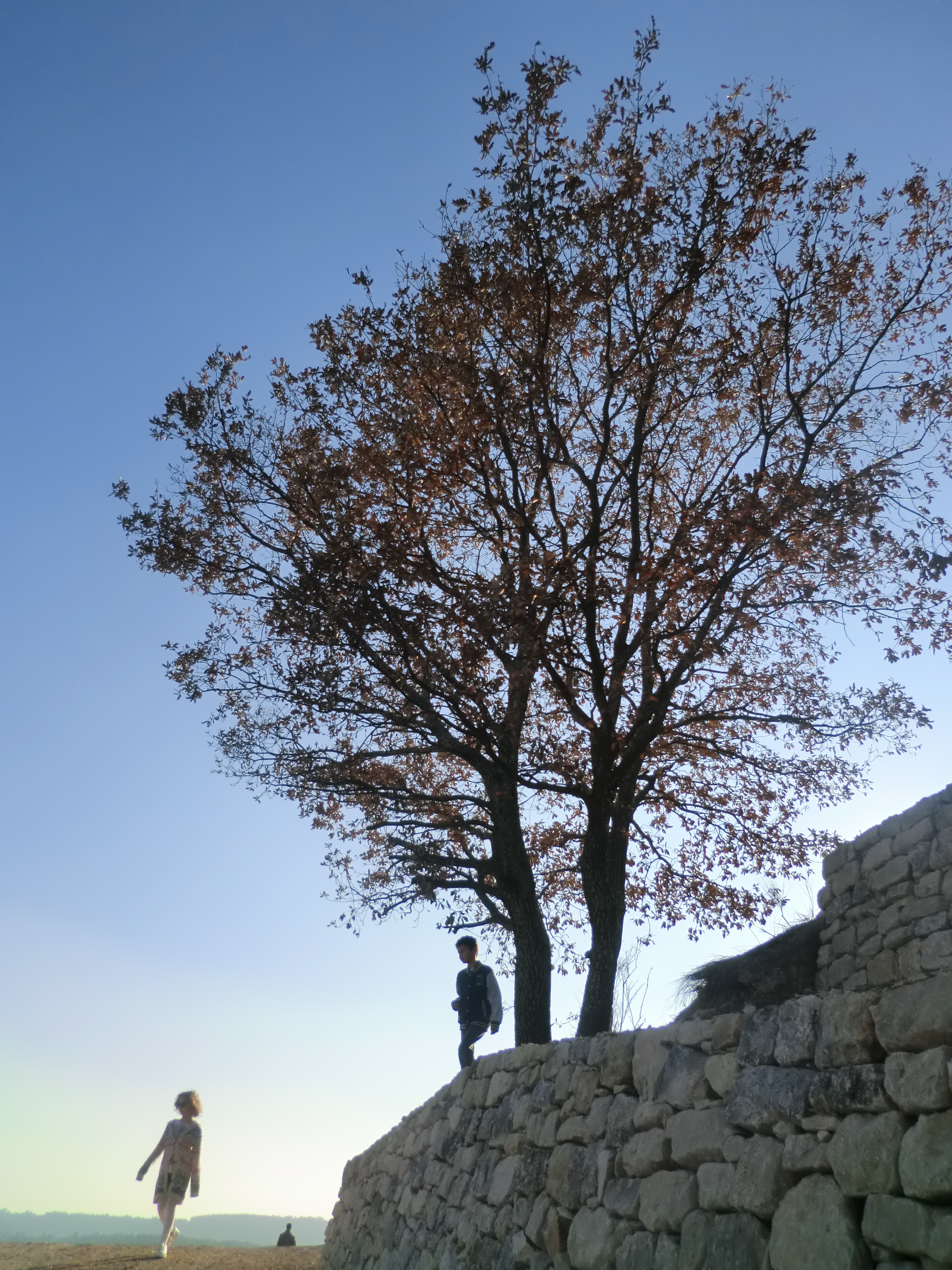
Content with the book, inspired by but lacking the garden, we instead take a drive and a stroll around a much closer abandoned ruin, appreciating its beauty among the weeds.

CIMG3742

Ruins of L’oppidum de la Quille, Puy Sainte Réparade

CIMG3751

The fading winter light of Provence, Puy Sainte Réparade