
The International Booker Prize 2025 longlist has been announced by this years judging panel, made up of a novelist, a poet, a translator, a critic and a songwriter, all of whom cross boundaries into other art forms. In their various ways, they are steeped in the world of words.
These are the 13 books they have chosen in the first cut, from 154 books submitted – 11 novels and two collections of short stories, translated from 10 original languages representing 15 nationalities and 11 independent publishers:
The longlisted books are:

The Book of Disappearance by Ibtisam Azem (Palestine) translated from (Arabic) by Sinan Antoon

– The shocking premise of Azem’s novel can be summed up in a sentence: what would happen if all the Palestinians in Israel suddenly disappeared?
Alaa is haunted by his grandmother’s memories of being displaced from Jaffa and becoming a refugee in her homeland after the Nakba. Ariel, Alaa’s neighbour and friend, is a liberal Zionist, critical of the military occupation of the West Bank and Gaza, yet faithful to the project of Israel. When he wakes up one morning to find that all Palestinians have suddenly vanished, Ariel begins searching for clues to the secret of their collective disappearance.
That search, and Ariel’s reactions to it, intimately reveal the fissures at the heart of the Palestinian question. Between the stories of Alaa and Ariel are the people of Jaffa and Tel Aviv – café patrons, radio commentators, flower-cutters – against whose ordinary lives these fissures and questions play out.
Spare yet evocative, intensely intelligent in its interplay of perspectives, The Book of Disappearance, critically acclaimed in its original Arabic edition, is an unforgettable glimpse into contemporary Palestine as it grapples with both the memory of loss and the loss of memory.
On the Calculation of Volume I by Solvej Balle (Denmark) translated by Barbara J Haveland

– a woman is trapped in a time loop, waking up each morning to find it’s the 18th of November, again and again.The first book of a planned septology. Five books have been published in Danish so far, with translations underway in over 20 countries.
She no longer expects to wake up to the 19th of November, and she no longer remembers the 17th of November as if it were yesterday. She comes to know the shape of the day like the back of her hand – the grey morning light in her Paris hotel; the moment a blackbird breaks into song; her husband’s surprise at seeing her return home unannounced.
But for everyone around her, this day is lived for the first and only time. They do not remember the other 18th’s of November, and they do not believe her when she tries to explain. As Tara approaches her 365th 18th of November, she can’t shake the feeling that somewhere underneath the surface of this day, there’s a way to escape.
There’s a Monster Behind the Door by Gaëlle Bélem (La Réunion) translated (French) by Karen Fleetwood & Laëtitia Saint-Loubert

– in 1980s La Réunion (an overseas department of France, in the Indian Ocean), a young girl with a zest for life rises up against her jaded, bitter parents.
La Réunion in the ’80s is a place of high unemployment and low expectations, the legacy of postcolonialism. Here, a little girl makes a bid for escape from her sadistic parents’ reign of terror and turns to school for salvation. The name Dessaintes is one to reckon with. A bombastic, violent and increasingly dangerous clan, little do they know that their downfall is being chronicled by one of their own.
Rich in the history of the island’s customs and superstition and driven by a wild, offbeat humour, this picaresque tale manages to satirise the very notion of freedom available in this French territory, and perhaps even the act of writing itself and where it might lead you.
Solenoid by Mircea Cărtărescu (Romania) translated by Sean Cotter

– partly inspired by the author’s years as a teacher in Romania, spiraling into a bizarre account of history, philosophy and mathematics, with flashes of nightmarish body horror. Said to have been written in a single draft, at 627 pages, the longest book on the list.
Grounded in the reality of communist Romania, the novel grapples with frightening health care, the absurdities of the education system and the struggles of family life, while investigating other universes and forking paths.
In a surreal journey like no other, we visit a tuberculosis preventorium, an anti-death protest movement, a society of dream investigators and a minuscule world of dust mites living on a microscope slide. Combining fiction and history with autobiography – the book is partly based on Cărtărescu’s experiences as a teacher – Solenoid searches for escape routes through the alternate dimensions of life and art, as various monstrous realities erupt within the present.
Reservoir Bitches (short stories) by Dahlia de la Cerda (Mexico) translated (Spanish) by Heather Cleary & Julia Sanches

– follows the efforts of 13 memorable Mexican woman, from the daughter of a cartel boss to a victim of transfemicide, to survive against the odds.
In the linked stories of Reservoir Bitches, 13 Mexican women prod the bitch that is Life as they fight, sew, cheat, cry and lie their way through their tangled circumstances. From the all-powerful daughter of a cartel boss to the victim of transfemicide, from a houseful of spinster seamstresses to a socialite who supports her politician husband by faking Indigenous roots, these women spit on their own reduction and invent new ways to survive, telling their stories in bold, unapologetic voices.
At once social critique and black comedy, Reservoir Bitches is a raucous debut from one of Mexico’s most thrilling new writers.
Small Boat by Vincent Delecroix (France) translated by Helen Stevenson
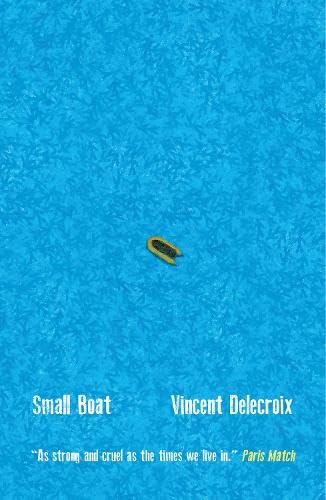
– the fictional account of a group of migrants’ attempt to cross the English Channel in an inflatable dinghy, which results in the deaths of 27 of those on board. Told from the point of view of a French woman who received, but rejected, their desperate calls for help.
Despite receiving numerous calls for help, the French authorities wrongly told the migrants they were in British waters and had to call the British authorities for help. By the time rescue vessels arrived on the scene, all but two of the migrants had died.
The narrator of Delecroix’s fictional account of the events is the woman who took the calls. Accused of failing in her duty, she refuses to be held more responsible than others for this disaster. Why should she be more responsible than the sea, than the war, than the crises behind these tragedies?
A shocking, moral tale of our times, Small Boat reminds us of the power of fiction to illuminate our darkest crimes.
Hunchback by Saou Ichikawa (Japan) translated by Polly Barton

– an unflinching account of sexual desire and disability about a protagonist born with a congenital muscle disorder who uses an electric wheelchair and a ventilator. Hailed as one of Japan’s most important novels of the 21st century.
Within the limits of her care home, her life is lived online: she studies, she tweets indignantly, she posts outrageous stories on an erotica website. One day, a new male carer reveals he has read it all – the sex, the provocation, the dirt. Her response? An indecent proposal…
Written by the first disabled author to win Japan’s most prestigious literary award and acclaimed instantly as one of the most important Japanese novels of the 21st century, Hunchback is an extraordinary, thrilling glimpse into the desire and darkness of a woman placed at humanity’s edge.
Under the Eye of the Big Bird by Hiromi Kawakami (Japan) translated by Asa Yoneda

– leaps back and forth across thousands of years and finds humankind on the verge of extinction, but still clinging to the impulses that make us human.
In the distant future, humans are on the verge of extinction and have settled in small tribes across the planet under the observation and care of the Mothers. Some children are made in factories, from cells of rabbits and dolphins; some live by getting nutrients from water and light, like plants. The survival of the race depends on the interbreeding of these and other alien beings – but it is far from certain that connection, love, reproduction, and evolution will persist among the inhabitants of this faltering new world.
Unfolding over geological eons, Under the Eye of the Big Bird is at once an astonishing vision of the end of our species as we know it and a meditation on the qualities that, for better and worse, make us human.
Eurotrash by Christian Kracht (Germany) translated by Daniel Bowles

– a Swiss writer named Christian, embarks on a tragicomic road trip with his wealthy, elderly mother in this tragicomic and absurd semi-autobiographical novel.
Realising he and she are the very worst kind of people, a middle-aged man embarks on a dubious road trip through Switzerland with his 80-year-old mother, recently discharged from a mental institution. Traversing the country in a hired cab, they attempt to give away the wealth she has amassed from investing in the arms industry, but a fortune of such immensity is surprisingly hard to squander. Haunted in different ways by the figure of her father, an ardent supporter of Nazism, mother and son can no longer avoid delving into the darkest truths about their past.
Eurotrash is a bitterly funny, vertiginous mirror-cabinet of familial and historical reckoning. The pair’s tragicomic quest is punctuated by the tenderness and spite meted out between two people who cannot escape one another. Intensely personal and unsparingly critical, Eurotrash is a disorientingly brilliant novel by a writer at the pinnacle of his powers.
Perfection by Vincenzo Latronico (Italy) translated by Sophie Hughes

– an expat couple attempt to live their dream in Berlin, but find themselves beset with the dissatisfaction and ennui of the modern world.
Millennial expat couple Anna and Tom are living the dream in Berlin – in a bright, plant-filled apartment in Neukölln. They are young digital creatives, freelancers without too many constraints. They have a passion for food, progressive politics, sexual experimentation and Berlin’s 24-hour party scene. Their ideal existence is also that of an entire generation, lived out on Instagram, but outside the images they create for themselves, dissatisfaction and ennui burgeon.
Their work as graphic designers becomes repetitive. Friends move back home, have children, grow up. An attempt at political activism during the refugee crisis proves fruitless. And in that picture-perfect life Anna and Tom feel increasingly trapped, yearning for an authenticity and a sense of purpose that seem perennially just out of their grasp.
With the stylistic mastery of Georges Perec and nihilism of Michel Houellebecq, Perfection is beautifully written and brilliantly scathing.
Heart Lamp (short stories) by Banu Mushtaq (Southern India) translated (Kannada) by Deepa Bhasthi

– the author, an activist and lawyer vividly captures the extraordinary everyday lives of Muslim women and girls in southern India, in 12 stories, originally published in Kannada between 1990 and 2023.
Praised for their dry and gentle humour, these portraits of family and community tensions testify to Mushtaq’s years as a journalist and lawyer, in which she tirelessly championed women’s rights and protested all forms of caste and religious oppression.
Written in a style at once witty, vivid, colloquial, moving and excoriating, it’s in her characters – the sparky children, the audacious grandmothers, the buffoonish maulvis and thug brothers, the oft-hapless husbands, and the mothers above all, surviving their feelings at great cost – that Mushtaq emerges as an astonishing writer and observer of human nature, building disconcerting emotional heights out of a rich spoken style. Her opus has garnered both censure from conservative quarters as well India’s most prestigious literary awards; this is a collection sure to be read for years to come.
On a Woman’s Madness by Astrid Roemer (Surinamese-Dutch), translated (Dutch) by Lucy Scott

– a classic of queer literature, as electrifying today as it was when it first appeared in 1982, tells of a courageous Black woman fleeing her abusive husband to embark a new life in the Surinamese capital.
When Noenka’s abusive husband of just nine days refuses her request for divorce, she flees her hometown in Suriname, on South America’s tropical northeastern coast, for the capital city of Paramaribo. Unsettled and unsupported, her life in this new place is illuminated by romance and new freedoms, but also forever haunted by her past and society’s expectations.
Amid tales of plantation-dwelling snakes, rare orchids, and star-crossed lovers, it is also a blistering meditation on the cruelties we inflict on those who disobey. Roemer, the first Surinamese winner of the prestigious Dutch Literature Prize, carves out postcolonial Suriname in barbed, resonant fragments. Who is Noenka? Roemer asks us. ‘I’m Noenka,’ she responds resolutely, ‘which means Never Again.’
A Leopard-Skin Hat by Anne Serre (France), translated by Mark Hutchinson

– captures the love and despair of an intense friendship between the book’s narrator and his best friend from childhood, who suffers from severe psychological disorders.
A series of short scenes paints the portrait of a strong-willed and tormented young woman battling many demons, and of the narrator’s loving and anguished attachment to her. Serre poignantly depicts the bewildering back and forth between hope and despair involved in such a relationship, while playfully calling into question the very form of the novel.
Written in the aftermath of the death of the author’s little sister, A Leopard-Skin Hat is both the celebration of a tragically foreshortened life and a valedictory farewell, written in her signature style.
Newbies, First Timers and a Classic Translated
Many of the books on the list are by authors being translated into English for the first time, which is a great sign for translated fiction, indicating that publishers and reading more widely and looking further than the already known. Not surprising I haven’t read any of these and only heard of one Solenoid, which won the Dublin Literary Award in 2024. It is not one I will be reading, way too long!
I like the sound of Heart Lamp and On a Woman’s Madness, not just for their premise, but for the language and locations they hail from! The Danish novel, The Calculation of Volume 1 sounds intriguing and something of a cult following, you’ve got to bat for someone who went ahead and self-published and is now being translated into over 20 languages.
Anything on the list tempting you? Let me know in the comments below.
The International Booker Shortlist and Winner 2025
The shortlist of six books will be announced on Tuesday, 8 April.
The winning title will be announced at a ceremony at London’s Tate Modern on Tuesday, 20 May.
 Word by Word
Excellent. Thanks so much for this overview!
LikeLike
It takes a little while, but I like to see everything on one page and be able to come back to it, so it’s worth the labour!
LikeLiked by 1 person
I’ve read The Calculation of Volume, which has a brilliant premise, and already had my eye on Perfection. Lots more you explore!
LikeLiked by 1 person
Oh that’s exciting to hear, so did the premise of Volume 1 equate into a fulfilling read?
LikeLiked by 1 person
It did for me although, obviously, you have to suspend your disbelief, but it’s a seven volume series which seems hard to sustain.
LikeLiked by 1 person
Thanks so much for this exhaustive run down. The Book of Disappearance looks unmissable. Small Boat? Eurotrash? Lots to follow up here!
LikeLiked by 1 person
Isn’t there. And hardly any of them reviewed yet, looking forward to hearing what readers make of them. I’m not sure I can cope with The Book of Disappearance, too close to home for me. I wonder how many your library has?
LikeLike
Sadly, a big zero, though I’m hopeful this may change. They have others by Hiromi Kawakami, so I’ll start there!
LikeLiked by 1 person
Yes, they might be ordering a few in now. 🤞
LikeLiked by 1 person
I hope so. They’re quite good like that.
LikeLiked by 1 person
Unsurprisingly, I haven’t read any (but keen on a few, particularly Eurotrash).
LikeLiked by 1 person
Autofiction of a middle age man from a privileged, dysfunctional, far right wealthy family on a road trip with his mentally ill, ageing mother – I don’t think that one is for me, but I can see the escapist appeal.
LikeLike
There’s nothing that immediately appeals, so I’ll wait for reviews to emerge and se if something becomes tempting.
LikeLike
Heh, our Aussie Indie who’s published Perfection was quick off the mark… would I like a copy?
Well, it wasn’t on my radar (millennial woes are not really my thing) but of course I said yes.
LikeLiked by 1 person
That’s interesting, you’ve just attracted the one title that matches what you’ve stated, “that nothing appeals”, in Perfection, ‘a spare, sociological novel about the emptiness of contemporary living’. Well we know it’s likely to be thought provoking and/or unique in style, when it’s been picked up by in the UK by Fitzcarraldo Editions. I’m certainly looking forward to reading your thoughts on it!
LikeLike
Yes, it’s ironic.
LikeLiked by 1 person
Claire, thanks for subscribing to my blog 🙂
LikeLiked by 1 person
Thank you, too, for your in-depth and informative posts, Rosaliene.
LikeLiked by 1 person
You’re welcome, Claire 🙂 Just doing my small part.
LikeLiked by 1 person
I normally never touch this list but I was already planning to read Hunchback and have an e-ARC, so… win?
LikeLiked by 1 person
I’m glad to see that there is an intersection between your own intended reading list and this prize, that’s the ideal in fact. Definitely interested to read your thoughts on that one.
LikeLiked by 1 person
It looks like a genuinely intriguing list! I’ve seen a lot of buzz about Perfection and Solenoid, so no big surprise to see those two on the list. Ditto the Balle. Those three aside, I know very little about the longlisted books. Looking forward to hearing more about the titles you decide to try, Claire. Your reviews are always a pleasure to read!
LikeLiked by 1 person
I do really enjoy a longlist of relative unknowns Jacqui, both for my own curiosity and for those authors, whose work now has much more chance of being discovered, so I’m often more likely to go for the lesser knowns, looking for those gems.
To have more books on the list in languages represented for the first time is also incredible, and so I would really like to read Heart Lamp, translated from Kannada, for the cultural immersion it promises. And the Serre looks interesting, one I ought to read in French!
Thank you for your kind words and reading my reviews, likewise, it’s always a pleasure to visit your reading journeying and your film watching!
LikeLike
Interesting selection for the prize.. I may read a few of those going by the description… 👍🏻
LikeLiked by 1 person
Which ones interest you Fatima?
LikeLike
The Book of Disappearance, Small Boat and Under the Eye of the Big Bird … seem promising to me… I didn’t know about these books, I have heard of Hiromo Kawakami but never read any of her books. Maybe it’d be the first one by her I will read.
LikeLiked by 1 person
Thanks Claire, this looks an interesting list. I’ve read and reviewed There’s a Monster Behind the Door and really enjoyed it. I’d like to read both books published by And Other Stories, though The Book of Disappearance will take precedence because of the political situation there- and I’ve read Minor Detail and Enter Ghost, both of which helped my understanding of the situation. I’d like to try Eurotrash, simply because I enjoyed Christian Krach’s book Imperium, though have some reservations about spending time dallying with the rich and privileged.
LikeLike