Far by Rosa Ribas tr. Charlotte Coombe

A Monument to Failure
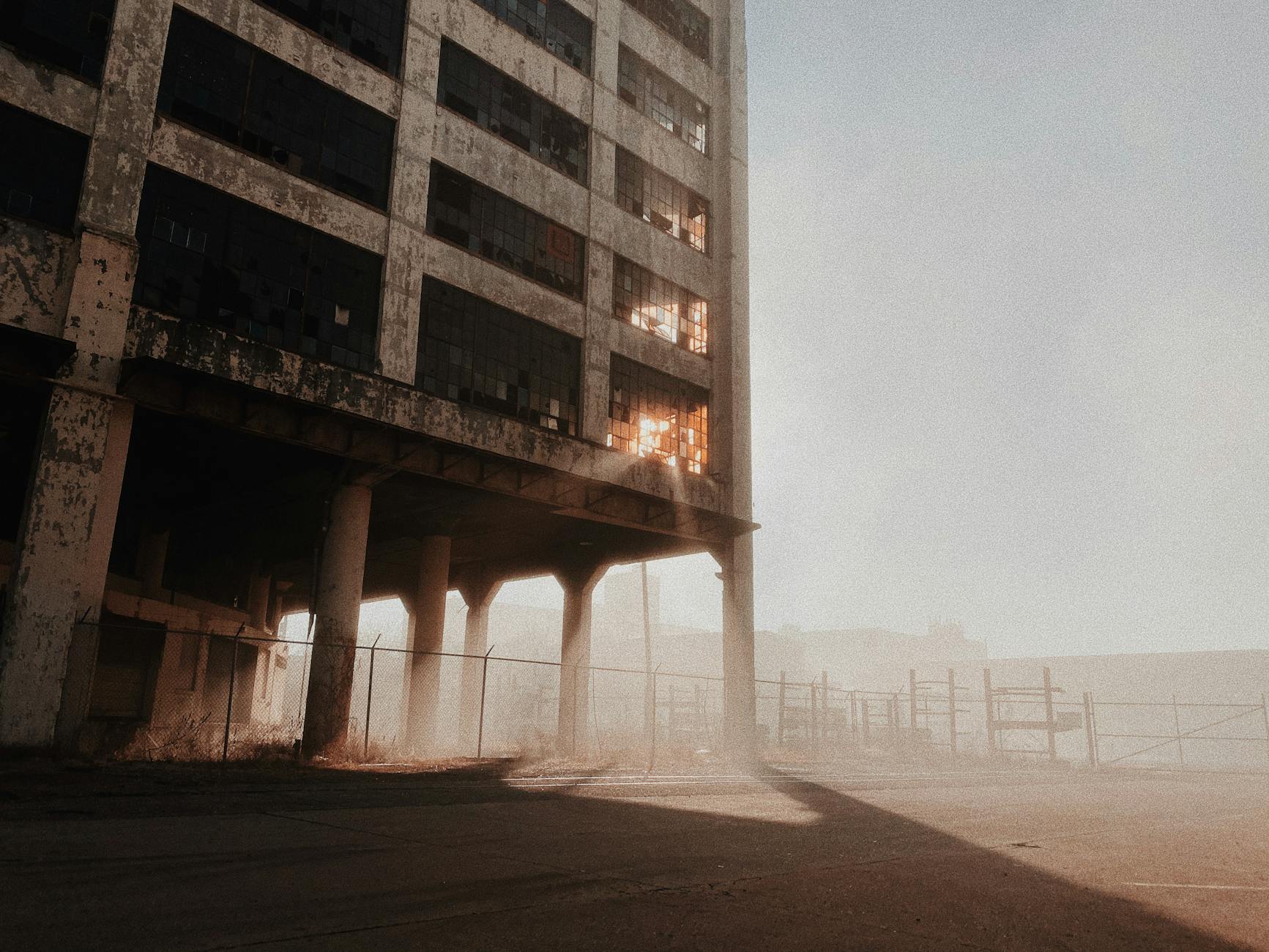
Abandoned apartment building in a development
Photo by Oliver Oudomsouk on Pexels.com

Seventeen years ago, the author Rosa Ribas was taken by friends to visit a strange monument to a broken era in Seseña; it was a housing development known as ‘The Manhattan of La Mancha’.

Built in 2008, it was designed to house 40,000 people in 13,500 affordable apartments – a ready made settlement emerging from the dust-bowls of remote farmland 40 kilometres from Madrid. It now looked something like between an eerie ghost town and an abandoned building site.

One representation of many, it was a stark reminder of a housing bubble, burst by a rampant, unchecked building boom bust, and a global financial crisis that created an unprecedented unemployment rate and the deepest economic recession Spain had experienced for fifty years.

“When you walked around, you’d see the blocks where people were living, the blocks that were semi-inhabited, and then all the skeletons of buildings in different stages of completion,” she said. “From one day to the next, they told the workers not to come back the following day. And it all stayed like that.”

Holding On to Threads

Santiago Calatrava City of Arts and Sciences Valencia Spain
Photo by Dominik Pexels.com

As night fell and three lights came, the realisation that they were the only people living there spawned the idea for a novel, Lejos in Spanish, now translated by Charlotte Coombe into English, brought to us by an excellent new imprint Foundry Editions, created in 2023 out of a love of these three things:

a love for discovering and sharing new voices, a love for the Mediterranean and the people and lands that surround it, and a love of internationalism and reading across borders.

The patterns on the covers of their books have been designed to capture the visual heritage of the Mediterranean. This one is inspired by the architecture of Santiago Calatrava’s City of Arts and Sciences in Valencia. It was created by Hélène Marchal.

Far, A Novel
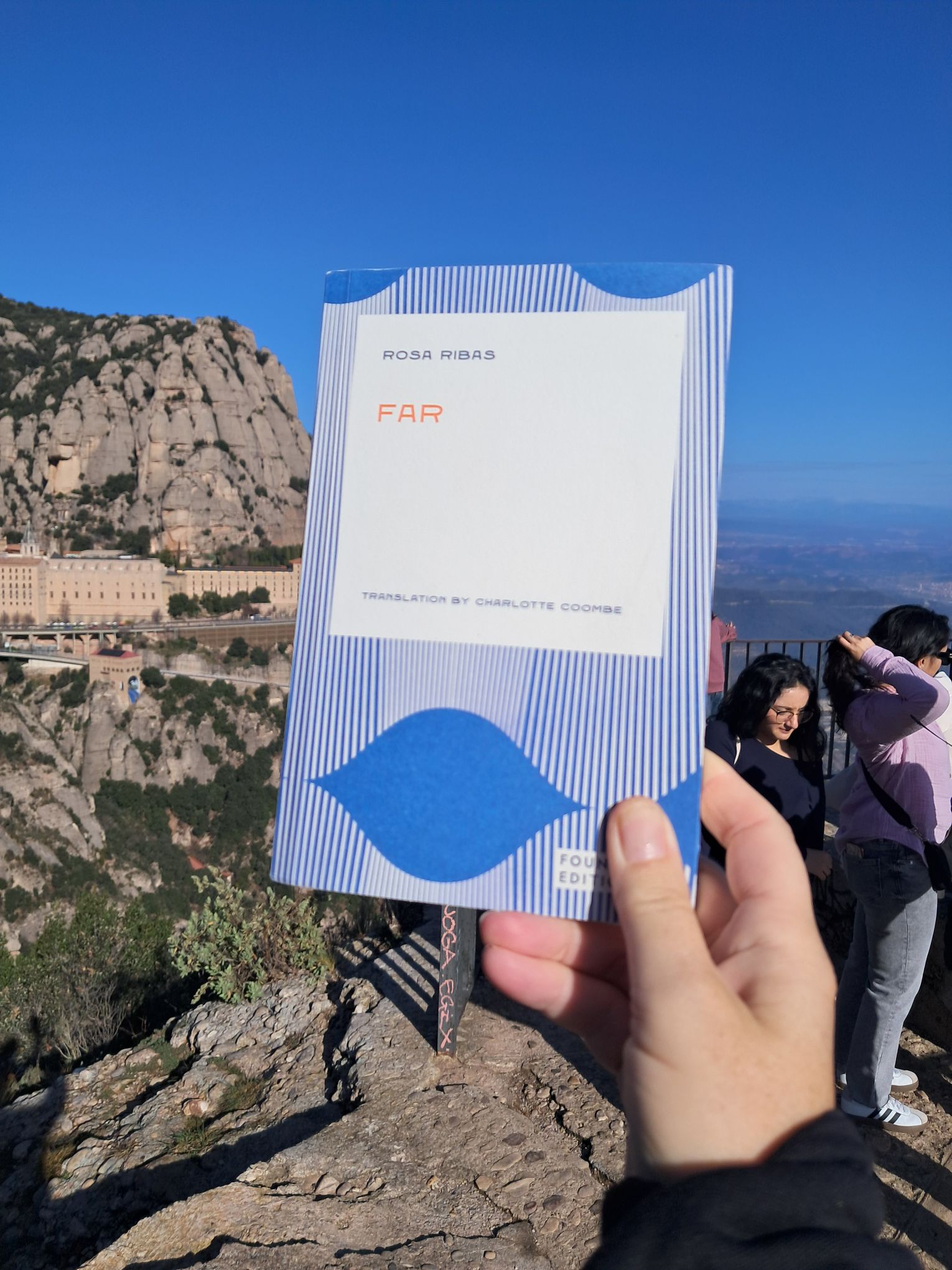
Book cover of English translation of Far by Rosa Ribas translated by Charlotte Coombe, mountain and monastery of Montserrat, Catalonia in the background

I loved this novel, it is evocative of this semi-abandoned place, it depicts a demarcation between the legals and the illegals, the rightful inhabitants and the opportunistic outsiders, the followers of rules, those that want to make their own, and those that fall into the cracks.

The entire development was constructed on a pile of poorly concealed sleaze, a chain of bribery, corruption, intimidation, and complicit silences. No ancient manuscripts, no mythical foundations. If these lands had been the scene of some momentous event, back when battles of conquest and reconquest were being fought all over the area, no one had bothered to record it. It was a bleak place, devoid of stories, where it was impossible to satisfy any yearnings for greatness.

The entrance to the development still shows billboards offering apartments for sale, the middle one depicting the fugitive developer Fernando Pacheco in his suit and tie, the others depicting scenes of golfing, swimming pools and cocktails, a far cry from the reality within which they sat.

An Element of Noir, Foretold

A rusty padlock on a wire mesh fence a symbol of keep out forbidden territory
Photo by Antonio G. Prats Pexels.com

The opening lines of Far stayed with me for the entire novel, they foreshadow the dénouement, a future turning point, that could even be the beginning of a follow up novel. For me it was a delightfully transgressive ending that I wasn’t even looking for, it arrived abruptly, though more regular readers of noir fiction might have seen it coming.

That night, he had no idea he was walking over a cemetery. A secret cemetery with no gravestones or crosses, and only two dead bodies. There would be three by the time he left.

The lyrical prose is clever, compelling and nothing is lost in translation.

The Lost and Fallen

We meet two unnamed characters, the first is the man we meet walking across that unconsecrated ground. He has just walked out of his office, his job, his life and is looking for a temporary refuge, when he remembers this place, this lost dream of many that one of his colleagues bought into. He needs to stay in hiding and at first is vigilant in keeping away from others, but the forced isolation and the desolate nature of the place loosen his discipline and he makes a friend in an older widower, Matias.

The second character is a woman living in one of the villas alone. Experiencing a double abandonment, she is sticking it out, she works from home and writes the minutes of the resident’s association meetings. Since the realisation that the development had truly been abandoned, the association had turned its focus onto other items.

Hegemons Harmony Hampered

Then, given the inhospitable environment, efforts became focused on the interior, on the decor of the apartments and villas. And on the “dignification” of the settlement. Swept pavements, manicured gardens. Being dressed properly in the street. “So, no more going out in your dressing gown to buy bread,” said Sergio Morales, the chairman of the residents’ association, at one of their meetings, in that jocular tone which often masks inconvenient or ridiculous orders.

a stairwell in an abandoned apartment building like Spain
Photo by W. Jacober Pexels.com

In this place that promised a kind of utopia, those that bought into it begin to realise that they have become neighbours with the marginalised, as the unfinished houses become occupied by people in equally difficult, but entirely different circumstances and they don’t like it. They begin to obsess over it, becoming paranoid, arguing about whether to call the police or take care of things themselves.

The destruction of their fantasy, the deterioration of an imagined life, of people’s mental states and even their physical states, emulates the disintegration of the country’s economic situation, that contributed to the depth of suffering inflicted on the population, as millions of jobs were lost and opportunities for youth disappeared, creating a surge in racism and xenophobia.

Light Always Illuminates

And there, amid the chaos, insecurity and fear, unlikely friendships and connections develop, between the man and the widower on the unfinished side of the settlement, the woman from the deteriorating utopia on the other side and the Dominican who doesn’t ask questions, working at the petrol station.

Brilliantly told, infused with sardonic humour, it is a disturbing yet revelatory tale of what happens when severe change arrives unbidden and the effect it has on the ‘haves,’ the ‘have-nots’ and those that fall through the cracks in between.

Highly Recommended.

Further Reading

Article, Guardian: ‘Huge scars’: novelist finds a fractured Spain in its half-built houses by Sam Jones, July 2024

Article, Guardian: Building boom reduced to ruins by collapse of Spain’s economic miracle by Giles Tremlett, Jan 2009

Author, Rosa Ribas

Rosa Ribas was born in El Prat de Llobregat in 1963. She has a degree in Hispanic Philology from the University of Barcelona, and spent time in Frankfurt at the Goethe University and the Instituto Cervantes. She now lives and works in Barcelona again and the city plays a big role in her writing.

Rosa is widely considered one of the queens of Spanish noir, achieving critical and commercial success in Spain with her Dark Years Trilogy (Siruela) and her Hernández trilogy (Tusquets). Far is her first foray away from crime fiction, into a more menacing social commentary. It is her first book to be translated into English.

Translator, Charlotte Coombe

Charlotte Coombe translates works from French and Spanish into English. She was shortlisted for the Queen Sofía Spanish Institute Translation Prize 2023 for her co-translation of December Breeze by Marvel Moreno. In 2022 she won the Oran Robert Perry Burke Award for her translation of Antonio Diaz Oliva’s short story ‘Mrs Gonçalves and the Lives of Others’, and she was shortlisted for the Valle Inclán Translation Prize 2019 for her translation of Fish Soup by Margarita García Robayo.
Such Small Hands by Andrés Barba (Spain) tr. Lisa Dillman

Such Small Hands is an incredible and unique novella, quite unlike anything I have read, it’s written almost from another dimension. The author somehow enters into a childlike perspective and witnesses the aftermath of a car accident in which the child Marina’s parents don’t survive.
“My father died instantly, and then my mother died in the hospital.”

An omniscient narrator theorizes on her relationship to sounds and words, as she repeats certain phrases and sees visions of the accident recurring.

As if, of all the words that might describe the accident, those were the only ones that possessed the virtue of stating what could never be stated; or, as if they, of all words, were the only ones there, so close at hand, so easy to grasp, making what could never possibly be discerned somehow accessible.

Marina sees a psychologist after recovering from her own injuries and is placed in an orphanage.

The narrative alternates between Marina’s perspective and the collective “we” of all the other girls. Marina is already different, in that up until she entered the orphanage she lived in her own family with her parents, unlike many of the other children.

They love her, they are intrigued by her, but resent the attention she receives.

“This is the moment when Marina realises something: I’m different. And as always, the realisation itself outshines the symbolic event that lead to it, the realisation emerges from the sludge of reality performed, , round and irrefutable, , something that had always been there: I’m different.”

Marina introduces them to a game, which splits their daytime from their nighttime selves. Without another outlet for their emotions, they resort to certain behaviours, which begin like a game, but without an authority to draw the boundary between acceptable and unacceptable behaviours.

“The doll opened one eye, her right one, slowly, surprised. Her hands were still, resting on her knees, waiting for what she did not know. We didn’t know either. It was just the momentum of the circle, the knowledge that something was about to spring like a coil, the conviction that the circle would spin faster and faster and faster until it was so fast that it would vanish into the air, and we’d vanish with it, everything would vanish.”

Inspired by a disturbing event, this enters the realm of post trauma in an innocent and bizarre way, taking the reader back to a kind of twilight zone of an insecure childhood, where the nightmare becomes real and the line between reality and dreams is blurred.

Fascinating.

Andrés Barba is the author of twelve books and was selected as one of Granta’s Best of Young Spanish Novelists.

He was a teacher at a university in Madrid and now gives writing workshops. His writing has been translated into ten languages.

Further Reading

Guardian Review – An unsettling tale set in an orphanage will trouble readers long after they have put the novella aside by Sarah Perry

Paris Review – All Writers Have a Corpse in Their Closet: An Interview with Andrés Barba by Jonathan Lee

2666 by Roberto Bolaño, tr. Natasha Wimmer

26662666 was the last novel written by Chilean author Roberto Bolaño before his untimely death at the age of 50 years due to liver failure, he was near the top of the list for a liver transplant, but sadly didn’t survive long enough to be a recipient.

Knowing of his precarious existence and wishing to be able to support his family for as long as possible, he embarked on the grand oeuvre that would become 2666. He had planned to publish it as five separate volumes, which is no doubt in part responsible for it being such an exceptionally long novel at 900 pages.

Born in Chile, he spent much of his childhood and youth in both Chile and Mexico before moving in 1977 to Spain where he married, settled and eventually would die. His literary success came late in life and with death looming, he appears to have been in somewhat of a rush to pen this last grand tome. It wasn’t until after his death, that his work became known to readers in the English language, though he was widely perceived as the most important Latin-American writer since Gabriel García Márquez.

2666 is structured into five parts, which would have been the five books, though they are meant to be read as a whole. Four of the five parts are reasonable in length and content and intrigue while Part 4. The Part About The Crimes is long, arduous and was for me in parts sickening.  It recounts hundreds of crimes against predominantly young women that occur in Santa Teresa, the one location that connects all 5 parts of the story. It is largely based on the mostly unsolved and still ongoing serial murders that took place in the MExican town of Ciudad Juárez (Santa Teresa in the novel).

In order to try to make sense of the sum of parts, I created the diagram below after reading, in its entirety it depicts the global, interconnected horrors that have infiltrated and usurped parts of 20th century society, while on the surface story level, it shows the connections between characters, locations and subject, with that Mexican town of Santa Teresa taking centre stage, the one place all these characters are at some time drawn to.

Making sense of Roberto Bolaño's 2666

Trying to Make Sense of Roberto Bolaño’s Five Parts of 2666

The five parts briefly are as follows:

Part 1: The Part About the Critics introduces us to 4 critics from 4 European countries who specialise in the literature of a German writer, they travel to conferences around the world, presenting, discussing his work, seeing each other, pursuing reports of the disappeared writer named Archimboldi, until Mexico. They too become more or less interconnected and though supposedly intellectuals and above the debased actions of the lesser educated, we see that they are no better than the rest and perhaps even worse.

Part 2: The Part about Amalfitano, his daughter Rosa, his wandering wife Lola and the poet in the asylum in San Sebastian, his move from Barcelona to Mexico and the beginning of hearing that voice in his head.

Part 3: The Part About Fate, the political/social journalist, his dead mother, her neighbour,writing up Barry Seaman’s speech, the death of a sportswriter, the fight he covers in Santa Teresa, the Mexicans, the gun, Rosa Amalfitano, Guadalupe Roncal and the albino German singing prisoner.

Part 4: The Part About the Crimes mentioned above, this reader begins to suffer fatigue from the pages and pages of repetition, another young woman, raped a certain way, strangled, the long hair, dumped on a highway or in a dump, the lack of police investigation, that lack of interest, as if to be woman is to warrant such a fate. The reader too starts to become as bored as the police seem to this endless, sordid situation. They have a job to do, but for what reason are we succumbed to having to absorb these hundreds of heinous crimes taking place in one city.

I was relieved when this part was behind me, all those murders in Santa Teresa, the inept investigations, the scapegoat, the media, the Congresswoman, the cause/effect of money.

Part 5: The Part About Archimboldi, in wartime Germany with a man named Hans Reiter. And finally we catch up with Bonno von Archimboldi, the writer pursued in Part 1.

orhan-pamuk-the-museum-of-innocenceOverall, it was a marathon read, that fatigued me, in a similar way to Orhan Pamuk’s lengthy novel of obsession The Museum of Innocence, a book that became a kind of effigy, that morphed into an actual museum displaying a collection of items evocative of everyday life and culture of Istanbul during the period in which the novel is set. Bolaño collected murders and experiences, Pamuk everyday objects and obsessions.

It is a novel highly regarded by many, however I would be reluctant to recommend it without the potential reader reading a variety of reviews to discern whether or not it is something that corresponds to their interest.

I chose to read it as my summer chunkster for 2015 and can relate to the following question raised in the Guardian review I’ve linked to below:

But why would you want to encounter “an oasis of horror in a desert of boredom” in the leisurely days of summer? Because you’ll have time to immerse yourself, for one thing. There’s never a bad time to read a great book, however dark, however dangerous.

Bravo to the late Roberto Bolaño, I believe he achieved his aim, to continue to support his family long after his own demise.

Further Reading:

Guardian Review

“Very long and very violent, this is a journey into the darkest parts of humanity. It’s hard going, but it is a truly great book”

New York Times Review

By bringing scents of a Latin American culture more fitful, pop-savvy and suspicious of earthy machismo than that which it succeeds, Bolaño has been taken as a kind of reset button on our deplorably sporadic appetite for international writing, standing in relation to the generation of García Márquez, Vargas Llosa and Fuentes as, say, David Foster Wallace does to Mailer, Updike and Roth.


The Yellow Rain by Julio Llamazares tr. by Margaret Jull Costa

A village high in the Pyrenees, mostly in ruin, houses one last ageing male resident who imagines those who will eventually discover him and all that has passed.

“Yes, that is probably how they will find me, still dressed and staring straight at them, much as I found Sabina amid the abandoned machinery in the mill. Except that, then, the only other witnesses were the dog and the grey moan of the mist as it caught and tore on the trees by the river.”

CIMG6791Julio Llamazares The Yellow Rain is an elegy to a forgotten village, a way of life, for a man who meets death long before it invites him to join it.

Ainielle is a village in the Spanish Pyrenees that has become abandoned and derelict, no one lives there any longer except this one man who refuses to let go of the past and will experience his last years, months, days in a kind of slow, yellowing reality.

“Solitude, it is true, has forced me to come face to face with myself. But also, as a consequence, to build thick walls of forgetting around my memories. Nothing so frightens a man as another man especially if they are one and the same – and that was the only way I had of surviving amid all this ruin and death, the only way of withstanding the loneliness and the fear of madness.”

A snake bite almost relieves him of his solitary existence, but even then he can’t help but fight against death’s shadows of invitation that sit uninvited next to his bedside.

“The panic and cold of death have long since ceased to frighten me. Before I discovered its black breath inside me, even before I was left all alone in Ainielle, like one more shadow amid the shadows of the dead, my father had already shown me by his example that death is only the first step on that journey into silence from which there is no return.”

Throughout the book, images of yellow and yellowing pervade, as everything succumbs to oblivion, a consequence of time passing and soon we are not sure if it is merely nature or the natural deterioration of an old man’s eyes, tainting everything he sees.

Source: Melancholy Morning by Vizibil

Source: Melancholy Morning by Vizibil

“But suddenly, at around two or three in the morning, a gentle breeze came up the river, and the window and the roof of the mill were suddenly covered by a dense, yellow rain. It was the dead leaves from the poplars falling; the slow, gentle autumn rain was returning once more to the mountains to cover the fields with old gold and the roads and the villages with a sweet, brutal melancholy. The rain lasted only a matter of minutes. Long enough, though, to stain the whole night yellow, and, by dawn, when the sunlight fell once more on the dead leaves and on my eyes, I understood that this was the rain which, autumn after autumn, day after day, slowly destroyed and corroded the plastered walls, the calendars, the edges of letters and photographs, and the abandoned machinery of the mill and my heart.”

Written in the future, the past and the present, in a lyrical style that for me never depresses though we might think it bleak, this ode to a changing landscape that is reverting back to its true nature is haunting, gripping, colourful and soul destroying all at the same time.

Even as it gets a little repetitive towards the end, it is all part of the slow degeneration of mind, body, house, village, life, with no witness but himself, the last inhabitant. Another 5 star read for me.

The author Julio Llamazares, was born in the now vanished town of Vegémian, which he left at the age of 12 to go to a boarding school in Madrid.  He is one of Europe’s most celebrated writers. Hundreds of these villages have disappeared in recent decades as their inhabitants leave for the cities.

Maria Barbal’s Stone in a Landslide tells a similar story, only she traverses the entire life of her female protagonist Conxa, while Llamazares focuses on the end and on one who refused to leave.

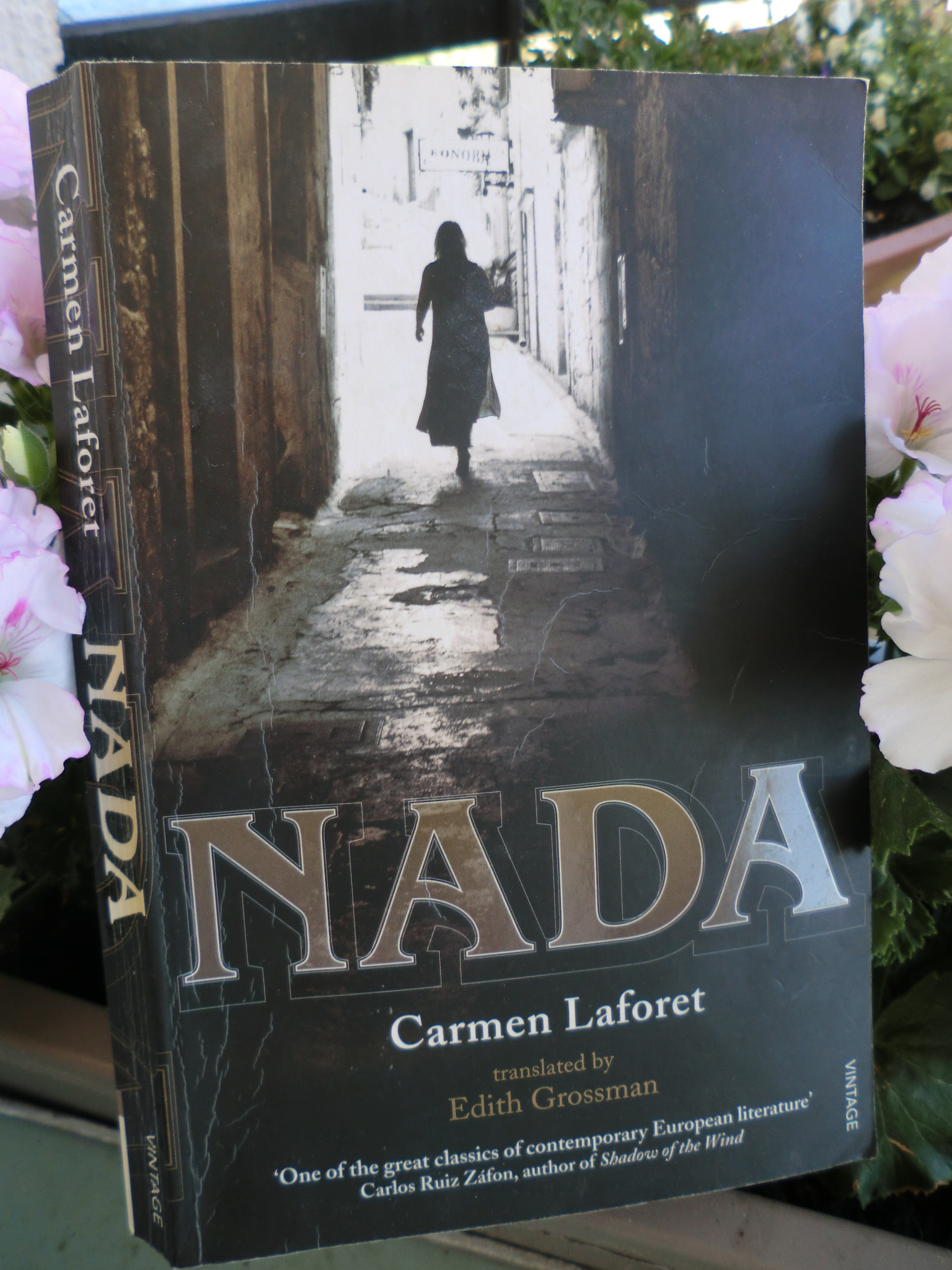
Nada by Carmen Laforet

Nada (2)On a recent visit to London, my Uncle was handing this book back to the friend who lent it to him and I listened intrigued as they discussed its merits. “Isn’t it brilliant?” she said.

Book envy hardly had time to rear its head before my Uncle said “but Claire, you must read this too” and rather than it returning to its owner, this book came home with me, delighted to be off the shelf once more, this time travelling closer to the territory where it was conceived.

Nada was written by Carmen Laforet when she was 23 years old and first published in Spanish in 1945. Born in Barcelona, she moved to Las Palmas in the Canary Islands when she was 2 years old and like her protagonist Andrea, moved to Barcelona when she was 18 to study literature and philosophy.

Edith Grossman, who also translated Gabriel Garcia Marquez and Mario Vargas Llosa (who writes a brilliant introduction in the opening pages) puts Nada into English in what Alberto Manguel describes as “a fluid translation”, one that I read as if it has been written in English as its first language. The book was finally published in 2007, three years after the death of its author.

Andrea has spent a dreamy summer in her hometown, looking forward to coming to Barcelona to study and spend time with her family she hasn’t seen in years and barely remembers. She arrives three hours late and thus finds her way to the Calle de Aribau alone in the dead of night, arriving at the dilapidated apartment to be met by an apparition, a strange gathering of eccentric characters.

gothic barcelonaHer family, weathered by years of neglect, corruption and psychological torment, live in a claustrophobic environment that causes Andrea to develop her own eccentric behaviour in an effort to escape theirs. The house is inhabited by her two uncles, Juan and Roman, her aunt Angustias, the maid Antonia, and Juan’s wife, Gloria, plus a menagerie of cats, an old dog and a parrot.

“That illuminated twinkling of stars brought back in a rush all my hopes regarding Barcelona until the moment I’d entered this atmosphere of perverse people and furniture. I was afraid to get into the bed that resembled a coffin. I think I was trembling with undefinable terrors when I put out the candle.”

Though never mentioned, the city and its people are in the shadow of the recent civil war which has pushed the population to its extremity, people are either starving or drowning in excess, oblivious to the plight of the depleted middle class, who grasp onto whatever they can, the more practical selling the candelabra and curtains no longer given occasion to flaunt their long-lost beauty.

“The memory of nights on Calle de Aribau comes to me now. Those nights that ran like a black river beneath the bridges of the days, nights when stagnant odours gave off the breath of ghosts.”

Carmen Laforet 1921 - 2004

Carmen Laforet 1921 – 2004

Carmen Laforet writes in a way that makes the reader experience the brutality of each encounter, while instilling in us something of the toughness of Andrea, we seem to know she will handle it all, despite her growing thinner by the day as she observes the decline into madness of her extended family.

The depth of the prose is extraordinary and intriguing, the kind of work that makes a reader want to listen to the writer talk about what inspired them and what was going through their mind when these words flowed onto the page.

Carmen Laforet has created a heroine who is witness to a decline, who is oppressed by it and at the same time somewhat oblivious to it, captured it with an intensity that causes us anguish, the story sits uncomfortably with the reader but compels us to turn the pages ravenously. An utterly absorbing and spellbinding read, what a treasure that took so long to be shared with the English reading world.

“She achieved this, and half a century after it was published, her beautiful, terrible novel still lives.” Mario Vargas Losa


Further Reading

Elena’s Books and Reviews – an excellent review by Spanish blogger, Elena Adler. Studying literature and humanities, her insights add much value to our reading and comprehension of the underlying tensions and dysfunction of society post the civil war.

The GuardianAlberto Manguel hails the first appearance in English of the modern Spanish classic Nada.