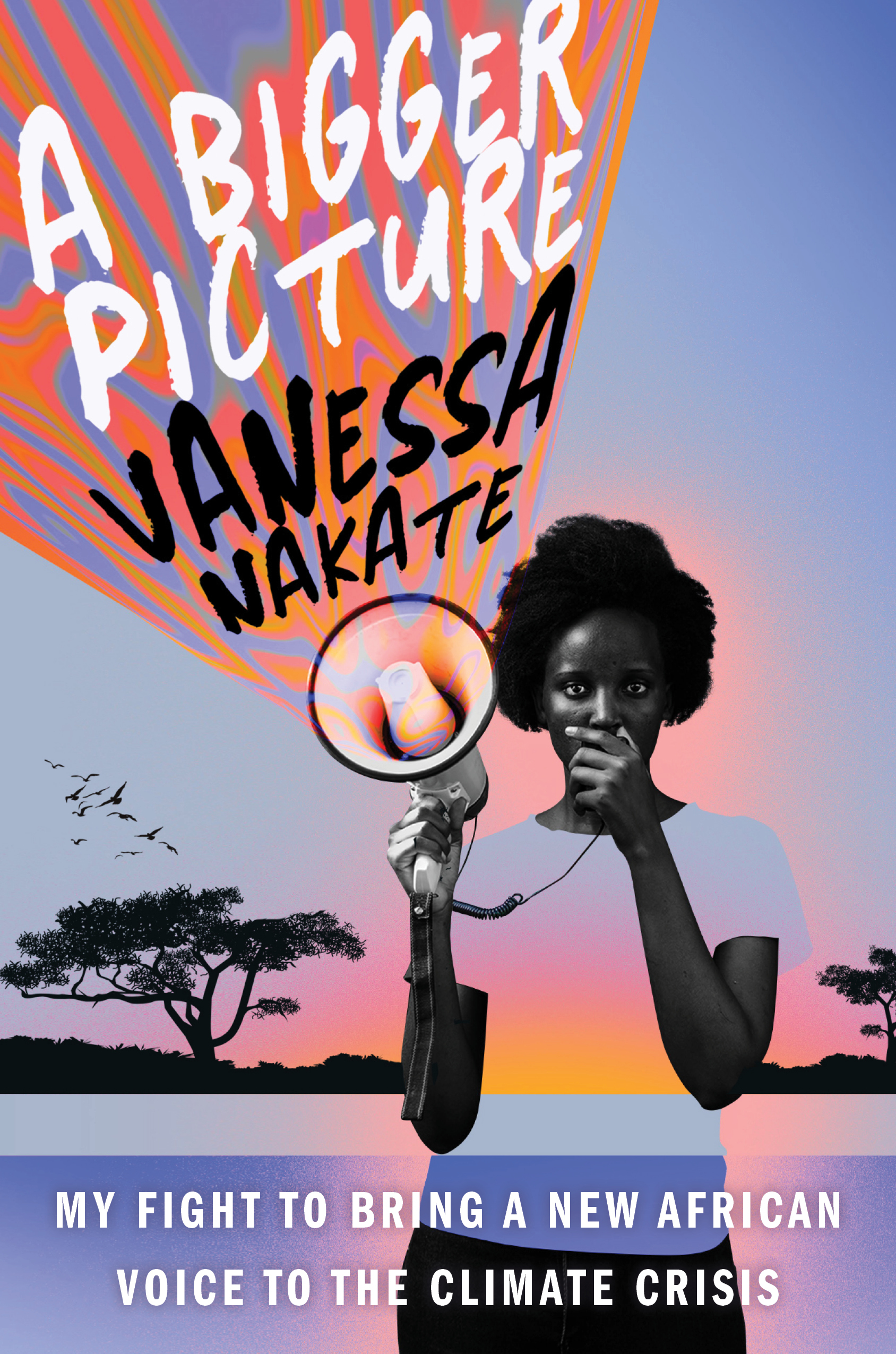
A Bigger Picture by Vanessa Nakate

My Fight To Bring A New African Voice To The Climate Crisis

Vanessa Nakate is a young Ugandan woman who became concerned about the effect of climatic conditions and change on her country and in particular the knock on effect floods, crop destruction would have on women and girls, disproportionately affected, as explained in her book.

Alternative Learning Experiences for Children

climate change literature Kenya African Voices

She decided to organise a strike, just herself, her two younger brothers (14 & 10), two visiting cousins (11 &9) and another cousin her age. It would be the six of them, holding up a few placards they made, and they would stand in four busy locations in Kampala, moving from each place after 30 minutes when her alarm went off.

“What shall we write?” Varak, the nine-year-old asked.
I wanted us to express something positive, and to ensure that my younger family members held placards they themselves would understand. We decided to pick slogans we thought wouldn’t be too threatening, and so wrote several, in English.
Trees Are Important For Us
Nature Is Life
When You Plant A Tree, You Plant A Forest
Thanks For The Global Warming (that was our sarcastic one) and
Climate Strike Now
We also drew some trees next to the letters.

Nothing dramatic happened, no one told to stop, but it was the beginning of an interest, of a young woman finding her cause and taking an action, that would lead her to learning and discovering more, to connecting with others, to finding local solutions and developing a presence and a new voice, on an international stage.

One woman stopped and told them of some trees being cut down to make way for a school, that they should be stopped. Each time Nakate went out and had the opportunity to engage or had a response on social media, it would often lead her to the next idea, it would put her in touch with others who genuinely wanted something to be done, their voices to be heard.

How One Exclusion Can Lead to Greater Inclusion

It is an excellent read, because it follows her personal journey, as a young person with little knowledge about activism and from this small spark of quiet daring (despite her anxieties, insecurities and fear of judgement), she shares her perseverance, her growing knowledge, the first invitations to attend international conferences and events, to a tipping point, when many more (including me) would hear about her – after she was cropped out of a photograph of young climate change activists including Greta Thunberg at Davos, Switzerland during the WEF (World Economic Forum) in January 2020.

My message was, and is, straightforward: People in Uganda, in Africa, and across what’s called the Global South, are losing their homes, their harvests, their incomes, even their lives, and any hopes of a livable future right now.

The Quiet Methodical, Cooperative Approach

What makes her message and her actions all the more interesting is that she takes a quiet methodical approach to doing things in her own authentic way, in a country where she is aware of both dangers and expectations, so does nothing foolhardy, acting responsibly.

However, when there is the opportunity for advancement of her cause and for manageable solutions she can implement herself, she steps up to those and has helped make life more amenable for many families already, while continuing to pursue the wider message, especially to young people, future leaders, for whom it will be better if they encounter this knowledge through their early education, than as adults already fixed in their opinions or influenced by position or power.

Since I’m always looking for solutions that reflect reality and the need to get the message out, I decided that instead of suggesting that students walk out of classes, I’d try to take the climate strikes into schools – where they could form part of the curriculum in a way that I’d wished climate change had been when I was a young girl.

The first school she approached in this way was open to this collaboration, the teachers assembled 100 students inside the compound, Vanessa Nakate gave a short speech explaining what the strike was about, in a way that could relate to and then lead them in a chant, the teachers encouraging the children to chant even louder.

What do we want? Climate justice. When do we want it? Now.

Genuine Efforts and Action Do Get Noticed

In 2019 she received an email from the UN Secretary General’s office in New York, an invitation to attend the Youth Climate Summit. Understandably, she and her parents didn’t think it was real, but it was, she would be the first person in her family to travel outside of Uganda and that would signify a new beginning in her self-appointed role.

The first half of the book is about the development of her role, the logistics of trying to attend events and to becoming involved in meaningful solutions at home, such as the Vash Green Schools Project (supports the installation of solar panels and building clean cooking stoves in primary schools) and to realising the need for self-care due to overwhelm.

Role Models and Inspiration, Making Connections

The second half gives a bigger picture of the wider issues, sharing information from others she interviewed and has been inspired by, including the late Wangari Maathai, the inspiring Kenyan woman who created the Green Belt Movement and made much progress (often hindered by men in power) who was the first African woman to win the Nobel Peace Prize in 2004 for ‘her contribution to sustainable development, democracy and peace’. Read my review of her autobiography Unbowed here.

Coincidentally COP28 is happening right now in Dubai and Vanessa Natake is there with others trying to get their message across to world leaders who have the power to phase out fossil fuels and support equitable and safe renewable energies. Her article appearing in today’s Guardian below.

I really enjoyed reading this book and learning more about how Vanessa Natake became a voice for her country and continent and inspired so many youth and adults to both learn and do more to try and halt the destruction that is affecting them all.

Highly Recommended.

Further Reading

The Guardian Opinion: At Cop28 it feels as if humanity’s shared lifeboat is sinking by Vanessa Nakate

Author & Activist, Vanessa Nakate

Vanessa Nakate is a Ugandan climate justice activist. She grew up in Kampala and started her activism in December 2018 after becoming concerned about the unusually high temperatures in her country. Inspired by Greta Thunberg to start her own climate movement in Uganda, Vanessa Nakate began a solitary strike against inaction on the climate crisis in January 2019. She founded the Youth for Future Africa and the Africa-based Rise Up Movement and spearheaded the Save Congo Rainforest campaign.

She has addressed world leaders at multiple climate summits and appeared on the cover of TIME magazine in 2021 (featuring on the Time100 Next list in 2021). She was appointed a UNICEF Goodwill Ambassador in 2022.

Nakate and her work have been featured in the New York Times, the Guardian,Yes!,Vox, Vogue, the Huffington Post, the International Women’s Forum, and the Global Landscapes Forum, and on globalcitizen.org, greenpeace.org, CNN, the BBC, PBS, and United Nations media. She lives in Kampala, Uganda.

Soundings, Journeys in the Company of Whales by Doreen Cunningham

Soundings is a dual narrative memoir, that recounts two journeys a woman makes, pursuing her dream to see the grey whales that migrate up the coast from Mexico where her journey begins, to the northernmost Arctic town of Utqiagvik.

The Iñupiat have thrived there, in a place periodically engulfed in ice and darkness, for thousands of years, bound closely together by their ancient culture and their relationships with the animals they hunt, most notably the magnificent and mysterious bowhead whale. I hadn’t just seen the whales there, I’d joined a family hunting crew, travelling with them in a landscape of astonishing beauty and danger.

Doreen Cunningham Whales memoir nonfiction

The book is structured so that each chapter alternates the twin journeys, the first one when she is a young BBC journalist on a sabbatical – the trip isn’t a job assignment, she is winging it, not knowing ahead of time where she might stay, or that she might join an indigenous whale hunt – to be in a position to observe the whales.

She is going there to listen, observe and with luck, participate.

The idea was that you could immerse yourself in a place and absorb more than if you were questioning people as a reporter and narrowing the world down into stories. I was supposed to take thinking time away from the relentless news cycle, open my mind and return bursting with creativity and new ideas.

The second trip is more of an escape from her current reality, that of a young single mother awarded sole custody, who can not afford to live in her home (due to high mortgage payments), reluctantly returned to her parents home in Jersey – who then decides she wants to make a return trip and provide her two-year-old son a formative experience of travel and whale watching.

I’d felt so alive then, so connected to other people and to the natural world. If only I could feel that way again and give that feeling to Max.

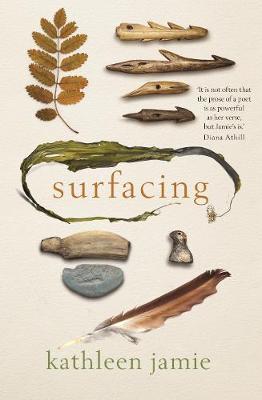
I recalled reading Scottish poet and nature essay writer Kathleen Jamie’s Surfacing, where she visits and brings alive an archaeological site Nunallaq, in the Yup’ik village in Quinhagak, Southern Alaska.

Kathleen Jamie Essays Surfacing Nature Writing

Doreen Cunnningham’s interest in whales and the environment inclines more towards the science, research and a personal desire for a sense of belonging and a large dose of wishful thinking, than the more poetic and philosophical Jamie, who went towards the tundra in search of surfaces that might reconnect us to the past. However, the two books together make informative and astonishing reading.

I told myself I would relearn from the whales how to mother, how to endure, how to live.
Beneath the surface, secretly, I longed to get back to northernmost Alaska, to the community who’d kept me safe in the harsh beauty of the Arctic and to Billy, the whale hunter who’d loved me.

Once you realise that the narrative goes back and forth, it becomes easier to stick with it, the chapters in the more recent past focus as much on the logistics of trying to travel with a child, car seat and stroller, finding kindred spirits who might assist getting her on a boat to see the whales, while doing her best to avoid those fellow travellers who look askance at a young mother, attempting the extraordinary.

As they travel, she also shares something of the challenges in the past of reporting on climate change, the reluctance to report on the environment and the habit many broadcasters had of always finding a sceptic to present an alternative view to the facts.

What was going on was that media all over the world had regularly been allowing sceptics o misrepresent science without adequately challenging them, and presenting them as though they carried equal scientific weight to mainstream climate researchers…This ‘insistence on bringing in dissident voices into what are in effect settled debates’ created what the report called ‘false balance’.

In her earlier visit, she takes time to listen to their stories, of the first ships that came in, bringing equipment, alcohol and disease. She hears of the social problems of another indigenous people, of children sent away, of PTSD, of a sense of rage and powerlessness, of a need to educate themselves in order to better represent and protect their culture and ways.

She also hears of the effect of the warming of the ocean first hand, its impact on animals, on the ice, on patterns of behaviours, of the risk to their livelihood and comes to understand the importance differences between a people who live in harmony with their environment and depend on it and those who came intent on exploiting it.

We also learn a little of her childhood experiences, of her wild pony Bramble, of an Irish granny and the songs she still sings that the whales seem to respond to. She injects enough of the personal story to keep the pace going, as the flow risks at times being overwhelmed by the facts and background research. However, as I go back and reread the passages I highlighted, I find it interesting to encounter some of this information a second time around, now that I’ve removed the expectation of a flowing narrative.

There is a something in this book for everyone, it defies genre and shows the gentle, yet vulnerable courage of a young mother persevering against the odds, seizing the reins of her life, following her intuition and going on a grand adventure with a small boy, who is perhaps more likely the greater teacher to her than the elusive whales, on motherhood.

Doreen Cunningham, Author

Doreen Cunningham is an Irish-British writer born in Wales. After studying engineering she worked briefly in climate related research at NERC and in storm modelling at Newcastle University, before turning to journalism. She worked for the BBC World Service for twenty years as an international news presenter, editor, producer and reporter.

She won the RSL Giles St Aubyn Award 2020 and was shortlisted for the Eccles Centre and Hay Festival Writers Award 2021 for Soundings, her first book.

The Booker Prize Longlist 2023

The Booker Prize longlist has been announced, featuring books from four continents, representing seven countries – Scotland, England, Ireland, Canada, America, Nigeria and Malaysia and includes four Irish writers plus four debut novelists.

You can read more about the history of the prize here.

The Judges

Novelist Esi Edugyan, twice-shortlisted for the Booker Prize, is the chair of the 2023 judging panel. She is joined by actor, writer and director Adjoa Andoh; poet, lecturer, editor and critic Mary Jean Chan; Professor of English and Comparative Literature at Columbia University and Shakespeare specialist James Shapiro; and actor and writer Robert Webb

The judges are looking for their perceived best sustained work of long-form fiction written in English, selected from entries published in the UK and Ireland between October 1, 2022 and September 30, 2023.

The Booker Dozen

The longlist of 13 books was announced on August 1, 2023 ; the shortlist of six books will follow on September 21 and the winner of the £50,000 prize will be announced on November 26, 2023.

Photo by lil artsy on Pexels.com

The 13 longlisted books explore universal and topical themes: from deeply moving personal dramas to tragi-comic family sagas; from the effects of climate change to the oppression of minorities; from scientific breakthroughs to competitive sport.

The list includes: 

  • 10 writers longlisted for the first time, including four debut novelists 
  • Three writers with seven previous nominations between them 
  • Writers from seven countries across four continents  
  • Four Irish writers, making up a third of the longlist for the first time 
  • A novel featuring a neurodiverse protagonist, written from personal experience 
  • ‘All 13 novels cast new light on what it means to exist in our time, and they do so in original and thrilling ways,’ according to Esi Edugyan, Chair of the judges
fiction

The House of Doors – by Tan Twan Eng

Based on real events, Tan Twan Eng’s masterful novel of public morality and private truth examines love and betrayal under the shadow of Empire

It is 1921 and at Cassowary House in the Straits Settlements of Penang, Robert Hamlyn is a well-to-do lawyer, his steely wife Lesley a society hostess. Their lives are invigorated when Willie, an old friend of Robert’s, comes to stay.   

Willie Somerset Maugham is one of the greatest writers of his day. But he is beleaguered by an unhappy marriage, ill-health and business interests that have gone badly awry. He is also struggling to write. The more Lesley’s friendship with Willie grows, the more clearly she see him as he is – a man who has no choice but to mask his true self.  

As Willie prepares to face his demons, Lesley confides secrets of her own, including her connection to the case of an Englishwoman charged with murder in the Kuala Lumpur courts – a tragedy drawn from fact, and worthy of fiction.  

The Bee Sting by Paul Murray (Ireland)

A patch of ice on the road, a casual favour to a charming stranger, a bee caught beneath a bridal veil – can a single moment of bad luck change the direction of a life?

Dickie’s once-lucrative car business is going under – but rather than face the music, he’s spending his days in the woods, building an apocalypse-proof bunker. His exasperated wife Imelda is selling off her jewellery on eBay while half-heartedly dodging the attentions of fast-talking cattle farmer Big Mike.  

Meanwhile, teenage daughter Cass, formerly top of her class, seems determined to binge-drink her way to her final exams. And 12-year-old PJ, in debt to local sociopath ‘Ears’ Moran, is putting the final touches to his grand plan to run away. 

Yes, in Paul Murray’s brilliant tragicomic saga, the Barnes family is definitely in trouble. So where did it all go wrong? And if the story has already been written – is there still time to find a happy ending? 

Western Lane by Chetna Maroo (Kenya/London)

Chetna Maroo’s tender and moving debut novel about grief, sisterhood, a teenage girl’s struggle to transcend herself – and squash

Eleven-year-old Gopi has been playing squash since she was old enough to hold a racket. When her mother dies, her father enlists her in a quietly brutal training regimen, and the game becomes her world.  

Slowly, she grows apart from her sisters. Her life is reduced to the sport, guided by its rhythms: the serve, the volley, the drive, the shot and its echo. But on the court, she is not alone. She is with her pa. She is with Ged, a 13-year-old boy with his own formidable talent. She is with the players who have come before her. She is in awe.  

Skilfully deploying the sport of squash as both context and metaphor, Western Lane is a deeply evocative debut about a family grappling with grief, conveyed through crystalline language which reverberates like the sound “of a ball hit clean and hard…with a close echo”

In Ascension by Martin MacInnes (Scotland)

Exploring the natural world with wonder and reverence, this compassionate, deeply inquisitive epic reaches outward to confront the great questions of existence, while looking inward to illuminate the human heart

Leigh grew up in Rotterdam, drawn to the waterfront as an escape from her unhappy home life. Enchanted by the undersea world of her childhood, she excels in marine biology, travelling the globe to study ancient organisms.  

When a trench is discovered in the Atlantic Ocean, Leigh joins the exploration team, hoping to find evidence of Earth’s first life forms. What she instead finds calls into question everything we know about our own beginnings, and leaves her facing an impossible choice: to remain with her family, or to embark on a journey across the breadth of the cosmos. 

In this strange and wonderful world, every outward journey – whether to space or the depths of the ocean – is an inward one, as Leigh seeks to move beyond her troubled childhood. In Ascension is a Solaris for the climate-change age.

Prophet Song by Paul Lynch (Ireland)

A mother faces a terrible choice, in Paul Lynch’s exhilarating, propulsive and confrontational portrait of a society on the brink

On a dark, wet evening in Dublin, scientist and mother-of-four Eilish Stack answers her front door to find the GNSB on her doorstep. Two officers from Ireland’s newly formed secret police want to speak with her husband.  

Things are falling apart. Ireland is in the grip of a government that is taking a turn towards tyranny. And as the blood-dimmed tide is loosed, Eilish finds herself caught within the nightmare logic of a collapsing society – assailed by unpredictable forces beyond her control and forced to do whatever it takes to keep her family together.

Paul Lynch’s harrowing and dystopian Prophet Song vividly renders a mother’s determination to protect her family as Ireland’s liberal democracy slides inexorably and terrifyingly into totalitarianism. Readers will find it timely and unforgettable. It’s a remarkable accomplishment for a novelist to capture the social and political anxieties of our moment so compellingly.

All the Little Bird-Hearts by Viktoria Lloyd-Barlow (England)

Viktoria Lloyd-Barlow’s lyrical and poignant debut novel offers a deft exploration of motherhood, vulnerability and the complexity of human relationships

Sunday Forrester does things more carefully than most people. On quiet days, she must eat only white foods. Her etiquette handbook guides her through confusing social situations, and to escape, she turns to her treasury of Sicilian folklore. The one thing very much out of her control is Dolly – her clever, headstrong daughter, now on the cusp of leaving home.  

Into this carefully ordered world step Vita and Rollo, a charming couple who move in next door.

Written from the perspective of an autistic mother, All the Little Bird-Hearts is a poetic debut which masterfully intertwines themes of familial love, friendship, class, prejudice and trauma with psychological acuity and wit.

Pearl by Siân Hughes (England)

Siân Hughes contemplates both the power and the fragility of the human mind in her haunting debut novel, which was inspired by the medieval poem of the same name

Marianne is eight years old when her mother goes missing. Left behind with her baby brother and grieving father in a ramshackle house on the edge of a small village, she clings to the fragmented memories of her mother’s love; the smell of fresh herbs, the games they played, and the songs and stories of her childhood.  

As time passes, Marianne struggles to adjust, fixated on her mother’s disappearance and the secrets she’s sure her father is keeping from her. Discovering a medieval poem called Pearl – and trusting in its promise of consolation – Marianne sets out to make a visual illustration of it, a task that she returns to over and over but somehow never manages to complete.  

Tormented by an unmarked gravestone in an abandoned chapel and the tidal pull of the river, her childhood home begins to crumble as the past leads her down a path of self-destruction. But can art heal Marianne? And will her own future as a mother help her find peace?

Pearl, an exceptional debut novel, is both a mystery story and a meditation on grief, abandonment and consolation, evoking the profundities of the haunting medieval poem. The degree of difficulty in writing a book of this sort – at once quiet and hugely ambitious – is very high. It’s a book that will be passed from hand to hand for a long time to come.

This Other Eden by Paul Harding (USA)

Full of lyricism and power, Paul Harding’s spellbinding novel celebrates the hopes, dreams and resilience of those deemed not to fit in a world brutally intolerant of difference

Inspired by historical events, This Other Eden tells the story of Apple Island: an enclave off the coast of the United States where castaways – in flight from society and its judgment – have landed and built a home.  

In 1792, formerly enslaved Benjamin Honey arrives on the island with his Irish wife, Patience, to make a life together there. More than a century later, the Honeys’ descendants remain, alongside an eccentric, diverse band of neighbours.  

Then comes the intrusion of ‘civilization’: officials determine to ‘cleanse’ the island. A missionary schoolteacher selects one light-skinned boy to save. The rest will succumb to the authorities’ institutions – or cast themselves on the waters in a new Noah’s Ark… 

Based on a relatively unknown true story, Paul Harding’s heartbreakingly beautiful novel transports us to a unique island community scrabbling a living. The panel were moved by the delicate symphony of language, land and narrative that Harding brings to bear on the story of the islanders.

How to Build a Boat by Elaine Feeney (Ireland) (Read my review here)

With tenderness and verve, Elaine Feeney tells the story of how one boy on a unique mission transforms the lives of his teachers, and brings together a community

Jamie O’Neill loves the colour red. He also loves tall trees, patterns, rain that comes with wind, the curvature of many objects, books with dust jackets, cats, rivers and Edgar Allan Poe.  

At the age of 13, there are two things he especially wants in life: to build a Perpetual Motion Machine, and to connect with his mother Noelle, who died when he was born. In his mind, these things are intimately linked.  

And at his new school, where all else is disorientating and overwhelming, he finds two people who might just be able to help him. 

The interweaving stories of Jamie, a teenage boy trying to make sense of the world, and Tess, a teacher at his school, make up this humorous and insightful novel about family and the need for connection. Feeney has written an absorbing coming-of-age story which also explores the restrictions of class and education in a small community. A complex and genuinely moving novel.

If I Survive You by Jonathan Escoffery (USA)

An exhilarating novel-in-stories that pulses with style, heart and barbed humour, while unravelling what it means to carve out an existence between cultures, homes and pay checks

In 1979, as political violence consumes their native Kingston, Topper and Sanya flee to Miami. But they soon learn that the welcome in America will be far from warm.    

Trelawny, their youngest son, comes of age in a society that regards him with suspicion and confusion. Their eldest son Delano’s longing for a better future for his own children is equalled only by his recklessness in trying to secure it.  

As both brothers navigate the obstacles littered in their path – an unreliable father, racism, a financial crisis and Hurricane Andrew – they find themselves pitted against one another. Will their rivalry be the thing that finally tears their family apart?

An astonishingly assured debut novel, lauded by the panel for its clarity, variety and fizzing prose. As the stories move back and forth through geography and time, we are confronted by the immigrants’ eternal questions: who am I now and where do I belong?

Study for Obedience by Sarah Bernstein (Canada/Scotland)

In her accomplished and unsettling second novel, Sarah Bernstein explores themes of prejudice, abuse and guilt through the eyes of a singularly unreliable narrator

A woman moves from the place of her birth to a ‘remote northern country’ to be housekeeper to her brother, whose wife has just left him. Soon after she arrives, a series of unfortunate events occurs: collective bovine hysteria; the death of a ewe and her nearly-born lamb; a local dog’s phantom pregnancy; a potato blight.  

She notices that the community’s suspicion about incomers in general seems to be directed particularly in her case. She feels their hostility growing, pressing at the edges of her brother’s property. Inside the house, although she tends to her brother and his home with the utmost care and attention, he too begins to fall ill… 

Study for Obedience is an absurdist, darkly funny novel about the rise of xenophobia, as seen through the eyes of a stranger in an unnamed town – or is it? Bernstein’s urgent, crystalline prose upsets all our expectations, and what transpires is a meditation on survival itself.

Old God’s Time by Sebastian Barry (Ireland) (Read my review here)

In his beautiful, haunting novel, in which nothing is quite what it seems, Sebastian Barry explores what we live through, what we live with, and what may survive of us

Recently retired policeman Tom Kettle is settling into the quiet of his new home, a lean-to annexed to a Victorian Castle overlooking the Irish Sea. For months he has barely seen a soul, catching only glimpses of his eccentric landlord and a nervous young mother who has moved in next door.  

Occasionally, fond memories of the past return – of his family, his beloved wife June and their two children. But when two former colleagues turn up at his door with questions about a decades-old case, one which Tom never quite came to terms with, he finds himself pulled into the darkest currents of his past. 

A Spell of Good Things by Ayọ̀bámi Adébáyọ̀ (Nigeria/Norwich)

A dazzling story of modern Nigeria and two families caught in the riptides of wealth, power, romantic obsession and political corruption

Ayọ̀bámi Adébáyọ̀’s breathtaking novel shines a light on the haves and have-nots of Nigeria, and the shared humanity that lives in between.  

Eniola is tall for his age, a boy who looks like a man. His father has lost his job, so Eniola spends his days running errands, collecting newspapers and begging – dreaming of a big future.  Wuraola is a golden girl, the perfect child of a wealthy family, and now an exhausted young doctor in her first year of practice. But when sudden violence shatters a family party, Wuraola and Eniola’s lives become inextricably intertwined…

A Spell of Good Things is an examination of class and desire in modern-day Nigeria. While Eniola’s poverty prevents him from getting the education he desperately wants, Wuraola finds that wealth is no barrier against life’s harsher realities. A powerful, staggering read.

* * * * * * * * * *

Have you read any of these novels, or are you tempted by any? A great many unknown authors here, which is exciting, it will be interesting to see how their stories are received by readers.

I haven’t read any of the books mentioned and I have only read two of the nominated authors, Ayọ̀bámi Adébáyọ̀’s Stay With Me which I really enjoyed and Tan Twan Eng’s The Gift of Rain and The Garden of Evening Mists.

I’m always interested in new Irish fiction, so I’ll be taking a good look at those titles and plan to read at the very least, Old God’s Time and How To Build A Boat.

Flight Behaviour by Barbara Kingsolver

Flight Behaviour (2)Barbara Kingsolver’s novel Flight Behaviour started off for me with a sense of déjà vu. There is something about the young character walking up into the forest, the sense that it may be a life changing moment, that evoked a memory of her earlier novel Prodigal Summer. There is something similar between the character of Dellarobia, a young mother of two children, and Deanna, the older wildlife biologist living in the forest, keeping an eye on the threatened coyote species.

Rereading the first line of my review of Prodigal Summer, the connection is obvious:

Animal nature, human nature, bugs and insects, forest life, their dependence and interdependence, habits good and bad and how the balance is affected when death, destruction or any kind of change is introduced; how species adapt, how human beings cope – or don’t – all of this we find in the juxtaposition of creatures assembled from the thoughtful poetic pen of Barbara Kingsolver in Prodigal Summer.

caterpillar-emergingHer latest story tracks another of nature’s creatures whose pattern of migration has changed, attracting scientists, environmentalists and believers. The events of this winter period coincide with Dellarobia’s realisation of what lies beneath her inclination to engage in behaviour likely to destroy her family. She is given the opportunity to work with the scientists and comes to understand that there is an alternative path to changing her life, one that will cause less suffering than the impulsive gesture she was intent on in the first pages.

Flight Behaviour also reminded me a little of Ann Patchett’s State of Wonder, they are both works of literary scientific fiction, stories that follow a particular ‘what if’ scenario. Kingsolver starts with the facts and then creates a hypothetical scenario, which science is trying to prove is related to climate change.

Just as history is sometimes more appealing to absorb through a well-researched historical novel, so too are certain scientific suppositions. And then there are the reactions of the population and how they sort themselves into like-minded categories, less about the science and more about community, faith, belonging and the short-term survival of families whose basic living may be at odds with the conservation of another of nature’s species.

Kingsolver looks at what motivates humanity to take positions against each other, the tendency to seek only those positions that support their belief system or corporate sponsor, regardless of evidence to the contrary, the challenges of the outsider and the blind acceptance of those who accept their lot without question, living in the present on account of mistakes they’ve made in the past.

coyote runningAn enjoyable novel, though slow going for me, there was something about Prodigal Summer that was urgent and compelling, while this book meandered; comparing the experience of these two books is a little like a reflection of the speed of the creatures in their midst.

Flight Behaviour has been short listed in the Women’s Prize for Fiction 2013, Barbara Kingsolver was a recent winner of the prize in 2010 for her excellent novel The Lacuna, one of the first novels reviewed here on Word by Word.