
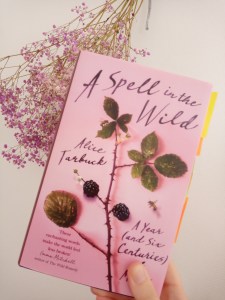
 I came across this book in a newsletter I read by the founders of Tramp Press, who published two nonfiction books I recently read and loved, Doireann Ni Ghriofa’s A Ghost In The Throat and Sara Baume’s Handiwork.
Laura Waddell mentioned hibernation season approaching and the desire to curl up and zone out, which she’d been doing with A Spell in the Wild, describing it as “a witch’s year broken down month by month, full of foraging, feminism, magic, and making meaning” expounding further in this column she wrote for The Scotsman.
At the time I was reading two novels about a woman accused of being a witch, Ann Petry’s Tituba of Salem Village and Maryse Condé’s I, Tituba, Black Witch of Salem and I thought it would be interesting to follow those up with a contemporary view of witchcraft, so the timing of this book, from a Scottish/British perspective, with rich historical references was perfect.
Review
Dr Alice Tarbuck is a woman at the intersection of many interests and influences, a poet, an academic, a keen forager with a practical and intellectual interest in witchcraft. Being such a loaded word, her book is a wonderful celebration of ritual and magic as well as a demystification of things witch-related, from someone who appreciates the natural world, pulling various practices together into her version of ‘witchcraft’, a blend of the practical, spiritual, academic, magical and intuitive.
Magic happens in all those moments when the world and you aren’t separated any longer by any sort of barrier; be it the brain or the body. It is a stepping into awareness of connection, a tuning into that feeling. Witchcraft is, among other things, a good container for trying to communicate these difficult-to-talk about experiences. We aren’t sure how else to articulate them, so we use metaphor, metaphysics, magic.
She records a year living in accordance with this way of being in the world, sharing it from both a practical perspective and through the vast canon of literature that has gone before.
A Spell For Every Season
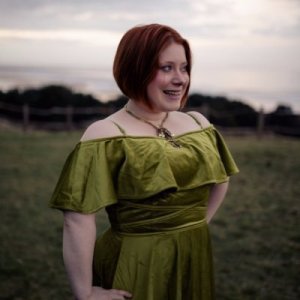
Dr Alice Tarbuck, Author
The book is structured into twelve chapters, months of the year, mapping seasonal occurrences, discovering magic in the ordinary, sharing rituals, spells, making suggestions and backing up her pondering with a wealth of literature, indexed at the end. I read the book straight through, but it can be dipped into month by month.
Reigning in the academic somewhat, makes it an extremely accessible and compelling read, blending in personal experience, musing on and striking back at the snobbery, judgement and the often patronising attitudes of those who diminish the occult as some dark, fanciful indulgence, while applying critical academic rigour and vigour to her subject.
An urban dweller, she seeks to demonstrate and share the possibilities inherent in a city, the sacred spaces, the possibility of urban foraging, making use of what is around, rather than dwelling on what it is not.
Debunking the myths, she makes a case for creating one’s own practices, and takes us along as she enters what might be a more traditional sacred space, a forest near Moniack Mhor, and sits and waits. And gauges everything with a sense of humour and realism.
The ground is soft with the decaying remnants of falling trees, velveted with moss. It’s damp. Unmistakeably, so am I. There is nothing less transcendent than a damp arse. It’s time to go back I think.

Photo by Lisa Fotios on Pexels.com
Reading this in December, the month entitled Midwinter and Magic in the Dark holds particular resonance. Solstice means ‘sun-stop,’ in Neolithic times, sacrifices were made to entreat the sun to return. We in turn become sorcerers of light, following traditions that illuminate, with candles, hanging lights to create a warm ambiance indoors.
It isn’t surprising that humans quickly turn to introspection as the light fails. We light candles against the darkness, and talk long into the night, turning thoughts inward, using the little light left to illuminate our darkest places. Winter can be seen as a time of healing, regrouping, of doing work on ourselves rather than work in the world.
Witches Confessions and Popular Medieval Literature
Tarbuck gives a fascinating short talk, an extension of her April chapter Witches Becoming Animals referring to the trials and subsequent writings that exist around a cotter’s wife Isobel Gowdie’s confession in 1662. She has a wonderful storytelling voice and gives an informative, riveting account, questioning many of the assumptions various writer’s have made about her.
History and reference to the North Berwick witch trials, King James Daeomonologie text, Isobel Gowdie’s confession and Latin treaties on witchcraft make for mesmerising reading.
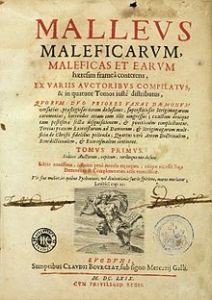
Referring to a popular Latin text that likely influenced King James text, Malleus Maleficarum (The Hammer of Witches) produced in 1487 in Germany, was so popular that by 1669, thirty editions had been published.
It contained among other things why women were particularly prone to satanic seduction, the answer – their weak character and voracious sexual appetite – a misogynistic, church-sanctioned sentiment which echoed throughout medieval witch panics.
Listening to her speak so knowledgeably on her subject in the two talks below, especially the historical context, makes me realise how much Tarbuck has held back, each chapter could easily have been a book. Her ability to narrow it down into something digestible to the everyday reader is exceptional.
Totally down to earth, yet open to the magic of being the silent observer, Alice Tarbuck introduces an enchanting perspective on connecting with nature, creating one’s own simple remedies from urban foraging, keeping and displaying little things one collects on nature walks, inventing spell-poems, (which could as easily be affirmations or prayers) and a little bit of ritual and divination to see one through various difficulties.
Witchcraft is, I believe, the practice of entering into relation with the world, of exerting your will in it and among it, and learning how to work with it in ways that are fruitful for yourself and the world.
The casual, engaging style is a pleasure to read and I couldn’t help but think what a privilege of the 21st century it is, to nonchalantly be able to refer to one’s passion and pastime as witchcraft, without threat of dire consequence. As Tarbuck reminds us, now that witchcraft and research into it is legal, those with an interest are able to reclaim the nuances that were lost during that terrible period of history that condemned women for their ways, opening ourselves up to the more than human environment that surrounds us.
“magic is the superpowerfulness of everything, just as it is” Sabrina Scott
 Handiwork is a pure joy to read, it’s a small book, with often only a paragraph on a page, it has a beautifully thought out structure, referencing a number of different texts that the author, who is an artist, a craftswoman clearly holds dear and memories of her father and grandfather, as family members who worked with their hands.

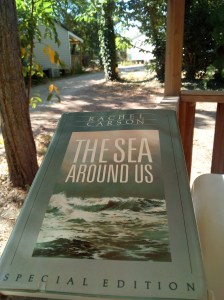 In The Sea Around Us Carson makes the sea her subject, addressing it in three parts, Mother Sea, The Restless Sea and Man and the Sea About Him.

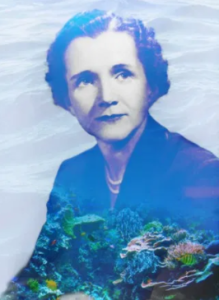
 Following my

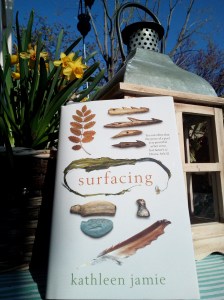 In the second half of Kathleen Jamie’s latest nature writing essay collection, Surfacing, she writes about an archaeological dig on the the island Orkney in Scotland, remembers a trip to a Tibetan town in China in her twenties, and tries to recall voices of her own female ancestors that are beginning to fade from her memory.
 The most famous find, discovered in 2009, is kept in the Heritage centre, where they have a small section, most of the centre given over to more recent Viking finds.
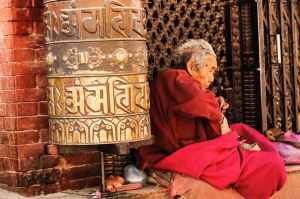


 Every morning at the moment I am reading a chapter of Courageous Dreaming by Alberto Villoldo and this morning I read Chapter Six, Courage As Action, which ends with this exercise to create your own haiku.
 Nature Inspiration

 3.
3.  4.
4. 5.
5. 
 I absolutely loved this, a surprise read, it was a gift from a friend who spends more time living in the wilderness than with humanity. When I read the bio of the author and saw she was a nature writer and wildlife scientist, with a degree in Zoology and a PhD in Animal Behaviour, I was even more attracted to the potential this might infuse, what looked like a murder mystery novel.
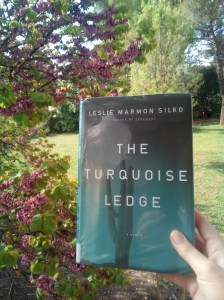 I loved this book. I chose it because I wanted to visit the natural landscape of Tucson through the eyes and insights of a lyrical nature writer. I was also looking for the perfect birthday present for someone who knows that landscape well, to transport them back there, reignite something without having to travel.
 “We learn to ignore the discrepancies between our memory of an event and a sister’s memory. We can’t be certain of anything.
 Word by Word