
Recently someone asked as I live in France, was I reading any French authors, which prompted me to look on my shelves and reflect on this question. There were the two Irène Némirovsky books, ‘All Our Worldly Goods’ and ‘Fire in the Blood’ I read earlier this year and after discovering one of my French students was reading Dostoevsky’s ‘The Idiot’, one of my favourite classics and an excellent study of character, we exchanged books, he lending me Stefan Zweig’s ‘le voyage dans le passé’ (in French and an Austrian author so translated from German) while I gave him Paul Durcan’s epic poem ‘Christmas Day’.
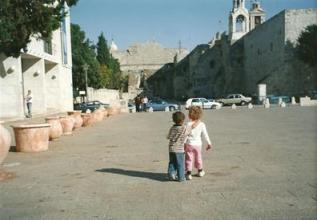
Manger Square, Bethlehem, Nativity Church beyond
I have read a couple of Amélie Nothomb books, ‘Fear and Trembling’ a factional account of her year spent in Japan, which was very funny in an excruciating way and I adored Gustave Flaubert’s ‘Madame Bovary’, a book I’d put off reading for years and finally read it during a two month visit to Bethlehem, a welcome reward following Karen Armstrong’s
 excellent but gruelling ‘A History of Jerusalem’
– One City, Three Faiths after which I had a feeling of absolute awe that there were ANY people left living in that part of the world, having endured one crusade after another as successive peoples carried out their quest to occupy that Holy Land. I also became more wide awake as to how this current generation of people carry the blue eyed gene.
I digress. Back with contemporary literature, my book buddy had mentioned Emmanuel Carrère’s ‘lives other than my own’ to me a few times and her creative writing class are about to be introduced to it, so I found a window of opportunity to read it this week. And what an extraordinary thing it is. Familiar with the phrase ‘truth can be stranger than fiction’; here I am left with the feeling that ‘truth can be as compelling as fiction’.
Emmanuel Carrère was on holiday in Sri Lanka with his girlfriend when the tsunami struck, they had been considering separating and then found themselves in a whirlwind period where the relative significance of these reflections was crushed by that incoming wave and the devastation it wreaked on others.
“Everything that has happened in those five days and was ending then, at that precise moment washed over us. A dam opened, releasing a flood of sorrow, relief, love, all mixed together.
I hugged Hélène and told her, I don’t want to break up anymore, not ever.
She said, I don’t want to break up anymore either.”
The couple return to France only to learn that Hélène’s sister is on a downward spiral with the return of a cancer that she had thought she was rid of when she was a teenager. Juliette, now in her thirties, is a juge d’instance (a judge of small claims and grievances) and has three girls, the youngest only fifteen months old. Through Juliette, Carrère meets her colleague Etienne, a cancer survivor, who shares with the author an insight into both the world of being a cancer survivor and their realm as judges in the small town of Vienne, where they strive and indeed succeed to make a difference.
 What makes this recount all the more extraordinary is the sense of the author’s narcissism, long time chronicler of the tormented self, he readily admits this and while I wouldn’t say that being witness to these events resulted in an absolute cure, it certainly lead him, as the book title suggests, to explore and find some empathy in lives other than his own.
While on the French theme, I would like to mention Patricia Sands, author of ‘The Bridge Club’, another story inspired by the lives of others, Patricia is an advocate of the premise that everyone has a story to tell and she does this not only through her novel but via her blog. Each Friday she posts about France and this week, she has very kindly written a post about this blog, which you can view here. So thank you Patricia and do check out her book.
 A bit of a cultural insight today, but one I think will interest you. I have lived in France for six years and affirming insights continue to delight me, and if you visit France for the first time, they can be a revelation and prevent a lot of frustration.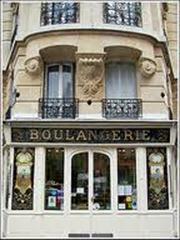
 Word by Word