I read the opening line and let it tell me as much as possible about the story I am about to read.
“Enero Ray, standing firm on the boat, stocky and beardless, swollen-bellied, legs astride, stares hard at the surface of the river and waits, revolver in hand.”
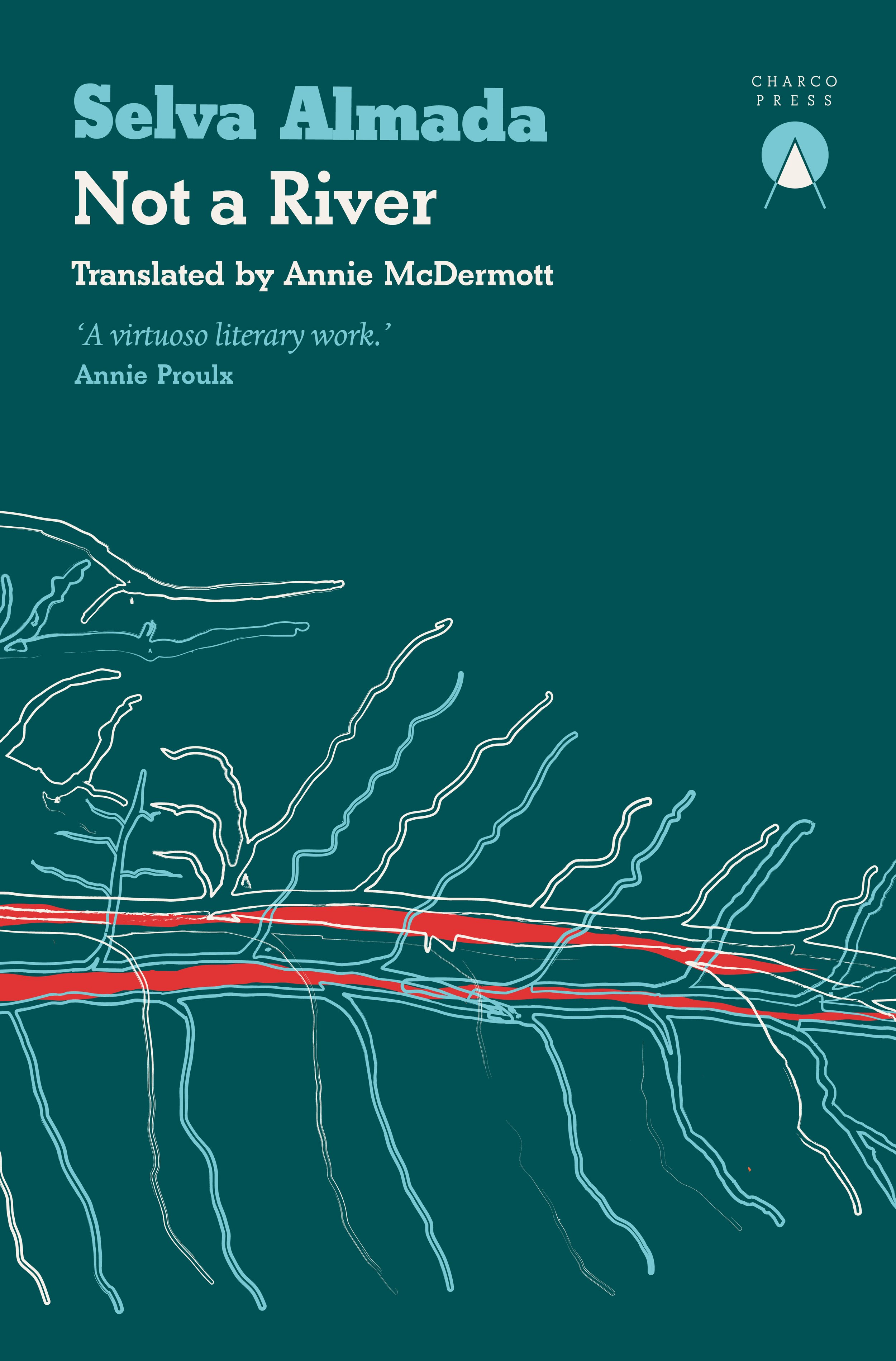
It’s a Charco Press title, so there is always a thought provoking abstract image on the cover, that never fails to contribute to the understanding of what the book has to say. This one shows twin rivers, fed by tributaries, running red.
It is clear that will be blood, death, perhaps menace and/or violence – and more than one episode. Just as the water of the smaller channels has no choice but to flow into the main river, so too the intent of a man standing firm, awaiting his prey. But who/what else will the river claim?
To Understand Any Story We Circle Back
Not a River tells a story, not in a linear way, but in a circular fashion, beginning with two men El Negro and Enero and a boy Tilo, on a fishing trip; circling back to a previous trip when Eusubio was with them, slowly revealing the memory that is acting on both men and what happened to their friend. The fishing trip is further disturbed by a visit from ‘a local’ whose questions unsettle the trio.
The second tributary/narrative follows Siomara and her two daughters Lucy and Mariela. The girls are entering womanhood, the mother is becoming more protective.
Siomara was in one of those phases she sometimes went through, when she was grouchier than usual. Saying no to everything and dealing out punishments and bans for no reason. All because she could see how the two girls were growing, how little by little they were slipping away, how sooner or later they were going to leave her as well.
She lights fires as a way to deal with her emotions, she has done so since she was a girl. She seems to be lighting them a lot recently.
Sometimes she thinks the fire talks to her. Not like a person does, not with words. But there’s something in the crackle, the soft sound of the flames, as if she could almost hear the air burning away, yes, something, right there, that speaks to her alone… Come on, you know you want to. It says.
Again the story turns on itself, something has happened here too, sometimes the mother is living in the past, the present too much for her. The girls hear about a dance and plan to go.
Lucy wants to be a hairdresser. She wants to give other woman those moments of peace her mother seems to feel when she is doing her hair.
The narrative moves back and forth like the tide, people in the community are connected and affected by events that occur at the river. Paths cross, fates intertwine. It is necessary to let go of needing to know whether we are in the past or the present. If certain events happened before or after others. We accept each part of the story’s mosaic, see how they fit together, until all the pieces have been laid.
A summer like this one. Twenty years back, a summer like this one. The same island or the next one along or the one after that. In the memory it’s all just the island, with no name or exact coordinates.
The longer the men stay in the forest, the more uneasy they feel about what they have done, what has happened in the past and how unwelcome and out of place they feel. Invited to a dance, they leave their campsite for the evening.
Eusubio looked at him and thought for a moment. We need to go see my godfather. He knows about this stuff. He said.
Mariela also has a dream, she tells her sister Lucy about it.
And what happened in the dream? I don’t know, like I say I just had a kind of flashback. It was weird, there were lights and sirens.
There is a sense of the repetitive cycles of the generations, girls hide from their families, they grow up to become a mother who can’t help but try and prevent their child from repeating the same mistakes. To keep them safe.
She pretends not to hear. Still just about strong enough to resist. But for how much longer. One day, she knows she will answer the fires’s call.
In less than 100 pages, Not a River depicts disparate elements of a broken community, marginalised families, their efforts to bond, heal, escape, punish, revel and cope with the aftermath of it all.
Selva Almada’s paragraphs are like brushstrokes on a canvas, each one contributes to the story and is necessary in order to see beyond it.
The characters in my novel, men and women who live on what the river can provide, are a reflection of what the neo-liberalism of the 1990s has done to Argentina: impoverishing it, condemning a significant part of its citizens to poverty and marginalization.
Selva Almada
Highly Recommended for fans of thought provoking literary fiction.
Selva Almada is considered one of the most powerful voices of contemporary Argentinian and Latin American literature and one of the most influential feminist intellectuals of the region.
Compared to Carson McCullers, William Faulkner, Flannery O’Connor, Sara Gallardo and Juan Carlos Onetti, Almada has published several novels, a book of short stories and a book of journalistic fiction. She has also published a film diary, written on the set of Lucrecia Martel’s film Zama, based on Antonio di Benedetto’s novel.
She has been a finalist for the Medifé Prize, the Rodolfo Walsh Award and of the Tigre Juan Award. Her work has been translated into French, Italian, Portuguese, German, Dutch, Swedish and Turkish.
Not a River (shortlisted for the Vargas Llosa Prize for Novels) is her fourth book to appear in English after The Wind that Lays Waste (Winner of the EIBF First Book Award 2019), Dead Girls (2020), and Brickmakers (2021).
A reverend and his teenage daughter break down in the middle of nowhere on a steaming hot dry day, after he ignores her advice to get the problem checked before they left the last town (his home town). A visit that caused her to feel both sorry for her father.
But her sympathy didn’t last. At least he could go back to places full of memories…Leni had no lost paradise to visit. Her childhood was very recent, but her memory of it was empty. Thanks to her father, the Reverend Pearson, and his holy mission, all she could remember was the inside of his car.
Leni, now 16, hasn’t seen her mother since the Reverend dumped his wife and her suitcase on one of their road trips.
This happened almost ten years ago. The details of her mother’s face have faded from Leni’s memory, but not the shape of her body: tall, slim, elegant. When she looks at herself in the mirror, she feels that she has inherited her bearing. At first she believed it was just wishful thinking, a desire to resemble her. But since becoming a woman, she has caught her father, more than once, looking at her with a blend of fascination and contempt, the way you might look at someone who stirs up a mixture of good and bad memories.
A truckdriver tows them to ‘the gringo Brauer’s‘ garage, a man raising his teenage son Tapioca alone, the boy abandoned there by his mother when he was 8 years old.
Tapioca’s memories of his mother are vague too. After she left him, he had to get used to his new home. What interested him most was the heap of old cars. The dogs and that mechanical cemetery were a comfort in the first weeks while he was adjusting. He would spend all day among the car bodies: he played at driving them, with three or four dogs as co-pilots. The Gringo left him to it, and approached the boy gradually, as if taming a wild animal.
The father hadn’t finished school himself, his son could read, write and do sums so didn’t see why the boy needed to keep up with it. He decided Tapioca could learn by working and observing nature.
It might not be scientific, but nature and hard work would teach the kid how to be a good person.
The Reverend sees good in the boy and sets his righteous missionary sights on him. Leni sees what’s happening but doesn’t intervene.
Leni had conflicting feelings: she admired the Reverend deeply but disapproved of almost everything her father did. As if her were two different people. Earlier, she had told him to leave Tapioca alone, but if she had joined them on the porch now, she too would have been captivated by his words.
Brauer doesn’t appreciate the Reverend putting ideas in his son’s head, the tension mounts and none of them know yet that there’s a storm coming.
It’s a slow build-up, getting to know the characters, two men set in their ways, with children who rarely question their authority. They are used to being in charge. It’s a short, tense, reflective novella of these two unorthodox families whose lives intersect and cause a disruption, just as the storm breaks a long period of dry.



 Evangalising Across the Argentinian Countryside

 Word by Word