
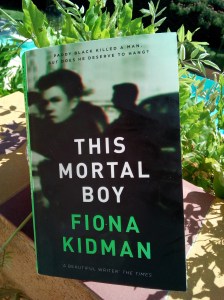
 This Mortal Boy is a fictionalised account of a true crime story. A sensitively written account of the life of Albert Black a young man from Belfast, Northern Ireland who arrived in NZ in the 1950’s on a £10 one-way ticket, guaranteed work for 2 years, who never quite fit in and discovered it was a whole lot more expensive to return, if you decided you didn’t want to stay.
His father hadn’t been conscripted but had gone to war anyway, leaving his wife and young son Albert, who survived the Blitz together, an experience that drew mother and son closer than ever. He never attained the same closeness to his father, who returned a different man.
Remembering how it was, the explosions and the fire raids, the people dying or already dead all about their street, the way she had put Albert on a shelf in a closet and held the door shut against him, leaning her body in with all her might, hoping not to be thrown off her feet when the next blast came. He was barely six at the time, still small enough to put in a cupboard and keep him safe.
Belfast had its own problems and New Zealand seemed like an experience that might be good for him, so his parents bought him a ticket and Albert set off dreaming of getting rich and building a fine house for his family.
Some days she looks at her husband and think it is his fault. Then she thinks it is hers for over-loving him, for not wanting to let him go, and her husband seeing that, and thinking he needed the chance to to grow up, to go to a land of opportunity.
Initially he worked in Wellington where he stuck with his new friend Peter, a young man from Liverpool who he met on the boat, they move in as private boarders with a young widow and her children, but the letters from home give Albert itchy feet; he takes the train to Auckland in search of better paid work to save for his passage home.
He is a gentle, kind lad, one his landlady trusted immediately to take care of her boarding house while she tended to a sick friend. A little lonely he began to frequent a local cafe where he came across a violent young man, who would cause a significant change in his life’s trajectory.
The volatile man called himself Johnny McBride after a character in a Mickey Spillane novel, he was quick to settle any dispute with his fists and feet. Against his better judgement, Albert allowed him to stay a few nights, he overstayed his welcome, their relationship turned sour, ultimately violent, resulting in a death. Albert Black was accused of murder and forced to face a judge and jury unlikely to consider the mitigating circumstances that might have reduced his crime to manslaughter.
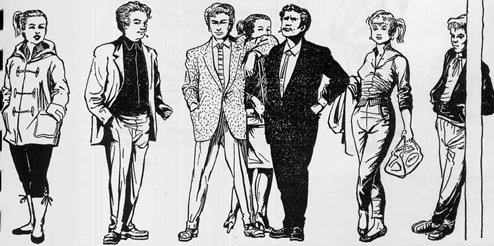
Originally meaning ‘fake, false, inferior, worthless’, the term ‘bodgie’ was applied in the 1950s to a male youth distinguished by his conformity to certain fashions and behaviours. The ‘widgie’ was his female counterpart.
A change in government to a more right wing party and its disapproval of youth culture prompted the Mazengarb inquiry into ‘juvenile delinquency’ and the reintroduction of the previously outlawed death penalty. The government took a hard line on what they perceived as immoral youth and its representatives publicly expressed their prejudice against and contempt for outsiders, often blaming them for this wave of moral delinquency.
The offender is not one of ours. It is unfortunate that we got this undesirable from his homeland.
Delivered to every household it also blamed the perceived promiscuity of the nation’s youth on working mothers, the ready availability of contraceptives, and young women enticing men to have sex. Kidman, who was 15 years old at the time, remembers it arriving at her family home and it being quickly removed before it gave them ideas. It is said to have had no observable impact on young people’s behaviour, rather contributing to the sense of moral panic.*
The report, sent to every New Zealand home, blamed lack of parental supervision for juvenile delinquency and advocated a return to Christianity and traditional values. Excessive wages for teenagers, a decline in the quality of family life, the influence of films, comics and American literature all apparently contributed to the problem. The report provided a basis for new legislation that introduced stricter censorship and restrictions on contraceptive advice to young people.
Albert effectively becomes a scapegoat for a violent message they wished to deliver to wayward youth, and with the odds stacked against him, a terrible verdict is delivered.
…in the eyes of God as in those of conscience, what is a crime when individuals do it is no less an offence when society commits the deed. Victor Hugo
It’s a tragic story of a young man caught in a moment of history that came down hard on youth and migrants. His case was sensationalised by the media and there were a number of irregularities that are likely to have contributed to the verdict.
More than just a novel, Fiona Kidman has requested and hopes for a posthumous pardon for Albert Black, hoping for the sake of his family that he can be seen in a different way to how history has portrayed him. This work helps create more of a balanced view of the young man, his hopes, dreams and intentions in his short-lived life.
I began the story of Albert’s short life and death because it illustrated a theme that has run through my mind for a long time, a concern for young people who make one terrible mistake and have not only had their own lives changed forever, but that of theirs and their victim’s families, and of the wider society.
This Mortal Boy won the Ockham New Zealand Book Award for Fiction.
Further Reading
Article by Fiona Kidman, Irish Times – Chasing justice for a Belfast man hanged in New Zealand
* NZ History – Mazengarb report released, 20 September 1954
More reviews of Fiona Kidman novels, The Captive Wife, The Infinite Air, Songs From the Violet Cafe

Buy a Copy of This Mortal Boy via Book Depository
N.B. Thank to the publisher Gallic Books, Aardvark Bureau for an ARC (advance reader copy) of this book.
 Songs From the Violet Café novel begins and ends with chapters set in 2002, with independent events that take place on the same night, near each other. In Part One, an old boat laden with personal items, private notes and other paraphernalia is set alight and pushed out onto the lake, providing a spectacle for the family and their friends gathered for the occasion.
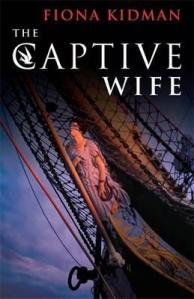


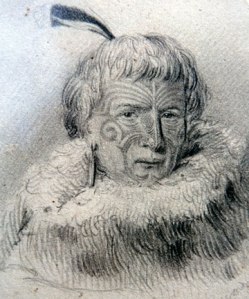 Jacky Guard takes Betty to New Zealand as his wife and they set up home in a bay that is handy for their whaling activities and where it is easy to trade with the native Maori population. Jacky trades with, though doesn’t trust the Maori Rangatira (chief), Te Rauparaha. He is able to negotiate with him, but fears he may have disrespected some of their taboo beliefs. There are constant challenges to their attempt to settle on this land, each time they return to Sydney, their home and belongings are often burned on their return.
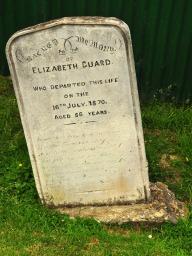 Elizabeth Parker, the Real Betty Guard
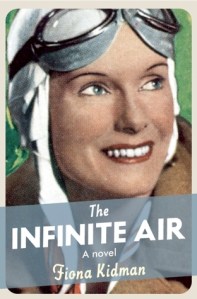
 The Infinite Air is a novel that brings together much that is known about the international aviation legend Jean Batten and through research, letters, radio excerpts brings her character and personality to life, in a more understanding and compassionate way than some of the more judgemental depictions of her in the past, views that hastened to depict her as a gold-digger, due to her adept success at raising the necessary funds to support her desire to break long haul aviation records.

 Word by Word