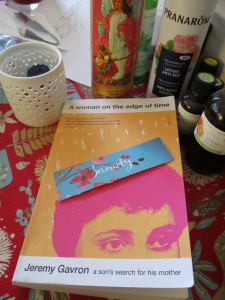
A Woman on the Edge of Time: A Son’s Search for His Mother by Jeremy Gavron

img_0485A Woman on the Edge of  Time is a memoir that reads like a mystery, as Jeremy Gavron, a journalist, interviews family, old school friends, neighbours and colleagues of his mother Hannah Gavron, whom he has little memory of.

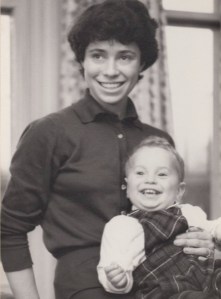
It documents his long-delayed search for a greater understanding of why she took her own life at 29 years of age, a married, working mother of two boys aged four and seven, living in Highgate, London.

It was 1965, she had been on the cusp of publishing a manuscript encapsulating the findings of her sociology research into the conflicts faced by young housebound mothers in North London, The Captive Wife. It was two years since another mother of two young children Sylvia Plath, had done the same thing.

Hannah Gavron was an out-going, confident child, an accomplished, confident teenager, popular and desirous of growing up. She wanted to do something with her life, to share her views with the world, but she also wanted freedom, to leave the constraints of family, to be in love, to claim her place in a rapidly changing society. She married at 18, went to RADA drama school for a year, quit, had two children, then realising her prospects were limited, went back to university to study sociology, attained a PhD and then a teaching post at the “iconic British art institute”, renowned for its experimental and progressive approach, Hornsey College of Art.

It seemed she had everything going for her, and yet at that tender age of 29, when her youngest son Jeremy, was 4 years old, she took her own life, shocking everyone around her.

Now the father of two girls himself, having previously just accepted the subject of his mother was a taboo subject never raised, he is seized by an urgency to know and understand the mystery, for how could it happen that a woman with so much going for her, two small children and a manuscript about to heighten her career, could suddenly end it all?

He interviews an extraordinary number of people and succeeds in recreating the jigsaw of Hannah’s life in incredible detail and begins to understand the multiple forces that may have played a part in leading up to that tragic decision.

As gripping as any mystery, it reads like a pageturner providing an interesting insight into the subject Hannah Gavron wrote her thesis about, ‘The Captive Wife’ and the struggle of women in the early 1960’s, a period just prior to the second wave of feminism, an era whose attitudes and dilemmas were encapsulated in Doris Lessing’s powerful account of a woman searching for her personal and political identity, The Golden Notebook, published in 1962.

 

Looking back from our own times, the subject seems an obvious one, still relevant today, but in 1960 it was neither obvious nor easy for her to get past her academic supervisors. For all the advances gained by the suffragette movement, and the opportunities the war had given woman to work and experience life beyond family,  the woman’s movement was in retreat in the 1950’s and early 1960’s. in the post-war period, emphasis had been put on the role of motherhood in rebuilding Britain. The Beveridge Report, the basis for social reforms, spoke of how ‘housewives as mothers have vital work to do in ensuring the adequate continuance of the British race and of British ideals in the world’.

A woman attempting to forge an academic career in sociology at the time and proposing studies which focused on women as the subject, was provocative and a gesture not ready to be accepted by many in power in academia.

In Her Wake, Nancy Rappaport

In Her Wake, Nancy Rappaport

It reminded me of reading Nancy Rappaport’s In Her Wake: A Child Psychiatrist Explores the Mystery of Her Mother’s Suicide, she too was 4 years old when her mother, who was raising a large family as well as being involved in organising society events and political campaigning, suddenly committed suicide. That drama took place in 1963 in Boston.

They are tragic stories and serve to create a more substantial memory for the authors, piecing together the lives of these woman who should have been able to contribute so much more than they did.

It left me wondering about the author himself, as he keeps himself well out of the narrative, not shining any light on how it had been for him to grow up under this shadow, this absence. How was it for him to accept the love of another mother, how might this turning point have influenced who he would become. Rather he shines his light outward and builds an incredibly detailed vision of his mother, leaving just a hint of suggestion that within her, we may also finds parts of him.

Further Reading

The Guardian, Nov 2015 – Jeremy Gavron: ‘My mother was a woman who looked for solutions. Suicide was a solution’

The Guardian, Apr 2009 – ‘Tell the Boys I Loved Them’

Buy a Copy of A Woman on the Edge of Time Here
 

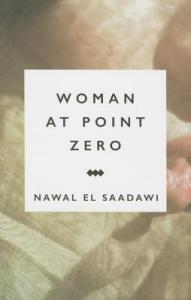
Woman at Point Zero by Nawal El Saadawi (Egypt) tr.Sherif Hetata #WITMonth

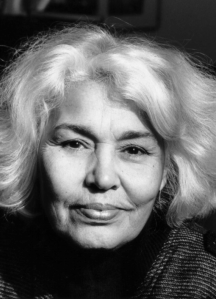
Author Nawal El Saadawi

Author Nawal El Saadawi

Nawal El Saadawi is an internationally renowned feminist writer, activist, physician and psychiatrist. Born outside Cairo, Egypt in 1931, she has published nearly 50 plays, novels and short story collections, translated into over 40 languages worldwide. Many of her works are taught in universities around the world.

While practising as a psychiatrist in the 1970’s she had the opportunity while conducting research into the causes of women suffering from neurosis, to meet with a woman who had been imprisoned for killing a man, a woman who was due to be executed. The woman had refused to speak to anyone until that point, and she had also refused to sign an appeal by the prison Doctor to the President so that her sentence might be commuted to life imprisonment.

The idea of ‘prison’ had always exercised a special attraction for me. I often wondered what prison life was like, especially for women. Perhaps this was because I lived in a country where many prominent intellectuals around me had spent various periods of time in prison for ‘political offences’. My husband had been imprisoned for thirteen years as a ‘political detainee’.

After days of refusal, just as El Saadawi was leaving the prison for the last time, the Doctor told her the woman had agreed to meet her. They spent as many hours as were left of that day together, the woman recounting her the story of her life that had led to that moment.

El Saadawi left at the end of that day, never to see her again. She would be executed by hanging, her story absorbed by El Saadawi who would eventually put it to paper, in this telling of Firdaus or Woman at Point Zero, originally published in 1973.

FirdausFrom her early days, Firdaus was a child who was noticed, though rarely looked out for, instances of cruelty and neglect made up the patchwork of her childhood. “Rescued” by an Uncle who’d already crossed filial boundaries, her one respite was to have been sent by him to school, his new wife further insisting she live there, perhaps the only paradisiacal period of her life, the one time she was left alone to flourish, to evolve, gaining her secondary school certificate, her sole prized possession.
Finding no place for her in her Uncle’s home on leaving school, still a teenager she is forced to marry the more than 60-year-old Uncle of her Aunt, eventually runs from him and is taken in by another only to suffer worse abuse, a fate she seems destined to continue to live through until she meets Sharifa, who takes her in and teaches her how to recognise and extract her value, a turning point in her awareness which will change her fate.

‘How is it possible to live? Life is so hard?’
‘You must be harder than life, Firdaus. Life is very hard. The only people who really live are those who are harder than life itself.’
‘But you are not hard, Sharifa, so how do you manage to live?’
‘I am hard, terribly hard, Firdaus.’
‘No, you are gentle and soft.’
‘My skin is soft, but my heart is cruel, and my bite deadly.’
‘Like a snake?’
‘Yes, exactly like a snake. Life is a snake. They are the same, Firdaus. If the snake realises you are not a snake, it will bite you. And if life knows you have no sting, it will devour you.’

She would learn the value of her flesh, of her person and how to ensure she was rewarded for it, she would find a measure of independence, and wished never to be beholden to man. She became an employee and discovered a world where women were held in even lower esteem, in many ways more a slave than a prostitute.

At various moments in her life, she experienced a feeling that might have been love, experienced like a poetic symptom, ‘two circles of intense black surrounded by two rings of pure white, expanding before my eyes’ but each time it fades to illusion, leaving a dark shadow on her heart.

But I expected something from love. With love I began to imagine I had become a human being…In love, I gave all: my capabilities, my efforts, my feelings, my deepest emotions. Like a saint, I gave everything I had without ever counting the cost. I wanted nothing, nothing at all, except perhaps one thing. To be saved through love from it all. To find myself again, to recover the self I had lost.To become a human being who was not looked upon with scorn, or despised, but respected, and cherished and made to feel whole.

Her story and those moments are narrated in spell-binding, lyrical prose with a compassionate sensitivity that underpins a tale of one woman’s life long oppression and desire to lift herself out of it, to put a stop to the cause of that injustice, to face the truth without fear, which she ultimately did so, through her fearlessness of death, in her absolute refusal to live.

Highly Recommended, a must read.

Buy Woman at Point Zero via Book Depository (Affiliate Link)

WIT logo

ARTE by Kei Ohkubo Episode One #Manga

Arte 1I learned that yesterday was World Book Day and when asked if I did anything to celebrate, I realised that I’d done something I’ve never done before in terms of reading, I finished my first Japanese Manga called ARTE, illustrated and written by Kei Ohkubo translated into French and set in Florence Italy!

My daughter never liked reading books when she was younger and seemed almost stressed out by the appearance of so many words on the page, it provoked some kind of anxiety and there was nothing I could do to encourage her.

One day she came home from school with a book in her hand and didn’t stop to look up and continued to her bedroom to read. I was fascinated, what was this book that got her reading and why was she reading it back to front?

It was a Japanese manga and although it was translated into French, they still published them with the front cover on the back and you must read and turn the pages from right to left, from the back to the front – I am sure this is an excellent brain exercise!

Arte, was the first volume I chose, I wanted to read one myself, though not the genre my daughter reads (and creates – she’s created more than one of her own series preferring storytelling through drawing and dialogue), which has more of a gothic orientation.

I also chose it to show her some images of Italy through storytelling and to reinforce why it is a beautiful language to learn (she started the school year late and there were no more places in Spanish class, so she has been forced to learn Italian).

So reading a new genre that immerses itself into another culture, reading it in another language seemed like a fun way to celebrate World Book Day. And not to mention it has a fabulous, feisty, young woman protagonist, just the thing for an adolescent girl and her mother to read!

Arte lives in Florence at the beginning of the 16th century and dreams of becoming a painter, a wish indulged when her father was still alive, but scorned by her mother after he dies, a young woman must marry to ensure the continued protection and support of the family, her passions were secondary, not deemed important.

arte Ohkubo

Arte rebels against this idea and with determination visits the city’s ateliers in search of an apprenticeship, only to be laughed at and scorned by the community, until one young artisan offers her a challenge, he thinks she won’t achieve, and then must fulfil his promise to let her become his apprentice. Although she is of noble birth and he of humble origin, he discovers they share a common motivation to want to pursue art in their lives.

Eventually he takes her to meet a client, one whom he often makes a portrait of. The client wishes Arte to paint the portrait, thus life begins to change for Arte!

Although the story appears to show painting as a domain for men and Arte a young feminist, wanting equally to indulge her passion and develop her skill, it appears Arte did have contemporaries in the Renaissance period, they were rare indeed and faced numerous challenges.  Four of these women (there were more) produced the stunning self portraits below as well as other great works and were encouraged in their chosen metier.

The book shows the challenge also between young and old, between youthful idealism and middle age fear, the daughter unafraid to pursue her dreams, life has yet to disappoint her greatly, she believes in her own determination, while the mother has lost her protector and her chance to change her own life, so wishes to use the daughter to allay her own fears, to protect her from disappointment, even if at the expense of destroying her spirit.

Further Reading

Female painters from the Italian Renaissance period

Artemisia Lomi Gentileschi (Rome 1593 – Naples 1652)

Liviana Fontana (Bologne 1552 – Rome 1614)

Sofonisba Anguissola (Crémone 1535 – Palerme 1625)

Elisabetta Sirani (Bologne 1638 – 1665)