Time For Outrage, Indignez-vous! by Stéphane Hessel tr. Marion Duvert

Looking Beyond the Ordinary & Expected

On a recent visit to Paris, I accompanied friends on a day-trip to the town of Épernay in the North East of Paris, 30 kilometres south west of Reims. Like Reims, it is known for its champagne houses, vineyards and the close to 50 kilometres of underground tunnels built to store their wine, a veritable underground city.

The town sits on layers of chalk, which gives those underground tunnels their unique aspect that contributes to the uniqueness of their product and why the fierce protection over the use of the word ‘champagne‘. Champagne is only ‘champagne‘ if grown and cellared and produced in the Champagne region of France. If not, its crémant, prosecco, cava, sparkling …

The archbishops of Reims controlled the town of Épernay from the 5th-10th century, it then passed to the counts of Champagne and in 1642 to the Duke of Bouillon.

 It was badly damaged during the Hundred Years’ War, and was burned by Francis I in 1544. Having been destroyed or burned more than 20 times, the town has few ancient buildings, the mansions you can see there today are mostly from the 1800’s.

The Champagne Hillsides, Houses and Cellars are on the World Heritage list for the Protection of World Culture and Heritage for all humanity.


The town also houses some 9th century manuscripts, a wine museum and archaeological artifacts.

Stéphane Hessel encourages youth to engage!

As we wandered along the famous Avenue Champagne with its palatial 19th century mansions, some of which can be visited for wine tastings, I looked for number 31 (a favourite number) to take a photo. At about the halfway point in the long, fairly sterile avenue, it was not a champagne house, but a 2,000 + student lycée (high school), named Lycée Stéphane Hessel.

I was intrigued and delighted to see the name of this institution, certain that it must have been named recently, I knew that Stéphane Hessel had died only 10 years ago.

Indignez vous Time for Outrage

The high school was named in 2013/2014 when the lycée Godart-Roger et lycée Léon-Bourgeois merged to become the lycée Stéphane Hessel, renamed in tribute to this inspirational author of a best-selling essay, written and directed specifically towards youth.

Discovering this lycée was one of the highlights of my visit, I found it brilliantly provocative that in the middle of this world famous avenue of procuring bubbles, sat a human rights activist, member of the Resistance, a voice for peace and equality, the author of a famous essay, written in his 93rd year, 3 years before his death in 2013.

It a short half hour read that has since been translated into numerous languages and sold 4.5 million copies worldwide.

I knew about it because at the Salon de Livre in Paris in 2014, there were massive queues of young people lining up to get their booklet signed by him or to listen to him talk. Journalists were intrigued and wanted to know why these young students were so interested in the words of a very old man. The response was “because he lived it” they said, unlike most who teach us about this era, this man actually lived through everything he has written about. He is authentic, we respect that.

The Essay

Stéphane Hessel wrote his essay in his 93rd year and considered himself fortunate to be able to reflect at that age on events that laid the foundation for his lifelong commitment to politics and human rights.

Born in Germany, he became French in 1939 and in 1941 fled to London and became part of Charles de Gaulle’s group of Resistance members.

He returned to France to organise communications, was captured and sent to Buchenwald, tortured and later sentenced to execution by hanging. He and two others managed to escape execution through an act of identity exchange.

He wrote of the declaration adopted by the National Council of Resistance in March 1944, a set of values and principles created to guide the nation’s modern democracy once it was freed from occupation. He reiterated the importance of many freedoms that came with the end of the war, demanding that they continue to be protected for the good of all.

It is the duty of us all to ensure that our society remain one of which we are proud, not a society wary of immigrants and intent on their expulsion or a society that disputes the welfare state or a society in which the media are controlled by the wealthy.

Find Your Reason

The basic motive of the Resistance was indignation. He addressed his young audience, reminding them of this and implores them to find their reason for indignation, to join the great course of history, to understand the Universal Declaration of Human Rights and if encountering someone who is robbed of these rights, to have empathy and them help them reclaim them.

He wrote about the rise of fascism and his understanding of the origins of it, and how young people today will find their own reasons for expressing their outrage. His indignation was born less of emotion than a desire to engage. He was influenced by the words of Jean-Paul Sartre who said “You must engage – your humanity depends on it.”

The Worst Attitude is Indifference

There are unbearable things all around us, look for them he said:

This is what I tell young people: If you spend a little time searching, you will find your reasons to engage. The worst attitude is indifference. “There’s nothing I can do; I get by” – adopting this mindset will deprive you of one of the fundamental qualities of being human: outrage. Our capacity for protest is indispensable, as is our freedom to engage.

He highlights the challenges, of grievous injustices inflicted on people deprived of the essential requirements for a decent life, the widening gap between rich and poor and the violation of basic freedoms and fundamental rights, citing Franklin Delano Roosevelt’s “Four Freedoms” and his own participation in the creation of the UN’s Universal Declaration of Human Rights.

I will never forget the crucial role played by Eleanor Roosevelt, whose great kindness and natural authority worked wonders to help reconcile the disparate personalities that comprised the commission. She was a vibrant feminist, and it is largely due to her that, for the first time, and on a global scale, the equality of men and women was inscribed without ambiguity in an official text.

His message is one of active engagement, nonviolence and hope, against injustice.

“TO CREATE IS TO RESIST.
TO RESIST IS TO CREATE.”

It is an inspiring short work, that I encourage everyone to read, its message could not be more appropriate at this time, given all that the world is currently facing.

Stéphane Hessel, Author

Stéphane Frédéric Hessel (20 Oct 1917–26 Feb 2013) was a French diplomat, ambassador, writer, concentration camp survivor, French Resistance member. Born in Germany, he became a naturalised French citizen in 1939. He became an observer of the editing of the Universal Declaration of Human Rights of 1948.

In 2011 he was named by Foreign Policy magazine in its list of top global thinkers. In later years his activism focused on economic inequalities, the Israeli-Palestinian conflict and protection for the post-World War II social vision.

His book IndignezVous! (Time for Outrage! )sold 4.5 million copies worldwide. Hessel and his book were linked and cited as an inspiration for the Spanish Indignados, the Arab Spring, the American Occupy Wall Street movement and other political movements.
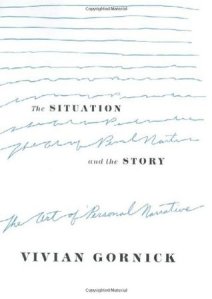

The Situation and the Story by Vivian Gornick

The Art of Personal Narrative

A deliberate slow read for me as I wished to absorb the teaching, while researching and writing my own work, something definitely clicked in my understanding which I hope translates across into my writing.

On The Essay
In the first half Gornick dissects a few essays, citing them as evidence of her theory of the narrative that really demands attention and works, because it has been structured, attention being given to understanding the difference between the situation and the story.

A theory that came to her like an epiphany while attending a funeral, where one person in particular moved her more than the others.

Her words had deepened the atmosphere and penetrated my heart. Why? I wondered even as I brushed away the tears. Why had these words made a difference?

She concludes that because the narrator knew who was speaking, she always knew why she was speaking. She had created a ‘persona’ of herself in order to eulogize the deceased. An instrument of illumination.

The unsurrogated narrator has the monumental task of transforming low-level self interest into the kind of detached empathy required of a piece of writing that is to be of value to the disinterested reader.

But getting from the understanding of a theory to being able to apply it in one’s writing was something that eluded her until she analysed her own attempt of personal journalism (part personal essay and part social criticism) when she was invited to go to Egypt and write about the middle class existence in Cairo. Overwhelmed by the energy of the city, the drama of its citizens, the work mimicked Egypt itself. It would take years before she was able to control the material with sufficient composure to see the situation and narrate the kind of story she wished to share.

Every work of literature has both a situation and a story. The situation is the context or circumstance, sometimes the plot; the story is the emotional experience that preoccupies the writer: the insight, the wisdom, the thing one has come to say.

Using examples from different essays and memoirs, she shares extracts to demonstrate the theory in it’s most eminent form e.g. Augustine’s Confessions, Edmund Gosse’s Father and Son, George Orwell’s Shooting an Elephant, Ackerley’s My Father and Myself.

She compares a trilogy of essays that exhibit the way self-implication can shape a piece of nonfiction writing: Joan Didion’s essay on the companionship of a migraine, ‘In Bed’, Harry Crews’s divided feelings about home in ‘Why I Live Where I Live’ and Edward Hoagland’s disturbing urban nature essay, ‘The Courage of Turtles’.

We are in the presence, in each instance, of a mind puzzling its way out of its own shadows – moving from unearned certainty to thoughtful reconsideration to clarified self-knowledge. The act of clarifying on the page is an intimate part of the metaphor.
Joan Didion, perhaps the most practiced of them all, excavated her subconscious regularly, stayed in touch with the times, and wrote right down to the core of her self-examined existence.

“I have tried in most of the available ways to escape my own migrainous heredity … but I still have migraine. And I have learned now to live with it, learned when to expect it, how to outwit it, even how to regard it, when it does come, as more friend than lodger.”

Joan Didion, ‘In Bed’, 1968

On The Memoir

Truth in a memoir is achieved not through a recital of actual events; it is achieved when the reader comes to believe that the writer is working hard to engage with the experience at hand. What happened to the writer is not what matters; what matters is the large sense that the writer is able to make of what happened. For that, the power of the writing imagination is required.

She posits that modern memoir is of value to the reader only if it is able to dramatise and reflect on the experience of transformation or ‘becoming’ as the writer moves away from that person one has been told they should be towards the more authentic version that might be revealed beneath.

Quoting the example of Gosse’s, Father and Son she observes:

That this son must come into his own by making war not on a parent who is willful and self-involved (which he is) but on one filled with the tender regard that alone gives a growing creature the ability to declare itself (which he also is). This is the thing the reader is meant to register; this is the narrator’s wisdom. It is the betrayal of love that is required in order that one become.

These memoirs that succeed are works that record a steadily changing idea of the emergent self.

For each of them a flash of insight illuminating the idea grew out of the struggle to clarify one’s own formative experience; and in each case the strength and beauty of the writing lie in the power of concentration with which this insight is pursued, and made to become the writer’s organising principle. That principle at work is what makes a memoir literature rather than testament.

Ultimately the advice she gives is to aspiring writer’s is to ask oneself certain questions, both in reading and in writing:

What, we would ask of the manuscript,was the larger preoccupation here? the true experience? the real subject? Not that such questions could be answered, only that it seemed vital to me that they be asked.

That exploration of the subconscious might precipitate insights to rise to the surface and spill over onto the page, by digging deeper, one may stumble across the inner context that makes a piece of writing larger than its immediate circumstance.

“who is speaking, what is being said, and what is the relation between the two” had become my single-minded practice”

She ends with an observation about timing, the thing that a writer can rarely predict.

Writing enters into us when it gives us information about ourselves we are in need of at a time that we are reading.

This explains why a worthy book might be overly criticized while one of fleeting value is highly praised, the former, great though it may be, misses the mark because what it has to say can not be absorbed at the moment, while the latter

is well received because what it is addressing is alive – now, right now – in the shared psyche.Which is perhaps as it should be. The inner life is nourished only if it gets what it needs when it needs it.

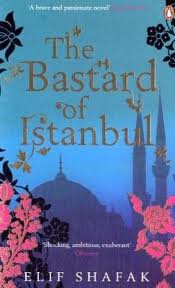
The Happiness of Blond People – A Personal Meditation on the Dangers of Identity by Elif Shafak

011312_1324_TheTigersWi2.jpgBastard of IStanbulElif Shafak writes great stories and as this essay illustrates, she both lives and has already lived an interesting life between East and West; experiencing different cultures and absorbing the influence of a high achieving, single parent mother and her superstitious, story-telling grandmother in a untypical but enriching, matriarchal upbringing.

ElifShafak Ask EbruBilun Wiki

Elif Shafak, Publicity shot by Ebru Bilun – wikipedia

As a young pupil she learnt what it means to be on the receiving end of prejudiced comments, introducing her to the clichéd stereotypes cast about by those who might never have experienced but seemed “to know” what it meant to be Turkish, that false responsibility, those who leave will all take on, for the actions of government or other citizens, on behalf of their maternal country and people.

Elif Shafak has inherited and nurtured a healthy imagination and studied many of the great philosophers, with a particular interest in Rumi, sometimes witnessed through her novels and now combines her knowledge with first-hand observations of how cultural differences are perceived in this short book.

The title of the essay was inspired by a conversation overheard at the Rotterdam airport in the Netherlands between Turkish fathers, one despairing of the difficulty of living in proximity to his downstairs neighbour.  She developed a habit of calling the police each time his children made too much noise playing in the apartment, causing his family much stress and anxiety, because the police invariably arrived with sirens blazing – makes me wonder what story she told the police, and thankful that my neighbour isn’t so bad after all!

The man finishes by asking his friend in earnest, how it is that blond children are so quiet and well-disciplined, introducing us to Shafak’s reflections on identity, cultural difference and the inherent, almost unavoidable angst of first generation immigrants worldwide.

The immigrant must be prepared to swallow his share of humiliations every day. He has to accept that life will treat him with disrespect and that he’ll be smacked and jostled with undue familiarity.

Happiness of Blond PeopleShe discusses the perception that happiness can be found in the West, less likely to have to deal with war, warlords, tribal conflict, poverty, corruption, human-rights violations or major natural disasters and the equally ingrained counter-assumption that life in the East is more real and less degenerate than in the West: where society is so selfish and individualistic that communal and family ties have virtually disappeared, unable to support a person, especially the elderly, in a time of need.

A secondary-school student I met in Ankara during a literary event put this to me in a slightly different way. “If you are young, it is better to live in the West than in the East,” he said. “But if you are old, then it is better to be in the East than in the West, because we respect our elders, whereas they don’t. In Europe I have seen old ladies in supermarkets buying one courgette, one carrot, one tomato, one bunch of parsley. Have you ever seen a Muslim woman doing that? No! We always buy at least half a kilo, if not more, because we cook for the entire family.”

What seems to be missing in the immigration experience is often lack of community, the lack of acceptance or gesture of kindness and therefore difficulty in integration, families are often not made to feel welcome (except among their own kind) which then encourages them to live separately and to maintain their own traditions and cultural perceptions and habits, rather than merging with the new country and culture. It can also breed resentment, particularly if it wasn’t a mutual decision to leave or even a choice, as in times of war.

It is often true that it must take at least one generation to normalise integration, but in more closed communities whose occupants themselves have little curiosity for the outsider or have not travelled and come to understand how and why things are done differently, with an altogether different logic elsewhere, this separation is at risk of continuing into multiple generations, especially where there are clear physical differences between people that can provoke prejudice, judgement or even worse, racism.

HonourFor me, most of the time I enjoy being confronted with those genuine mind-bending situations that require one to figure out how people came to see or do something in a way so different from our own – with the exception of violent or inhumane acts, but even behind those practices, there is a story to be told and a history to be understood, which doesn’t make it right, but can assist us to at least consider these practices in context, something Elif Shafak explores in her latest gripping novel ‘Honour‘.

An immigrant myself, I understand many of the isolating factors inherent in such a status, especially when it is necessary to learn a new language. Whilst it is not easy to participate in a traditional society with its many rituals and social codes, it is more likely that an immigrant will find success and contentment in creating a business or activity of their own, something unique that is or will be valued, than putting themselves up against their compatriots and being disappointed time after time, especially if living outside the larger multicultural cities.

This is a short read and a refreshing, open-minded perspective, from a woman who interacts with people in both the East and the West, always interesting to read and listen to.

In this life, if we are ever going to learn anything, we will be learning it from those who are different from us. It is in the crossroads of ideas, cultures, literatures, traditions, arts and cuisines that humanity has found fertile grounds for growth.