Black Woods Blue Sky by Eowyn Ivey

A new novel by Eowyn Ivey is like no other anticipated novel for me. I still remember the effect of reading her debut The Snow Child, my One Outstanding Read of 2012 and now with Black Woods, Blue Sky, she has created that magic again.

It is extraordinary.

No Madeleine in Sight

The title is a reference to this quote from Marcel Proust:

Black Woods Blue sky by Eowyn Ivey book cover, the words a reference to Proust, the cover shows black tree trunks and a blue background, behind a tree a standing bear, his shadow is the shape of a man

Now are the woods all black
but still the sky is blue
May you always see a blue sky overhead
my young friend
and then
even when the time comes
which is coming now for me
when the woods are black
when night is falling
you will be able to console yourself
as I am doing
by looking up to the sky.

A Nature vs Nurture Conundrum

On the cover, we see the blue sky and the black woods and an image of a standing bear, whose shadow is a man.

It is the story of troubled Birdie, her six year old daughter Emaleen and a reclusive character Arthur, who Birdie is entranced by. In the opening scene Birdie awakens with a hangover, goes off into the woods with a fishing line, leaving her daughter alone sleeping, forgetting to take her rifle.

The large more fearsome grizzly bears were rarely seen, leaving only paw prints or piles of scat in the woods. But now and then, a bear would surprise you. They were too smart to be entirely predictable.

This entire scene is a foreshadowing of the novel, of the attempt of a young, single mother to do right, who doesn’t have sufficient awareness of certain red lines she should not cross, which have nothing to do with the depth of love she has for her child and the determination to do better than how she was mothered.

Though she doesn’t yet know him that well, and despite his odd way of being and other clues that might make her question going off to be with him, she and her daughter depart for the cabin in the mountains where Arthur dwells, not realising they will be living off the grid.

Arthur has some strange tendencies that Birdie tries to understand. Emaleen understands more than her mother and is both sympathetic to him and afraid of him.

The Alaskan Wilderness, Beauty and Bears
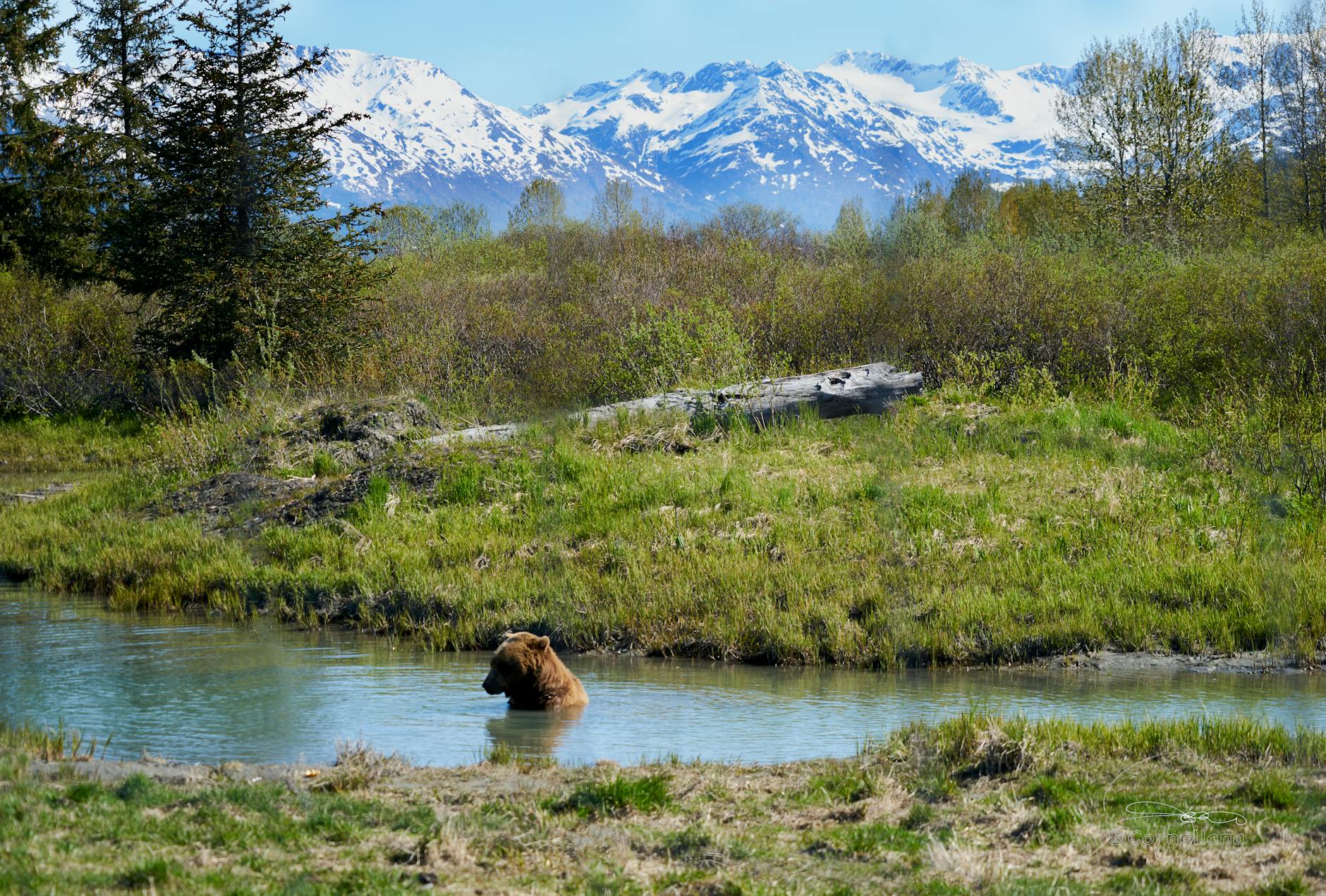
Photo by Francisco C. Castells on Pexels.com

The novel charts their relationship and brings the Akaskan landscape and botanical life alive, in all its beauty and bite.

The novel is told in three parts, each one introduced with a black and white pencil illustration of a native Alaskan plant, one that symbolically has something to say about what will pass.

It is also a study in the nature of the bear, of the similarity of some of their their instincts to humans.

A sow grizzly appeared to care for her cubs with the same tender exasperation as a human mother, and when threatened by a bear twice her size, she wouldn’t hesitate to put herself between the attacker and her offspring. She was the most formidable animal in all of the Alaska wilderness, a sow defending her cub.

In the Wilderness Pay Attention

While the initial period of their stay is encouraging, the signs of discontent are already present and like Icarus who flew too close to the sun, Birdie’s judgement is impaired.

It was impossible, what Birdie wanted. To go alone, to experience the world on her own terms. But also, to share it all with Emaleen.

Photo by Pixabay on Pexels.com

In an attempt to try and appease Birdie, he suggests she takes a day to herself, to be free as she desires. All is well until she is lured by shrubs of blueberries that lead her off course, or was it when she stepped into a ring of mushrooms igniting an age-old curse.

Don’t you dare go blundering into it. That’s what Grandma Jo would say. Witches and fairies danced in a circle here on moonlit nights, the mushrooms sprouting up where their feet touched. If you trespassed inside the circle, they would punish you. You might be forced to dance away the rest of your life in the ring, or, if you escaped, the curse would follow you back home and weave mischief and sorrow through your days.

The novel has a strong element of suspense at the same time as it explores the effect of decisions made by adults on children, on the things that might be overcome and others that are unlikely to. Every character carries something that contributes to our understanding of the story and the responses of the little girl Emaleen highlight much that demands our attention.

Autobiographical Elements

Eowyn Ivey describes Black Woods, Blue Sky as her most personal yet and the most important story she has ever told, with Emaleen being the closest to an autobiographical character she has written. It is a story the author had been trying to figure out how to write her entire life, as she wrote into ‘the darkest fears and most magical memories of childhood’, while demonstrating how people’s choices have a ripple effect through time.

“…the little girl’s fear and sense of magic, the feeling she loves about being so far out in the wilderness of Alaska, but also the thing she is afraid of, that is all directly from me”

It is a heart-stopping, captivating read, unpredictable and nerve-wracking in parts and yet we are able to bear witness, knowing we are safe in the hands of an empathetic, nature loving author, whose authenticity and understanding of human nature resonate throughout the text. Just brilliant.

If you enjoyed The Snow Child, you will love this too. If you haven’t read Eowyn Ivey yet, you’re in for a treat.

Outstanding. Best of 2025.

Author, Eowyn Ivey

Eowyn Ivey is the author of The Snow Child, an international bestseller published in thirty countries, a Richard and Judy Bookclub pick, a finalist for the Pulitzer Prize, and winner of a British Book Award.

Her second novel, To the Bright Edge of the World, was longlisted for the International Dublin Literary Award, shortlisted for the Edward Stanford Travel Writing Award, and was a Washington Post Notable Book.

A former bookseller and reporter, she was raised in and lives in Alaska.

The Bright Edge of the World by Eowyn Ivey

To the Bright EdgeEowyn Ivey was the author of my favourite book of 2012 and one of my all time favourite reads, her debut novel The Snow Child an extraordinary, accomplished work about a childless couple who leave the close-knit support of their child-filled families to try to make a success of ‘homesteading’ in the Alaska wilderness.

I’m not the only one who long-awaited the next thing she would write, a book that was first mentioned a couple of years ago, with the suggested title Shadow of the Wolverine and which would eventually be published in 2016 as To the Bright Edge of the World.

I reviewed this title for Bookbrowse, that review (not the same as my comments below) and an article I wrote about Lieutenant Henry Tureman Allen, can be viewed by members by clicking the link.

bookbrowse_logo
Set in 1885, Ivey’s new book was inspired by real events, and in particular by the adventures of the little known Lieutenant Henry Tureman Allen, an Alaskan Explorer and Decorated US Major General and his Report of an Expedition to the Copper, Tananá, and Kóyukuk Rivers.

The author also cites for inspiration Bram Stoker’s Dracula (first-person voices, use of documents and tremendous suspense), Mary Shelley’s Frankenstein (for its humanity in the face of terror and its time frame) and William Vollmann’s mythological fantasy The Ice-Shirt from the Seven Dream series.

It is narrated firstly through the letters and diary entries of the fictional Lieutenant Allen Forrestor (based on Henry Allen) and his younger wife Sophie, as he makes a commissioned expedition through harsh US owned Alaskan territory up the fictitious Wolverine River, with a small team accompanying him.

His wife Sophie writes him letters and keeps a journal of her time while he is away, so she can share how she spent her time. Sophie is both a woman of her time and ahead of her time, she knows what is expected of her, but has married a man who she hopes accepts she has a mind and a curiosity of her own, a part of her that shall not be tamed.

She takes up photography, learning how to mix chemicals and process plates and spends hours observing birdlife, in some of the most exquisite passages, as she patiently waits to capture a singular event, that might express that moment of pure magic she does not have the words to define, but can recognise instantly in an image, rare though it may be.

allen-team

The Team Who Inspired the Novel

In contemporary time, we also read letters between a descendant of Allen Forrestor named Walter Forrester, who has sent the Colonel’s journals, papers and other items for safekeeping to Josh, the exhibitions curator of the Alpine Historical Museum in Alaska, hoping to convince him to safeguard the documents and artefacts, given they are some of the earliest, firsthand descriptions of those northern lands before colonisation, while still inhabited by native Midnooskies (a Russian word for “people of the Copper River”) and Wolverine River Indians (Ahtna and Eyak tribes).

While it is a novel, the journey upriver was inspired by the expedition of Lieutenant Henry T. Allen (1859 – 1930), a true account Eowyn Ivey came across when the bookshop she worked for acquired a rare copy of Allen’s Report of their Expedition to the Copper, Tanana, and Koyukuk Rivers in the Territory of Alaska.

Ivey took the book home for an evening, staying up late to read it, sharing passages with her husband and was completely fascinated by this piece of Alaskan history she had never heard of before, despite growing up and living all her life there.

In 1885, Allen and two men trekked up the Copper River into completely unmapped territory and encountered Native Alaskans who had never seen white people. The men nearly died many times from starvation and exposure, but eventually they made it through the mountains, down the Yukon River and to Saint Michael.

Though inspired by the Colonel’s expedition, the novel is influenced by other encounters and ancient beliefs she became aware of over time, and it was then the idea for the novel developed:

And at some point it struck me—what if a landscape actively reflected the beliefs of its people? And when these military men ventured into Alaska, what if they had encountered those beliefs as living, breathing, tangible forces?

030412_2011_TheSnowChil1.jpgAnd in a style true to Eowyn Ivey and familiar from her novel The Snow Child (inspired by both a fairy tale and her own life), The Bright Edge of the World might be described she says, as “documentary meets mythology” where certain things the men encounter, they will fail to be able to explain, despite the fact that they all witnessed them. They are things the natives accept and speak of openly, but that these men have no words to describe and are somewhat reluctant to mention.

It is a novel that charts out the recent history of this relatively untamed wilderness and while recognising the beauty and simplicity of a way of life before armies, prospectors and settlers would change it forever, also looks back and recognises that if it were not for those who went first and documented what they found, little of that way of life would be known about and be able to be appreciated today.

The Colonel’s diaries, like the writings of Meriwether Lewis and Captain Cook, are a kind of cursed treasure.

eowyn-ivey

Author, Eowyn Ivey

To the Bright Edge of the World is a wonderful introduction to a little known expedition that opened up further the Alaskan frontiers and a delightful story of a well matched couple, who manage to combine their love of nature and the outdoors with the way they live their lives.

Eowyn Ivey manages to inform and entertain in this worthy follow-up to the magical Snow Child, a novel that was always going to be a tough act to follow.

Click Here to Buy a Copy of To The Bright Edge of the World

Note: This book was an ARC (Advance Reader Copy), thank you to the publisher for providing a copy via NetGalley.

The Snow Child

I recognise in the first two paragraphs the allure of melodic sentences, the promise of picturesque phrases that almost make music as they fly off the page like dancing quavers to craft pictures in my mind of that breath-taking, wild and unforgiving Alaskan landscape.

“Mabel had known there would be silence.”

“She had imagined that in the Alaska wilderness silence would be peaceful, like snow falling at night, air filled with promise but no sound, but that was not what she found.”

Nature’s beauty and harshness leave me in a perpetual state of wonder with an undercurrent of fear and Eowyn Ivey doesn’t waste any time bringing both these sensations to the reader. A walk across the ice river bristles with tension and though I am sure Mabel will be safe, this is only the first chapter after all, I have to pause momentarily and put the book kindle down, my heart racing as I hear imagine that ominous crack.

Mabel and Jack have left the tame pastures of Pennsylvania and the close-knit support of their child filled families to try and make a success of ‘homesteading’ in the Alaska wilderness. The daughter of a literature professor, from a family of privilege, Mabel is finding her own self-imposed exile and the never-ending grief of a stillborn child that rendered them childless, almost too much to bear.

“We needed to do things for ourselves. Does that make any sense? To break your own ground and know it’s yours free and clear.”

    “Here at the world’s edge, far from everything familiar and safe, they would build a new home in the wilderness and do it as partners, out from the shadow of cultivated orchards and expectant generations.”

On a day when Mabel, a believer who often set fairy traps as a child, was near her lowest, she and her husband Jack build a beautiful snow girl from the first winter snow, lovingly sculpted with childlike features and dressed with a blue scarf and red mittens.

“Such delicate features, formed by his calloused hands, a glimpse at his longing.”

Wakened by the cold, Jack catches a glimpse of something passing through the trees on the edge of the forest, a glimpse of a blue scarf and long blond hair flying behind it, disappearing into the trees.

The next morning the snow child has been reduced to a pile of melting snow, the mittens and scarf are gone; footprints lead from the remnant of their powdery infant, across the yard into the trees.

This is no ghost story, but I couldn’t help but make comparisons with my recent read of Susan Hill’s ‘A Woman in Black’, another character who may or may not have been real, in this story there is a genuine intrigue that carries you through some of most beautiful passages of writing both in the depiction of characters and what they experience, as well as the incredible wilderness within which they live, as we try to grasp what she is, this child of the snow.

Red Fox by John Luke

“A red fox darted among the fallen trees. It disappeared for a minute but popped up again, closer to the forest, running with its fluffy red tail held low to the ground. It stopped and turned its head. For a moment its eyes locked with Jack’s, and there, in its narrowing golden irises, he saw the savagery of the place. Like he was staring wilderness itself straight in the eyes.”

For me this story is an exquisite depiction of humanity living alongside nature and the constant to-ing and fro-ing between the seasons, trying to make progress, the necessity of humanity respecting nature and understanding the nature of fellow human beings. When we cease paying attention to either, suffering will undoubtedly follow.

A magical story that unfolds like an extraordinary dream; a unique blend of the inescapable reality of life in the wilderness, beside the quiet affirming beauty of believing in the imagination and visualising life into being.

Note: This book was an Advanced Reader Copy (ARC), provided by the publisher via NetGalley.