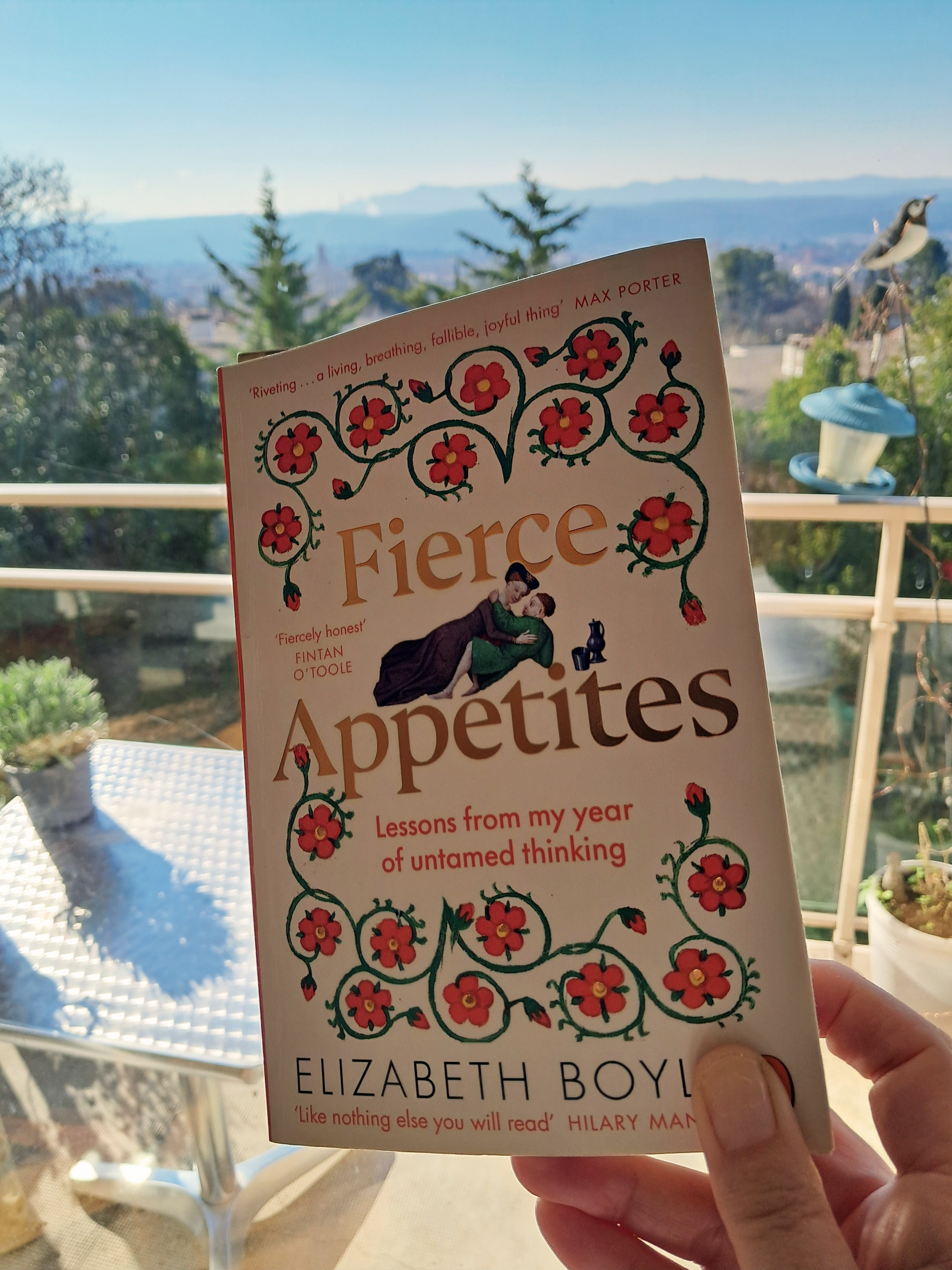
Fierce Appetites by Elizabeth Boyle

Fierce Appetites is my next read for Reading Ireland Month 2025, a nonfiction title I came across in 2022 when it was shortlisted for the Irish Book Awards Non Fiction Book of The Year. It didn’t win the award, that went to the excellent book I reviewed here, journalist Sally Hayden’s My Fourth Time We Drowned.

Lessons From My Year of Untamed Thinking

Fierce Appetites Elizabeth Boyle Medieval Irish literature The Táin Bó Cúailnge

Fierce Appetites is a hybrid memoir, written over the year following the death of the author’s father, which gives her cause to reflect on their relationship, her childhood, her role as a parent/mother, her academic profession and some of the decisions she has made over the years, both the well thought out and the impulsive, those she takes some pride in and others she regrets.

The bonds between different members of a family are explored and pondered and found in the ancient texts.

The world has always been full of stepmothers, foster-mothers, fathers who do the ‘mothering’, aunts and cousins and grandparents who take on primary caring responsibilities, adoptive mothers, institutions that rear children (for better or worse), and innumerable kinds of almost-mothers, surrogate mothers, ‘they-were-like-a-mother-to-me’s. I was reared by a stepmother who mothered me as best she could, even when I sometimes believed she was like the mythic wicked stepmother from a fairy tale, and treated her accordingly.

Writings of the Past

Alongside the memoir aspect, written in 12 chapters, months of the years, her reflections lead into a potted introduction to medieval literature, each chapter finding some connection between the personal narrative and something of the medieval history/literature texts that she is reminded of. In fact each chapter is an essay, but I read it more as an interconnected text.

There is a popular misconception that people in the Middle Ages didn’t grieve as much or as deeply as we do today. Perhaps because of the extremely high rates of infant mortality, and images in modern culture of the Middle Ages as a time of endemic warfare, people tend to think that societies became numbed to death. But the medieval literature of grief disproves that claim. People suffered from the loss of their loved ones then just as much as we do now.
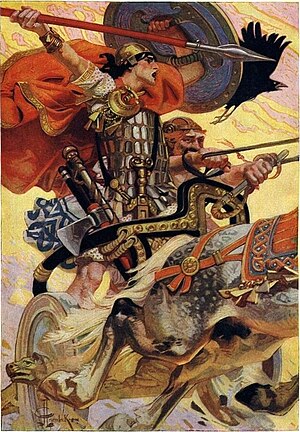
Most of this was unfamiliar to me, as it would be to most people unless you had studied it in university, but that was what initially piqued my interest in the book and I found it fascinating to read about all these references and the translations of those texts and how the author demonstrates how they have something relevant to say today if you care to sit with them and interpret/reflect on their meaning or find a connection, which Elizabeth Boyle does so brilliantly.

The things we fight for, and the reasons we fight for them, can be so elusive, so futile, and yet so deeply felt. Every year, I try to explain the emotional complexities of The Táin: From the Irish Epic Táin Bó Cúailnge to a new generation of students: Fer Diad and Cú Chulainn, fighting on opposite sides of a conflict and yet deeply bound by love for each other; Fergus’s divided loyalties; Medb’s myopic willingness to sacrifice her daughter for the sake of a bull.

They tell us through their stories and poems, how people lived, loved, coped and the scale of their imagination, and we reflect on how much things have or haven’t changed. Boyle not only shares her losses, she shares her excesses, yet this is not a transformational memoir, it is raw and unashamedly wicked, just like some of the characters in those ancient texts.

At the mortuary, we had been handed a NHS leaflet on dealing with grief. One of its sensible pieces of advice is not to make any major life changes in the first year of losing someone close to you. In medieval literature, characters are not given self-help pamphlets. When they suffer grief, they destroy mountains, raze kingdoms, tear their hair out and scorch the earth. I just sat numbly at the kitchen table, drinking gin and sending unwise WhatsApp messages to ex-lovers.

History Repeats
The book was written in 2020, which is also interesting because it was a year that gave many the opportunity to pursue projects like this, and also because of the political climate that gets occasionally referenced.

While Boyle lives in Ireland, she often travels to the UK to see her daughter and abroad to speak on her subject of expertise.

One of the main objections to travel in the Middle Ages was that it led to sin.

When she mentions the political situation, she does so from the point of view of a historian, and these points made from five years ago are interesting to reconsider today.

History is full of incremental improvements and revolutionary convulsions – often these are followed by reactionary backlashes in which rights are revoked, inequalities re-established.

There are so many interesting insights and observations, challenges and meandering trains of thought, I highlighted so many and could easily have spent many more hours looking up the references.

Highly Recommended, if you are curious about medieval literature and balancing family, career and personal interests.

Author, Elizabeth Boyle

Elizabeth Boyle was born in Dublin, grew up in Suffolk and returned to live in Dublin in 2013. She is a medieval historian specialising in the intellectual, literary and religious culture of Ireland and Britain. A former Leverhulme Early Career Fellow at the University of Cambridge, she now works in the Department of Early Irish at Maynooth University, where she was Head of Department for five years until 2020. 

Fierce Appetites is her debut collection of personal essays and was shortlisted for the Irish Book Awards Non Fiction Book of the Year 2022.

Reading Ireland Month 2025 Best Irish literature

The Girl With the Louding Voice by Abi Daré

Back in September 2024, I visited the small Provençal village of Ansouis for their annual vide grenier which included a corner of tables where the local French library sell second hand books in French and English. I like to donate a couple of boxes of books and try not to be too tempted by what I find.

Nigerian Literature and Storytelling

The Girl With the Louding Voice was one of the titles that jumped out at me that I couldn’t resist picking up.

I enjoy Nigerian literature and storytelling, all more so because I visited Lagos for a friend’s wedding many years ago and writing like Abi Daré’s evokes all the senses that bring back memories of being in that place and time.

Not only the location, but the descriptions of people’s lives sounded familiar, those that have been educated outside and come back, the self-made women entrepreneurs who just get on and create businesses as well as raise families and those that you know have never been outside of their country, trying to make their way.

Loss of a Mother Changes Everything

A young girl from a Nigerian village whose life changes multiple times, but a desire for an education, never

14 year old Adunni’s life changes after the death of her mother, who had been keeping the family afloat. Despite the husband having made promises to his dying wife not to marry off his only daughter, he’s unable to keep up with paying the rent and soon his daughter has been promised as the 3rd wife of a much older man.

Why will Morufu pay our community rent? What was he wanting? Or is he owing Papa money from before in the past? I look my papa, my eyes filling with hope that it is not the thing I am thinking. ‘Papa?’

‘Yes.’ Papa, wait, swallow spit and wipe his front head sweat. ‘The rent money is … is among your owo-ori.’

‘My owo-ori? You mean my bride price?’ My heart is starting to break because I am only fourteen years going on fifteen and I am not marrying any foolish stupid old man because I am wanting to go back to school and learn teacher work and become a adult woman and have moneys to be driving car and living in fine house with cushion sofa and be helping my papa and my two brothers.

Marrying Morofu puts Adunni into an environment where a woman’s value is defined by her ability to bear male babies and one where she is in competition with other wives. Adunni doesn’t wish to bring more children into the world with no chance at an education, or voice.

Education is Key

Adunni has held aspirations of continuing her education ever since it was cut short and it is one element of belief and resilience that carries her through the challenges that confront her when a sudden tragedy causes her to flee her situation.

When she finds herself in the busy city of Lagos, working for the self-made Big Madam, she hopes her luck might change. She manages to steal time in the library where she comes across a dictionary and a book of Nigerian facts, in which are written things like:

Fact: Nigerians are known for their love of parties and events. In 2012 alone, Nigerians spent over $59 million on champagne.

Cover of the girl with the louding voice against a blue winter sku

Adunni learns facts about her country, dictionary definitions and new vocabulary and tries to keep herself safe and true to her ideal. Fortunately she also meets one or two characters who look out for her, however Big Madam seems intent on crushing her spirit.

As the novel ends, it feels like a new chapter of her life is beginning and that we may not have heard the last of Adunni.

It’s an excellent read that is very evocative of place, the descriptions of Lagos put you right there, as were the descriptions of the contrasting lives of the haves and the have nots. It highlights that fact that despite the patriarchal society, many households and entrepreneurial businesses are run by women and much of the fragment of society is kept together by their determined contribution and drive.

‘My mama say education will give me a voice. I want more than just a voice, Ms Tia. I want a louding voice,’ I say. ‘I want to enter a room and people will hear me even before I open mout to be speaking. I want to live in this life and help many people so that when I grow old and die, I will still be living through the people I am helping.’

Highly Recommended.

If You Like This Book

Reading The Girl With the Louding Voice reminded me of the equally excellent novels Nervous Conditions (my review here) (the first in a trilogy) by Tsitsi Dangarembga (Zimbabwe) and The Son of the House (reviewed here) by Cheluchi Onyemelukwe-Onuobia (Nigerian/Canadian), which was shortlisted for the Scotiabank Giller Prize (2021).

Author, Abi Daré

Abimbola (Abi) Daré grew up in Lagos, Nigeria and has lived in the UK for eighteen years. She studied law at the University of Wolverhampton and has an M.Sc. in International Project Management from Glasgow Caledonian University as well as an MA in Creative Writing at Birkbeck University of London.

The Girl with the Louding Voice won The Bath Novel Award for unpublished manuscripts in 2018 and was selected as a finalist in 2018 The Literary Consultancy Pen Factor competition. It has been translated into 20 languages.

Her second novel And So I Roar follows Adunni’s and Ms Tia’s journey and was published in 2024. Listen here to Abi Daré talk about the new novel and some of the interesting people who reached out to her after reading her debut, in this 90 second summary of And So I Roar.

In 2023, she established the Louding Voice Educational and Empowerment Foundation in Nigeria, a nonprofit dedicated to providing scholarships to young girls in rural Nigeria.  It exists as a testament to the belief that education and empowerment can be a beacon of change for girls trapped in the shadows of domestic labor and gender-based violence in Nigeria.

Abi lives in Essex with her husband and two daughters, who inspired her to write her debut novel.

Poor, A Memoir by Katriona O’Sullivan

Grit, Courage, and the Life-Changing Value of Self-Belief

Poor is the story of a young woman as she looks back at the circumstances of her birth, childhood and younger years, through the lens of having been raised by parents who were addicts. The middle sibling of five children, she would become pregnant at 15, abandoned and homeless. And then things got even worse – until she began to find the support and mentors she needed to begin the long climb out of a destiny she desperately wished to avoid.

It is a riveting read, constructed from the hopeful perspective of having by chance – in the people she met along the way – found support and been shown how to save herself and the path to higher education.

More importantly this book is essential reading for anyone considering working with children, for parents and those in higher education who might have a tendency to favour “the good, the ideal” student, to think about how we might uplift and give hope to those who might not fit that category.

Turning Points In A Life

Irish Book Awards Biography of the Year 2023

Katriona’s story pinpoints the moments in childhood that mark a life, both the good (the teacher who taught her and facilitated her being able to manage her own cleanliness) and the bad (a man her parents left her with), from which there is no turning back, but perhaps with the right resources, there can eventually be a kind of healing.

Being able to look back and identify those moments that shifted her self-worth, while often devastating to relive, enabled her to understand their impact and address them through appropriate methods, and where they were positive shifts, to cultivate gratitude.

It also highlights the many adults that let these children down.

I know my parents let us down, significantly. The blame is with them. Of course it is. But the world around us let us down too, and in a way, that is worse. Because my parents were drug addicts and that is how it all got so bad and messed up. But the people of the world around us – the police, the teachers, the social workers – they were untrustworthy. They pushed us into a corner and frightened us. How could we have grown up to do anything else but bite them back?
My parents let me down, but so did the world. And the world was where I had to live.

She is one of the few who has managed to climb out, to break a cycle; her story is shared in the hope others who identify, might find the motivation to pull themselves towards something that might bring them out of what is almost inevitable if you’ve grown up in such an environment.

I’d take a heroin addict parent over an alcoholic one any day of the week. That may seem surprising but there is a meanness in booze and horrible unpredictability that you just don’t get with heroin addiction.

Photo by Ahmed akacha on Pexels.com

It is also for those who have never known such misery, to refrain from judgement, to be open to understanding what happens to people in these situations, how they got there, the consequences and the ineffectiveness of today’s government policies in properly identifying the cause, creating and applying appropriate, sustainable solutions.

This isn’t a tale of woe is me or blame, and neither is it a story of a one-off. It is a demonstration of the difficulty of these lives, and a desire to want to change the world in a more caring and empathetic way than it is now, to search for and find and fund solutions, so that more might learn how to follow a different path, when similar struggles are present.

My education has taught me that choice is a myth: our path is set by history and it is very rare for someone to change that path. I am one of the lucky few who escaped the destiny set for me by my parents’ addiction.

Inclusivity and Diversity, We Must Do Better

She challenges educational institutions to do more to be inclusive of struggling students, to strive for the value of greater diversity. “Diversity brings power”.

Although the ‘same’ opportunities are open to people of all backgrounds, we live in a system where those coming from stable, secure childhoods do well and there is no allowance for the struggle of those who don’t. We need equity in education, not equality. If someone can’t see straight because the world is falling in around them, we need to raise them up to clearer skies…and the truth is, we are losing some brilliant minds in the trenches of poverty.

In an interview with the Guardian she expresses her fury at the rhetoric around poverty – that if someone is poor, it is their own moral failing, and if only they worked harder, they could drag themselves out of it. It is society that loses, she points out.

“We’re missing talent, vibrancy and creativity. Because I’ve been empowered, I have been able to change my life, my children’s lives. I’m not costly any more to the state. I’m not doing all of the things that happen when you live in poverty. The people who are making decisions are clearly very educated and yet they don’t seem to have the long-term lens on what investing in reducing poverty can do.”

A brilliant and engaging memoir and an important voice in support of educating children out of poverty.

Highly Recommended.

Poor has been shortlisted for two categories in the 2023 An-Post Irish Book Awards for Biography of the Year and for the Listeners’ Choice Award (winners announced 22 November).

Further Reading/Listening

Irish Times :The Women’s Podcast – Poor by Dr Katriona O’Sullivan – in conversation with Róisín Ingle

Dr Katriona O’Sullivans New Podcast POOR discusses issues relating specifically to poor systems, supports, people and process: Episode 1 Intro, Episode 2 But I Think It’s Ok to Say Fuck!

Irish Times Review: Poor by Katriona O’Sullivan, What Will You Do To Change Society For People Like This? by Lynne Ruane

Guardian Interview: Raised by addicts, abused, neglected, broke: how Katriona O’Sullivan escaped her fate by Emine Saner

Katriona O’Sullivan, Author

Dr Katriona O’Sullivan was born in Coventry to Irish parents. In 1998, at 20, she moved from Birmingham to Dublin and subsequently enrolled in the Trinity College access programme. She went on to gain a PhD in psychology from Trinity and joined its staff.

She now works as a senior lecturer in Digital Skills in Maynooth University’s Department of Psychology. She has worked with policy-makers to develop strategies around education and inclusion, and has been an invited speaker at the UN, the World Education Forum, the European Gender Action Workshop on Women and Digitalization.

Most recently, the programme she leads to improve working class girls’ access to education in STEM subjects won the Most Impactful Initiative Award at the Women in Tech Europe Awards in Amsterdam.

She is married with three children and lives in Dublin. Poor is her first book.  

“I needed encouragement to build my life and the tools to give it structure and strength. I needed tools to understand the world and how to think.

I needed an education.” Katriona O’Sullivan

Minor Feelings by Cathy Park Hong

A Reckoning On Race and The Asian Condition

Essays Race Asian AmericanMinor Feelings is a collection of creative nonfiction essays that invites the reader to view aspects of the life experience of artist and writer Cathy Park Hong, from a little observed and known viewpoint, that of an Asian American woman pursuing her own authentic form of expression, while looking for other role models, disrupting the silence that is expected, through a polemic on race, ethnic origins and art.

There have been a few books published in recent years, on the subject of race and intersectionality, where race intersects with other characteristics such as feminism, gender, class and civil rights.

Cathy Park Hong’s contribution moves between different subjects in seven compelling essays that begin with a memory of her own depression, anger and growing realisation at what was at the core of her disturbance.

In her essays, she deconstructs aspects of life that have contributed to a feeling of oppression and her discovery of artists, comediens and writers, who have overcome something, their example like a stepping stone to her own liberation.

It is a thought provoking exploration of both her own personal experiences and opinions and the examples of other artists, citizens, friends and family that have inspired her to delve into the subject and express a truth.

United

In the opening essay she searches for a therapist, having described what lead her to that moment and then her difficulty in being able to engage with the one she selected.

I wanted a Korean American therapist because then I wouldn’t have to explain myself so much. She’d look at me and just know where I as coming from.

connection race Minor feelings

Photo by DS stories on Pexels.com

Her inability to get what she wants or an adequate explanation, followed by a thought provoking conversation with a friend, prove to be defining moments, as she experiences a moment of equanimity, seeing herself from outside of herself, raising her awareness. Her determination and vulnerability fight it out against each other. Intelligence finally wins.

Racial self-hatred is seeing yourself the way the whites see you, which turns you into your own worst enemy. Your only defense is to be hard on yourself, which becomes compulsive, and therefore a comfort, to peck yourself to death.

Her enterprising and persevering father, who studied his way successfully out of rural poverty, immigrated to the US in 1965 when the ban was lifted. The little detail of the hard working father and the frustrated mother provide a barely visible backdrop to the narrative, yet illuminate a strength, highlight contradictions and suggest future avenues not unexplored by this collection.

Stand Up

In this essay she finds inspiration listening to and watching Richard Pryor’s 1979 classic concert film Live in Concert, leading to an epiphany, a brief career in comedy and a deeper understanding of her world.

Pryor told lies – by spinning stories, ranting, boasting, and impersonating everything from a bowling pin to an orgasming hillbilly. And by telling lies, Pryor was more honest about race than most poems and novels I was reading at the time.

The transparency she finds in stand up comedy is like an apprenticeship in opening up and practicing in front of an audience. Comedians can’t pretend they don’t have an identity. They can’t hide behind words, they stand inside them.

It is here she defines for us what ‘minor feelings’ are, acknowledging a debt to cultural theorist Sianne Ngai who wrote extensively on non-cathartic  ‘ugly feelings‘ – negative emotions such as envy, irritation and boredom.

Minor feelings occur when American optimism is enforced upon you, which contradicts your own racialized reality, thereby creating a static of cognitive dissonance. You are told, “Things are so much better,” while you think, Things are the same. You are told, “Asian Americans are so successful,” while you feel like a failure. This optimism sets up false expectations that increase this feeling of dysphoria.

The End of White Innocence

Here Park Hong looks sideways at childhood, finding her own definition for what that means, dissecting Wes Anderson’s Moonrise Kingdom, set in 1965 – a violent, landmark year for the civil rights movement, the assassination of Malcom X – yet manages to avoid everything outside the nostalgic memories it recreates.

Moonrise Kingdom is just one of countless contemporary films, works of literature, pieces of music, and lifestyle choices where wishing for innocent times means fetishizing an era when the nation was violently hostile to anyone different.

She writes of innocence and shame, of power dynamics, disobedience and indignity.

The alignment of childhood with innocence is an Anglo-American invention that wasn’t popularised until the nineteenth century. Before that in the West, children were treated like little adults who were, if they were raised Calvinist, damned to hell unless they found salvation.

Bad English

Recalling her early school education and affinity with bad English, her fascination with stationery.

It was once a source of shame, but now I say it proudly: bad English is my heritage. I share a literary lineage with writers who make the unmastering of English their rallying cry – who queer it, twerk it, Calibanize it, other it by hijacking English and and warping it to a fugitive tongue.

An Education

The final essays focus on her university years, her influential friendships and the path of being an artist and eventually moving away from painting and sketching towards poetry and narrative.

The greatest gift my parents gave me was making it possible for me to choose my education and career, which I can’t say for the kids I knew in Koreatown who felt bound to lift their parents out of debt and grueling seven-day workweeks.

Her focus is on her friendship with two friends in particular, unapologetically ambitious artists Erin and Helen, deflecting interest in her mother. The poet Hoa Nguyen persevered:

“You have an Asian mother,” she said. “She has to be interesting.”

I must defer, at least for now. I’d rather write about my friendship with Asian women first. My mother would take over, breaching the walls of these essays, until it is only her.

Portrait of an Artist

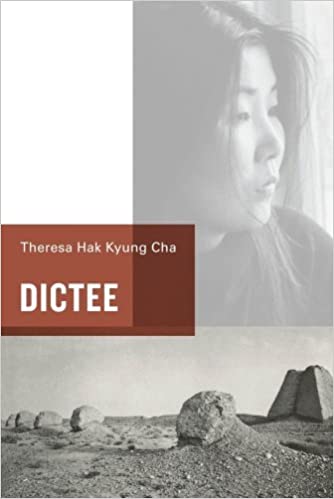
Asian American visual artist poetA tribute to thirty one year old artist and poet Theresa Hak Kyung  Cha visual artist and poet who on the day she hand delivered an envelope of photographs of hands, for an upcoming group show at Artists Space Gallery, whose book Dictée had just been published, was raped and murdered on her way to join her husband, by a security guard, who knew her.

Cathy Park Hong comes across Dictée when it is assigned by a visiting professor, ‘a bricolage of memoir, poetry, essay, diagrams and photography.’

Published in 1982..Dictée is about mothers and martyrs, revolutionaries and uprisings. Divided into nine chapters named after the Greek muses, Dictée documents the violence of Korean history through the personal stories of Cha’s mother and the seventeen-year-old Yu Guan Soon, who led the protest against the Japanese occupation of Korea and then died from being tortured by Japanese soldiers in prison.

Struggling to find much out about her, she brings the life of this exceptional artist out of the silence she has been buried, back into focus. What she finds is extraordinary.

The problem with silence is that it can’t speak up and say why it is silent. And so silence collects, becomes amplified, takes on a life outside our intentions, in that silence can get misread as indifference, or avoidance, or even shame, and eventually this silence passes over into forgetting.

The Indebted

The final essay looks back at those to whom she is indebted and discusses this trait as a concept, the weight of it, the gift of it. The difference between indebtedness and gratitude.

Further Listening Reading

Podcast New York Times: Still Processing – The Asian-American poet wants to help women and people of color find healing — and clarity — in their rage. Culture Writers Jenna Wortham & Wesley Moram discuss Minor Feelings & talk to Cathy Park Hong, April 2021

Article The New Yorker: “Minor Feelings” and the Possibilities of Asian-American Identity – Cathy Park Hong’s book of essays bled a dormant discomfort out of me with surgical precision by Jia Tolentino

Interviews – NPR, Goop, Kirkus, NY Times, The Atlantic, Vox, The Yale Review, Medium, Glamour and more.

Cathy Park Hong, Poet, Author

Cathy Park Hong has written three books of poetry Translating Mo’um (2002), Dance, Dance, Revolution (2007) chosen by Adrienne Rich for the Barnard Women Poets Prize, Engine Empire (2012). She is the recipient of the Windham-Campbell Prize and fellowships from Guggenheim, the Fulbright Foundation, the National Endowment for the Arts, and the New York Foundation for the Arts. Her writing on politics and her prose and poetry have appeared in the Village Voice, the Guardian, New Republic, Paris Review, Poetry,  Salon, Christian Science Monitor, and New York Times Magazine.

Minor Feelings was a Pulitzer Prize finalist, won the National Book Critics Circle Award for autobiography, and earned her recognition on TIME’s 100 Most Influential People of 2021 list.

She is the poetry editor of the New Republic and is a full professor at Rutgers-Newark University. 

“Cathy Park Hong’s brilliant, penetrating and unforgettable Minor Feelings is what was missing on our shelf of classics….To read this book is to become more human.” –Claudia Rankine, author of Citizen

To My Children’s Children by Sindiwe Magona (1990)

“Until the lioness can tell its own story the story of the hunt will always glorify the hunter.” African Proverb

This first of two autobiographies by South African author Sindiwe Magona was initially published in 1990, and the second volume in 1997.

A Lioness Shares Her Story

Frustrated like many, at seeing her country and people portrayed as backward and uncivilised by colonisers, she decided to rectify the balance, a literary scholar, sharing her life and experience first hand, an important and insightful narrative for a wider audience, dedicated to her own children and grandchildren, and perhaps especially for girls, on their path to womanhood.

In a conversation with anthropologist and activist Elaine Salo, Magona said:

I experienced incredible anger about others writing about us, I asked myself, ‘How dare they write about you?’ I told myself that shouldn’t stop me from writing about myself … There is value in those like me writing about our experiences, who did not study apartheid but lived it.

It is authentic experiences like this, that offer a richness in understanding other cultures from the inside, reading the personal experience of one women in her struggle to raise and support her children, understanding how her childhood and upbringing shaped and supported her, enabling her to cope when other societal support structures let her down.

Review

Autobiography South Africa WomenThe slim autobiography shares stories from her childhood up to the age of 23, all of it taking place in South Africa. In her early years, as was customary among amaXhosa people, she lived with her grandparents. It was often the case while parents were trying to earn a living in starting a new life, that the extended family and home community was the safest, most caring environment for young children to be. There was always someone to look after children, they had food, shelter, company and they thrived.

As she explains, looking back it may have been poverty, but that wasn’t something they were aware of; they belonged, were loved and felt secure. There was no awareness of the link between the colour of one’s skin and a difference in lifestyle, until much later, their paths never crossed, outsiders had no impact on their very young lives.

In such a people-world, filled with a real, immediate, and tangible sense of belongingness, did I spend the earliest years of my life. I was not only wanted, I was loved. I was cherished.
The adults in my world, no doubt, had their cares and their sorrows. But childhood, by its very nature, is a magic-filled world, egocentric, wonderfully carefree, and innocent. Mine was all these things and more.

Generations of Storytellers

Not only did they learn and grow from being socialised in these large families, they listened to stories, passed down the generations. There was always one or two in the family, renowned for their storytelling ability, masters in this art and the children revelled in those evenings when they became the audience to them.

Central to the stories in which people featured, was the bond of love with the concomitants: duty, obedience, responsibility, honour, and orderliness; always orderliness. Like the seasons of the year, life was depicted full of cause and effect, predictability and order; connectedness and oneness.

grayscale photo of woman kissing child

Photo TUBARONES on Pexels.com

In this warm, human environment she spent her first five years, immersed in a group where her place was defined, accepted, giving her all she required and more.

Far from the distant world where white people lived and ruled, busy formulating policies that would soon impact them all, policies that invited in certain immigrants, offering them privileged rights, while denying them of the local black population, restricting their ability to move from one area to another, fracturing families, keeping them in poverty.

Everything changed when her mother left to join her father due to illness, to be near medical support and soon after, her grandmother died, requiring them all to leave and join their parents.

A New Era, Fractured Families and Apartheid

It would be fortuitous timing as a year later, in 1948, the Boers came into power and laws were formulated restricting the movement of Africans. Had her grandmother died later, they may not have legally been able to rejoin them.

The move to live with their parents introduced them to a less harmonious world, one where police raids occurred and crime existed. Within the law or outside the law, there was reason to be more careful and fearful. The importance of attaining an education was the focus, to rise above.

The year I left primary school was the year that education became racially segregated. Hitherto, white pupils, African pupils coloured pupils, and Indian pupils could, theoretically, attend the same school. After 1955, the law forbade that practice. There would be different Departments of Education for the different race groups.

Her years of education were dependent on her attitude, some years she did well, others she lapsed, eventually her focus concentrated on becoming a teacher, though in her initial attempts to secure a position, she would initially be thwarted. Her real life lessons were only just beginning.

Lessons from the Real World

Father began hinting at what might at the root of my problem: I had omitted to offer the Secretary of the School Board “something” and people were telling him it would be donkey’s years before I would get a post if we did not oil  this gentleman’s palm.

Though she had done well in her classes, they were inadequate and wholly misleading as to how to prepare to teach children from poor homes, without textbooks, without exercise books, without materials. Trained to teach children from homes where there was a father and a mother, most of her pupils came from women-headed homes. And those women stayed in at their places of employment: busy being smiling servants minding white babies.

Not having books is one of the misdemeanors punishable by corporal punishment. The beatings and probably the sheer embarrassment that must surely accompany the daily proclamation of one’s poverty, prompted a lot of the pupils to pilfer. The very young do not always understand that poverty is supposed to ennobling…

The first class she would teach would have 72 pupils and had all been well, they should have been aged 11 or 12. All was not well however, the children ranged in age from 9 to 19 and the variation in skills just as wide.

Due to her principled stance, that first job would take a while in coming. Unemployed, but desperate to work, she accepted a job at the local fisheries.

Eventually she is offered a teaching job, experiencing the few joys and many disappointments inherent in an unfair, overstretched, oppressive system.

All along, I had known the agony for which some were destined. Such is the design of the government. And such is the abetting by even those of us who regard ourselves as oppressed.  Which we are. But we are also called upon to help in that oppression and unwittingly become instruments of it.

A Woman’s Lot

And then comes the intersection of youth with a newly developing career and as a woman, the added risk of pregnancy. Magona’s challenges are only just beginning and her teaching jobs will become continuously thwarted by how society expects women to behave. The arrival of her own children will force her from her role and into domestic service herself, and really open her eyes to how the other live.

What I had not known was that their perception of people like us did not quite coincide with our perception of who we were and what we were about.

More than anything, however, being a domestic servant did more to me than it did for me. It introduced me to the fundamentals of racism.

The different families she would work for, each provide key insights that broaden her understanding and perception of the other groups living within the country and how the system aimed to maintain and strengthen the situation in favour of white people.

As this volume comes to an end, Sindiwe’s situation seems dire, however, she delivers some of the most inspiring passages of the book, in the low place she has arrived at, she suddenly sees all that she is grateful for, all that she has, even the abandonment of a husband who had never supported them, she recognises as a freedom and a significant contribution to her own growth.

It is a wonderful and frank autobiography and introduction to an inspiring woman. I’m looking forward to the sequel, Forced to Grow, the same title as the last chapter in this volume, in which she shares how determination and resourcefulness lead her through and out of those challenges we end with here.

Sindiwe Magona

My Childrens Children Memoir Autobiography South AfricaMagona was born in 1943 in the small town of Gungululu near Mthatha, in what was then known as the homeland of Transkei, in the Eastern Cape of South Africa.

She was born five years before colonial Britain handed over power to the Afrikaners. Apartheid was officially introduced in 1948 and with it a series of oppressive and racist laws such as separate living areas and the Bantu education system. It was within this context that Magona grew up.

She is an accomplished poet, dramatist, storyteller, actress and motivational speaker. She spent two decades working for the UN in New York retiring in 2003. Her previously published works include thirty children’s books (in all eleven South African languages), two autobiographies, short story collections and novels.

My writing, on the whole, is my response to current social ills, injustice, misrepresentation, deception – the whole catastrophe that is the human existence. Sindiwe Magona

Further Reading

The Conversation Article: Learning From the Story of Pioneering South African Writer Sindiwe Magona, 5 March, 2021