Having very much enjoyed her previous two novels translated into English A Girl Returned (my review) and A Sister’s Story (my review), I jumped at the chance to read her latest, winner of the 2024 Strega Prize, a novel inspired by a historic true-crime event in the 90’s, a double femicide in the mountainous region of the Abruzzo Apennines in Italy, a novel dedicated to “all the women who survive”.
Brittle or Fragile, the Impact of Events
When the novel opens, its first three chapters, just over a page each, touch on everything to come, Lucia’s daughter Amanda who has returned from Milan on one of the last trains as the pandemic shuts everything down, she stays in her room, barely eats, doesn’t talk, her phone uncharged under the bed. Lucia worries but can get nothing out of her.
Lucia visits her elderly widowed father, who lives in the house she was born, halfway between the town and the mountain. They walk up there and he reminds her all this will be hers one day too, land he owns that he no longer wants responsibility for.
An alarm signal arises from my stomach to my throat, suffocating me. “That’s impossible. You sold this land.” He tried for a long time, he confesses, without success. I’m silent for a while, in the chorus of birds. At regular intervals the cuckoo solos. “After what happened no one wanted it, I couldn’t give it away,” he says, as if to justify himself. “I don’t want it either, it’s a frightening place.” I’ve raised my voice, the last syllables echo. It will be mine of necessity, I’m his only heir.
Eighteen months before, the excitement of her daughter’s departure for Milan, the city where life would open up and happen for her, a grandfather’s pride. Now in quarantine, returned and nothing like that ambitious young woman that had left.
The Present Awakens the Past
Amanda’s reclusiveness awakens Lucia’s memories of those events of 30 years ago and throughout the novel, we learn not only what happened, but of the guilt Lucia carries for her absence and the heaviness that surviving the tragedy cost her friend, who, to make a better life left the place that held those terrible memories.
She doesn’t want to be seen in the town, people said of her, after the crime. No one mentions her anymore now. They’ve all forgotten Doralice and her story. The young people of Amanda’s age never knew her. Our parents didn’t help us stay connected.
With the memories come scenes that depict generational ways of living, ways of being, some things that stay the same, the things that change, the reasons some stay, while others leave.
Lucia recalls trying not to worry about her daughter in the city alone, allowing her her freedom, throwing herself into her work to stop herself taking the train after her. But now she questions whether she underestimated the impact of something that happened to her.
I consoled her as well as I could, from a distance. That time, I really was wrong not to get on a train. Respecting her freedom, I failed her when she needed me. Some boundaries are too subtle for an indecisive mother like me. But do the most stable parents know at every moment the truth of what to do? “Don’t worry, it will pass,” and I believed her.
Although the story is about a crime, the mystery of what happens sits alongside the portrait of a fractured family and community, all impacted by the past, burying it with silence.
Our birthplace had protected us for a long time, or maybe that had been a false impression. We grew up in a single night.
The return of Amanda, interest in the mountain property from a developer and a need for resolution, ultimately brings the community together in an act that will work to heal wounds and create momentum for a new era.
The novel is told in five parts: Amanda, The Girls, Dente del Lupo, The Flight, and The Concert in short chapters, going back and forth in time, revealing aspects of the past of Amanda (recent) and her mother (long ago), while witnessing the changed state of their present and their dual need for healing.
The slow reveal of the tragic murders, alongside understanding how it impacted our narrator, plus her own awakening to the effect of that suppressed event, from the safer distance of 30 years in the future, is skillfully blended with the present day psychological suffering of her daughter, as they move towards recovering.
I thought this was so well portrayed, blending the mystery of tragic events, with inter-generational trauma and present day personal struggles, facing the difficulty of breaking through patterns of silence and repression, of deep caring even without understanding, of the need to forgive oneself and the dedicated perseverance of familial maternal love.
Highly Recommended.
N.B. Thank you to Europa Editions UK for sending me a copy of the novel for review.
Author, Donatella Di Pietrantonio
Donatella Di Pietranonio lives in Penne, Abruzzo, where she practices as a pediatric dentist. She began publishing books in 2011, at the age of 49. In the span of a little more than a decade, she has come to the attention of Italian critics and readers, winning the Campiello Prize with her third novel L’Arminuta (A Girl Returned) in 2017. A Sister’s Story was shortlisted for the prestigious Strega Prize and The Brittle Age the 2024 winner of the Strega and Strega Youth Prize. Her short fiction has been published by Granta Italy.
We first encountered the two sisters in an earlier novel, A Girl Returned. At the time they first met, the elder, the narrator, was being returned to her parents without explanation, 13 years after having been adopted and raised by another couple.
She had given me to another woman to bring up, and yet I had remained her daughter. I will be forever.
Though raised in different neighbourhoods, circumstances, economic conditions and under extremely different parenting, from the moment Adriana first encountered her previously unknown older sister, she became attached, fiercely. Of their mother, our narrator had mixed feelings.
She roused in me an inextricable knot of tenderness and revulsion…
My mother occupied me inside, true and fierce. She remained in large part unknown: I never penetrated the mystery of her hidden affection.
In A Sister’s Story, we encounter them again; the novel opens with the recall of a graduation celebration at Piero’s parent’s country home. Again the novel is narrated by the unnamed elder sister.
I have a photograph of the two of us, in love, looking at each other, Piero with the laurel on his head, eyes of devotion. At the edge of the frame Adriana appears: she entered the shot at the last moment, and her image is blurry, her hair draws a brown wake. She has never been tactful, she interjects herself into everything that has to do with me as if it were hers, including Piero. For her he wasn’t very different from a brother, but nice. My sister is laughing blithely at the lens, ignorant of what was to come for us.
As the narrative returns to the present, the elder sister awakes in a hotel, having travelled overnight from Grenoble back to Italy, confused memories interrupt her thoughts, the result of a telephone call she received that set her out on this journey.
In a now familiar style, unique to Donatella Di Pietrantiono, the present is a mystery, we don’t know why she has returned to where her family came from or what the phone call was about, there is much to fill in since she left. It is clear she has cut ties with many people from her past; the phone call reluctantly yet urgently drawing her back.
Related but moulded by different values and role models the sisters held different aspirations and expectations and behaved nothing like each other. They are deeply connected strangers.
As children we were inseparable, then we had learned to lose each other. She could leave me without news of herself for months, but it had never been this long. She seemed to obey a nomadic instinct: when a place no longer suited her, she abandoned it. Every so often our mother said to her: you’re a Gypsy. Later I was, too, in another way.
The last time the sister’s saw each other, Adriana arrived on her doorstep with a baby, named after their belated brother Vincenzo, denying she was in any danger.
The novel, while moving towards the revelation of the telephone call, explores the complicated relationship between sisters who’ve been formed and wired differently, their desire and struggle to be around each other, their bond and indifference, their separate struggles and opposite ways of dealing with them.
I don’t know when I lost her, where our intimacy was stranded. I can’t trace it to a precise moment, a decisive episode, a quarrel. We only surrendered to distance, or maybe it was what we were secretly looking for: repose, shaking each other off.
It’s an enjoyable read, enhanced by having read the earlier story; while the first novel was compelling and urgent in a way that made me not want to put it down, the sequel was reflective and mysterious. I enjoyed seeing how the sisters evolved into adulthood in such different ways, trying to hold on to their connection, challenged by the ongoing effect of those formative years.
N.B. Thank you kindly to Europa Editions for providing me with a review copy.
A Girl Returned came to my attention because I like to see what Europa Editions are going to be publishing, they are known for bringing Italian literature to readers of the English language and their big title in 2020 will be Elena Ferrante’sThe Lying Life of Adults. One I will be reading soon.
The Adoptee Experience
I chose to read A Girl Returned because I am interested in reading as much as possible, fiction or nonfiction, stories that portray the adoptee experience. And the premise of this book is shocking as the title suggests, when a thirteen year old girl is returned to the family she is born into without being told why or there appearing to be any clear motive.
Though as anyone with a connection with adoption will know, it is rare for the process to exist without the presence of secrets, lies, clandestine activities, resentments, heartbreak and denial.
Book Review
I was thirteen, yet I didn’t know my other mother.
The story opens as a 13-year-old girl struggles up the stairs of an apartment with an unwieldy suitcase and a bag of jumbled shoes. The door is opened by her sister Adriana, whom she has never met.
We looked like each then, more than we do as adults.
Through the months of adjustment that follow, thrown back into the reluctant family she was born into, events are narrated with hindsight, as her memory of that vision of her sister attests. She is determined to unravel the cause of this separation and abandonment by both sets of parents, at birth by her biological family and at 13 by her adoptive family, the latter, whose love she never questioned.
Aware her mother had been suffering, she continues to worry and wonder about her, we the reader do too, trying to imagine and fearful of what might have ailed her that she was unable to share with her only daughter.
Who knew how my mother was. Whether she’d started eating again, whether she was getting out of bed more often. Or if instead she’d been taken to hospital. She hadn’t wanted to tell me anything about her illness, certainly she didn’t want to frighten me, but I had seen her suffering in the past months, she hadn’t even gone to the beach, she who was usually there in the first warm days of May. With her permission I went to our umbrella by myself, since I was grown up now, she said. I had gone the day before my departure and had even had fun with my friends: I didn’t believe that my parents would really find the courage to give me back.
As time passes, small clues diminish her resolve and trust in those around her, who seem to believe in or at least practice, silence and deception. The only way will be to take matters into her own hands.
The idea came to me at night, I reported it to Patrizia in the morning under the umbrella.
The one unexpected joy in her changed circumstances, though she accepts it reluctantly and is wary of it, is the fierce love, and admiration tinged with jealousy, she receives from her younger sister. Like candle light in a dark room, she is luminous yet capable of harm. There are wild differences, given their different upbringings, but there exists the thread of undeniable connection.
I wasn’t acquainted with hunger and I lived like a foreigner among the hungry. The privilege I bore from my earlier life distinguished me, isolated me in the family. I was the arminuta, the one who’d returned. I spoke another language and I no longer knew who I belonged to. I envied my classmates in the town, and even Adriana, for the certainty of their mothers.
Identity, Exile and The Mother
In a brilliant essay-style review, translator Stiliana Milkova suggests that the main concern of the novel is how essential the role of the mother is to our sense of identity.
Looking at mothers as the figures that determine and define who we are allows us to think about A Girl Returned as a novel about exile and dislocation, rather than simply motherhood. The Arminuta (a word that in the language of the Abruzzo region of Italy means “the returned”) is unexpectedly forced to leave her maternal home, or what she considers her maternal home, and exiled to a place whose customs, and even the language, are almost foreign to her.
The longer she stays in this forced exile, the more detached she becomes from both her present and her past, to who she was, is. So much had been tied to a mother’s love or bond. Though she remembers the feeling of being loved, she now questions it, faced with such devastating evidence.
In certain melancholy moods, I felt forgotten. I’d fallen out of her thoughts. There was no longer any reason to exist in the world. I softly repeated the word mamma a hundred times, until it lost all meaning and was only an exercise of the lips. I was an orphan with two living mothers. One had given me up with her milk still on my tongue, the other had given me back at the age of thirteen. I was a child of separations, false or unspoken kinships, distances. I no longer knew who I came from. In my heart I don’t know even now.
A short novel, A Girl Returned packs a powerful, moving punch and generously provides that glimmer of hope, in an unexpected alliance. Rereading these passages I highlighted makes me wish to repeat the entire reading experience, the shock, the solace, the resistance and resilience.
We look less like each other now, but we find the same meaning in this being thrown into the world.
Highly Recommended.
Reviews
Bella Mia by Donatella Di Pietrantonio, review by HeavenAli (Published in 2014, translated to English in 2016)
My Mother is a River by Donatella Di Pietrantonio, review by HeavenAli (Published in 2011, translated into English 2015)


 In A Sister’s Story, we encounter them again; the novel opens with the recall of a graduation celebration at Piero’s parent’s country home. Again the novel is narrated by the unnamed elder sister.
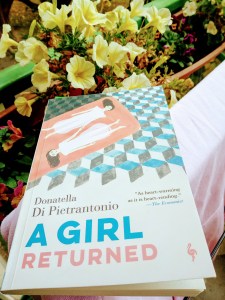 A Girl Returned came to my attention because I like to see what

 Word by Word