

Foyles bookshop, Southbank Centre, Royal Festival Hall, London
It’s been a busy month and my reading has suffered for it, not to mention having to take a break 400 pages into a historical novel about the French revolution, but a visit to London and another wonderful bookshop, Foyles on the Southbank helped, tempting me with Book 3 of Murakami’s trilogy and promising to be even more of a page-turner than the first two books.
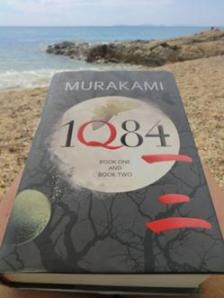
If you haven’t read it already, I suggest you begin with Book 1 &2, which I read in the summer and review here.
In essence Book 1 and 2 follow the lives of the two main protagonist’s Aomame and Tengo, who were in the same class at primary school, twenty years before the episode the book narrates occurs.
 In these first two books, we follow the two characters into the alternative world of 1Q84, where everything appears normal, until they notice the presence of the two moons. Tengo has ghost-written what he assumes is a fantasy novel, however the presence of the two moons suggests otherwise. Aomame is a sports instructor with a penchant for carrying out untraceable acts of revenge.
By Book 3, we are just waiting for these two to meet as they seem to be on a collision course for doing so and Murakami seems to delight in teasing the reader, as this reunion almost happens on more than one occasion. He adds tension and pace by introducing Ushikawa, a private investigator searching for leads after the murder of the leader of a cult, an act that has yet to become public. He has sniffed out a connection between the two, before they have realised it, Tengo and Aomame are relying on and following an instinct, Ushikawa deals only in facts and is closing in on them both.
In times like these Ushikawa didn’t like to have a set objective. He let his thoughts run free, as if he were releasing dogs on a broad plain. He would tell them to go wherever they wanted and do whatever they liked, and then he would just let them go. He sank down into bath water up to his neck, closed his eyes, and, half listening to the music, let his mind wander.
Yet again, I am in awe of the grand imagination of Haruki Murakami in conceiving this extraordinary plot and notice once again the mirroring effect in the separate lives of two characters who have not yet met up and yet who encounter equivalent or parallel situations. I am sure I am only skimming the surface of what lies beneath this narrative, but it was a joy to find Book 3 as enticing as and perhaps even more exciting than the book preceding it.
 Haruki Murakami’s work was introduced to me by
  In this volume Toru Okado is looking for a job, and while living through this in-between stage, in between jobs – his wife doesn’t return home one day thus he enters into a strange period where each of his interactions take on questionable qualities as he tries to navigate his days and understand what is happening around him.
 Revelations came to me also, weird dreams of deep wells and immersing in blue pools of water and seeing things clearly.
 Aomame is a loner, growing up in a Jehovah’s Witness family she had no real friends and rejected her family’s way of life early on. The one true friend she did have later in life met a tragic end which changed Aomame’s life; she couldn’t save her friend but through her skills and work she ensured that many other women were saved from a similar fate.
 Word by Word