
Conversations on a Triple Murder Trial
The Mushroom Tapes was probably more interesting for me because I knew nothing about the trial and stumbled across it after having already decided to read Helen Garner’s collected diaries. This is a catch up review from Dec 2025.
Courtroom Content, Trial Coverage, the Spectacle of Justice
The book concerns a 2025 trial in Australia, which was very widely covered in the media, in a similar way to the coverage of the Johnny Depp v. Amber Heard trial.
Court Trials of public interest become like live reality television when the Courts decide to allow love broadcasting to the wider public, who capitalise on it turning it into something more like serialised drama.
Three Literary Authors on a Road Trip
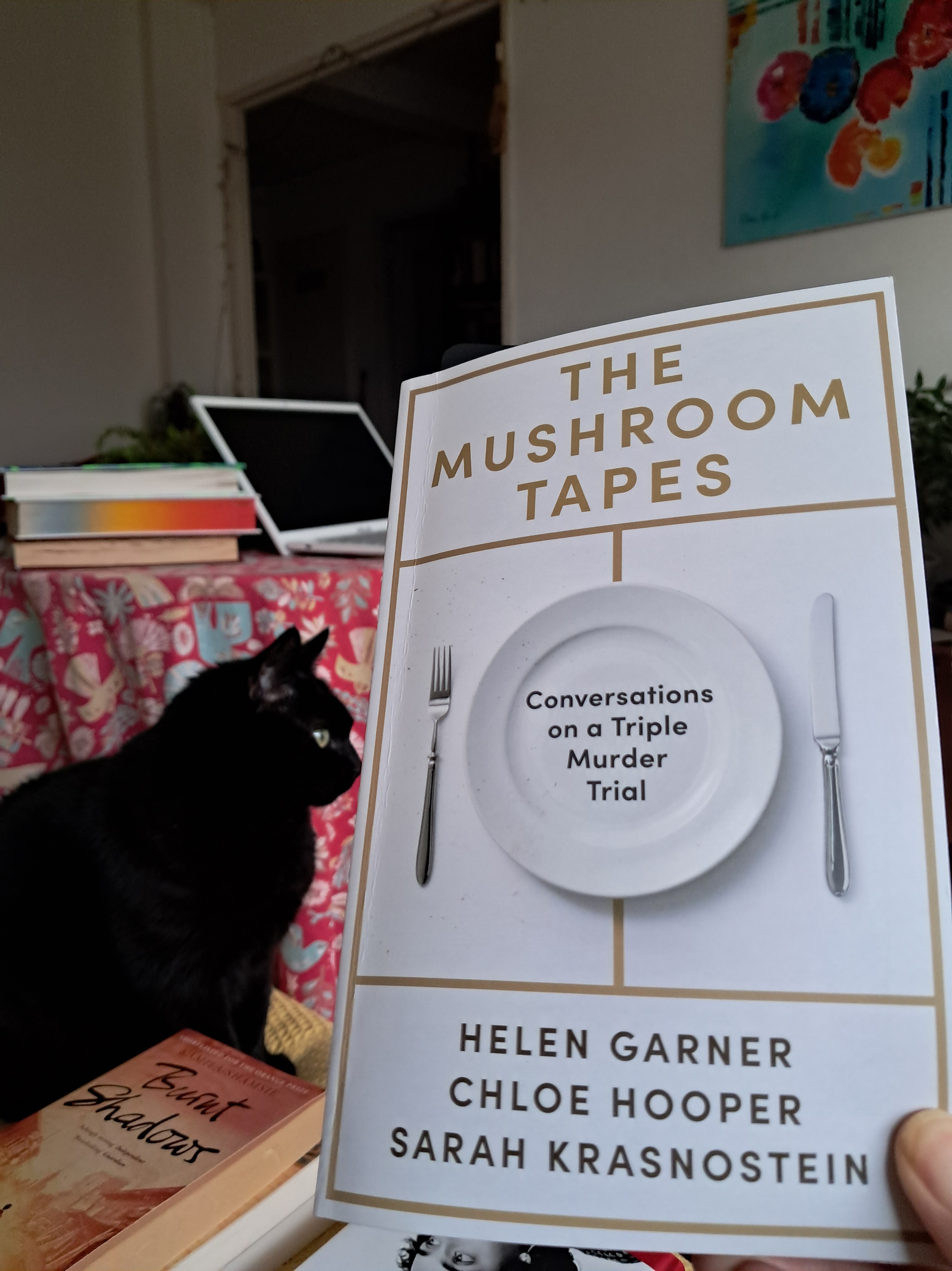
The nonfiction book The Mushroom Tapes: Conversations on a Triple Murder Trial was created by three established Australian literary nonfiction writers:
Helen Garner, an acclaimed novelist and nonfiction writer with a long history of researching and writing about real-world true crime legal cases.
Chloe Hooper, an award-winning author known for deeply researched true-crime and nonfiction works.
Sarah Krasnostein, multi-award-winning writer and critic with a background in long-form journalism and law.
The book was created shortly after the conclusion of nine weeks of evidence to a jury in 2025. It is based on recorded conversations in the car and a local cafe, and reflections during and after the Erin Patterson triple-murder trial in Victoria, Australia, combining legal observation with personal and ethical analysis rather than simple narration.
It starts and we are not even there. Everyone in the world is talking about it. People say to us, you must be going. No, we answer. No. No. No.
…Heads turn to watch the trial. We see them start to stir. Via a media audio-link we listen to the evidence of the woman’s estranged husband. One wild domestic detail galvanises us: his dying aunt remembered that the guests ate off four grey plates, while the hostess served herself on an orange one.
On day five we get in the car.

The book is split into six parts: The Court, The Church and the House, The Death Cap, The Victims, The Accused, The Verdict and it ends with Coda (the conclusion).
The first page shows a map of south east Australia, showing where the trial took place, the distance from the city of Melbourne, where the homes of the people involved were and where she foraged.
The text begins on 5 May and concludes on 4 July 2025.
Collaborative Authorship
This was a spontaneous book purchase. I was curious to see how the three authors could pull off the idea of road trip conversations, and create a collaborative approach to authoring a book of this nature.
We’ve never travelled anywhere together before. We’re writers and we’re friends, but this morning we’re almost shy of each other, not a hundred percent how we’re going to handle the day.
None of us wants to write about this. And none of us wants not to write about this.
While it does work and I really enjoyed the way the book is presented, I read it not long after Killers of the Flower Moon by David Grann, which is true crime on a whole different level, a case that involves years of research and delving into archives and uncovering the conspiracy of a nation. This is nothing like that, so not not investigative epic, but reflective, conversational, and essayistic.
It has more in common with Helen Garner’s earlier work, This House of Grief, being as much about the writer’s observations and response as the crime itself and in this case, The Mushroom Tapes shares the considerations of three people, arriving at a collective understanding and sensibility. It might be compared to French author, Emmanuel Carrère’s The Adversary, an exploration of the double life of a once respectable doctor.
What Happened

In July 2023, in a quiet Australian country town, Erin Patterson, stay-at-home mother and true-crime aficianado, invited her estranged husband’s devoutly Christian family to Sunday lunch. Her ex-husband was invited but pulled out at the last minute.
Within days, three of her guests were dead and the fourth was in a coma. They had been poisoned by death cap mushrooms found present in the Beef Wellington dish she had served.
The Trial
Two years later, Patterson stood trial, accused of three counts of murder and one count of attempted murder. The prosecution argued she deliberately foraged, prepared, and added the poisonous mushrooms to the meal to kill her guests; the defence claimed it was a tragic accident and that she had “panicked” after realising people had died.
The Mushroom Tapes
It is a terrible and tragic event when three close relatives die so suddenly after a Sunday lunch and even worse to imagine the poisoning may have been deliberate. The three writers decide to follow the trial and between them combine close legal examination and observation of people in the courtroom as the events unfold (reminding me of Yvvette Edwards courtroom novel The Mother), with personal and ethical analysis.
Chloe: Why is the public fascinated by a female poisoner?
Sarah: It’s archetypal. Adam and Eve and the apple. It’s through myths and fairytales.
Chloe: These crime stories seem to work as modern folktales. We mike it all the more if the characters are clearly good or bad, much as those old tales need a witch.
Helen: When I was splitting up with my husband, he said angrily to me, ‘You think you’re a good person!’
Chloe: Did you take that as an insult?
The women listen to the evidence and discuss it in a way that makes for an easy reading, intriguing form of coverage, a lot less repetitive no doubt than the actual trial.
Female Poisoners
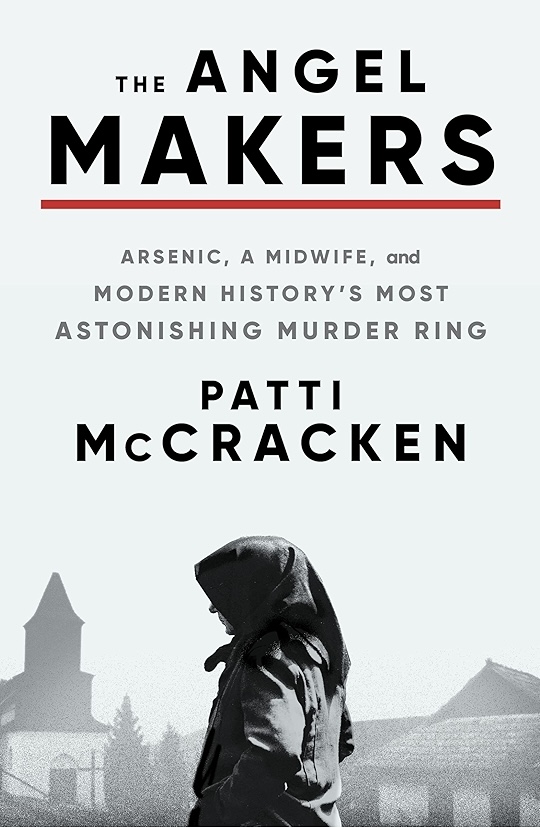
I also picked this book up because my curiosity had been piqued earlier after listening to a podcast interview with the author Patti McCracken prior to the publication of her true crime book The Angel Makers (2023). A village in Hungary in the 1910-1920’s had more than 160 cases of death by poison.
Women in the village had been complaining to their midwife ‘Auntie Suzy’ about unwanted pregnancies, domestic violence and a host of other marital complaints; she had a plethora of knowledge that she passed on to her clients. The story blends social history, gender roles, desperation, and crime, exploring why these women turned to murder and how the killings remained undetected for so long.
True Crime Devotees
It is likely that Erin Patterson and her true-crime friends were aware of that book. Stories about true crime, we learn, fascinate women. A criticism of true-crime is that it desensitises us to murder.
Chloe: I want to know more about true-crime’s appeal to women. I read that something like seventy percent of Amazon’s true-crime book reviews are by women, whereas for war books it’s like eighty-two per cent men. A female audience is driving the production of true crime in every medium. Why are women so fascinated by this?
Though they attempt to discover a motive, the four victims are portrayed as kind, gentle people, so the focus shifts to an analysis of the personality of Erin Patterson, the accused, the disintegration of her marriage, her resentments, her fascination with true crime and the devoted online community of friends she was part of in absence of the same in her own life.
According to the newspapers, Erin had described her upbringing to her Facebook friends:
My mum was ultra weird her whole life. We had a horrible upbringing. Mum was essentially a cold robot. It was like being brought up in a Russian orphanage where they don’t touch babies.
Dad wanted to be warm and loving to us, but mum wouldn’t let him because it would spoil us, so he did as he was told. She would shout at him if he did the wrong thing, so he became very meek and compliant. My sister and I would hide in our room most of the time so we couldn’t do anything wrong.
Chloe: Erin said that, to cope with this, she spent most of her childhood reading.
It seems also strange the attention the trial is given in this age of podcasts and content creation, so many people pursuing a trial for their own opportunity and attention, a conversational book seems almost an oxymoron.
Helen: I look at some people I’ve seen in the dock and I think, Jesus, I’ve been there, and somehow I didn’t crack – something in me stopped me from cracking and murdering…A friend of mine said to me, ‘I have to know why she broke.’ That’s what I’m always looking for in these stories. What was the point at which Erin just could not hack it any longer.
Chloe: She has elements of a fantasist or fabulist. Who knows what she’s told herself about breaking.
Final Words From the Survivor
It is an intriguing and compelling read, with its own glimmer of hope, as the sole survivor of the four dinner guests shares the final thought-provoking words, exhibiting values seriously lacking elsewhere.
Sarah: Erin was estranged from her parents, so Don and Gail became even more important for the practical and emotional support they gave. Love betrayed is often the motive for extreme rage. I almost find it more incriminating the more she talks about this well of deep feeling she had for them, because this rage about rejection hovers at the edges.
Further Reading
The Guardian: The Mushroom Tapes review – Erin Patterson through the eyes of Helen Garner, Chloe Hooper and Sarah Krasnostein
Author, Helen Garner
Helen Garner is one of Australia’s most acclaimed and revered writers: of novels, stories, screenplays and works of non-fiction. In 1993 she won a Walkley award and in 2006 she received the inaugural Melbourne Prize for Literature. In 2019 she was honoured with the Australia Council Award for Lifetime Achievement in Literature. Her best-selling books include Monkey Grip, The Children’s Bach, Cosmo Cosmolino, The Spare Room, The First Stone, This House of Grief, Everywhere I Look, The Season and her diaries, the collected volume of which has been shortlisted for the 2025 Baillie Gifford Prize.
Author, Chloe Hooper
Chloe Hooper’s first novel, A Child’s Book of True Crime , was short-listed for the Orange Prize for Fiction. In 2006 she won a Walkley Award for her writing on the inquest into the death in custody of Cameron Doomadgee. The Tall Man, her 2008 book-length account of the case, received numerous awards including the Victorian, New South Wales, Western Australian and Queensland Premier’s Literary Awards.
Her account of the Australian Black Saturday bushfires, The Arsonist: A Mind on Fire, was voted 2018’s Best Non-fiction title by Australian Independent booksellers.
Author, Sarah Krasnostein
Sarah Krasnostein is a multi-award winning writer and critic. Her best-selling books include The Trauma Cleaner, The Believer, the Quarterly Essay, Not Waving, Drowning, and On Peter Carey
She has won Walkley Awards and been awarded the Victorian Prize for Literature, the Australian Book Industry Award for General Non-Fiction, the Victorian Premier’s Prize for Non-Fiction, the Prize for Non-Fiction at the New South Wales Premier’s Literary Awards and the Dobbie Literary Award. She holds a doctorate in criminal law and is admitted to legal practice in New York and Victoria.


I agree that the conversational book seems a little strange in the age of podcasts… but, Australia has been GRIPPED by this story and I think there’s a large number of people who have consumed everything that’s been published about this case, so the publishers of this book knew they had a winner.
I have not been one of the people who has read and listened to everything about the case, however, I read Mushroom Tapes as soon as it was released, because of the authors.
LikeLiked by 1 person
I think maybe reading about it in this way, a printed book, a reflective analytical style is a kind of push back on that instantaneous consumption and live content. I am interested to read Helen Garner and having heard of the Hungarian village story, I guess there was a possible connection.
Have you read other works by Garner? I’m interested in her voice, but not sure whether her earlier fiction is for me or not. I am reading This House of Grief and her diaries though.
LikeLike
I’ve read lots by Garner but the one that made the greatest impression was The First Stone. To give context, though, I read the book decades ago when I was studying at the university where the crime had occurred, so it all felt very close and very real to me. It was also the first book I’d read in the genre of true crime (although it’s different by today’s standards of true crime, I think).
LikeLike
That quiet country town is where I am from! Well, I lived 8km outside of it (in Koonwarra, where the food hydrator was located) but did my secondary education in Leongatha, and later, after 6 years in Melbourne and Brisbane, I returned to work on the Leongatha Star as a rookie reporter. To think that a hideous murder put our small dairy farming town on the map is quite something!
I love Garner and Hooper, so will read this at some point, but the structure worries me slightly. I’ll likely borrow it from the library rather than rush out and buy it.
LikeLiked by 1 person
Oh my goodness, that IS a little close to home, Kim. And to have been a rookie reporter in the area. No doubt you’ve also heard too much about the case, I enjoyed these 3 women’s take on it and am now reading This House of Grief and noticing that in that book too, it works all the better for the conversations and engagements with people locally, you get multiple perspectives and she also has a 16 year old niece who often tags along, and her clear eyed observations are brilliantly placed.
Look forward to your thoughts on The Mushroom Tapes eventually.
LikeLike
Helen Garner has been quite controversial in Australia. Her book The First Stone where she appeared to side with a powerful Master of a university college when he was accused of sexual harassment of young undergraduate girls caused many feminists to turn against her.
In my view her diaries are her best work.
The Mushroon Tapes seem quite exploitative to me.
LikeLiked by 1 person
I hadn’t heard that one mentioned, but my reaction to your comment, having literally finished ‘The House of Grief’ this morning is how often she shows in the narrative, a swaying of view from one perspective to another, after each presentation of evidence, or demonstration of character by a witness. Like being blown about in the wind. And it also reminds me of the terrible lack of support, here in France during the #MeToo movement by women of a certain age and privilege, who thought other women should just let things be, that they were over-reacting.
Recently I listened to an excellent interview with Suzie Miller a week ago, the author of the screenplay Prima Facie (which I intend to read) and thought – here is the inside view, someone who can deconstruct why the law and its enforcement is against women from the beginning. And how ironic that after being a scientist, a lawyer and finally a playwright, that it was in the role of the latter that she actually affected change. I’m not sure I want to read The First Stone, given it’s 20 year ago, and with that suggested slant. What a pity it didn’t go the other way, to stand against popular conditioning.
The Mushroom Tapes is interesting, but it feels almost premature, looking at the coalface and using conversations to gain perspective, rather than time and research as much true crime does. It does seem to have published rather in haste, but I still enjoyed it as an intro to the author and two other interesting Australian authors.
LikeLiked by 1 person
‘Over-reacting’ is what Helen Garner thought about the eighteen year old girls who were speaking out about the harassment they were subjected to. She was a woman in her fifties at the time she wrote that book, with a child and a fairly bohemian past, but she thought the girls should just toughen up. She was over-looking or forgetting the huge power imbalance, as in the situation you describe.
LikeLiked by 1 person
I’ve just finished reading this and still mulling it over. I don’t read true crime at all so this was an exception for me, mostly because of the authors. Like them I was trying to work out why. Why did she do it? What pushed her to it? Or what about her personality or life experience would lead her to this?
LikeLike
I haven’t read your post Claire because I prefer to read books before I read posts. But I am hoping to get to it soon. I would never have read it – I didn’t follow the trial in detail other that what I heard on general news. But I love all three of these authors, and I am intrigued by their approach. I attended a session with them and it sounds like each brought a different perspective to their discussion which I’m looking forward to reading.
LikeLiked by 1 person
Oh, listening to them speak would have certainly peaked interest, I’m sure. Have you read any other works by any of the 3 authors?
LikeLike
Yes I’ve read a lot by Helen Garner, two by Hooper, and two by Krasnostein, who is newest on the scene (I think), so I have a good sense of them. I do recommend them all. I see you have read some other Garner.
LikeLiked by 1 person
I just finished her other courtroom drama This House of Grief and I’m interested in the diaries, but I had not heard of the other 2 writers.
LikeLike
There is her first courtroom drama, Joe Cinque’s consolation, and of course The first stone that Gert mentions which was her first big work of nonfiction. Her diaries are great, as are her essays, short stories and novels.
The other two are not as well known even in Australia I’d say though Chloe Hooper in particular would be known in most reader circles. Sarah Krasnostein was born in America. Her first book (at least I think it was), The trauma cleaner, made quite a splash and is a great read. I would read more all of these writers which is why I plan to read this!
LikeLiked by 1 person
Thanks for sharing that, I’ll look into them more.
LikeLike
Do … if you have the time … she is a brave and honest writer.
LikeLiked by 1 person
Pingback: This House of Grief (2014) by Helen Garner – Word by Word