By the Sea (2001) by Abdulrazak Gurnah

By the Sea begins as a compelling narrative and mystery of a man who arrives at Gatwick airport from Zanzibar without a visa and refuses to speak English, until the crucial moment where he is about to be deported and he utters the words that will change his trajectory.

Refugee. Asylum.

Old Scores Revisited

Nobel Prize for Literature 2021 Zanzibar Tanzania witing about immigration culture refugees requesting asylum

In trying to locate someone to translate for him, Latif is contacted and the two men realise there is a connection, a history that has perpetuated with major gaps on either side of their understanding, voids often filled by those wishing them ill.

Their story began by the sea and concerned a fragrance Ud-al-qamari, and would be retold far away where few understood the nature of their feuds and punishment, of corruption and power, petty rivalries over debts, possessions, and influences that could drive a man to flee for his life.

The man I obtained the ud-al-qamari from was a Persian trader from Bahrain who had come to our part of the world with the musim, the winds of the monsoons, he and thousands of other traders from Arabia, the Gulf, India and Sind, and the Horn of Africa. They had been doing this every year for at least a thousand years. In the last months of the year, the winds blow steadily across the Indian Ocean towards the coast of Africa, where the currents obligingly provide a channel to harbour. Then in the early months of the new year, the winds turn around and blow in the opposite direction, ready to speed the traders home.

Time Dismembers, Perceptions Unremembered

Told in three parts, the first two focus on each of these characters and their early life in Zanibar and something of their present, while the third part is a kind of oral storytelling as the two meet and their intertwined story is retold from start to finish until a different connection emerges, as they find themselves newly isolated in this place around people uninterested in their journey.

So time dismembers the images of our time. Or to put it in an archaeological way, it is as if the details of our lives have accumulated in layers, and now some layers have been displaced by the friction of other events, and bits of contingent pieces still remain, accidentally tumbled about.

A drama of disappointment, self-deception and renewal, the novel explores both the double bind of the known culture that entraps, and the unknown culture that frees but isolates the individual, for their betterment, yet never quite attaining an imagined, desired status.

Like Admiring Silence, an excellent, astute read by an accomplished author.

Further reading

My review of Admiring Silence (1996)

Nobel Prize Interview with Abdulrazak Gurnah

Article Guardian on Winning the Nobel Prize

New York Times: Abdulrazak Gurnah Refuses to Be Boxed In: ‘I Represent Me’

Abdulrazak Gurnah, Author

Abdulrazak Gurnah was the Winner of the Nobel Prize for Literature in 2021 for

‘his uncompromising and compassionate penetration of the effects of colonialism and the fate of the refugee in the gulf between cultures and continents’,

He was born in 1948 and grew up on the island of Zanzibar in the Indian Ocean, arriving in England as a refugee at the end of the 1960s. After the liberation from British colonial rule in December 1963 Zanzibar went through a revolution which led to oppression and persecution of citizens of Arab origin; massacres occurred. Gurnah belonged to the victimised ethnic group and after finishing school was forced to leave his family and flee the country, by then the newly formed Republic of Tanzania. He was eighteen years old. Not until 1984 was it possible for him to return to Zanzibar, allowing him to see his family shortly before the father’s death.

Themes of Refugee Disruption

Gurnah’s writing is from his time in exile but pertains to his relationship with the place he had left, which means that memory is of vital importance for the genesis of his work. 

The theme of the refugee’s disruption runs throughout his work. His novels depict a culturally diversified East Africa. His dedication to truth and aversion to simplification are striking. It can make the work bleak and uncompromising, however he follows the fates of characters with great compassion and unbending commitment.

His novels include Paradise (1994), which was shortlisted for both the Booker and the Whitbread Prize; By the Sea (2001), which was longlisted for the Booker and shortlisted for the Los Angeles Times Book Prize; and Desertion (2005), shortlisted for the Commonwealth Writers’ Prize. His most recent novel Theft (2025) is the story of the intertwined lives of three young people coming-of-age in postcolonial East Africa, selected as a book to look out for in 2025 by the GuardianObserverIrish Times and BBC.

Until his retirement he had been Professor of English and Postcolonial Literatures at the University of Kent in Canterbury, focusing principally on writers such as Wole Soyinka, Ngũgĩ wa Thiong’o and Salman Rushdie.

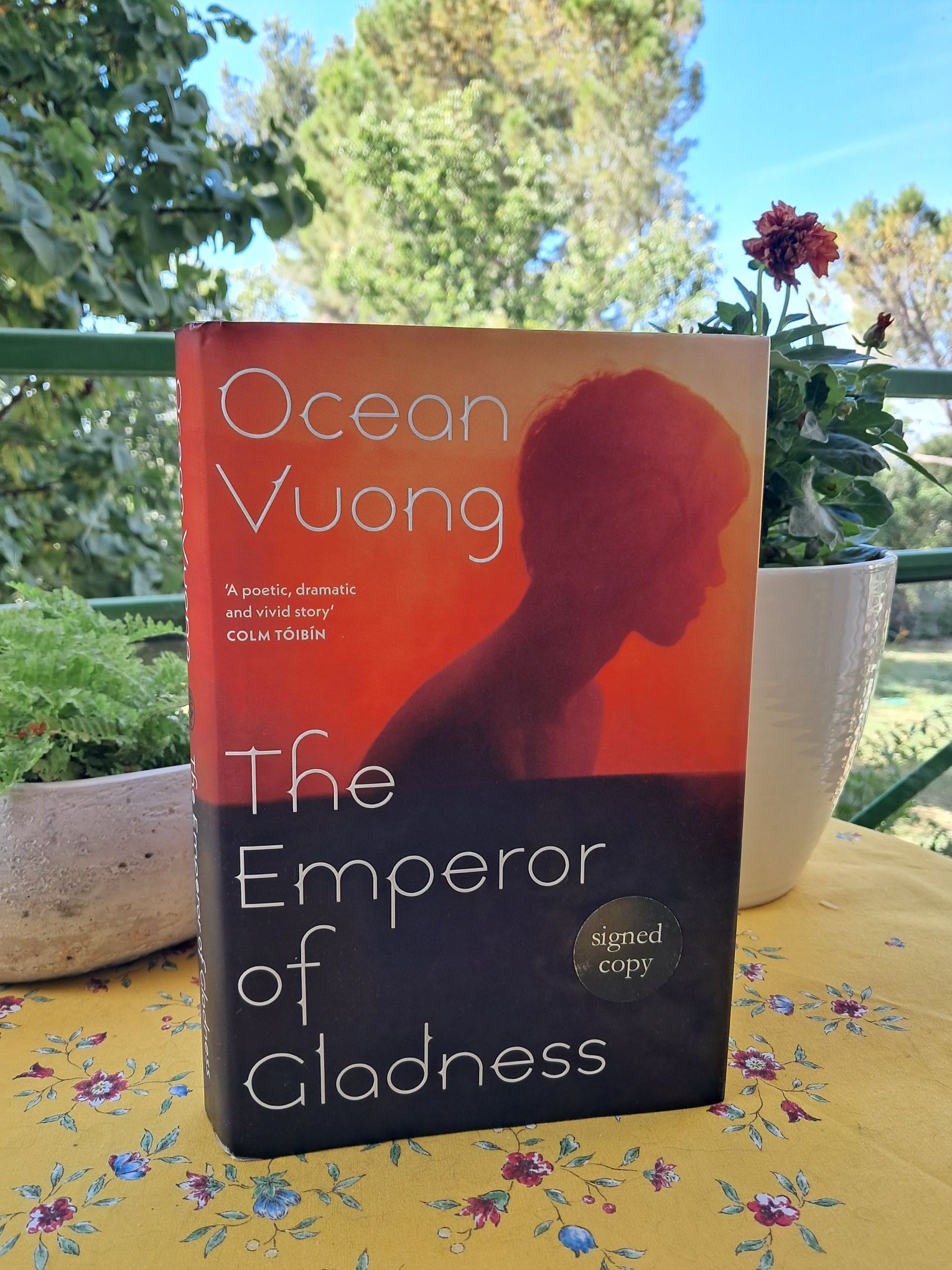
The Emperor of Gladness by Ocean Vuong

The hardest thing in the world is to live only once.

But it’s beautiful here, even the ghosts agree.

literary fiction Oprahs bookclub immigrant experience fiction Vietnam Lithuania the eldery the disenfranchised marginalised

Ocean Vuong’s latest novel begins with a chapter that stands apart from the rest of the novel, a lyrical description of the New England town of East Gladness, that sits in a valley that when the prehistoric glaciers melted and the river dried up, left a silvery trickle along the basin called Connecticut : Algonguin for ‘long tidal river’.

The chapter ends with the arrival of a nineteen year old boy named Hai, crossing a bridge in September 2009 and climbing the railings.

Though it was true the boy had run out of paths to take, out of ways to salvage his failures, he never planned on jumping off King Philipp’s Bridge that evening. It was only when he glimpsed, between the rail ties, the river swirling so massive below, a place you could slip clean into, that something in him both jolted and withered at once.

Young and Old On the Margins of Society Take Centre

Hearing a voice shouting at him, he encounters 84-year-old Grazina, a Lithuanian widow drifting in and out of the grip of dementia, trying to stay in her home and keep the hallucinations at bay.

Photo by T.Constant Pexels.com

Hai is the son of a first generation Vietnamese immigrant, entrapped in recurring cycles of illusion, failing to achieve promises he made to his mother, leading him deeper into despair.

When these two characters paths cross, it marks the beginning of a shape shifting, temporarily life-altering bond and uplifting experience in both their lives, as together they attempt to navigate the unsustainable circumstances they are desperately confronted with.

The novel traverses a season in the lives of these two, intimately demonstrating the beautiful supporting effect two strangers can have on each other’s lives, when their closer familial ties are unable to.

When the Past Emerges into the Present

Hai is given refuge and in return he monitors Grazina’s medication, he inserts himself in her hallicinatory episodes, gently accompanying her back to safety, while learning something of the traumatic earlier years she has navigated, that return to haunt her.

She stared out the window as he read the first few paragraphs from the story of a man wandering the warscape of his mind after the wars of his body. When he finished, she looked at him from beneath her glasses and said only, “Very well, then.” He was about to say something about the book when the cuckoo clock on the wall behind him went off, the wooden owl shooting out to nod along to a jagged tune spinning in its broken gears. Her eyes lit up. “Ah, 6.43, the hour Vilnius fell to Stalin.” She crossed herself, shut her eyes, and said a prayer under her breath.

The Circumstantial Family

He reaches out to an estranged family member and gets a job in a fast food restaurant and quickly becomes part of a team that are all shouldering their own struggles and dreams and together they become something that extends beyond the comradeship of colleagues, the circumstantial labour family created through simultaneous work shifts; who take risks, find humour and support each other for a brief chapter in each others lives.

It was in these moments that he thought this new life, if you could call it that, wasn’t so bad. That he could bide his time until something ahead of him lifted, like the mist rising each morning above the river outside his window, revealing what was always there. But he was wrong.

The characters of Hai and Grazina are flawed and unforgettable, they are vulnerable, disillusioned and in perfect alignment as they keep each other as stable as possible, until the external world inevitably interferes.

When Kindness and Care Lead

immigrant american culture, chosen family, kindness of strangers

I was reminded a little of the reading experience of Barbara Kingsolver’s Demon Copperhead, only I loved this even more, because of the added multicultural layer that came from these characters having connections to another culture and way of being in the world, while trying to survive against the odds in the United States.

They are having to cope with and navigate for one, the effects of ageing and the other, the allure of addiction to regulate an overwhelmed nervous system. The support and consistency they stumble across in each other, shines a ray of light in an otherwise dark and lonely existence.

I really enjoyed this novel, even more than his accomplished debut novel On Earth We’re Briefly Gorgeous. There’s so much more to gain from this novel, but I urge you to read it for yourself and gift yourself that experience.

Highly Recommended.

How strange to feel something so close to mercy, whatever that was, and stranger still that it should be found in here of all places, at the end of a road of ruined houses by a toxic river. That among a pile of savaged trash, he would come closest to all he ever wanted to be: a consciousness sitting under a lightbulb reading his days away, warm and alone, alone and yet, somehow, still somebody’s son.

Whereabouts by Jhumpa Lahiri

Cerebral Distractions or Healing Attractions

Whereabouts indeed. I have been absent this space and reading less, as I pursued another passion, the great jigsaw puzzle of building a family tree, which started out as an exercise in tracing my female lineage looking for a particular pattern, I felt called to heal and ended up as a series of unfinished mysteries seeking to be resolved. And it is so much fun, imagining and reclaiming these lives!

Well, all of that is another story, but interesting enough to have pulled me away from my regular habit of sharing my reading here. I miss this space, and the interactions, so here we are, sharing a few recent reads.

I picked up the reading again as the temperatures here rocketed into full summer heat and my brain asked, “Can’t we just read a book today?”, instead of spending my free time working like the dedicated closet researcher I had become.

A day at the beach with a Jhumpa Lahiri novel turned the tide.

A Gifted Book Returns Unread

Whereabouts by Jhumpa Lahiri translated from Italian by the author

Whereabouts by Jhumpa Lahiri is a novel that came back to me, one I gifted a friend from abroad who has a love affair with the city of Rome. Back in Europe to visit the city again, she brought this book I gave her halfway round the world, pulled it out of the suitcase and said:

‘I haven’t read it yet. I’m going to read it in Rome. Here. You have got two weeks to read it before I go. We can talk about it when I get back from Ireland.’

Challenge accepted and quietly delighted; I really wanted to read it too.

Now I have.

I loved it.

It felt like I was reading a work of creative non-fiction. In disguise. Autofiction perhaps?

Jhumpa Lahiri is a British-American author of Bengali parents, whose earlier novels have highlighted the immigrant experience. For some years now she has lived in Italy, learned the language and her last two books were written and published in Italian before being translated into English.

Whereabouts is a collection of short vignettes of one woman’s highly observational, contentedly solitary, existence in Rome. The epigram, a quote from Italo Svevo provides a clue to what follows.

‘Every time my surroundings change I feel enormous sadness.It’s not greater when I leave a place tied to memories, grief, or happiness. It’s the change itself that unsettles me, just as liquid in a jar turns cloudy when you shake it.’

Averse to Change, Loves Movement

Disliking change, but always on the move, her days capture aspects of the surroundings she has grown attached to, taking us right there. The chapter titles nearly all begin with the prepositions: On, In or At.

On the Sidewalk, In the Street, At the Trattoria, In the Piazza, At the Bookstore, On the Couch, On the Balcony, At the Beautician, In the Sun, At my House, In Bed, On the Phone.

Jhumpa Lahiri autofiction Whereabouts set in Rome Italy

Near the end, as I began to notice this pattern and list of locations, I asked myself, “What is this ‘Whereabouts?’ and I flicked back to the contents page and read through the list of destinations. I then turned the page and the only chapter that doesn’t start with a preposition, Nowhere, seemed to be speaking to me, responding to my question.

It began by saying:

‘Because when all is said and done the setting doesn’t matter: the space, the walls, the light. It makes no difference whether I’m under a clear blue sky or caught in the rain or swimming in the transparent sea in summer.’

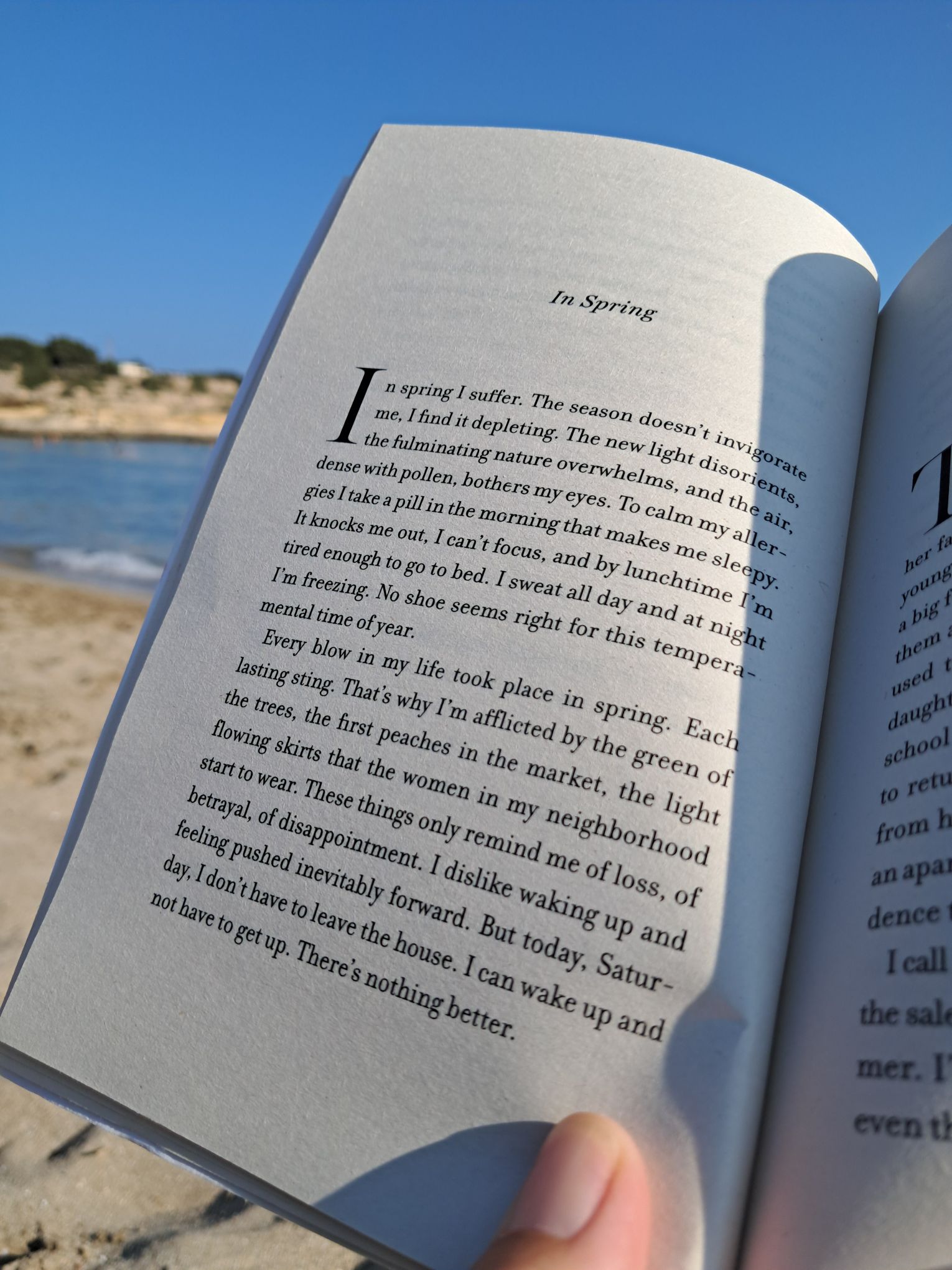
This has come just after Up Ahead, a sign of change, something our protagonist does not like and spends the entire short chapter of In Spring pondering. A chapter I sent to another friend, one who shares the protagonist’s dislike of that season.

Transition, Change and Things that Stay the Same

In Spring, a chapter from Jhumpa Lahiri's novel of vignettes Whereabouts

Now, she contemplates a transition; both of the day, and of a life, observing the peripheral characters to this solitary existence she has created, people in movement, marking the end of a day.

‘They’ll keep walking along these sidewalks. They’re permanent fixtures in my mind, knotted up in the fabric of my neighbourhood just like the buildings, the trees, the marble woman. These are the faces that have kept me company for years, and I still don’t know the people they belong to. There’s no point saying goodbye to them, or adding, we’ll meet again, even though right now I’m overflowing with affection for them.’

Overall, it’s a reflective relatively smooth paced novel in which not much happens and yet you feel as though you have visited and lived for a short time in a city apartment in one of the squares of this major European city of Rome, a part of it not populated by tourists, but where the everyday life continues to unfold week after week, year upon year, following the same rhythms, with small changes a natural part of its existence.

‘Is there any place we’re not moving through? Disoriented, lost, at sea, at odds, astray, adrift, bewildered, confused, uprooted, turned around. I’m related to these related terms. These words are my abode, my only foothold.’

Brilliantly crafted. Could not put it down, read it in a day.

Highly Recommended.

Have you read Whereabouts? Do you have a favourite by Jhumpa Lahiri? Tell us in the comments below.