

Zelda Sayre
Born with an exotic name that lent itself to bright lights and a spirit that loved nothing more than to dwell under them, it is not surprising that Zelda Sayre’s life was illuminated and became of interest to so many who were less daring themselves but fascinated with her life and antics.
But just as light cannot exist without shadow, she would discover the darker underside of a life lived in the shadow of her husband, when she dared to pursue her own desire to be recognised as a professional in her own right.
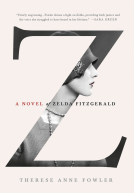 Z: A Novel of Zelda is an excellent companion novel to The Paris Wife and one of an expanding collection that gathers around that group of artists, writers, wives and hangers-on of the “lost generation“, a term coined by a young French mechanic who was reprimanded for giving insufficient priority to repairs on Gertrude Stein’s Model T Ford and thus complained to his patron that they were all a “generation perdue“, those young people who served in the war, respected little and indulged themselves to immoderate excesses.
Hemingway’s A Moveable Feast is a logical follow on read, having now read the fictionalised accounts of the two wives of these well-known writers and great friends who were in the midst of that post WWI group that sought a kind of writing utopia in Paris.

Zelda and F.Scott Fitzgerald
While the utopia may have eluded them, their experiences would provide rich material for their writing, even if at the expense of some of their friends and loved ones. It is interesting to note that while their output during those early years was largely even, the Hemingways‘ lived quite frugally with an awareness of their financial struggle, while the Fitzgeralds‘ lived hedonistically in complete denial of theirs.
Zelda was reluctant to be lured away from Montgomery, Alabama by a complete dreamer and in the early days of their courtship actually threatened to dump F.Scott Fitzgerald unless he proved himself worthy and obtained his first serious publishing contract.
“I was so sure of our love then, so determined to prove to Mama and Daddy that we weren’t doing things wrong, just differently. There was no way to know that certainty would one day become a luxury too.”
 When Fitzgerald succeeds in getting that commitment from his publisher to publish This Side of Paradise, she is ready to join him in New York and their life of adventure will begin.
From New York to Paris and the south of France, where Zelda throws herself into her own professional dance ambitions and is rewarded with an offer, which makes this reader wonder, what might have happened if…
“Scott and I both were awed by how cultured all these folks appeared to be, how intact they all were. For a change, Scott listened more than he talked. They spoke of painting and music and dance – their own work as well as other artists’ – with knowledge and candor and passion. If they felt rivalries, they expressed the situations as challenges, not jealousies.”
I came to this novel with no idea about Zelda or the role she played among the writing set of Paris and while much has been written in personal letters and hospital records documenting her mental health challenges and treatments, I find Therese Anne Fowler’s depiction of the character Zelda to be both realistic and sensitive and portrayed in a way that is compelling to read. It has made me interested to read more about Zelda Fitzgerald and that period in history she was a part of; she was one of, if not the first young women referred to as a “flapper” of the 1920’s, a kind of “it girl” whose rise in society came about alongside a public contempt for prohibition and was described by Dr. R. Murray-Leslie, who criticized
“the social butterfly type… the frivolous, scantily clad, jazzing flapper, irresponsible and undisciplined, to whom a dance, a new hat, or a man with a car, were of more importance than the fate of nations.” Times 5 Feb 1920, p 9
They were a significant step away from accepting the lives of their mothers before them and while they accepted the lesser role in support of their husbands and were not quite suffragettes, they developed an awareness that women could be more outgoing and present in the relationship and even pursue a career, something that usually required marriage to be forfeited for.
 The sad truth was that all that freedom and lack of meaningful purpose was not good for their mental health and whereas today one might be prescribed medication for depression, bi-polar disorder or spend time in rehab, in the 1920’s/1930’s it was off to the psychiatric asylum for electric shock treatments and a prognosis of hysteria or even worse schizophrenia, if one showed signs or symptoms of not coping with it all.
If you enjoyed The Paris Wife or A Moveable Feast, this book should certainly be on your list to read. A riveting read and a thought-provoking insight into an exciting and turbulent period of cultural history.
Note: This book was an Advance Reader Copy (ARC) kindly provided by the publisher via NetGalley.

 One of the most striking and memorable moments supports a comment by Hemingway scholar Jamie Barlowe that Hadley Richardson “was a ‘true’ woman and not a ‘new’ woman of the early 19th century” and shows both how removed she was from their group and the reverence Hemingway held for her.
 Word by Word