
 Thank you to publisher Gallic Books, who noticing that I had recently read The Lost Domain (le Grand Meaulnes) by Alain-Fournier suggested I might also enjoy Michel Déon’s The Foundling Boy. Originally written in French Le jeune homme vert was first published in 1975 and now translated into English for the first time, is beginning to be enjoyed by readers of the English language.
Set in Grangeville, Normandy in the inter-war years prior to WWII, it is a coming-of-age story of the young Jean Arnaud, who starts his life in a basket on the doorstep of Albert, a one-legged war veteran, now a pacifist gardener cum caretaker and his wife Jeanne, who raise the child as their own.
Jean grows up in the shadow of Michel and Antoinette, children of Antoine de Couseau, an errant landowner whose father built up a fortune, only for his son to slowly lose it all – unsurprisingly as much of the first 200 pages is spent in his company, a man who whenever challenged by his wife or confronted by business decisions, takes to his latest model Bugatti, a car he replaces every year and heads south, following what becomes a well-worn trail via Lyon, Aix, St Tropez to Menton, allegedly to see his grown daughter Genevieve, recuperating in a hospital residence from lung problems.
The visits rarely last longer than a wave from the window before he heads off to enjoy the hospitality and warm sheets of various mistresses en route and this being France of course, the husbands all take it in their stride.
There is a real fascination throughout the novel for unique cars that love to take to the road. I went back to look at the references which I probably glossed over in my first read, now much more knowledgeable about Ettore Bugatti and his racing cars, from the 1923 Type 22 here on the left through many other models to the 1938 57SC Atlantic on the right. And Antoine de Couseau is not the only character whom Jean Arnaud meets, to possess a similar fascination. For being raised a peasant, he has seen many a luxurious interior when it comes to cars.


Jean too, has a love of his bike and travel and will spend four days in London, developing a taste and allure for freedom and adventure and not long after will follow in the footsteps of the writer Stendhal to Milan, Florence and Rome, meeting up with Ernst, a German lad who is following a similar trail in the footsteps of Goethe, his father’s hero – having swapped his son’s copy of Mein Kampf for Goethe’s Italienische Reise (Italian Journey).
 The two young men share adventures, debate philosophical perspectives and encounter the fragility of friendship in the face of prejudice and racism.
Losing everything and having almost become the amoureux slave of a restaurant proprietor, who offers him a job so he can earn enough money to return home, Jean finally returns making the acquaintance of Palfry on his way, only to discover things at home vastly changed.
Throughout all Jean’s experiences, there are the interactions with family, friends, neighbours, villagers and people he meets along the way, it is not enough to accept the wisdom of others, he wants to explore for himself, whether it is the landscapes of neighbouring countries or the social acquaintances of his friend Palfry, a man who gave him a ride in his car dressed as a priest and whom he meets at various stages in his life who teaches him that things are not always as they seem. Ultimately, this searching might also be to understand who he really is, something within him, but that he also seeks outside from those he knows, the mystery of his birth.
“What is certain is that, overnight, Jean Arnaud matured by several years, learning that a priest may also be a plotter, and that without being thieves and murderers men might have to hide from the police because they were defending a noble cause. The world was not built of flawless blocks, of good and bad, of pure and impure. More subtle divisions undermined the picture he had so far been given of morality and duty. “
Fairly early on, it occurred to me that nearly every female character was caricatured as something of an object, the neighbour’s daughter, the house-maids, the women Antoine de Courseau encounters on his travels, even his daughter Geneviève becomes a ‘kept’ woman.
While it is an engaging and entertaining read, that moves along at the rambling, colourful pace of a joy-ride in a Bugatti, it began to feel like a book written for men, for it is they who travel (with the exception perhaps of Geneviève), have adventures, engage in meaningful banter, witty dialogue and to whom much of the advice within is given.
I admit to a moment of despair in being unable to think of one woman with redeeming qualities, that a female reader might relate to, why even the landlady of the Bed & Breakfast in Dover drags the poor 13-year-old youth off to the pub keeping him there till closing, Jean’s first impression of England is certainly one that stays long in his memory.
Jean purchases himself a notebook early on in his journeys and in his letters and notes, we are witness to how he begins to see the world:
I’ve bought myself a notebook where I’ve started making a few notes:
a) Duplicity: absolutely necessary for a life without dramas. You have to harden your heart. I need to be capable, without blushing to my roots, of sleeping with a woman and then being a jolly decent chap to her lover or husband. This is essential. Without it society would be impossible.
I guess, we could just say it is delightfully French and certainly the women are not portrayed as victims, quite the opposite in many cases, but they did make this reader pause for reflection. An eye-opening, memorable journey through the European landscape whilst inhabiting a very French culture and perspective.
Michel Déon inhabits his male characters with pride and indeed enjoys himself so much, he can’t help but put himself into the narrative from time to time speaking with much enthusiasm and familiarity directly to the reader. And with good reason, for it has been said of his young hero that:
“The character of Jean Arnaud has been heralded as one of French literature’s great adolescents, alongside Flaubert’s Frédéric Moreau, Stendhal’s Julien Sorel and Alain-Fournier’s Augustin Meaulnes.”
Michel Déon has the last say, as he leaves Jean Arnaud in a military camp on the eve of war, a sealed envelope in his pocket with instructions not to open it unless he is in extreme need, his life full of promise yet hardly begun by telling us not to worry about those things he has not revealed, that here he was a foundling boy and in another book, he will tell the story of how his protagonist becomes a man.
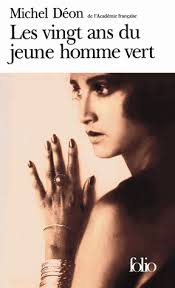
The sequel, The Foundling’s War (Les Vingt Ans du Jeune Homme Vert) is due to be translated into English and published also by Gallic Books. I am intrigued to know what Jean Arnaud makes of life given his experience thus far and how war might change him. Watch this space!
 Word by Word