Erasure by Percival Everett (2001)

I read this after Percival Everett’s excellent So Much Blue (my review) so my reading was influenced by having read that earlier novel, which I enjoyed more.

I did really enjoy this, however I enjoyed So Much Blue more on account of the type of reader I am, because it takes you outside of America to Paris and El Salvador – that novel was about the growth of the protagonist as a result of those experiences, whereas Erasure is more of a commentary on American culture and racial bias.

Revenge Can Backfire
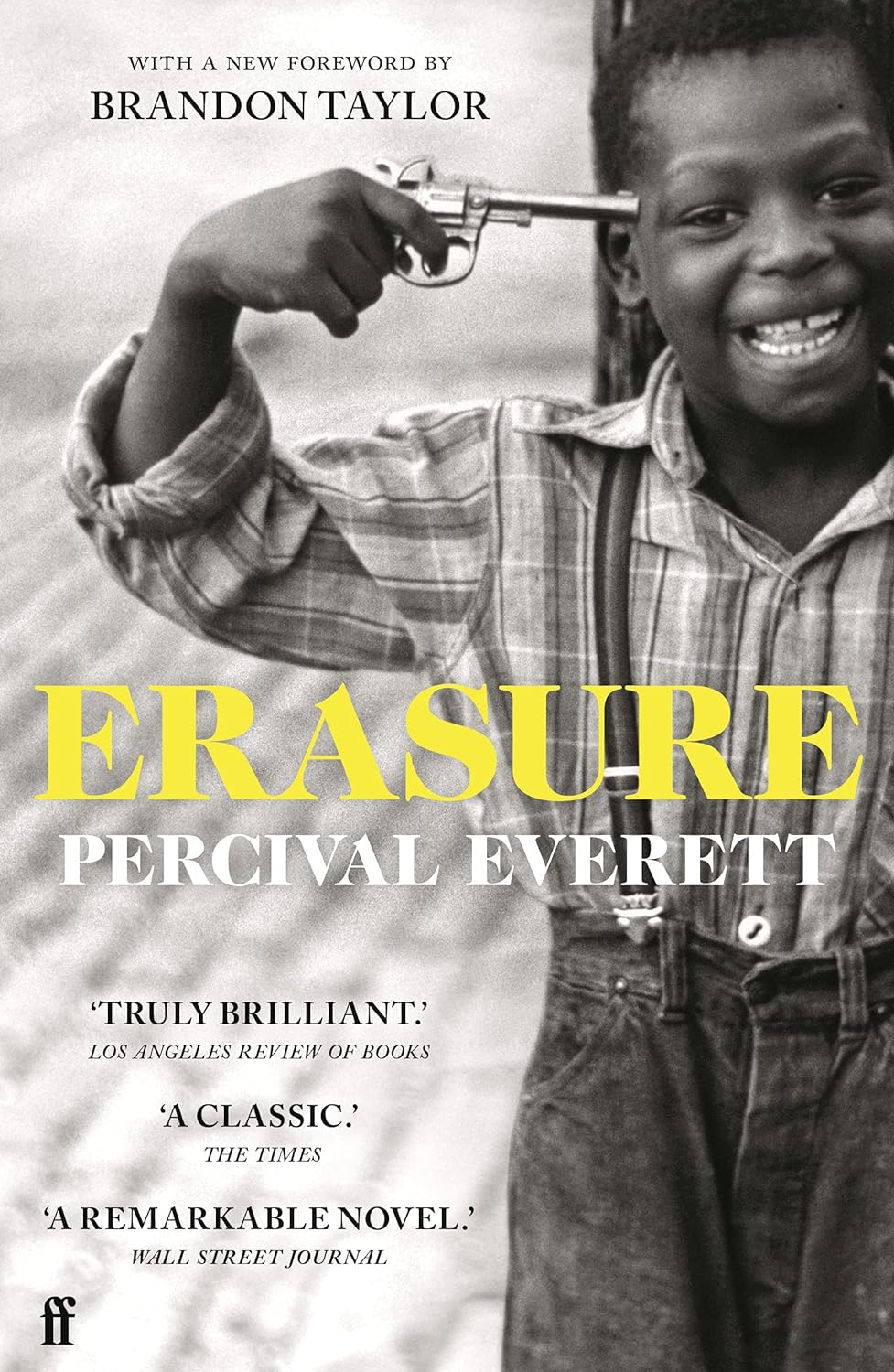
American Fiction film classic satire Cord Jefferson book cover young smiling black boy child holds a toy pistol to his head wearing checked shirt and jeans with braces photo in black and white the word Erasure in yellow text

In Erasure, a deeply satirical novel of the publishing industry and its biases; we have a Black American writer ‘Monk’ as protagonist, whose current work isn’t gaining traction.

I called my agent to check on the status of my novel and he had no good news for me. Three more editors had turned it down. ‘Too dense,’ one had said. ‘Not for us,’ a simple reply from another. And, ‘The market won’t support this kind of thing,’ from the third.

‘So, what now?’ I asked.

‘I don’t know what to tell you,’ Yul said. ‘If you could just write something like The Second Failure again.’ The ice clinked in his glass.

‘What are you telling me?’ I asked.

‘I’m not telling you anything.’

He feels resentful of some of what he is seeing gain popularity (fiction about the Black community using performative and pejorative racial themes and language); and he has had enough of his work being criticised for being too white.

He is middle aged and his mother is showing signs of needing additional care as her dementia begins to endanger her life. His sister and brother are both Doctors as was his late father. He visits his mother and sister, to learn his sister is being harassed by pro-life protestors every day and his mother has been lighting fires inside – a box of papers his father asked her to burn.

The Novel With A Novel

In his angst about work he writes a revenge novella using the pseudonym Stagg R. Leigh, one that uses every terrible trope about his race and sends it to his agent. The agent thinks it is a joke, he is instructed to send it out to prospective publishers anyway.

I remembered passages of Native Son and The Color Purple and Amos and Andy and my hands began to shake, the world opening around me, tree roots trembling on the ground outside, people in the street shouting dint, ax, fo, screet, and fahvre! and I was screaming inside, complaining that I didn’t sound like that, that my mother didn’t sound like that, that my father didn’t sound like that and I imagined myself sitting on a park bench counting the knives in my switchblade collection and a man came up to me and he asked me what I was doing and my mouth opened and I couldn’t help what came out, ‘Why fo you be axin?

I put a page in my father’s old manual typewriter. I wrote this novel,, a book on which I knewI could never put my name:

That 80 page novella, initially entitled My Pafology is contained within the novel Erasure. When I started reading, I skipped ahead to see how long it was. It is a unique experience to read a novel within a novel and one that is…well, I don’t really know how to describe it, because it is so deliberately offensive – and so then we witness the author watch his act of protest backfire as he is made to kind of account for what he has done.

Dealing With A Parent With Dementia

In the meantime he takes his mother and her maid on a short holiday, which results in hastening things forward there, dealing with a tragedy and coming to terms with aspects of the family that had been hidden.

Photo furkanfdemir Pexels.com

As in So Much Blue, where we learned that Percival Everett has a bit of a fascination for secrets, so too are they present here. He explores their impact on those whom they have been withheld from.

It is a thought provoking novel and there are many references to other writers and artists and thinkers within, like clues to the things that the author might have been thinking about while writing, that can take the reader down various rabbit holes. Like this one:

* * *
D.W. Griffith: I like your book very much.
Richard Wright: Thank you.

* * *

Going Down A Rabbit Hole

I learned that film director D.W.Griffith, in 1915, directed a controversial, silent film, Birth of a Nation, that depicted previously enslaved African Americans as uncivilised, and that order was restored to the chaotic South by the noble KKK.

African American author Richard Wright wrote Native Son, a book with a similar premise to My Pafology, one that may or may not undermine the humanity of the African American. James Baldwin objected to it, believing it confirmed the damning judgment on African-Americans delivered by their longstanding tormentors.

All that to say there are complex references and issues contained within Erasure that might require more close reading.

It also satirises the book prize industry, when our protagonist finds himself in a dilemma having been asked to judge a prize.

The Movie American Fiction

The book has recently been made into a film which I have not seen, entitled American Fiction. It was written and directed by Cord Jefferson and won an Academy Award (Oscar) for Best Adapted Screenplay in 2024. Jefferey Wright plays the role of the author ‘Monk’, he received a nomination for Best Actor in the Academy Awards 2024.

I was aware of this, although I did not look at any reviews or trailers, but did wonder how much of the depth of reflection could ever be portrayed in a film.

Highly Recommended. Read the book before seeing the film.

Have you read Erasure or seen the film American Fiction? What did you think?

Further Reading

New York Times: The Book Behind ‘American Fiction’ Came Out 23 Years Ago. It’s Still Current.

NPR: Advice from a critic: Read ‘Erasure’ before seeing ‘American Fiction’ by Carole V. Bell

Percival Everett, Author

Percival Everett is the author of over thirty books, including So Much BlueTelephoneDr No and The Trees, which was shortlisted for the 2022 Booker Prize and won the 2022 Bollinger Everyman Wodehouse Prize.

He has received the Hurston/Wright Legacy Award and the PEN Center USA Award for Fiction, has been a Pulitzer Prize finalist, and is Distinguished Professor of English at the University of Southern California. His novel Erasure has now been adapted into the major film American Fiction.

His latest novel James (a reimagining of Mark Twain’s The Adventures of Huckleberry Finn, told from the perspective of the enslaved Jim) was published on 11 April 2024. He lives in Los Angeles.

The Warmth of Other Suns by Isabel Wilkerson (2010)

Inspiration in A Title

The book title ‘The Warmth of Other Suns’ is a line written by the novelist Richard Wright (1908-1960) who wrote about the plight of being African-American, most notably in his novel Native Son (1940) and autobiography Black Boy (1945). It provides the opening to this book. A migrant from Mississippi, he set out on his journey in 1927 for Chicago.

“I was leaving the South
To fling myself into the unknown . . .
I was taking a part of the South
to transplant in alien soil,
To see if it could grow differently,
If it could drink of new and cool rains,
Bend in strange winds,
Respond to the warmth of other suns
And, perhaps, to bloom”

Isabel Wilkerson is an American journalist and the first woman of African-American heritage to win the Pulitzer Prize in journalism. Both her parents were part of the migration North, as were many in the neighbourhood where she grew up. As a journalist she heard many stories of similar journeys and began to join the dots and see the bigger picture, which lead to the premise of this book.

Non-Fiction Personal Narrative

The Warmth of Other Suns: The Epic Story of America’s Great Migration is a factual account of the little acknowledged great migration of African Americans out of the Jim Crow* Southern states of America, beginning after WW1 in 1915 continuing until the 1970’s, a long continuous diaspora that had a significant impact on families, their culture and connections between their new home and old.

Who or what is Jim Crow?

Jim Crow is an adjective used to describe a set of laws that southern states devised regulating every aspect of black people’s lives, solidifying the southern caste system, prohibiting even the most casual and incidental contact between the races. They would come to be known as the Jim Crow laws, though it is unknown who precisely Jim Crow was or if anyone by that name even existed.

One Woman’s Personal Journey to Accumulate & Document History

After fifteen years of research, studying many reports and papers and archives and conducting hundreds of interviews and journeys, Isabel Wilkerson decided to focus the narrative of this great flux of humanity, choosing three people who left over three decades, for different destinations. Their stories provide specific and heart felt accounts of their journey’s and the life they created.

Historians would come to call it the Great Migration. It would become the biggest under-reported story of the twentieth century. It was vast. It was leaderless. It crept along so many thousands of currents over so long a stretch of time as to be difficult for the press truly to capture while it was underway.

The result of that research is this book documenting the experiences of those who are representative of the larger whole, essentially the defection of six million African Americans from the South to the North, the Midwest and the West, from 1915, World War I, until 1970 when the South began truly to change.

What binds these stories together was the back-to-the-wall, reluctant yet hopeful search for something better, any place but where they were. They did what human beings looking for freedom, throughout history, have often done.

A Historical Study

Isabel Wilkerson Caste The Warmth of Other Suns Great Migration

Isabel Wilkerson, Author

Intertwined with these personal narratives, Wilkerson shares historical facts, bringing together a history of the struggle of a vast group of American citizens who left their homes, their ancestral roots and memories for another part of the country where they hoped to find freedom and be treated as equals.

Though they would find opportunity, the search for equality would be somewhat illusory, the oppression taking a different form, the discrimination more clandestine, eventually erupting into the civil rights movement and the Civil Rights Act of 1964.

Three People from the South, Three Decades, Three Destinations

Of the three whose lives unfold in this gripping narrative, Ida Mae Brandon Gladney would leave first in the 1930’s and ultimately end up in Chicago; George Swanson Starling left in the 1940’s to live in New York and Robert Joseph Pershing Foster departed in the 1950’s headed for California.

Ida Mae Brandon Gladney

We meet Ida Mae in her hometown of Chickasaw County, Mississippi, in 1937, the wife of a sharecropper, working the land of a planter picking cotton. They were a young couple who worked hard and stayed out of trouble, who decide to leave after witnessing the terrible beating of a cousin, in a case of mistaken identity. Their vulnerability to false accusation was a catalyst to their decision to leave. The North was facing a labour shortage and actively recruiting workers from the South.

Oftentimes, just to go away, is one of the most aggressive things that another person can do, and if the means of expressing discontent are limited, as in this case, it is one of the few ways in which pressure can be put. John Dollard, Yale Scholar

Ida Mae and her husband struggled initially to find work, reminding me of the many who waited, Bernice McFadden’s Harlan raised by his grandmother while his parents sought their fortunes in the North and in Not Without Laughter, Langston Hughes and his mother waited for his father to send for them.

Competing with other immigrant groups, the increased cost of living, raising a family, they persevered in continual determination to keep bettering their situation.

She was the matriarch of her family. She was one of the wisest and most beautiful people I’ve ever met in my life. Doing this book changed me in so many ways. She had a way of – a kind of Zen perspective, if you can say – if you can imagine it, of accepting what was and recognizing what she couldn’t change, and moving on and not living in the past. And she was beloved by everyone who knew her.


George Swanson Starling

Photo by julie aagaard on Pexels.com

George held aspirations to further his education, doing well in school, but there was pressure on him to work in the orange groves like everyone else. He made a mistake that altered the course of his life, though not his underlying essence and ambition. Working in the fruit groves using his intelligence and ability to bring people together to collectively try and improve their wage, made his existence dangerous accelerating the need for him to leave.

Jim Crow had a way of turning everyone against one another, not just white against black or landed against lowly, but poor against poorer and black against black for an extra scrap of privilege. George Starling left all he knew because he would have died if he had stayed.

He would leave Eustis, the interior citrus belt of Florida and take the twenty-three hour train ride up the Atlantic coast to New York alone, not knowing when he’d be able to send for his wife Inez. That set something of a precedent for their relationship, though it was a wound that went back further than her marriage, for ironically George would spend his working life away from home, riding the rails up and down the East Coast as a railway attendant.

Robert Pershing Foster 

Photo by Jan Kroon on Pexels.com

Robert was the youngest son in a family of high achievers from Monroe, Louisiana, his brother Madison a doctor, encouraged him to go into partnership, but Robert had other aspirations.

The only way that someone as proud and particular as Pershing could survive in the time and place he was in was to put his mind somewhere else. He grew up watching his parents exercise exquisite control over the few things they were permitted to preside over in life.

Through marriage and his profession he aimed higher and further than most and had high expectations of himself and others in consequence. A proud man, he drove his way to California in his Buick Roadmaster, taking a circuitous route to Nuevo Laredo on the Mexican border, satisfying his craving for adventure and for doing what he did in grandiose style. Unsure whether he could make it in Los Angeles, he drove to Oakland before making his decision.

It was looking like Monroe, which was perhaps one reason why people from Monroe had gravitated there in the first place and made a colony for themselves. It was precisely what Robert was looking to get away from. It was not living up to his glamour vision of California. It felt as if he had driven all this way for the same place he had left. Los Angeles had seduced him. Oakland didn’t stand a chance.

The Structure, The Decades, The Fear, The Exodus, The Dream, The Reality

Though they leave in different decades, the narrative has been beautifully orchestrated to allow their stories to be read concurrently, so we learn about their circumstances in the South first, discover their personal motivations for leaving, their plans and then their departure. Each new section tells their three stories.

It’s a brilliant way to join the stories and see the mass migration for the terrifying, courageous yet exciting act it was. The departures, no matter which decade they were in, all carry within them an undercurrent of fear of the unknown, and it is with some relief that I recall I’m reading about people who will survive into old age, the danger surrounding their life-changing departure palpable nevertheless.

The stories are rich with detail and anecdote, the historical references are eye-opening and important to acknowledge. It is an excellent book, a thorough examination of the movement of people out of oppression towards equality, rights that continue to be fought for today. It’s impossible to do justice to the book, both it’s humanity and history, it’s an astounding accomplishment and well worth reading.

We cannot escape our origins, however hard we might try, those origins contain the key – could we but find it – to all that we later become. James Baldwin, Notes of a Native Son

Isabel Wilkerson’s new book Caste: The Origins of Our Discontents is published on August 11.

Have you read any novels that incorporate a character making this migration out of the South? Do let me know in the comments below.

Further Reading

TED Talk by Isabel Wilkerson: The Great Migration and the Power of A Single Decision

New York Times: Isabel Wilkerson’s Caste is an instant American Classic about our abiding sin by Dwight Garner

Chicago Tribune: Isabel Wilkerson’s Caste is is about the strict lines that keep us apart — lines that are more than race or class