The Kindness of Enemies by Leila Aboulela (2015)

Earlier this year I read my first book by Leila Aboulela Bird Summons (2019), a wonderful novel about three immigrant women, born in different countries but living in Scotland, setting off on a holiday in the Highlands, to pay homage to Lady Evelyn Cobbold, the first British woman convert to Islam to perform the pilgrimage to Mecca.

I really enjoyed it for many reasons, confirming I wished to read more of her work, thus I chose The Kindness of Enemies as her next book to read, one I have had my eye on for some years, having refused to buy earlier because of the dreadful cover. That may sound whimsical, but I think that earlier cover does this book a great disservice, the way it turns readers away.

Being Muslim and an Academic in 21st century Scotland

Hadji Murad Tolstoy Leila AboulelaI was completely drawn into the dual narrative story and loved both parts of it, modern day Scotland and mid 1800’s Russia and the Caucasus.

The contemporary story centres around Natasha Wilson (born Natasha Hussein to a Russian mother and Sudanese father, themselves the product of a Russian university education, her name is changed when her mother marries a Scot). A university lecturer in Scotland, her research concerns the life of the Caucasian Highlander, Shamil Imam.

Natasha is friends with Malak, of Russian/Persian parentage; her son Oz, is in her class and they possess a historical artefact belonging to Shamil Imam, due to an ancestral connection. Natasha is in their home when Oz is arrested for downloading  materials related to jihad and she too comes under suspicion, her telephone and laptop seized.

“I was seeing in these awkward composites my own liminal self. The two sides of me that were slammed together against their will, that refused to mix. I was a failed hybrid, made up of unalloyed selves. My Russian mother who regretted marrying my Sudanese father. My African father who came to hate his white wife. My atheist mother who blotted out my Muslim heritage. My Arab father who gave me up to Europe without a fight. I was the freak. I had been told so and I had been taught so and I had chewed on this verdict to the extent that, no matter what, I could never purge myself of it entirely.”

Meanwhile, in Sudan, her father whom she hasn’t seen for 20 years is dying and there is pressure for her to go and see him, along with feelings of resentment and ill-will, demanding her to stand up for herself and her existence, a daughter of mixed heritage, living a life she has created for herself.

“It was an effort formulating this summary, explaining myself. I preferred the distant past, centuries that were over and done with, ghosts that posed no direct threat. History could be milked for this cause or that. We observed it always with hindsight, projecting onto it our modern convictions and anxieties.”

Being Muslim and a Caucasian Highlander in the 19th century

Interwoven between chapters of Natasha’s story, we are transported to the Caucasus territory in the 1850’s, to a period during the conflict between the Highlander mountain men lead by Shamil Imam who were resisting Tsarist Russia from expanding into their territory.

Shamil Imam, the Chieftan of Dagestan, led an armed resistance for thirty years, he appears in Leo Tolstoy’s classic posthumous novella Hadji Murad.  Through imagination and historical fact, Leila Aboulela enters his territory and home, bringing us a view from the spaces women and children inhabit, not just that of men, as Tolstoy does.

Caucasus Pricess Anna of Georgia kidnap

In earlier years, to settle a conflict, Shamil was only able to negotiate peace by surrendering his son Jamaleldin, who for the next ten years or so was raised as part of the Tsar’s family (as his godson). Now Shamil’s men have captured the  Russian Princess Anna (previously of Georgia – her grandfather Gregory XI, the last King of Georgia, ceded the territory to Russia), her French governess and two children Alexander and Lydia.

“Nothing has caused me so much pain as treachery. If the Russians would fight me honourably, I would not mind living the rest of my life in a state of war. But they tricked me; in Akhulgo they treated me like a criminal, not a warrior, and they sent my son far away to St Petersburg.”

The Kindness of Enemies follows these stories and although one carries the heavyweight magnitude of a well-known story of significant characters in history, the foreshadowing of it by a modern story, brings to light the many aspects of the past, whose threads might be seen as being current today.

Kindness and Empathy, Another Perspective

Much of the literature of the Caucasus in the literary imagination is told from the Russian perspective, by grand novelists like Tolstoy and Pushkin, whereas Leila Aboulela, by setting this historical period during the time of the Princess’s capture, takes us on that journey, re-imagining events that took place, understanding better the complicated and mixed sympathies of Princess Anna, a young mother, exploring her loss and how those eight months in captivity might have changed her.

The Kindness of Enemies Leila Aboulela The Queen's Gambit

Photo by Charlie Solorzano on Pexels.com

She also presents the perspective of young Jamaleldin in another light, how his childhood memories lie dormant yet present, his mixed feelings of the return, his strange and estranged reality of feeling part of himself belonging to both worlds, the Highlands and to St Petersburg.

There was a time when it had all been much simpler. He rescued from the wild, Nicholas the benevolent godfather. He the pet, Nicholas the mighty. He the puppet, Nicholas the conductor, the thrower of crumbs, the arranger of roles, the changer of destinies. Jamaleldin the chess piece, and now Shamil had changed the rules of the game.

In the contemporary world, Natasha experiences something of the same, born of culturally different parents, spending her childhood in one country, her adulthood in another. She must create her own sense of belonging, to find peace of mind somehow. Being neither one thing or the other, having no one place called home, hers, by necessity is a spiritual journey, determined by the need for the soul to find home, rather than body or mind.

“I said that I was not a good Muslim but that I was not a bad person. I said I had a brother that I wanted to keep in touch with. I said that I wanted to give up my share of the inheritance to him. Apart from my father’s Russian books and Russian keepsakes, I wanted nothing. I said that I did not come here today to fight over money or for the share of a house. I came so that I would not be an outcast, so that I would, even in a small way, faintly, marginally, tentatively, belong.”

Highly Recommended.

My Reviews of Interest

Bird Summons by Leila Aboulela

Zuleikha by Guzel Yakhina tr. Lisa Hayden

Eugene Onegin by Alexander Pushkin

There Once Lived A Girl Who Seduced Her Sister’s Husband, And He Hanged Himself, Love Stories by Ludmilla Petrushevskaya

Further Reading/Watching

Interview: Leila Aboulela Discusses The Kindness of Enemies The Arab Weekly

Review: For the Joy of Reading: The Kindness of Enemies by David Kenvyn

Documentary: Mountain Men and Holy Wars – film-maker Taran Davies traces the life and legacy of Shamil Imam

Article: Why do we Continue to Use the Word Caucasian? by Yolanda Moses, Professor of Anthropology
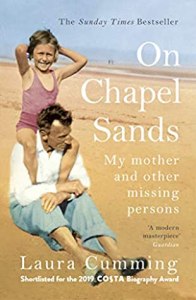
On Chapel Sands by Laura Cumming

How I Heard About The Book

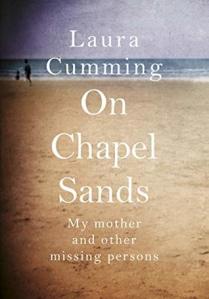
My curiosity was peaked by a mini review over at JacquiWine’s Journal in which she said this memoir may end up being one of the highlights of her reading year. Though first published in 2019 in the US with the title Five Days Gone: The Mystery of My Mother’s Disappearance as a Child, it was published in the UK by Vintage in April 2020 as On Chapel Sands by Laura Cumming.
I was drawn to it for research reasons, it being a memoir in the genre of mother/daughter relationships with an investigative element, focused on the author’s mother, ancestors and villagers from the Lincolnshire coast, her attempts to uncover past secrets and understand the people who kept them.

Laura Cumming’s Love Letter to Her Mother

I was a little skeptical due to the subtitle, which reads like a tabloid soundbite aimed at selling multiple copies of sensationalist content.

I wasn’t interested in reading a ghostwritten drama tragedy, but the understated cover I first saw here and the simplicity of the new title, suggested a narrative that might make a motif out of a sandy beach. And JacquiWine had recommended it. Others who write about books and follow her will know what I mean by that.

Laura Cumming On Chapel Sands

I loved it. The opening chapter sets the scene, recounting the story of a little girl of three years playing on the beach near her mother and her shocking disappearance.  It is a familiar scene, the beach being down a path not far from their home, the tide going out, the sea half a mile in the distance, her mother Vera inattentive for a moment sees nothing.

One minute she was there, barefoot and absorbed, spade in hand, seconds later she was taken off the sands at the village of Chapel St Leonards apparently without anybody noticing at all. Thus my mother was kidnapped.

The little girl, Betty, was found five days later and returned to her family. Laura Cumming learns about this event in her mother’s life many years later, something her mother has no recollection of, a mystery unsolved, yet it is a turning point in her life explaining why she never went to the beach or left the front yard of their house or played with other children from school.

Her life began with a false start and continued with a long chain of deceptions, abetted by acts of communal silence so determined they have continued into my life too. The mystery of what happened, how it changed her, and her own children, has run through my days ever since I first heard of the incident on the beach thirty years ago.

On Chapel Sands Laura Cumming Memoir

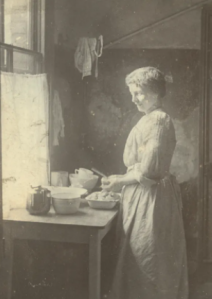
Veda Elston, Betty’s Mother

Rather than seek to resolve the mystery, the book introduces us to the main characters like a novel, including black and white photos, not collected in the middle of the book but placed amidst the text where we read about them.

They are described in a way that makes me flick back to look at them again and again, and I realise this isn’t just a daughter telling a story about her mother, this is an art historian studying a family portrait looking for clues – and finding answers.

To my surprise the truth turns out to pivot on images as much as words. To discover it has involved looking harder, looking closer, paying more attention to the smallest of visual details – the clues in a dress, the distinctive slant of a copperplate hand, the miniature faces in the family album.

She poses many unanswered questions about the events that occurred and seeks answers in the photos she possesses, assembling evidence with the assurity of a forensic expert. Her mother was an artist and taught her how to notice and remember images seen in a museum long before telephones could record them. It has become the way she thinks.

A sense of place is created through references to Dutch painters, there being a resemblance in this landscape to Holland.

The flattest of all English counties, Lincolnshire is also the least altered by time, or mankind, and still appears nearly medieval in its ancient maze of dykes and paths. It faces the Netherlands across the water and on a tranquil day it sometimes feels as if you could walk straight across to the rival flatness of Holland.

Laura Cumming On Chapel Sands

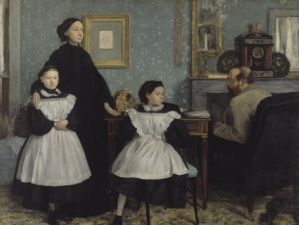
Edgar Degas, The Bellelli Family, (1858-1869) musée d’Orsay

Characters are pondered deeply through photos and family paintings, the author finding inspiration and clues even in more famous works that help us understand the narrative power of an image. By the time I got to reading about Degas’s The Bellelli Family, I had to put the book down and seek the painting out to see more clearly the father’s revealing hand placement mentioned and the escaping dog. What an incredible painting!

I was completely hooked, even looking up to see which museum this painting hangs, and what luck, it’s in the musée d’Orsay in Paris, at least I live in the right country to visit it.

Serendipitously, that same day, Laura Cumming wrote an article in the Observer about the collective yearning for visiting art exhibitions; for Velázquez in Edinburgh, Monet in Glasgow, Goya in Cambridge, Rembrandt at Kenwood House, Poussin in Dulwich, Gwen John in Sheffield.

Cumming is aided by her mother’s writing, the photographs and a little by the visits they would make back to the place of her birth, but she holds out on the big reveal on what really happened until midway into the book, by which time the reader is increasingly desperate have confirmed what she is beginning to suspect.

For my twenty-first birthday, my mother gave me the gift I most wanted: the tale of her early life. This memoir is short, ending with her teenage years, but its writing carries so much of her grace, her truthful eloquence and witness, her artist’s way of looking at the world.

She was fifty-six when she sat down to write and still knew nothing about the kidnap, or her existence before it, except that she had been born in a mill house in 1926; or rather as it seemed to her, that some other baby had arrived there.

Once Cumming learns the truth, there are a roller coaster of emotions spilling onto the page, from anger, disbelief and outrage to sadness, regret and finally some semblance of compassion for those involved. On the continued collective silence though, a protective gesture to cover-up shame, that distorted her mother’s life, she says “in a way, I can’t forgive them.”

I suppose my book, quite apart from being a memoir about my mother and what happened to her and this mystery – it’s also a campaign against collective silence because these people who knew – they knew.

There’s so much more I could say and share, but I urge you rather to read it yourself, particularly if you have an interest in memoir, in mother-daughter dynamics and understanding how art reveals life. It’s a fantastic read, one I’d actually like to read again. And the NPR radio interview is excellent.

On Laura Cumming

Laura Cumming has been the Observer’s art critic for 20 years. Previously, she was arts editor of the New Statesman and a presenter of Nightwaves on BBC Radio 3.

Author of two highly acclaimed books: A Face to the World (2009) draws on art, literature, history, philosophy and biography to investigate the drama of self-portraiture; and The Vanishing Man: In Pursuit of Velázquez (2016), tells the haunting tale of a bookseller’s discovery in 1845 of a lost portrait by Diego Velázquez and how his quest to uncover its strange history ruined his life.

Further Reading

Laura Cumming, Observer Article: Close Your Eyes and Imagine Seeing the Art Worlds Treasures as if for the First Time

NPR Radio, Listen: Laura Cumming Explores Her Mother’s Brief Disappearance In ‘Five Days Gone’

To Read:  An Extract from On Chapel Sands

Laura Cumming On Chapel Sands

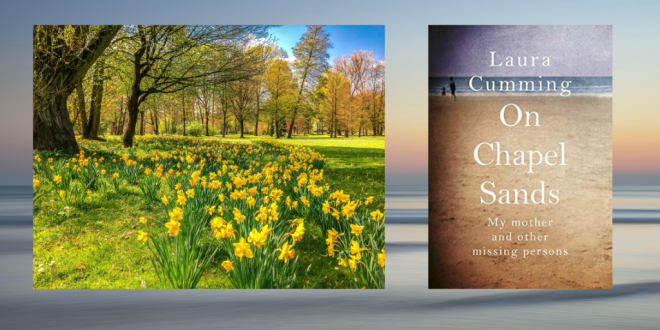
“To commemorate Veda’s life, Elizabeth planted thousands of daffodil bulbs in the grounds of Chapel school for the pupils to pick on Mother’s Day each year, so that no future mother would ever be forgotten.”

Buy a Copy of On Chapel Sands