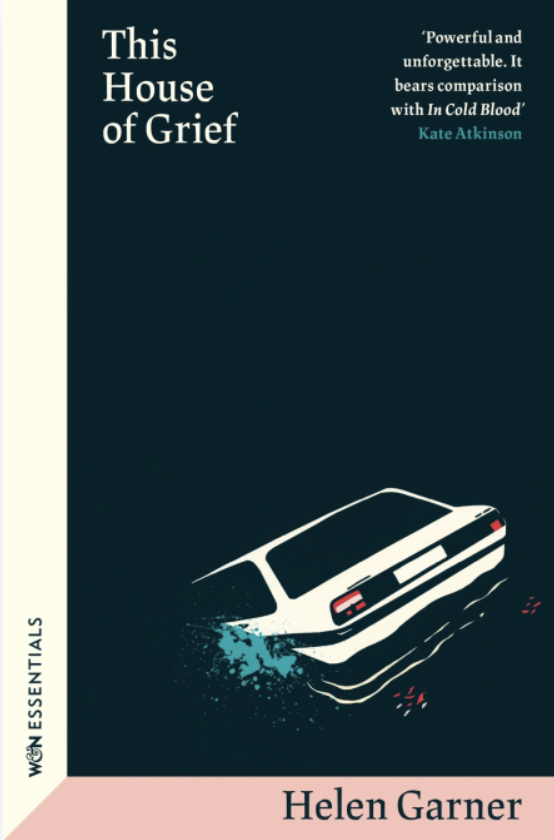
This House of Grief (2014) by Helen Garner

True Crime in Australia
This House of Grief by Helen Garner courtroom drama true crime Rob Farquharson Cindy Gambino

On Father’s Day in 2005, driving his three young children back to their mother’s house, a recently separated husband drives off the road plunging down a bank and into a dam. The man manages to escape and the three children drown.

Everything that happens just before the couple’s separation, on that day and in the period afterwards becomes part of the story presented as evidence to either support the man’s grief or accuse him of the children’s murder.

Sitting In on Courtroom Drama

Helen Garner, author and freelance journalist, sits through the initial court case, the appeal and retrial, presenting to the reader a version of what she witnesses from the courtroom.

Courtroom justice The Mushroom trials Helen Garner This House of Grief
Photo by K. Bolovtsova Pexels.com

Unlike a jury that must weigh evidence against a charge, she speculates, confers and tries to understand the truth. She swings from one opinion to another, grappling with the thought of whether or not it is possible in a moment of impulsivity, that a man who clearly loved his children, could commit this act deliberately.

The man’s ex-wife doesn’t believe he did it intentionally.

Ultimately it is for a jury to decide and a judge to sentence.

As the American writer Janet Malcolm says in her magisterial work ‘The Journalist and the Murderer,’ “Jurors sit there presumably weighing evidence but in actuality they are studying character.”

Whose Perspective Matters?

The case shows how complex justice can become, often with strategic purpose, how fatiguing it can be on everyone involved, how very different perceptions of the same information can be, how loyal family can be, how spiteful people in relationships can act, and how strong denial and self-delusional are.

Garner doesn’t just follow the evidence and observe all the attendants in the room – noting their expressions, responses, who looks at who, capturing side comments, little notes passed to and from people, eavesdropping conversations – she also follows up with people on the outside, who have spent their careers in courtrooms, testing out some of her observations and theories.
The Mushroom Tapes by Helen Garner Chloe Hooper Sarah Krasnostein Conversations on a Triple Murder Trial in Australia

In her recent collaborative book The Mushroom Tapes, she attended a murder trial with two literary authors. They provided a counter to own thinking, enabling perspectives to be tested, refined, looked at from different angles.

In this earlier work, Garner is accompanied by her curious and attentive 16-year-old niece Louise. Though at certain points she questions the parents openness in allowing her to be present (she considers this on a day she was absent, with frank relief), each time she shares one of Louise’s insightful comments, it is revelatory.

There is something to be said for the cross generational team observation, good for the author and also a reminder to the reader that this is one person’s observation and it is a majority that decide.

On a day when the trial was slow going, when confusion and boredom filled the room and she noted that everyone had been affected by it, she contacted an old friend, a now retired barrister.

‘Farquharson’s counsel,’ I texted, ‘is killing us with boredom.’

He replied at once: ‘A time-honoured approach, when no feather to fly with. Still, one has heard it said that the fear of boring oneself or one’s listeners is a great enemy of truth.’

Time Heals and Time Destroys

The trial dissects not just the events of that one devastating Father’s Day, but the relationship of the couple, and things said to others while they were going through the painful process of separating. Things that in hindsight might be construed as intention, not mere jest. Throughout the first trial Cindy Gambino is supportive of her ex-husband, she refuses to believe that this man she knows loved his children, could ever intentionally carry out such an act.

Police wire-tap friends and try and get them to lead conversations where they need them to go. But all of these relationships are averse to betrayal, their histories are too long, connections too deep and their fear of reprisal too great.

Be Careful What You Say in Public

A couple of months before the retrial Garner was invited to give a talk about non-fiction in a State library. Someone in the audience asked her about her opinion on the trial, a subject she did not wish to get drawn into.

I confined myself to the observation that the only person who knew the truth wasn’t talking, and changed the subject.

One day a month or so later during a lunch break of a pretrial preliminary sitting, the defence lawyer pulled Garner aside for a word. He told her he had been sent a video of her talk at the library; Fear that she had said something inappropriate ripped through her.

My heart went boom. ‘Did I drop a clanger?’

‘You did. You said, “Only one person knows what happened in the car that night, and he’s not talking.” He leaned forward on both elbows and subjected me to a power-darkened look. ‘Our case is that my client doesn’t know what happened in the car that night. Because he was unconscious. By offering that opinion in a public forum, you were undermining my client’s right to silence. I think you might be in contempr of court.’

‘Contempt of court? Me?’ I broke into a cold sweat.

Discrediting a Witness

By the time of the retrial, five years after the event, the experience of repetition was disagreeable for many who took the stand. Significantly, Cindy no longer took the same position she had held. The defence sought to undermine that too.

It was exactly what Morrissey was after, a deeply ‘feminine’ shift, inspired not by reason but by wifely grievance and the bitter desire to settle a score.

Audiences attend to unravel a mystery, to understand a truth, but what they find in the courtroom is something a game or a debate, presentations of evidence on one side and efforts to discredit them on the other. The law is the rule book.

I tried to describe how I thought cross-examination worked.

‘The whole point of it is to make the witness’s story look shaky, to pepper the jury with doubt. So you get a grip on her basic observations, and you chop away and chop away, and squeeze and shout and pull her here and push her there, you cast aspersions on her memory and her good faith and her intelligence till you make her hesitate or stumble. She starts to feel self-conscious, then she gets an urge to add things and buttress and emphasise and maybe embroider, because she knows what she saw and she wants to be believed; but she’s not allowed to tell it her way. You’re in charge. All she can do is answer your questions.’

An Unjust System?

Prima Facie Suzie Miller Jodie Comer theatre play justice system

There are most certainly issues in the legal system that are problematic. The re-traumatising of victims is one and the unconscious bias against certain people is another. Recently I listened to an interview with Australian lawyer Suzie Miller, who ironically, has turned to theatre to communicate the inherent biases in the legal system.

Her play Prima Facie to be shown at the Gaiety theatre in Dublin 27-31 January sold out in less than a minute. It is the story of a proud barrister, who becomes a victim and finds herself on the other side of the justice system, and has a rude awakening, on discovering that the law was not written with victims in mind and that she is the one on trial.

I am planning to read the play soon, because of the incredible story of how Suzie Miller came to be in a position to be able to present this story, after all her education and experience and the fact that judges immediately set about implementing change after seeing it. Watch this space.

Though it is at times a laboured read and a tragic one, I did enjoy following the lengthy process through Helen Garner’s eyes. It did not leave me with any definitive answers though, except how difficult it must be to be a jury member in one of these crimes, when there is a system that facilitates the process that seems more like a chess game that an attempt to deliver justice. A system in need of its own reform.

Have you read This House of Grief or seen Suzie Miller’s play?

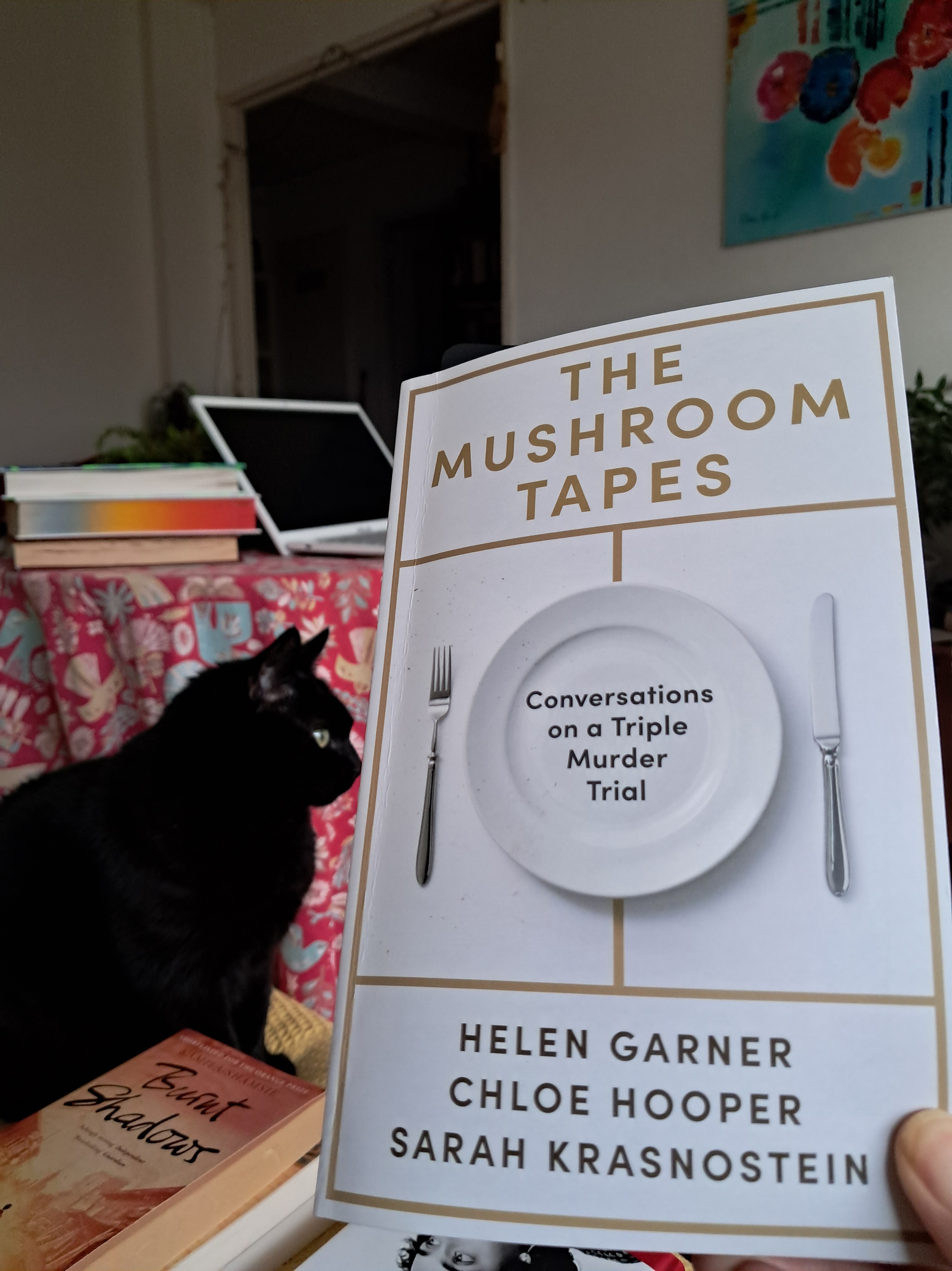
The Mushroom Tapes (2025) by Helen Garner, Chloe Hooper, Sarah Krasnostein

Conversations on a Triple Murder Trial

The Mushroom Tapes was probably more interesting for me because I knew nothing about the trial and stumbled across it after having already decided to read Helen Garner’s collected diaries. This is a catch up review from Dec 2025.

Courtroom Content, Trial Coverage, the Spectacle of Justice

The book concerns a 2025 trial in Australia, which was very widely covered in the media, in a similar way to the coverage of the Johnny Depp v. Amber Heard trial.

Court Trials of public interest become like live reality television when the Courts decide to allow love broadcasting to the wider public, who capitalise on it turning it into something more like serialised drama.

Three Literary Authors on a Road Trip

The Mushroom Tapes by Helen Garner Chloe Hooper Sarah Krasnostein Conversations on a Triple Murder Trial in Australia

The nonfiction book The Mushroom Tapes: Conversations on a Triple Murder Trial was created by three established Australian literary nonfiction writers:

Helen Garner, an acclaimed novelist and nonfiction writer with a long history of researching and writing about real-world true crime legal cases.

Chloe Hooper, an award-winning author known for deeply researched true-crime and nonfiction works.

Sarah Krasnostein, multi-award-winning writer and critic with a background in long-form journalism and law.

The book was created shortly after the conclusion of nine weeks of evidence to a jury in 2025. It is based on recorded conversations in the car and a local cafe, and reflections during and after the Erin Patterson triple-murder trial in Victoria, Australia, combining legal observation with personal and ethical analysis rather than simple narration.

It starts and we are not even there. Everyone in the world is talking about it. People say to us, you must be going. No, we answer. No. No. No.

…Heads turn to watch the trial. We see them start to stir. Via a media audio-link we listen to the evidence of the woman’s estranged husband. One wild domestic detail galvanises us: his dying aunt remembered that the guests ate off four grey plates, while the hostess served herself on an orange one.

On day five we get in the car.

Courtroom justice The Mushroom trials Helen Garner
Pic K. Bolovtsova Pexels.com

The book is split into six parts: The Court, The Church and the House, The Death Cap, The Victims, The Accused, The Verdict and it ends with Coda (the conclusion).

The first page shows a map of south east Australia, showing where the trial took place, the distance from the city of Melbourne, where the homes of the people involved were and where she foraged.

The text begins on 5 May and concludes on 4 July 2025.

Collaborative Authorship

This was a spontaneous book purchase. I was curious to see how the three authors could pull off the idea of road trip conversations, and create a collaborative approach to authoring a book of this nature.

We’ve never travelled anywhere together before. We’re writers and we’re friends, but this morning we’re almost shy of each other, not a hundred percent how we’re going to handle the day.

None of us wants to write about this. And none of us wants not to write about this.

While it does work and I really enjoyed the way the book is presented, I read it not long after Killers of the Flower Moon by David Grann, which is true crime on a whole different level, a case that involves years of research and delving into archives and uncovering the conspiracy of a nation. This is nothing like that, so not not investigative epic, but reflective, conversational, and essayistic.

It has more in common with Helen Garner’s earlier work, This House of Grief, being as much about the writer’s observations and response as the crime itself and in this case, The Mushroom Tapes shares the considerations of three people, arriving at a collective understanding and sensibility. It might be compared to French author, Emmanuel Carrère’s The Adversary, an exploration of the double life of a once respectable doctor.

What Happened

Photo V. Vieira Pexels.com

In July 2023, in a quiet Australian country town, Erin Patterson, stay-at-home mother and true-crime aficianado, invited her estranged husband’s devoutly Christian family to Sunday lunch. Her ex-husband was invited but pulled out at the last minute.

Within days, three of her guests were dead and the fourth was in a coma. They had been poisoned by death cap mushrooms found present in the Beef Wellington dish she had served.

The Trial

Two years later, Patterson stood trial, accused of three counts of murder and one count of attempted murder. The prosecution argued she deliberately foraged, prepared, and added the poisonous mushrooms to the meal to kill her guests; the defence claimed it was a tragic accident and that she had “panicked” after realising people had died.

The Mushroom Tapes

It is a terrible and tragic event when three close relatives die so suddenly after a Sunday lunch and even worse to imagine the poisoning may have been deliberate. The three writers decide to follow the trial and between them combine close legal examination and observation of people in the courtroom as the events unfold (reminding me of Yvvette Edwards courtroom novel The Mother), with personal and ethical analysis.

Chloe: Why is the public fascinated by a female poisoner?

Sarah: It’s archetypal. Adam and Eve and the apple. It’s through myths and fairytales.

Chloe: These crime stories seem to work as modern folktales. We mike it all the more if the characters are clearly good or bad, much as those old tales need a witch.

Helen: When I was splitting up with my husband, he said angrily to me, ‘You think you’re a good person!’

Chloe: Did you take that as an insult?

The women listen to the evidence and discuss it in a way that makes for an easy reading, intriguing form of coverage, a lot less repetitive no doubt than the actual trial.

Female Poisoners

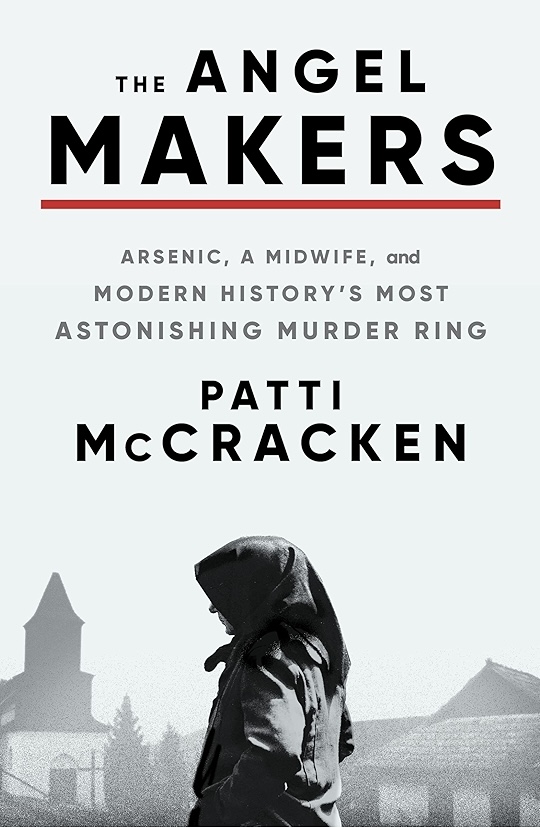
I also picked this book up because my curiosity had been piqued earlier after listening to a podcast interview with the author Patti McCracken prior to the publication of her true crime book The Angel Makers (2023). A village in Hungary in the 1910-1920’s had more than 160 cases of death by poison.

Women in the village had been complaining to their midwife ‘Auntie Suzy’ about unwanted pregnancies, domestic violence and a host of other marital complaints; she had a plethora of knowledge that she passed on to her clients. The story blends social history, gender roles, desperation, and crime, exploring why these women turned to murder and how the killings remained undetected for so long.

True Crime Devotees

It is likely that Erin Patterson and her true-crime friends were aware of that book. Stories about true crime, we learn, fascinate women. A criticism of true-crime is that it desensitises us to murder.

Chloe: I want to know more about true-crime’s appeal to women. I read that something like seventy percent of Amazon’s true-crime book reviews are by women, whereas for war books it’s like eighty-two per cent men. A female audience is driving the production of true crime in every medium. Why are women so fascinated by this?

Though they attempt to discover a motive, the four victims are portrayed as kind, gentle people, so the focus shifts to an analysis of the personality of Erin Patterson, the accused, the disintegration of her marriage, her resentments, her fascination with true crime and the devoted online community of friends she was part of in absence of the same in her own life.

According to the newspapers, Erin had described her upbringing to her Facebook friends:

My mum was ultra weird her whole life. We had a horrible upbringing. Mum was essentially a cold robot. It was like being brought up in a Russian orphanage where they don’t touch babies.

Dad wanted to be warm and loving to us, but mum wouldn’t let him because it would spoil us, so he did as he was told. She would shout at him if he did the wrong thing, so he became very meek and compliant. My sister and I would hide in our room most of the time so we couldn’t do anything wrong.

Chloe: Erin said that, to cope with this, she spent most of her childhood reading.

It seems also strange the attention the trial is given in this age of podcasts and content creation, so many people pursuing a trial for their own opportunity and attention, a conversational book seems almost an oxymoron.

Helen: I look at some people I’ve seen in the dock and I think, Jesus, I’ve been there, and somehow I didn’t crack – something in me stopped me from cracking and murdering…A friend of mine said to me, ‘I have to know why she broke.’ That’s what I’m always looking for in these stories. What was the point at which Erin just could not hack it any longer.

Chloe: She has elements of a fantasist or fabulist. Who knows what she’s told herself about breaking.

Final Words From the Survivor

It is an intriguing and compelling read, with its own glimmer of hope, as the sole survivor of the four dinner guests shares the final thought-provoking words, exhibiting values seriously lacking elsewhere.

Sarah: Erin was estranged from her parents, so Don and Gail became even more important for the practical and emotional support they gave. Love betrayed is often the motive for extreme rage. I almost find it more incriminating the more she talks about this well of deep feeling she had for them, because this rage about rejection hovers at the edges.

Further Reading

The Guardian: The Mushroom Tapes review – Erin Patterson through the eyes of Helen Garner, Chloe Hooper and Sarah Krasnostein

Author, Helen Garner

Helen Garner is one of Australia’s most acclaimed and revered writers: of novels, stories, screenplays and works of non-fiction. In 1993 she won a Walkley award and in 2006 she received the inaugural Melbourne Prize for Literature. In 2019 she was honoured with the Australia Council Award for Lifetime Achievement in Literature. Her best-selling books include Monkey Grip, The Children’s Bach, Cosmo Cosmolino, The Spare Room, The First Stone, This House of Grief, Everywhere I Look, The Season and her diaries, the collected volume of which has been shortlisted for the 2025 Baillie Gifford Prize.

Author, Chloe Hooper

Chloe Hooper’s first novel, A Child’s Book of True Crime , was short-listed for the Orange Prize for Fiction.  In 2006 she won a Walkley Award for her writing on the inquest into the death in custody of Cameron Doomadgee. The Tall Man, her 2008 book-length account of the case, received numerous awards including the Victorian, New South Wales, Western Australian and Queensland Premier’s Literary Awards.

Her account of the Australian Black Saturday bushfires, The Arsonist: A Mind on Fire, was voted 2018’s Best Non-fiction title by Australian Independent booksellers.

Author, Sarah Krasnostein

Sarah Krasnostein is a multi-award winning writer and critic. Her best-selling books include The Trauma Cleaner, The Believer, the Quarterly Essay, Not Waving, Drowning, and On Peter Carey

She has won Walkley Awards and been awarded the Victorian Prize for Literature, the Australian Book Industry Award for General Non-Fiction, the Victorian Premier’s Prize for Non-Fiction, the Prize for Non-Fiction at the New South Wales Premier’s Literary Awards and the Dobbie Literary Award. She holds a doctorate in criminal law and is admitted to legal practice in New York and Victoria.