heart, be at peace by Donal Ryan

It has been 10 years since The Spinning Heart (my review), and in this small town in rural Ireland, County Tipperary, not a lot seems to have changed, or maybe it has. Previously it was economic collapse, lack of employment, toxic masculinity and how the actions of one man affected a community.

In Donal Ryan’s heart, be at peace we meet many of the cast from the past, another 21 voices some years further on, with a new set of troubles affecting the community.

Some are faring rather well financially, but not everyone is happy about the activities they are involved in and their loved ones who might be affected. Suspicion, mistrust, grief, regret prevail and all manner of connections have been formed and remade.

Births, Deaths and Estrangements

One of the most intriguing characters that I could have happily read a novel on and one of the few characters that does stand out was Lily, described as a witch by training and a whore by inclination, estranged from her son, then made up over her granddaughter Millicent who turns up at her door one day.

Having the gift of insight, she can see her granddaughter will find little solace with the boy she’s seeing. When she asks her granny for a spell to bind him always to her for fear of losing him, she knows there will be trouble ahead.

I explained to her again that the spells weren’t real magic, that the power of them was already inside the people who wanted them, the spells just allowed them the use of it, that the magic was in their faith that the magic would work and she screamed at me then, That’s what I want, Granny, that’s what I want, to have faith that he’ll always love me, that he’ll never leave me. I can’t bear the thought of losing him, of some other bitch touching him. He’s MINE, Granny, he’s mine.

A Chorus of Voices

The way the novel is written with short chapters from multiple character viewpoints, we can only discern what happens next to some of those we meet along the way, as we imagine the implications of all that is revealed. It is a novel that might be better understood after multiple readings, as it takes some work to connect and reconnect the different voices. It’s a kind of fly-on-the-wall polyphonic chorus.

In a way, the novel reading experience is like being in the presence of a community but not really knowing them, observing for a while reveals some connections but not others.

Some men can lie with such ease that they quickly begin to believe themselves, and so in a way their lies become truth and their sin is expunged.

21 voices a community in Tipperary follow up to The Spinning Heart

I have a few of Donal Ryan’s novels and I do recall having a little difficulty with his Booker longlisted debut mentioned above, and then absolutely loving All We Shall Know (reviewed here), then not being impressed at all by Strange Flowers. So a bit hit and miss for me, but one I’ll keep reading as he seems to have his finger on the pulse of contemporary community issues.

I enjoyed heart, be at peace and its themes, but it is a novel that is unlikely to stay with me due to the vast cast of character voices that too often became indiscernable for me.

Author, Donal Ryan

Donal Ryan is an award winning author from Nenagh, County Tipperary where this latest novel is set. His work has been published in over twenty languages to critical acclaim.

heart, be at peace won Novel of the Year and the Overall Grand Prize of Book of the Year at the An Irish Book Awards in 2024, described by the Irish Times an “absorbing, emphatic story of a community in trouble”

Maria Dickenson, Chair of the Judging Panel, said:

“Heart, Be at Peace was the unanimous choice of the judges from among the fantastic array of titles shortlisted this year. Donal Ryan’s writing has earned him a place among the greatest names in Irish literature and this lyrical novel speaks to the very heart of modern Irish society. Weaving twenty one voices together, Ryan portrays the passions, frailties and sorrows of one Irish town with compassion and clarity. Heart, Be at Peace is a masterful achievement and we congratulate Donal warmly on winning this award.”
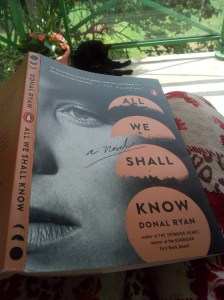
All We Shall Know by Donal Ryan

Donal Ryan is the Irish author many of us remember for his debut The Spinning Heart, long listed for the Man Booker Prize in 2013 (won that year by Eleanor Catton’s, The Luminaries) and noted for perseverance in pursuing his dream to become a published author – his manuscript was rejected 47 times – before becoming a word of mouth sensation and setting him firmly on the track he knew he was destined for.

Since then he has published The Thing About December and A Slanting of the Sun: Stories and now this riveting novel, which was easily a five star read for me. I liked his debut, but this I loved and did not want to put down.

Similar in style to his earlier work, in which he zooms in on the minutiae of life and thoughts of a character(s) in the wake of a pivotal event, here he focuses on one character, Melody, a thirty-three-year woman, whose marriage has become like a habit she wants to kick, but rather than seek help to heal the cracks, she gives in to an impulse and finds herself pregnant to her 17-year-old private student, Martin Toppy, from a Traveller community.

Courageously, Ryan assumes the first person narrative voice of a pregnant woman, the first chapter labelled week twelve, finishing with Post-partum, though this is not a woman obsessed with what is going on inside her body, it’s a woman in the throes of needing to build a nest.  Alone with her thoughts, she thinks back over how she came to be where she is now, interrupted often by memories of her best friend Breedie.

“I’d look at Breedie’s long bare arms, and long legs, and I’d feel a fizzing mixture of admiration and love and terrible envy, that she could make my mother smile and wish she had a daughter like a swan.”

Into this isolation comes another Traveller, partially rejected by her family and community, whom Melody befriends and becomes attached to, picking up her teaching with Mary, where she left off with Martin. Here’s their encounter when they first meet:

You can come into town with me now, if you want.

I can’t. There’d be murder. I’m been watched every single second.

Why did your sisters leave you out?

I’m a shame to the family.

And she told me a story, and I listened, and I didn’t interrupt her once. Her name is Mary Crothery, and she’s nineteen years old.

The language, their way of speaking, the dialogue is raw, visceral and puts the reader right inside the story, it easily evokes a sense of place, you can sense the attitude of the characters around Melody as soon as they rap their knuckles on the door. Mostly they’re angry, except her father, he’s sad and in fear of disappointing him further, Melody stays away from where she’d be most welcome.

“Thinking now about the way I thought about things then, about how I let my mother’s anger towards him seep into me, I feel a desperate need to apologise, to mitigate the hurt I must have caused him as I drew away from him, as I let my perfect love for him be sullied, and eroded, and disintegrated, by the coldness of a woman I didn’t even really like, but whom I wanted more than anything to be like.”

The weeks pass leading to a crisis point as Melody’s life and that of the Traveller community intersects, highlighting family grudges, betrayals, their battles for redemption and overcoming guilt.

Irish Travellers

It is interesting that Donal Ryan chose to highlight characters from within the Irish Traveller community, as 2017 was a significant year in terms of identity for them. There are estimated to be between 29,000 – 40,000 Travellers in Ireland, representing 0.6% of the population. Recent DNA research has proven they are as genetically different from the settled Irish as they are from the Spanish and that this difference may have emerged up to 12 generations ago, as far back as 1657.

Irish Travellers, sometimes pejoratively referred to as tinkers or gypsies are a traditionally itinerant ethnic group who maintain a set of traditions, who after years of lobbying, finally gained recognition of their ethnic status from the government. It is seen as a momentous victory for the thousands of Traveller children who have long suffered from  exclusion and discrimination.

It’s an engaging story, beautifully rendered and while it doesn’t promise to address all the issues it raises, it does what for me the best novels do, puts the readers in the shoes of another in an attempt to see things from multiple perspectives.

Highly Recommended!

Further Reading

Article in Irish Times, Travellers as ‘genetically different’ from settled Irish as Spanish

Article in Irish Times, Historic Recognition of Ethnic Status for Irish Travellers

Buy a Copy of All We Shall Know via Book Depository

The Spinning Heart by Donal Ryan

Reading Donal Ryan’s The Spinning Heart is to wake up in the heart of a struggling suburban neighbourhood where overnight the fate of a significant proportion of its population has changed.

Spinning HeartLittle time elapses between the pages of the novel, sufficient to penetrate the perspective of 21 residents of this neighbourhood, a chapter each.  Rather than a plot, this one event is more of a turning point from which we survey each character from their own and multiple perspectives, gradually creating a picture of this community, where perceptions often outweigh and overrule reality.

That event is the discovery that Pokey Burke has disappeared after a dodgy property deal in Dubai halts all work on his property developments in this Irish suburb.  He has absconded from his responsibilities including all those in his employ (at least they thought they were in his employ), those who thought they were doing okay in these hard times find out that not only do they no longer have a job, they have never been registered as employees.

Donal Ryan unmasks his characters in the single chapter he gives them each to speak (ironically, no chapter is given to Pokey Burke), this is no slow build up to revealing a characters inner thoughts, they are not characters prone to thinking about various options, this is a neighbourhood in which its men rarely ponder anything, their thoughts are often aggressive, misogynistic and raw, many of them are of the act now, think later persuasion. They make for uncomfortable reading and have the reader yearning for a fictional reprieve; could we have one character to latch onto to get us through this discomfort please?

And if we find it partially, it is with Bobby, the foreman whom we meet in the first chapter, on his daily walk to check whether his father is dead yet, something he wishes for that we will come to know more about as threads of his story snake through other chapters, so that we do meet him again and are able to follow his destiny.

“But the things Dad said, and the way he said them, were so scarily unlike him, so cutting, so cruel. That’s just the way he was reared, Ger reckons. She says people’s thoughts, when their upbringing is mired in dogma, aren’t really their own. Their opinions are twisted, not reflective of what’s in their souls; their words are delivered obliquely, like light being refracted through water – you can’t see their real feelings, just as you can’t see the true position of an immersed object.”

So much of what we experience is illusion, many people and situations hide another reality, nothing is what it seems.  Deception is normal, no one wishes to dig too deep to understand, empathy is an unknown concept, we too often ignore instinct, judge quickly and crush the weak and sensitive.

A disturbing read, unputdownable at the same time as not wanting to pick it up, the anticipation that maybe there is some good that can come of the situation, keeps us reading on. These are tough times and perhaps the bad karma of a financial crisis brought about by those who practice greed, corruption and a lack of empathy brings out the worst at every layer of society. It is certainly difficult to navigate the mire and find the seeds of hope.

Booker Longlist

Man Booker Longlist 2013

Donal Ryan is one of three Irish authors longlisted for the Man Booker Prize 2013 and a debut author, who is becoming as well-known for his perseverance (his manuscript was rejected 47 times) as he is for this contemporary work which digs under the skin of small town rural Ireland.

Note: This book was an ARC (advance reader copy) kindly provided by the publisher via NetGalley.