In 2024 I was recommended a book by a family member, who went to an event and heard the author tell the story of his childhood and this novel he wrote called Boy Swallows Universe. Barely a week after this conversation, a friend arrived in my hometown of Aix en Provence, from Australia, pressed this book into my hands and said “You have GOT to read this!”.
Yes, you guessed right, it was Boy Swallows Universe by Trent Dalton and I reviewed it here.
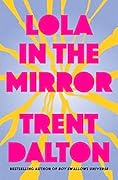
That book was published in 2018. I then saw there was another book about to be published called Lola in the Mirror, which some reviewers described as being even better than the debut novel. On reading about the inspiration for the novel, I decided to get a copy.
Love Stories and a Typewriter
Trent Dalton spent 17 years writing social affairs journalism across Australia. He had his own troubled childhood and upbringing, but he also witnessed and wrote about the situations of so many others, driven by the question; how was it that 120,000 people slept rough every night in one of the brightest, most fortunate countries in the world?
It is this question and the stories shared by the many people he has met over those years, that inspired him to create this latest story Lola in the Mirror.
Frank and Heartfelt
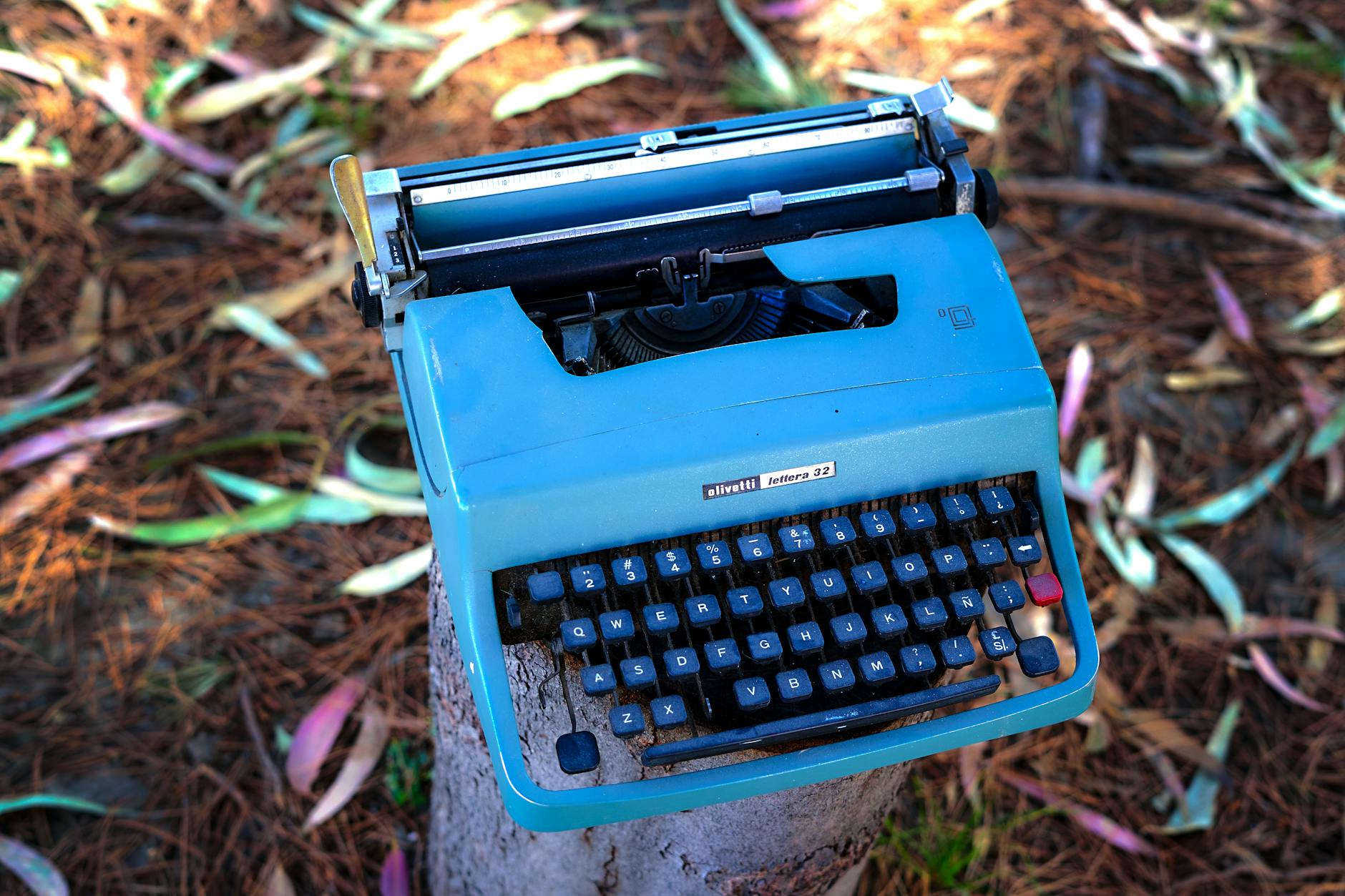
One of the people he was inspired by and wrote about, was Kathleen Kelly, the mother of a friend of his, who passed away on Christmas Day 2020. His book Love Stories is dedicated to her and prefaced with a letter written to her, typed on the sky blue Studio 44 Olivetti typewriter she bequeathed him.
In a letter to Kath, he writes of her memorial service:
Greg spoke of you and your beloved Olivetti Studio 44 typewriter, the sky-blue one that you’d been tapping on since the early 1970’s, writing fiery letters about woman’s rights and human rights and doing life right to politicians and principals and popes. He spoke about the letter you wrote to the Catholic Leader in 1970, railing against Canon Law demanding the covering of women’s heads in church. You were furious and brilliant.
After the service, Greg tells Trent that his Mum cut out all the stories he wrote and made scrapbooks that documented her life and all that was important to her and that she wanted him to have her typewriter. Being the honour that it was, Dalton wanted to do something special with it, to write something filled with love and depth and truth and frankness and heart because that’s how Kath was.
I told Greg I wanted to walk through the streets of Brisbane’s CBD (central business district) for two months asking random strangers to tell me love stories. I told him I then wanted to sit two for weeks straight with the Olivetti on the corner of Adelaide and Albert streets, on the edge of King George Square, and ask random strangers to stop and tell me more love stories, and then I wanted to write about all those love stories on your beautiful Olivetti.
Those two months of listening to people tell their stories of love, loss and belonging were research for this story of Lola, frank, fearless and full of heart.
Lola in the Mirror
Lola in the Mirror is a riveting, page turning novel that gripped me from the opening pages and never let go. It is a whirlwind of risk and adventure, an exploration of friendship, loss, perseverance and the resilience of the human spirit to not give up on a dream. It is a challenging coming-of-age story of an innocent girl who desperately wants to know who she is and rise above her situation.
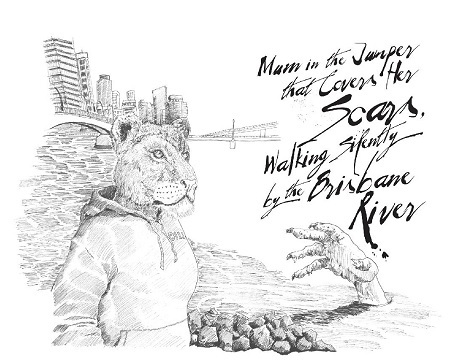
The novel opens with a black and white illustration entitled ‘Escaping the Tyrannosaurus Waltz‘, the dance of mothers and their monsters, or the dark shadow of domestic violence, something Dalton recalled about his own mother, who often had to choose between homelessness or ‘the monster’, a terrible choice faced by many women in Australia, for whom domestic and family violence is one of the leading causes of homelessness.
The artist is a 16-year-old girl, she and her mother are on the run, they have been for all her life. The girl does not know her own name, because it’s too dangerous, but her mother promises to reveal things to her soon, when she turns 18, because then she will be free to make her own choices.
Houseless not homeless
The girl does not describe herself as homeless, the two live in a van with four flat tyres parked in a scrapyard by the banks of the Brisbane River. There is a community of friends who live in similar circumstances, who look out for each other and this girl has a dream of a future life that will be different to how she lives now. For now that scrapyard home is her sanctuary, where she can dream up the best version of herself.
For a start, I ain’t homeless, I’m just houseless. Those two things are about as different as resting your head on a silk pillowcase and resting your head on a brick.
As this girl navigates her life in search of who she is, she comes across a mirror that she takes home, and after a period when the mirror cracks, something magical happens, half the mirror shows her legs and the other shows a dressed up woman in different world cities, who converses with her.
She wants to see her face, but she always has her back to her. She calls her Lola. Lola’s presence keeps her curious, keeps her coming back and looking in the mirror, gives her reason to keep dreaming. She is like a pulse on her mood, on her self-belief.
“Mirror, mirror, on the grass, what’s my future? What’s my past? … Mirror, mirror, please don’t lie. Tell me who you are. Tell me, who am I?”
The storytelling is incredible, the characters are fully formed, and the depiction of the city, the river, the bridges is visionary. You cannot read this book and not care about what happens to this girl or get hooked into wanting to know how she gets in and out of various situations. It is mystery, adventure, crime, psychological suspense and love story rolled into one. The best kind of holiday read ever.
I took this book on holiday with me to Australia, figuring I would read it there and leave it behind. It is set in Brisbane which is where I flew into, although I was staying much further South. On the day I started reading, my son was due to fly back to France. I sat in the passenger seat of the car as we drove to the airport. This time, we took a different route and suddenly we were driving alongside the CBD and there were all these bridges and a glimpse of Victoria Park and the mighty river.
When I got back to my book later in the day, on page 45, I read descriptions of exactly the same places we had just driven past. It was surreal, to move from the imagined place to these live flashes of what I had just seen. It brought the story to life and for the rest of the novel, those images kept recurring. I have always been a fan of reading works set in the places I travel to, and I’m glad I read this one in situ as well.
The Artwork
Throughout the novel are a number of superb illustrations, which both tell parts of the story and also suggest a future life of the girl artist. Each drawing is followed by an imagined art critic review in a black box, as if it were being displayed at an exhibition at the Metropolitan Museum of Art, the commentary describing what the artist is representing in the illustration.
Of course, I became curious about the actual artwork and skipped to the back of the book to look up the story behind it. It’s a good one.
Trent Dalton, Author
Trent Dalton is a two-time Walkley Award-winning journalist and the international bestselling author of Boy Swallows Universe, All Our Shimmering Skies, and Lola in the Mirror. His books have sold over 1.3 million copies in Australia alone. He lives in Brisbane, Australia, with his wife and two daughters.
Lola in the Mirror is for anyone who ever felt like they were going to collapse under the weight of sorrow. The book is also for all those beautiful souls who help us carry that weight. It’s an art story. It’s a crime story. It’s a mystery novel. And it’s a life story. I hope people will read this, get to the end and realise why I wrote Love Stories and sat on a Brisbane street corner watching people and asking them about love, loss and belonging for three months.
There There by Tommy Orange was lent to me by a friend and was a debut novel that made a significant splash when it was published in 2018. The author is a member of the Cheyenne and Arapaho Tribes of Oklahoma, born and raised in Oakland, California.
The Egyptian-Canadian novelist Omar Al Akkad who won the 2021 Scottiabank Giller Prize for his refugee tale What Strange Paradise, a book that examines the confluence of war, migration and a sense of settlement, raising questions of indifference and powerlessness, had this to say:
“There There is a miraculous achievement, a book that wields ferocious honesty and originality in service of telling a story that needs to be told. This is a novel about what it means to inhabit a land both yours and stolen from you, to simultaneously contend with the weight of belonging and not belonging.”
The novel starts out with a two page very short summary of 12 characters, giving the reader a little information about each, but avoids anything that might be a spoiler in the stories to come. I liked having this summary there and I would go back to it each time I encountered those characters as they developed and as I became aware of what was being given and what was being held back for the reader to discover.
The characterisation was excellent and I especially loved how the author built his female characters.
Jacquie kneeled in front of the minifridge. In her head she heard her mom say, “The spider’s web is a home and a trap.” And even though she never really knew what her mom meant by it, she’d been making it make sense over the years, giving it more meaning than her mom probably ever intended. In this case, Jacquie was the spider, and the minifridge was the web. Home was to drink. To drink was the trap.
There is an edge to the male characters and a tension that builds slowly over time that made their chapters harder to read.
The wound that was made when white people came and took all that they took has never healed. An unattended wound gets infected. Becomes a new kind of wound like the history of what actually happened became a new kind of history. All these stories that we haven’t been telling all this time, that we haven’t been listening to, are just part of what we need to heal.
The title ‘There There‘ has multiple references, the first being the name of a Radiohead song with the refrain, ‘just ’cause you feel it doesn’t mean its there’ and a Gertrude Stein quote ‘There is no there there’ referring to the place she’d grown up in that had changed so much, that there of her childhood, the there there, was gone.
The quote is important to Dene. This there there. He hadn’t read Gertrude Stein beyond the quote. But for Native people in this country, all over the America’s, it’s been developed over, buried ancestral land, glass and concrete and wire and steel, unreturnable covered memory. There is no there there.
As the novel builds, the connections between the characters and their journeys are revealed.
All the characters are Native and the way they identify, their identity, their knowledge or lack of knowledge about who they are and how they are perceived, how they cope, how they live is central to the kaleidoscopic narrative, that builds up to the final chapters, when they will be present at the Big Oakland Powwow festival.
We made powwows because we needed a place to be together. Something intertribal, something old, something to make us money, something we could work toward, for our jewellery, our songs, our dances, our drum.
I enjoyed the character building, the reflections, the cultural insights and getting to know their stories more than the actual plot.
They used to call us sidewalk Indians. Called us citified, superficial, inauthentic, cultureless refugees, apples. An apple is red on the outside and white on the inside. But what we are is what our ancestors did. How they survived. We are the memories we don’t remember, which live in us, which we feel, which make us sing and dance and pray the way we do, feelings from memories that flare and bloom unexpectedly in our lives like blood through a blanket from a wound made by a bullet fired by a man shooting us in the back for our hair, for our heads, for a bounty, or to just get rid of us.
The first two thirds of the novel was for me a 5 star read, but the ending had me imagining alternative choices. And yet, it could be said that the ending was foretold, that the ancestral memory had carried forward and become so twisted, it turned on itself.
Make them look and act like us. Become us. And so disappear. But it wasn’t like that.
Further Reading
There There was nominated for the Pultizer Prize (2019) and National Book Award (2018), won the PEN/Hemingway Foundation Award (2019) and was one of the New YorkTimes 10 best books of the year.
This is the first book I have read by Leila Aboulela, an author I have long wished to read, being someone who grew up in one culture and has experienced life in another, an observer perspective that interests me.
A New Exploration of Culture
There was a time when literary insights into other cultures came predominantly from male explorers of anglo-saxon cultures, now we are increasingly able to read stories from a viewpoint of a woman coming from an African or Eastern culture or country, living in the West. They are able to bring a richness in perspective and fresh insights of encounters with the place they have arrived in and people they live side by side.
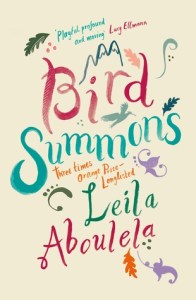
Bird Summons is a tale of three women. They share in common that they belong to the Arabic Speaking Muslim Women’s Group, although they have all grown up in different countries. Within the group and from that common element, they will challenge and learn from each other.
We witness how attitudes shift and change as they transform, within this environment they have adapted to. One can not live elsewhere and stay fixed in the past and even when one adapts to a new present, it is necessary to continue changing and moving forward, no matter what challenges us from the outside.
The first British woman to perform the Hajj
Salma has organised a trip for the members of the group to visit the remote site of the grave of Lady Evelyn Cobbold, the first British woman to perform the Hajj pilgrimage to Mecca, to educate themselves about the history of Islam in Britain, however rumours of its defacement cause some to have doubts, whittling their numbers to just three.
“The attempt of the women to visit Lady Evelyn’s grave is a way of connecting more closely to Britain. Because Lady Evelyn was a Muslim like them, they see her as one of them and it gives them a sense of belonging.
She was also more independent than they are, stronger, more confident, more able. She was a Scottish aristocrat and therefore vastly more entitled than they would ever be. She represents the figure of a leader which is something that they need.” Leila Aboulela
Sometimes adversity offers a gift and rather than an overnight visit, they decide to stay a week at the loch, a resort on the grounds of a converted monastery, from where they can leisurely make their way to the grave.
A Contemporary Scottish Pilgrimage
Each of the three women has a pressing life issue that over the week consumes them, that the other women become aware of, leading them to have a strange, hallucinatory, spiritual experience. As their journey unfolds, they explore how faith, family and culture determine their lives, decisions and futures.
As they travel we get to know their characters, their lives, how attached they are to the place they now call home and the pressures and influences on them that come from the cultures they have left behind. They live at the intersection of a past and present, of who they were and who they are becoming. This holiday will be transformational for all three of them.
“Salma, Moni and Iman are weighed down by their egos, though it might not be apparent to them at first. Like most of us, they see themselves as good people, justified in the positions and decisions they have taken.” Leila Aboulela
Salma was trained as a Doctor in Egypt, leaving her fiance, for David, a British convert who would bring her to Scotland, something her family approved of and she was excited to do, despite being unable to practice her profession. Though successful in her current job as a massage therapist, when Amir starts messaging her, she begins imagining the life she might have had, obsessively checking and replying to the messages.
Moni left a high flying career, her life now revolves around caring for her disabled son Adam, consuming her and pushing her away from her husband who wants them to join him in Saudi Arabia, something Moni rejects because of how she believes Adam will be perceived, an outcast.
Iman is young, beautiful, unlucky in love and a poor judge of character, the men she has married were stunned by her beauty but possessive.
Surrounded by adulation and comfort, like a pet, she neither bristled nor rebelled. She did, though, see herself growing up, becoming more independent.
And then there is the Hoopoe. The wonderful bird that’ll take some readers on a side journey to find out more. The bird comes to Iman in a dream, recounting fable-like stories.
It spoke a language that she could understand. It knew her from long ago, it had travelled with her all those miles, never left her side, was always there but only here in this special place, could it make itself known.
It is one of only three birds mentioned in the Quran, and symbolises tapping into ancient wisdom, probing one’s inner questions for the answers being sought.
The appearance of the Hoopoe late in the novel heralds a period of magic realism, that reminds me of the experience of reading The Enlightenment of the Greengage Tree. It comes as a surprise when the woman’s reality shifts, as they shape-shift and are tested within the experience. It is disconcerting for the reader as we too experience the women’s confusion, but I recognise it as part of the cultural experience, of an aspect of traditional storytelling bringing a mythical message-carrying bird into contemporary social relevance.
“The Hoopoe in classical Sufi literature is the figure of the spiritual/religious teacher who imparts wisdom and guidance. However, the Hoopoe’s powers are limited. The women must make their own choices.”
It is a wonderful book of three international women, their journey, which they believe to be a pilgrimage to an important site, which becomes an inner voyage of transformation.
Highly Recommended.
Leila Aboulela, Author
Leila Aboulela was born in Cairo and brought up in Khartoum, the capital of Sudan. She lived for some years in Aberdeen, Scotland.
Her novels include The Translator (1999), Minaret (2005) and Lyrics Alley (2010) all of which were longlisted for the Orange Prize — and The Kindness of Enemies (2015). Lyrics Alley also won Novel of the Year at the Scottish Book Awards and was shortlisted for the Commonwealth Writers’ Prize.
“When I write I experience relief and satisfaction that what occupies my mind, what fascinates and disturbs me, is made legitimate by the shape and tension of a story. I want to show the psychology, the state of mind and the emotions of a person who has faith. I am interested in going deep, not just looking at ‘Muslim’ as a cultural or political identity but something close to the centre, something that transcends but doesn’t deny gender, nationality, class and race. I write fiction that reflects Islamic logic; fictional worlds where cause and effect are governed by Muslim rationale. However, my characters do not necessarily behave as ‘good’ Muslims; they are not ideals or role models. They are, as I see them to be, flawed characters trying to practise their faith or make sense of God’s will, in difficult circumstances.”



 There There by Tommy Orange was lent to me by a friend and was a debut novel that made a significant splash when it was published in 2018. The author is a member of the Cheyenne and Arapaho Tribes of Oklahoma, born and raised in Oakland, California.



 Word by Word