Sagittarius by Natalia Ginzburg (1957) tr. Avril Bardoni

After just finishing Domenico Starnone’s The House on Via Gemito (my review here) featuring a domineering father, it felt appropriate to read another Italian author Natalia Ginzburg and her fictional account of a domineering mother.

The Interfering Parent
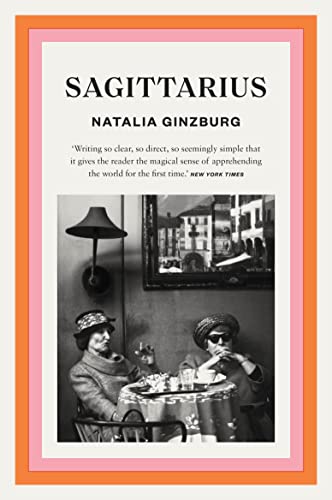
However, Ginzburg’s parent in the novella Sagittarius might be considered timid compared to Starnone’s Federico. While she is over invested in the lives of her two daughters, they seem able to pursue their own desires in spite of her interference.

Fed up with life in a small town she moves to the suburb of a city to be closer to her sisters, who run a china shop and her student daughter (who narrates the story), then demands that her second daughter and husband move with her, she has promised to give him money to set up a practice.

What he needed was a practice of his own in a good central location. My mother had promised to give him the money for this as soon as she had won a certain lawsuit against the local council in Dronero, concerning a property dispute; she had made the promise lightly, finding it easy to part with money that was so far away and so unlikely ever to be hers; the litigation had already dragged on for more than three years, and Cousin Teresa’s husband, a solicitor, had told us that our chances of winning were nil.

Photo by Ylanite Koppens on Pexels.com

We learn she disapproves of the husband Chaim, a Jewish Polish Doctor with only one brother left in his family, having lost his family in wartime. She was initially distraught over the one that got away, – a rich, blond, young man her daughter met on holiday, until she became ill and her mother arrived – not realising that her overbearing parental behaviour might have had something to do with it. She had done everything to ensure her daughter would marry well.

Every time she thought about the boy with the blond crew cut my mother became enraged. Not one spark of generosity had he shown! No crumb of comfort had he offered! And to think he had disappeared without even saying goodbye! Without a single word of any kind: The very memory of the blond crew cut and of the afternoon spent with is family now filled her with disgust.

There were days when my mother was almost as bored in town as she had been in Dronero. She already knew the central shopping district like the back of her hand, having walked the length and breadth of it looking for suitable premises, small but attractive, for her art gallery; but the rents were all extremely high and, besides; another problem was beginning to occur to her, that of finding painters willing to show in her gallery. She knew nobody.

Making Friends in the City

Finding it more lonely and isolating than she imagined, she is happy when she meets Pricilla (call me Scilla), a woman who (eventually) listens to her dreams and desires and seems in tune with them and even willing to partner with her on her project to open an art gallery.

My mother was now anxious to talk about her gallery project but was unable to get a word in edgeways because Signora Fontana never stopped chattering for an instant.

In her dogged pursuit of ambition, and desperate desire for a true friend, she overlooks important signs that perhaps all is not as it should be and naively keeps her plans to herself, avoiding criticism or advice from any of her family members that might have lead her to question her association – though probably not.

A Greek Mythology Warning

Photo by Damir on Pexels.com

It is no coincidence that Ginzburg names her character Scilla, that name immediately conjured up for me the creature Scylla lurking in the sea that enticed ships onto the rocks. She is adept at luring men into a perilous and rocky waterway, thus as I read, every person that Scilla was connected to, became for me, a potential villain or obstacle in her path, some perhaps by accident, others by design.

Scilla convinces her friend to wait on the art gallery project and invites her in on another shop idea. They will decide on a name, Scilla’s zodiac sign, Sagittarius, one that could easily be transferred to an art gallery.

Ultimately she will be confronted with her own poor judgement, both those she put her trust in that she should not have and those who she neglected and would be there for her in her downfall.

This novella is often read with the excellent Valentino which I read earlier in the year and loved. Sagittarius is a little more predictable, whereas for me, Valentino was exceptional, my favourite of the two, but I highly recommend them both and look forward to reading more Ginzburg this year.

Further Reading

My reviews of other Natalia Ginzburg works: Family Lexicon (memoir), The Dry Heart (debut novel), Valentino (novella)

JacquiWine’s Journal reviews Valentino and Sagittarius

Author, Natalia Ginzburg

Natalia Ginzburg (1916-1991) was born in Palermo, Sicily. She wrote dozens of essays, plays, short stories and novels, including Voices in the EveningAll Our Yesterdays and Family Lexicon, for which she was awarded the prestigious Strega Prize in 1963.

Her work explored family relationships, politics and philosophy during and after the Fascist years, World War II. Modest and intensely reserved, Ginzburg never shied away from the traumas of history, whether writing about the Turin of her childhood, the Abruzzi countryside or contemporary Rome—approaching those traumas indirectly, through the mundane details and catastrophes of personal life.

She was involved in political activism throughout her life and served in the Italian parliament between 1983 to 1987. Animated by a profound sense of justice, she engaged with passion in various humanitarian issues, such as the lowering of the price of bread, support for Palestinian children, legal assistance for rape victims and reform of adoption laws. 

She died in Rome in 1991 at the age of seventy-five.

Valentino (1957) by Natalia Ginzburg tr. Avril Bardoni (Italian), Intro by Alexander Chee

The more I read of the Italian author Natalia Ginzburg, the more I am hooked.

Valentino leads the reader along, thinking you are reading a straight forward story, until you arrive at the point of realising that your reactions are judgements and the book holds up a mirror to our own conditioning. And that is how it feels reading it in 2024. I can’t even imagine the storm it likely raised when published in 1957.

Little Sense or Sensibility

novella Italy parody fiction gender conditioning

Valentino is a short novella narrated by Caterina, who is training to become a teacher. She lives with her father, a retired schoolteacher, her mother, who used to give piano lessons and her brother, Valentino who does very little, but whose medicine studies and equipment cost a lot.

we had to help my sister who was married to a commercial traveller and had three children and a pitifully inadequate income, and we also had to support my student brother who my father believed was destined to become a man of consequence. There was little enough reason to believe this, but he believed it all the same and had done ever since Valentino was a small boy and perhaps found it difficult to break the habit.

Valentino spends his time playing with a kitten, making toys out of scraps of material, dressing up and admiring himself. A string of engagements to teenagers raise false hopes and always end the same way – broken. So when he announces he will be married within the month, naturally the family expect the pattern to continue.

What a Wife Can Be or Not to Be

So when he turned up with his new fiancée we were amazed to the point of speechlessness. She was quite unlike anything we had ever imagined.

We learn of all the family members reactions to this new fiancée, with the exception of the father.

he was about to launch into a long speech about what was the main consideration but my mother interrupted him. My mother always interrupted his speeches, leaving him choking on a half-finished sentence, puffing with frustration.

A Man of Consequence, The Weight of Expectation

Photo by W R on Pexels.com

Valentino is oblivious to the reactions and judgements of his family and continues to act and communicate as he always has, holding nothing back, expecting everyone to be happy for him.

Is he fearless? A truth teller who doesn’t hide things or worry about what others think of him? Is he a narcissist? He is a wonderful character because he is like the mystery at the centre of the story. Who don’t quite know who he is because he isn’t acting as everyone including the reader might expect him to.

His father lost for words, does not understand that what he is witnessing is the incarnation of his desire, his son is indeed becoming a man of consequence, just not in the way he had expected.

Valentino is captivated by his wife, by her look, her intelligence, her culture. She showers him in gifts, he has upended social convention, insulted the patriarchy and all who prop it up.

My father said he would go to have a talk with Valentino’s fiancée, but my mother was opposed to this, partly because my father had a weak heart and was supposed to avoid any excitement, partly because she thought his arguments would be completely ineffectual. My father never said anything sensible; perhaps what he meant to say was sensible enough, but he never managed to express what he meant, getting bogged down in empty words, digressions and childhood memories, stumbling and gesticulating. So at home he was never allowed to finish what he was saying because we were all too impatient, and he would hark back wistfully to his teaching days when he could talk as much as he wanted and nobody humiliated him.

Out of Place

Once they are married, it is his family that feels out of place, ill at ease. Valentino is easily able to be among his wife’s friends and family as well as his own. He does not feel undeserving or unworthy of their company or his newfound social status. Neither is he aware of the dilemmas facing his family.

It is best not to share too much of the storyline, but to discover it yourself, because every page is a wonderful discovery, of thought provoking insights into the human condition and the reaction of those around us when one defies convention and how they too can be displaced when set down inside an unfamiliar environment.

When Caterina finishes her diploma and gets a job, we observe how Maddalena’s offer to house and feed her, though on the surface seems attractive, acts to disempower her, denying her independence and supporting a selfish desire. Through the unconventional marriage, we see the ridiculousness of gender conditioning all the more clearly.

I thought it was absolutely brilliant, the way Ginzburg has created these two characters, upending societal norms and inverting typical behaviours.

Highly recommended.

Author, Natalia Ginzburg

Natalia Ginzburg (1916-1991) was born in Palermo, Sicily. She wrote dozens of essays, plays, short stories and novels, including Voices in the EveningAll Our Yesterdays and Family Lexicon, for which she was awarded the prestigious Strega Prize in 1963.

Her work explored family relationships, politics and philosophy during and after the Fascist years, World War II. Modest and intensely reserved, Ginzburg never shied away from the traumas of history, whether writing about the Turin of her childhood, the Abruzzi countryside or contemporary Rome—approaching those traumas indirectly, through the mundane details and catastrophes of personal life.

She was involved in political activism throughout her life and served in the Italian parliament between 1983 to 1987. Animated by a profound sense of justice, she engaged with passion in various humanitarian issues, such as the lowering of the price of bread, support for Palestinian children, legal assistance for rape victims and reform of adoption laws. 

She died in Rome in 1991 at the age of seventy-five.

Further Reading

My review of Ginzburg’s memoir, Family Lexicon (1963)

My review of Ginzburg’s debut novel The Dry Heart (1947)

Interview with Alexander Chee: On Natalia Ginzburg’s Valentino by Sander Pleij, 6 May 2023