
In 2020 I read the novel Summerwater by Sarah Moss after having listened to the author speak about her work. I didn’t review it because it didn’t work that well for me, but when I saw this slim novella at a book sale I thought I’d try again. It had been longlisted for the Women’s Prize in 2019.
Family Memory or Normalising Terror
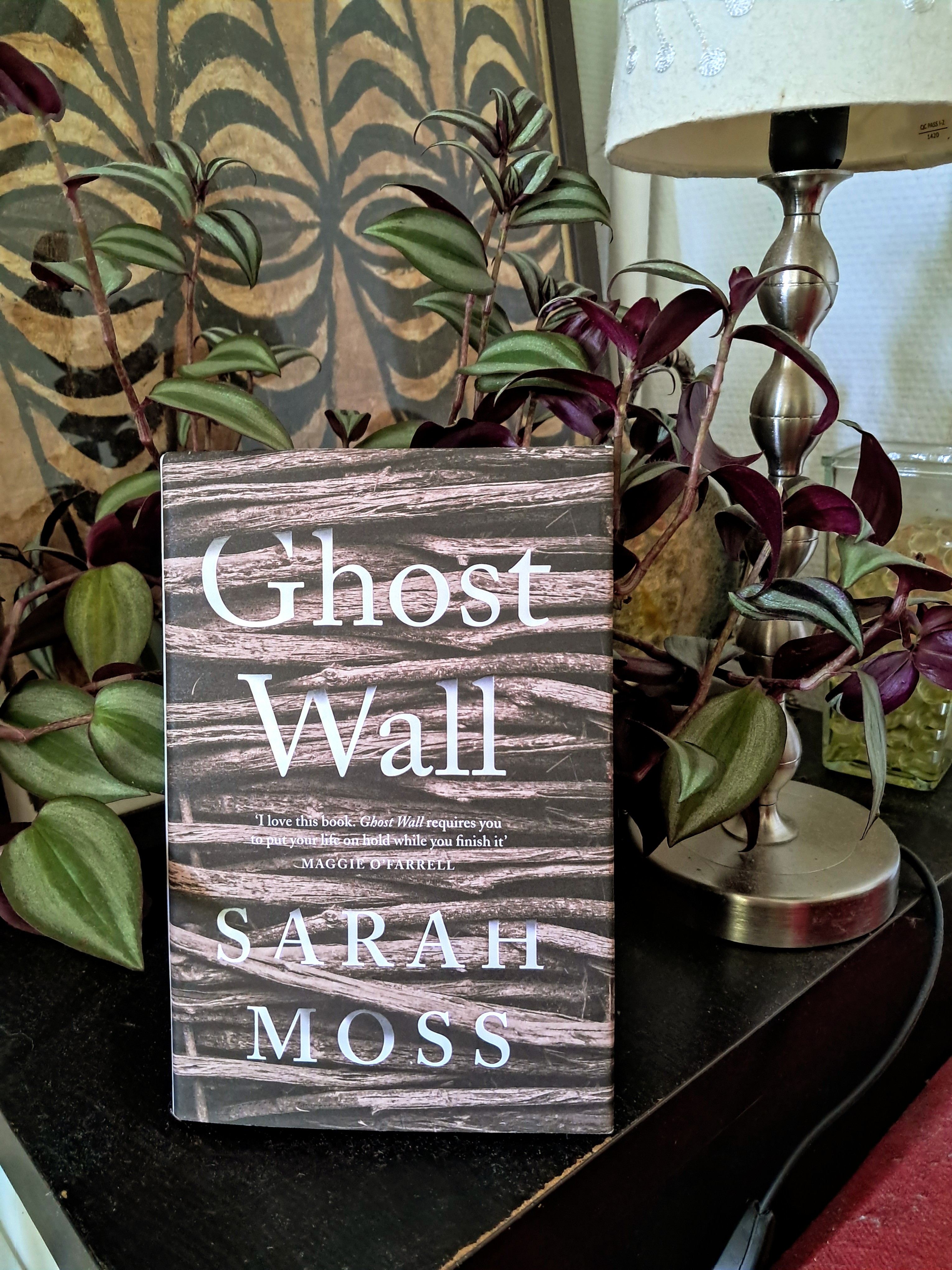
Interestingly, Summerwater was an ‘on-holiday’ novel, a rain soaked 24 hours in the Scottish Highlands, of families stuck in their cabins, inspired by the author’s two week stay under similar conditions, while Ghost Wall is also a tale of a less than salubrious summer holiday.
Teenage Silevia is spending time with her family in an Iron Age re-enactment hut in Northumberland, experiencing what it might have been like to live as they did. There is a Professor and his students also present, whereas Silvie and her father are there because her father, a bus-driver is passionate to the point of obsession about the history of this period.
We were sleeping in the roundhouse, my parents and I. The students had built it earlier in the year, as part of a course on ‘experiential archaeology’, but they had been firmly resistant to my father’s view that everyone should sleep in it together.
The point of the experience was to have a flavour of Iron Age life, a period around 800 BC when people learned how to use iron, which subsequently shifted the way they lived. Still very basic, so much of the holiday is spent foraging for food and for Silvie’s mother, preparing it.
Re-enactment not Reality
Silvie befriends one of the students Molly, who isn’t taking the experience as seriously as the others, who brings a reminder that life is not like this today and challenges some of the things that they do. Silvie admires her rebellious spirit, but is too fearful of her coercive father to defy his requests, finding it impossible to say no and seeing how little it takes for her mother to be punished.
I sometimes think I can tell when two pieces from the same site were made by the same prehistoric person, because the way my hands move is the same. I shivered. Of course, that was the whole point of the re-enactment, that we ourselves became the ghosts, learning to walk the land as they walked it two thousand years ago, to tend out fire as they tended theirs and hope that some of their thoughts, their way of understanding the world, would follow the dance of muscle and bone.

Underlying her experience and in the opening three pages, is the experience of the bog girl who was sacrificed, a story that as we read those pages, it is not clear whether this is a foreshadowing of something that is going to occur, or something from the past that she can imagine and feel, but whatever it is, it starts to feel real, even when she says otherwise.
Silvie, she said, you’re really OK with this, the ghost wall? It’s interesting, I said, I didn’t think it would be but it is. You’re not scared she said. I shrugged. Of what, bones? Of people, she said.
Passion or Persuasion

The novella is atmospheric and becomes increasingly alarming as Silvie gets swept up in the passion of her father and the history professor, who have convinced themselves that there’s nothing wrong with taking the way these people used to live further. Despite her unwillingness, Sylvie also recognises her father isn’t academic like the rest of the team and part of her wants to support him.
It’s slightly terrifying the further things goes and the ending might have been a little abrupt, but then often conclusions are dramatic when an intervention is required, rather than the ideal of thoughtfully addressing real concerns.
Interviewed for the Women’s Prize for Fiction 2019, Sarah Moss, on her inspiration for the novel shared:
I had a writing residency for the Hexham Book Festival, and became fascinated by Hadrian’s Wall and prehistoric arts and crafts. We think of Hadrian’s Wall as the boundary between England and Scotland but neither of those entities existed then; it was the boundary between the Roman empire and the barbarians. There was and is plenty of reason to be thinking about the borders between civilisation and barbarity, nature and culture, insiders and outsiders.
Further Reading
A Q & A with Sarah Moss: On Iron Age re-enactment camps, barbarity and civilisation and Brexit’s impact on writers
Guardian: Ghost Wall by Sarah Moss review – back to the iron age
Author, Sarah Moss
Sarah Moss has published eight novels, two memoirs, numerous essays, and academic work on Romanticism, travel, food and gender. Her work has been listed for prizes including the Women’s Prize for Fiction, the Royal Society of Literature Ondaatje Prize and the Wellcome Prize.
Her novels are Summerwater, Cold Earth, Night Waking, Bodies of Light, Signs for Lost Children, The Tidal Zone, Ghost Wall and Ripeness (2025). A memoir of her year living in Iceland, Names for the Sea, was shortlisted for the RSL Ondaatje Prize and another My Good Bright Wolf (2025) is about growing up in the 1970’s and how excess self-control affects her early adulthood.
 Word by Word
Hmm. This sounds both unsettling and thought-provoking. I find Moss a bit Marmite-ish, and I didn’t really enjoy Summerwater. But there’s enough here to tempt me.
LikeLiked by 1 person
Thanks for this reminder of Ghost Wall-I’m a great fan of Sarah Moss. If you liked this novel you may like her memoir My Good Bright Wolf, which I found very powerful, though extremely poignant too.
LikeLiked by 1 person
The recent memoir does look tempting. She is interesting to listen to, so perhaps her nonfiction might be more engaging.
LikeLiked by 1 person
I thought Ghost Wall was far better than Summerwater, though neither are my favourite Moss novels (I tend to prefer her earlier stuff).
LikeLiked by 1 person
Interesting, which one is your favourite then?
LikeLiked by 1 person
I liked Night Waking and The Tidal Zone a lot.
LikeLiked by 1 person
I love Sarah Moss and this was my favourite novel of hers, it was eerie and compelling. Her non-fiction book about living in Iceland was also brilliant. Here’s my review of it. https://contentcatnip.com/2024/04/14/book-review-ghost-wall-by-sarah-moss/
LikeLiked by 1 person
Eerie is right, a haunting feeling runs through it, not just the opening chapter but the unquestioning way the women act out unappreciated roles, it’s clear it’s not going to end well. I know I prefer a protagonist with a bit more of a rebellious streak, so being with this family was deeply unpleasant.
LikeLiked by 1 person
I know exactly what you mean. Yeah she was like a poor helpless victim, she seemed frozen and that helplessness made me really feel for her. I found it super triggering because I was in a relationship with someone like this when I was young but that’s a whole other story. I searched bog woman and bog man many times after reading it, the idea that they are frozen in time like this is fascinating to me! Definitely read the Iceland one, it’s really good!
LikeLiked by 1 person
There was so much vulnerability and abuse of power that removes a young girl’s agency and primes her taking on the future submissive role, without awareness of that being ‘done’ to them, I get that totally.
After reading this I too wondered about the ritual and then I saw that there is another book coming out later this year called Bog Queen by Anna North, which looks like another really interesting, perhaps deeper dive into the subject. Ghost Wall introduces the subject superficially, which is what makes us want to know more, so I’m not surprised to see this new historical fiction coming out. I’m going to check out her nonfiction for sure.
LikeLiked by 1 person
I totally agree with you about the vulnerability part for sure. Oh that book sounds incredible, Bog Queen I am super keen to get it thank you for putting this onto my radar.
LikeLike
I have only read Sarah Moss’ recent memoir My Good Bright Wolf and thought it was brilliant if quite confronting.I have Names for the Sea to read next.
LikeLiked by 1 person
The memoir does sound interesting, good to know you enjoyed it.
LikeLiked by 1 person
I’ve enjoyed the Sarah Moss I’ve read, and this one is my favourite. I found it so powerful.
LikeLiked by 1 person
‘alarming’ is the word you’re right, gosh this is an unsettling read but very good.
LikeLike
Eerie is right, a haunting feeling runs through it, not just the opening chapter but the unquestioning way the women act out in unappreciated roles, it’s clear it’s not going to end well. I know I prefer a protagonist with a bit more of a rebellious streak, so being with this family was deeply unpleasant.
LikeLike
I like Sarah Moss, and I read this one when it was released and appreciated it but I didn’t get along with Summerwater at all, the first of hers I haven’t liked. This one had a lot of impact.
One of my favourites of hers is Bodies of Light, just sublime.
LikeLiked by 2 people
Thank you for that, because Summerwater was my entrypoint and clearly not the best place to start. Bodies of Light sounds excellent, I’ll keep an eye out for that one.
LikeLiked by 1 person
It has a sequel that was also excellent, Signs for Lost Children. I started with those and I’m still looking for their equal in her work, but I haven’t given up on her yet.
LikeLiked by 1 person
Yes, reading the premise for that sounds like a very different genre and a great depth of historical research, which Ghost Wall touches on lightly by making it contemporary. It almost feels like she hasn’t settled on a niche, Ripeness sounds different again, set in two different cultures/countries.
LikeLiked by 1 person
Benjamin Myers is a bit like that, too. His novels change genres and tone with each new release. I don’t mind that, but you never know what you’re going to get, case in point with Summerwater.
LikeLiked by 1 person
I wasn’t terribly keen on Summerwater either – too many lightly sketched characters, some of whom could have been very interesting had they been fleshed out in more detail.
Ghost Wall, however, is a different matter altogether. As you say, it’s very alarming, and there’s a palpable sense of pressure building towards the end. Interestingly, I found the ending of Summerwater sensationalist, so much so that I didn’t buy it, but somehow the ‘shock element’ works much more effectively here.
LikeLike