
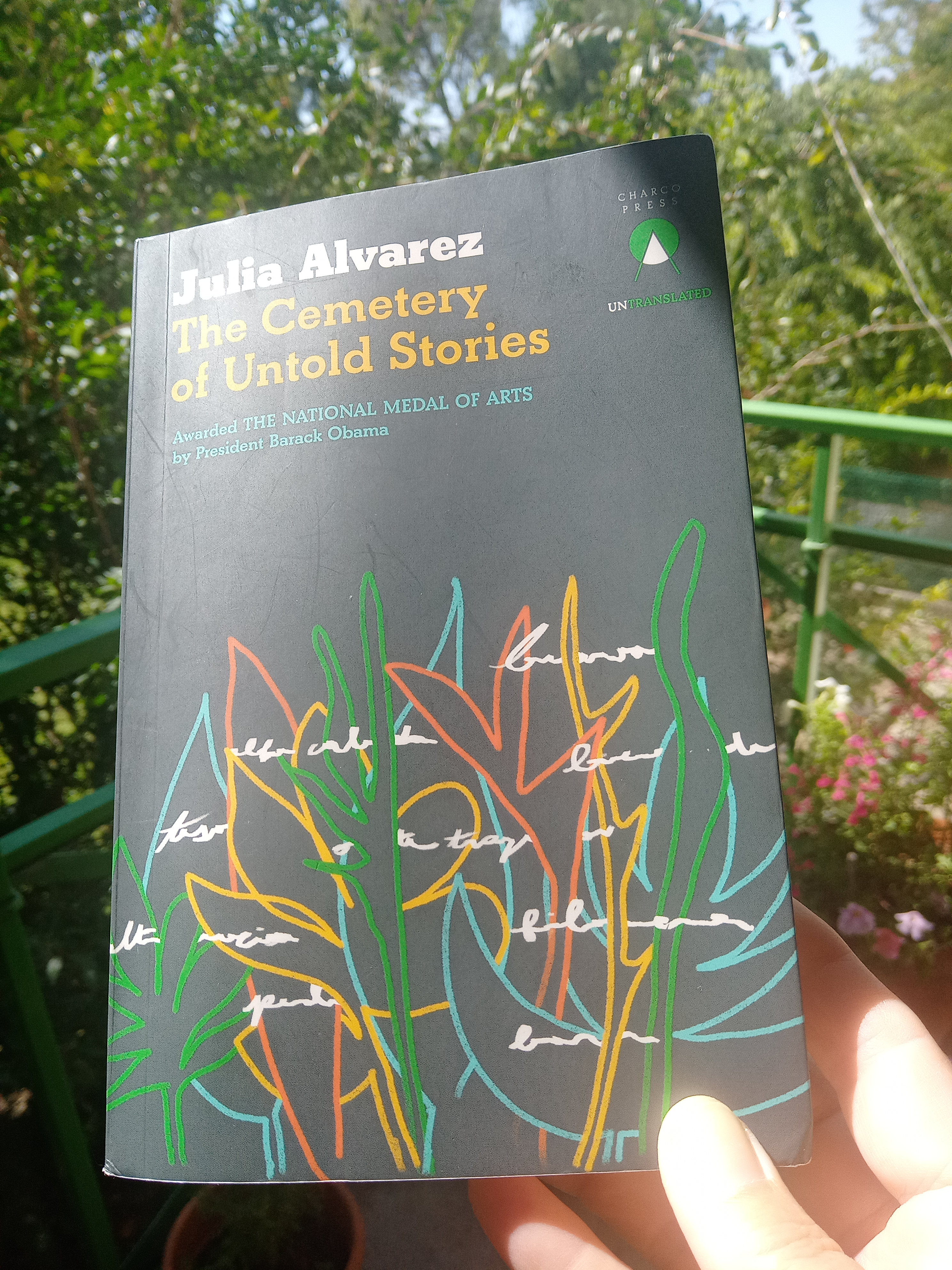
The Cemetery of Untold Stories by Julia Alvarez is part of the Charco Bundle 2024 Untranslated series. Most of the Charco books are works of Latin American origin translated into English.
Julia Alvarez was born in New York City, the second of four daughters. Moving back to the Dominican Republic shortly after her birth, her family were forced to flee ten years later due to her father’s involvement in an underground movement to overthrow the oppressive dictatorship of Rafael Trujillo, who maintained control of the country for 31 years.

Reading The Cemetery of Untold Stories very quickly pulled me in and gave me the feeling I would often encounter when reading works by other woman writers from the Caribbean, like Maryse Condé’s Victoire: My Mother’s Mother, Simone Schwartz-Bart‘s The Bridge of Beyond, Cristina García’s Dreaming in Cuban.
There is something unique to their storytelling that expands beyond our known reality, that embraces the imagination, allowing it a glimpse of another dimension of perceiving that is good hearted, that exists to open minds, bring awareness and healing.
We know we are going there, because the opening chapter entitled Let’s go to Alfa Calenda is a version of that place.
Half the time Papi didn’t even know where he was. What was the harm in pretending? We’re going to Alfa Calenda, they told him as they packed up his belongings, put the house on the market, and boarded the Jet Blue flight to JFK. Just the mention of that fantasy place he’d invented with his mother seemed to soothe him. His personal Shrangri -la-la land, his daughters had dubbed it.
Alma is a writer at a turning point in her life/career. She and her three sisters live in the US and their lives have converged after the recent deaths of both parents in short succession. When their father dies, they discover that he owned many small properties in the Dominican Republic. Unable to find a fair way to apportion them, they decide to draw lots (a mediator’s suggestion), Alma draws the first lot and chooses a wasteland near a dump, on the outskirts of a barrio, then withdraws from the selection process. Closing in on her own latter years, she decides to return to her native land and bury her unfinished stories.
Should Alma follow in her parents’ footsteps, she’d be much better off in her native land. Even if it wasn’t first rate in terms of social services, that world had been her first world: her senses, her body’s rhythms, her psyche were all steeped in it. The weather, the smells, the sound of Spanish, gestures understood without explanation. Life was also cheaper there.
Alma is going to put her stories to rest, stories she has abandoned, failed to bring to life. This new development has given her a project, crazy as it sounds to her sisters. She needs a collaborator and remembers her friend Brava, she won’t judge her new ambition.
Like her art, Brava’s personality was larger than life, a fireball throwing off sparks. None of the anguished and torturous revisions and self-doubts that beseiged Alma.
They will build a cemetery for characters of Alma’s untold stories, a gallery to Brava’s art.
Alma is a curiosity to the residents of the barrio, all kinds of rumours circulate when the bulldozers arrive.
A sign goes up on the wall at the main gate. EL CEMENTERIO DE LOS CUENTOS NUNCA CONTADOS. A cemetery for untold stories. The only way to enter is to speak into a small black box at the front gate. Cuéntame, a woman’s soft voice requests. Tell me a story. Only then does the door open, or not.
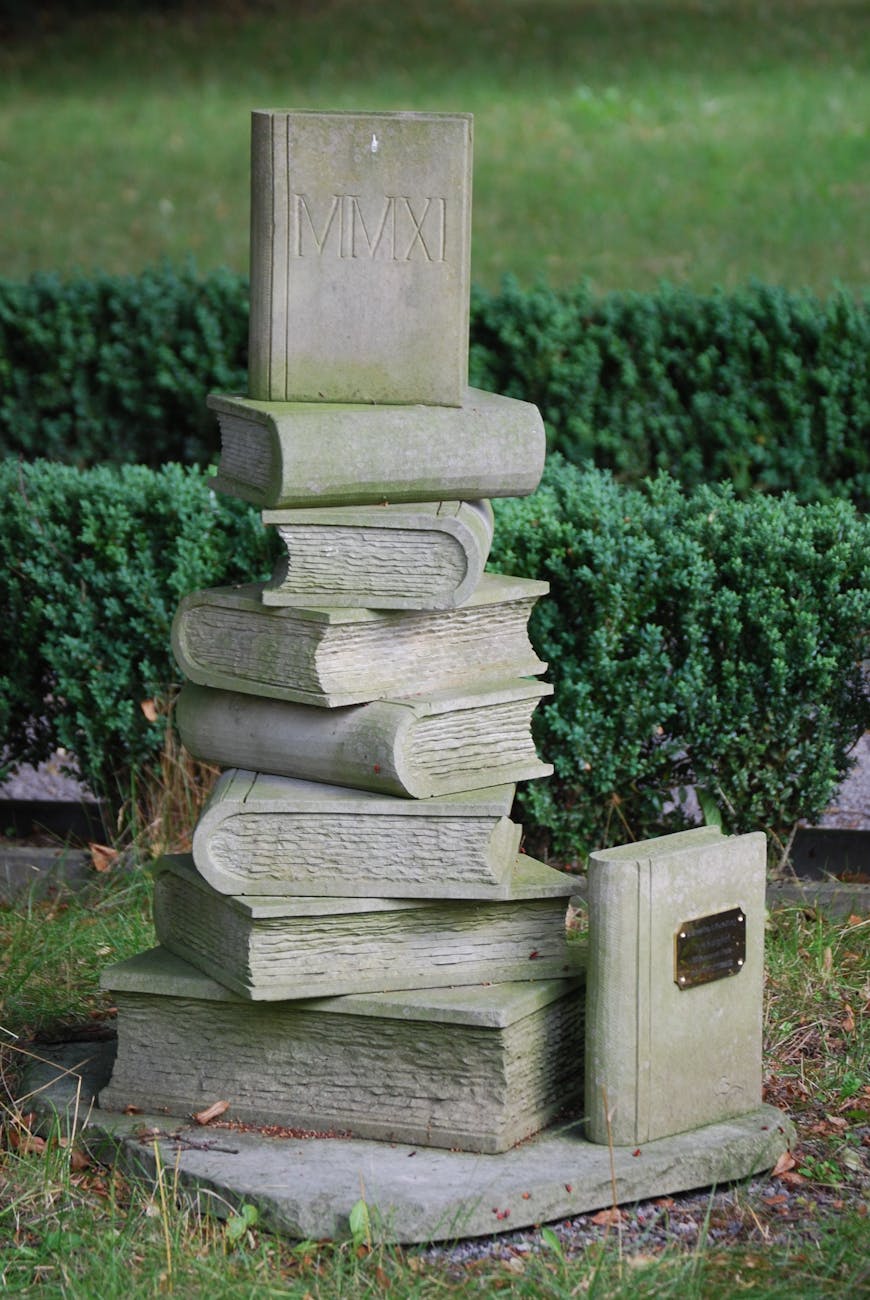
As she builds her cemetery and buries her boxes of manuscripts, different members of the community enter her life through their own stories and the neglected buried characters begin to reveal more about theirs, defying the author and rewriting their fates. Her helpers don’t always follow her instructions.
Alma pulls Brava aside. What’s going on?
El Baron is the boss of cemeteries, Brava explains. The deity who allows passage between the worlds. The first tomb always belongs to him.
The stories reveal themselves, as do the characters who enter the cemetery, looping in on themselves and making what might have been judged, better understood. It asks the question of whose stories get to be told by who, to whom and which stories are better buried.
It is also about listening, imagining, seeing differently, knowing when to speak up and when to stay quiet. It is a quiet celebration of stories, storytelling and the inspiration behind characters who might not always have had a voice.
Did these things really happen?
That isn’t the point, Pepito explains. These stories are about real passions in people’s hearts. They tell of all that is possible.
Julia Alvarez is a long accomplished author and while clearly this is a work of fiction, it often made me wonder about aspects of her own life, as it felt as if it dipped in and out of the familiar, (a successful Dominican Republican writer in the latter years of her career) while carrying a warning about a writer’s obsession to complete the unfinished.
I loved this novel and I am very happy to have encountered Alvarez for the first time, knowing there is a promising backlist to explore. It is always a pleasure to discover another of those unique voices with connections to that Caribbean storytelling culture that I so adore. Incredibly, though her 7th novel, it is her first to be published in the UK. It feels wrong to be starting at the end, but it also is a novel that begs to be reread, to be even more deeply understood.
Have you read any of Julia Alvarez’s works? If so, tell us your favourite in the comments below.
Further Reading
New York Times Review: A Novelist Comes Home to Bury Her Words, and Brings Them Back to Life, by Luis Alberto Urrea, April 2024
Interview: Following the screening of Julia Alvarez: A Life Reimagined, by Mikaela Lefrak, 6 Sept 2024
Documentary: American Masters (PBS) Julia Alvarez: A Life Reimagined (Premiere 17 Sept, 2024)
Author, Julia Alvarez
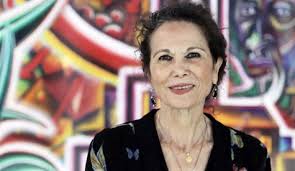
Julia Alvarez has written many bestselling novels including: How the García Girls Lost Their Accents (1991), In the Time of the Butterflies (1994) (considered her masterpiece), ¡Yo! (1997), In the Name of Salomé (2000), and Afterlife. She has also written collections of poems, three works of non-fiction, and numerous books for young readers. The Cemetery of Untold Stories is her most recent novel. She is currently assembling “Visitations,” a collection of poems, to be published in 2025.
The immigrant experience and bicultural identity is the subject of much of Alvarez’s fiction and poetry. Her awards and recognitions include the Pura Belpré and Américas Awards for her books for young readers, the Hispanic Heritage Award, and the F. Scott Fitzgerald Award. In 2013, she received the National Medal of Arts from President Obama.
Filmed in the U.S. and the Dominican Republic, Julia Alvarez: A Life Reimagined features extensive interviews with Alvarez, her family, and her literary contemporaries.
“Eventually, storied and unstoried join in mystery. Nothing holds anyone together except imagination.”
 Word by Word
I loved this novel, too, for lots of reasons, not the least of which is how it gets to heart of storytelling itself.
LikeLike
There’s so much more that could be shared about it Deborah, what a gift of a novel and a respect to characters and the art of storytelling. So great to hear from you!
LikeLike
Hi Claire, I think the internet ate my previous comment, so I’m trying again..
Thanks, Claire,, for mentioning this book just now as it sounds thoughtful, meditative and beautifully written – all of which appeal to me especially in #WIT reads. (I’m trying to make women in translation a more regular thing by reading one relevant book each month, rather than saving them up for August.)
This comment, from your review above, definitely resonate with the themes in Hour of the Star, which we were just discussing elsewhere.
“It asks the question of whose stories get to be told by who, to whom and which stories are better buried.”
LikeLike
Although this is a Charco Press title, its from their Untranslated series, as it was written in English but it definitely comes from that place of having experience and connection to another culture and way of storytelling.
Like you, I like to read WIT all year round, in the beginning I jumped into the August theme, but now I need to be venturing into those narratives whenever I feel like it, which is often!
Thanks for popping over after my comment on Hour of the Star and sorry your comment got munched first time round, its annoying when that happens.
LikeLike
Not at all, I’m really glad you mentioned it. Apologies, I must have missed the fact that it’s part of their Untranslated series (which I don’t think I was aware of before). It still sounds really interesting, though, and I’ve made a note!
LikeLiked by 1 person
It sounds like you enjoyed this as much as me. I thought the central ‘metaphor’ worked really well and loved the unfinished stories coming to life.
LikeLiked by 1 person
I did enjoy it very much, the way the stories came through other members of the community and the way the cemetery invited them to tell their own. I really liked the many layers of storytelling and the way her return, benefited the lives of others.
LikeLike
Catching up with this review, this sounds really good. Thanks for bringing her to my attention. I see there are a number of her books available here in Canada, but this one is still in hardcover so I might look into one of her other titles in the meantime.
LikeLike
Pingback: Book Review: Afterlife by Julia Alvarez – Write on the World