
Back in August the Booker Dozen 13 novels were longlisted for the Prize, which in September became a shortlist of six novels, and today a winner announced.
The judges were looking for the best work of long-form fiction, written in English, selected from entries published in the UK and Ireland between 1 October 2022 and 30 September 2023.
I read two from the longlist, both Irish novels that I very much enjoyed, Sebastian Barry’s Old God’s Time and Elaine Feeney’s How To Build A Boat. Sadly, neither made the shortlist below, but another two Irish novels did make it, The Bee Sting by Paul Murray which just won the Irish Novel of the Year and Paul Lynch’s Prophet Song.

From this shortlist of six novels, the winning novel is:
Prophet Song by Paul Lynch
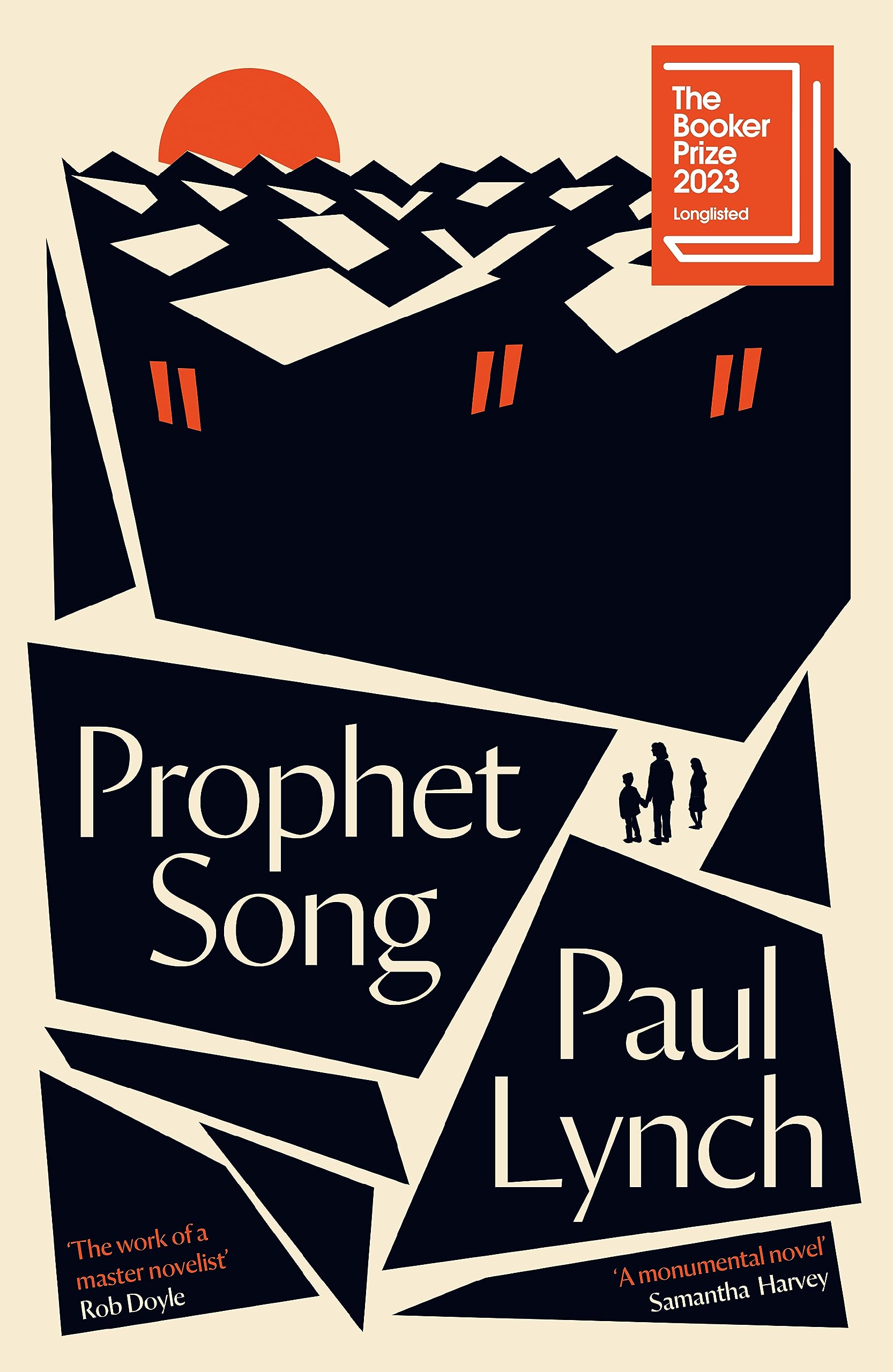
Why You Should Read This Book According to the Judges
How would you summarise this book in a sentence to encourage readers to pick it up?
Prophet Song follows one woman’s attempts to save her family in a dystopic Ireland sliding further and further into authoritarian rule. It is a shocking, at times tender novel that is not soon forgotten.
Is there something unique about this book, something that you haven’t encountered in fiction before?
The prose is a feast, with gorgeous rolling sentences you sink into. A stylistic gem.
What do you think it is about this book that readers will not only admire, but really love?
It is propulsive and unsparing, and it flinches away from nothing. This is an utterly brave performance by an author at the peak of his powers, and it is terribly moving.
Can you tell us about any particular characters that readers might connect with, and why?
Eilish is our guide through this relentless world, and we feel as deeply as she feels. The situations are sometimes dire, and yet she remains resilient, determined and, above all, human. She breaks our hearts.
Although it’s a work of fiction, is there anything about it that’s especially relevant to issues we’re confronting in today’s world?
Far from didactic, the book warns of the precarity of democratic ideals and the ugly possibilities that lie beyond their desecration.
Is there one specific moment in the book that has stuck in your mind and, if so, why?
Prophet Song has one of the most haunting endings you will ever read. The book lives long in the mind after you’ve set it down.
* * * * * * * * * * *
That’s a wrap, the end of the literary award season 2023.
Have you read Prophet Song, or if not, do you think you might be tempted to read it?
 Word by Word
Seriously? *yawn*
Another dystopia about authoritarian rule?
I don’t care how beautifully it’s written “in rolling prose”, we read about that every day in the media as countries fall to the far right. Novelists have been doing it since Huxley and Orwell.
PS It’s not quite the end of the literary season, the NZ book awards are due soon…
LikeLiked by 2 people
Oh I thought I already covered those in the spring, the Ockham NZ Book Awards winners were back in May.
LikeLike
Yes, so did I… and was delighted that The Axeman’s Carnival won it!
Hmm, so what was it that I saw on Twitter? Something to do with NZ Lit… some minor prize maybe? LOL brain cells are fading.
I’m not really on Twitter any more. I still post new reviews there because I was asked to but I only see what’s at the top of the feed.
Whatever…
I’ve just Googled it, and there’s a loooong list of awards at Wikipedia. Perhaps it was their PM’s award because I can see some links to announcements made in December.
But from what I can see it’s a moveable feast, sometimes announced in October, or November, or December. Nothing at WP for this year’s award, so maybe that was it?
LikeLiked by 1 person
PS It’s just dawned on me why there might be a delay this year. It took them (literally) weeks to decide on who would be Prime Minister after their election. And even though these things are probably decided by a committee, there’s the courtesy of waiting to see who is PM first, plus possibly a little vanity in the PM wanting to have a say?
According to Wikipedia, though the election was in October, he’s only just taken office as of today (27/11).
LikeLike
I think it was the Ngaio Marsh crime fiction awards, I did see that pass by last week, but it’s not really on my radar.
It’s been a fun week anyway watching the Irish Book Awards, the Warwick Prize for Women in Translation and finally the Booker. Awards rarely change my reading intentions but like bookshop browsing, it’s a fun alternative activity to the actual reading and a lot more dynamic these days than in the past.
LikeLiked by 1 person
I think this the first year that I’ve not read any of the Booker listed books. I might try the winner now it’s won, but it didn’t call out to me…
LikeLike
I haven’t read any of them either, I was tempted to try Prophet Song but then I thought about the effect on my imagination and so not sure I’m prepared to go there for that reason, it’s one of those stories that might linger but I’m not sure if it’s in a healthy way for me personally.
LikeLiked by 1 person
I sort of feel that the judges have made Prophet Song sound really *worthy* and *righteous* and slightly done it a disservice thereby. I found it terrifying and exhilarating in equal measure, a genuine attempt to batter down the doors of Western complacency.
LikeLiked by 1 person
Would you recommend it? I’m hesitant, but curious.
LikeLike
I would definitely recommend giving it a go. You’ll probably know within the first few pages if the voice isn’t for you–that’s the biggest potential obstacle I can think of.
LikeLiked by 1 person
Thanks, that’s good advice, an e-book sample should be enough to get a feel for the voice.
LikeLiked by 1 person
So many book awards…so little time to read! I’ll have to look very critically at Prophet Song…I’m not anxious to read more dystopia after Handmaid’s Tale, even if it is writtrn by an Irishman. I’ve found some great books via NZ and Okham Awards in the past. (poets Cilla McQueen and Selina Tusitala Marsh (…breathtaking) and Owen Marshall’s “Pearly Gates” (…delightful!) So I should look for more NZ writers to add to may 2024 reading lists. Thanks for all the reference posts for Booker, Warwick and Irish awards, much appreciated.
LikeLiked by 1 person
I’d be interested in your critical view of Prophet Song, I’m hesitant to fill my mind with dystopia like stories because of their lingering effect. I know he wants to make the reader feel it, but that’s also a warning.
LikeLiked by 1 person
We haven’t finalised anything yet, but Brona and I are going to do a Year of Reading NZLIT next year. Have you got Catherine Chidgey on your list? She had two books out this year, The Axeman’s Carnival and Pet and they were both really good reading.
LikeLiked by 1 person
Oops, Brona has corrected me on this, she thinks it was Kim from Reading Matters…
LikeLike
While I’m delighted with an Irish winner, I thought Prophet Song was not a good book. I thought the writing was overwrought and the story bizarrely dull. I read five of six shortlisted books and it was my least favourite. Although I am in the minority with this opinion, but once the news broke of the fighting in the Middle East, I had a feeling this would win.
LikeLiked by 2 people
Interesting Cathy, yes, I thought about the timing with what’s happening in Palestine and also the Dublin carnage recently ignited by a seething fury that’s lingering out there. In a way for me, reading about these fictitious scenarios gives them too much oxygen that could be best consumed elsewhere and plays on people’s fears.
LikeLiked by 1 person
Thanks for you honest review of this book…I had the same feeling.
The winners are not always the best books. The Walkley Award in Australia is another example of Middle East conflict pushing books over the finish line, in this case: The Palestine Laboratory by A. Loewenstein. I’ll circle back to your Irish shortlist reviews …..thanks.
LikeLiked by 2 people
I’ve reserved this at the library. I’m not sure that I’m going to enjoy the reading experience. But then nor should I. It’s not an enjoyable tale, by all accounts.
LikeLiked by 1 person
Well done you Margaret, dive right in and let us know how it goes.
LikeLike
Will do.
LikeLike
I haven’t read it yet but I might just check it out; I love stylistic prose!
LikeLiked by 1 person
I’m not sure I even know what that means”stylistic prose”, it feels very open to interpretation, I do like poetic prose, like the poet Kathleen Jamie when she’s writing prose nature essays or Sara Baume the Irish novelist whose latest work Seven Steeples is clearly poetic.
I will be interested to hear what you make of that when you read the book.
LikeLike
I’ve previously tried two other earlier novels by Paul Lynch and abandoned them, so not in a rush to read this one. If I see it in the library I might borrow it rather than waste my own money.
LikeLiked by 1 person
Oh dear, well that certainly adds to my already reluctant feeling about it, thank you for letting me know that.
I didn’t mention it in the post but I looked at the information page about the shortlisted authors and the writer’s who inspired them, which 4 out of the 6 authors shared, the 3 Paul’s + Sarah Bernstein. Paul Lynch mentions Melville, Dostoyevsky, Conrad and Faulkner, all of whom are considered greats, but when writers only refer to masculine influences then it tells me I am likely to encounter something that sits comfortably in that realm. And they’ve been hogging the playground for a long time.
LikeLike
Yea, it’s an immediate turn off if a male author only quotes male influences. It suggests a narrow mindset. I think you need to read widely. I attended a book launch for Christos Tsiolkas last week and one of the audience questions was could he share some advice for a budding writer. He said “be thy excellent reader” and read often and widely and out of your comfort zone.
LikeLiked by 1 person
Lynch does mention Flannery O’Connor, but in this context “In her essay ‘Some Aspects of the Grotesque in Southern Fiction’, Flannery O’Connor developed Forster’s thoughts”…
Good advice from Tsiolkas, I agree and now we are able to read even more widely as translations open up our offerings; but I do think it hard when we are /were young, because our reading has been curated in a certain way, though perhaps in the 21st century education establishments are approaching it in a more diverse way. I really had no clue how limited our availability and tendencies were until I came to France and saw what they were reading, my English students would be reading Colombian or Russian contemporary novels translated into French, lots of Japanese, so many different cultures and languages translated into French, they don’t even think of it as “a thing” like we do.
LikeLike
Yea, I’ve often told my 19yo niece that I’m jealous she’s exposed to such a diversity of books… she reads widely, classics, contemporary, translations etc. when I was her age I just existed on a diet of mediocre American fiction and never considered anything else because I didn’t really know anything else existed.
LikeLike
Pingback: Reading Intentions 2024 – Word by Word