
James Baldwin’s Go Tell It On The Mountain (1953) was his debut novel, a semi-autobiographical story (inspired by his own childhood in Harlem and his troubled relationship with his father), that narrates a day in the life of 14 year old John, who is the son of a fiery Pentecostal preacher Gabriel, and his second wife Elizabeth.
The Initiation
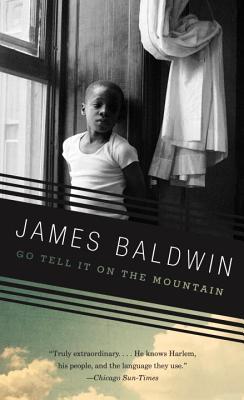
It is a coming-of-age story that depicts a range of thoughts, emotions and actions of this boy, while sharing the back stories of his family, culminating in a frenzied religious experience that appears to have set him on his true path.
The story is told in three parts, and though it follows the events of that one day, the three parts focus on the pasts of different characters connected to John’s family.
Part One, The Seventh Day, is about John, it is his fourteenth birthday and he spends the day thinking about the expectations the family has of him to follow in his father’s footsteps and that he is no longer a child.
He begins to worry that he doesn’t have the same conviction as young Elisha, he feels not only unseen by his father, he feels his wrath and returns it full force in his mind – it enters his dream-life with even greater violence than the looks of disapproval he receives daily.
The opening chapters are full of biblical language, religious fear and fervour, making it quite intense to begin with, though saved by the dialogue that brings us back to the present day.
“His father’s face, always awful, became more awful now; his father’s daily anger was transformed into prophetic wrath. His mother, her eyes raised to heaven, hands arced before her, moving, made real for John that patience, that endurance, that long suffering, which he had read of in the Bible and found so hard to imagine.”
An Act of Resistance
His mother gives him money and he uses it to attend the cinema. He begins to question his faith, and his father, noticing a rising desire for things he ought not to be thinking of:

“Broadway: the way that lead to death was broad, and many could be found thereon; but narrow was the way that lead to life eternal, and few there were who found it. But he did not long for the narrow way, where all his people walked; where the houses did not rise, piercing, as it seemed, the unchanging clouds, but huddled, flat, ignoble, close to the filthy ground, where the streets and the hallways and the rooms were dark, and where the unconquerable odor was of dust, and sweat, and urine, and homemade gin. In the narrow way, the way of the cross, there awaited him only humiliation forever; there awaited him, one day, a house like his father’s house, and a church like his father’s, and a job like his father’s, where he would grow old and black with hunger and toil.”
The Sins of the Father

Part Two, The Prayer’s of the Saints is told in 3 parts entitled Florence’s Prayer, Gabriel’s Prayer and Elizabeth’s Prayer.
This section focuses on the past, on Gabriel’s upbringing and life, his sister Florence, her escape North and marriage, a young woman Gabriel worked with named Esther, whose life would be forever changed by their encounter. We learn of Elizabeth’s past, how she meets Richard and also travels North, their tragic story and her meeting Florence, a turning point in her life.
“And this became Florence’s deep ambition: to walk out one morning through the cabin door, never to return. Her father, whom she scarcely remembered, had departed that way one morning not many months after the birth of Gabriel.”
Everything we read here begins to explain the depth of feeling John has, often driven by events he is not aware of, including his own being, his true identity, that he does not yet know. All that has been withheld from him, the secrets people have kept, impact the lives of everyone in this extended family, often without their knowledge.
In the final part, The Threshing Floor, John has a religious experience with terrifying hallucinations, but it is an event that appears to have propelled him out of childhood and towards his calling.
Love/Hate of Parents, Escaping Reality, Awaiting the Calling

This is the third book written by Baldwin I have read and while quite different from the others, it is equally compelling. The two I have read I have linked to my reviews below, also highly recommended.
It personifies the common experience of a confused adolescent, whose situation is magnified by the love/hate he feels from one or other parent and the guilt he takes on for it, the emotional roller coaster of new exciting friendship, and the desire to escape into another reality.
The stories of the secondary characters are informative and revelatory, as they contributed to my growing understanding of the unease of the young man.
John’s narrative was convincingly portrayed to the point of it feeling like you were in his shoes and in his mind, the relentless worrying, his paranoid and angry emotions that seemed to take over him, until they culminate in his heightened ‘salvation’ experience.
These heights are a reference to the mountain, a symbol of the ascent and descent through he must pass to move closer to his God, to his own salvation, to his becoming a worthy man.
He thought of the mountaintop, where he longed to be, where the sun would cover him like a cloth of gold, would cover his head like a crown of fire, and in his hands he would hold a living rod.
Life Informs Art
In The Fire Next Time, Baldwin’s essay that first appeared in the New Yorker as Letter from a Region of My Mind, talked of his developing self-awareness as he entered adolescence and the choice he made to seek both refuge and revenge by going into the Church.
“Shortly after I joined the church, I became a preacher – a Young Minister – and I remained in the pulpit for more than three years. My youth quickly made me a much bigger drawing card than my father. I pushed this advantage ruthlessly, for it was the most effective means I had found of breaking his hold over me. That was the most frightening time of my life, and quite the most dishonest, and the resulting hysteria lent great passion to my sermons – for a while. I relished the attention and the relative immunity from punishment that my new status gave me, and I relished, above all, the sudden right to privacy.” James Baldwin
Further Reading
If Beale Street Could Talk by James Baldwin
The Fire Next Time by James Baldwin
Thank you to Liz Dexter who blogs at Adventures in running, reading and working from home for the invitation to read this at the time time she was. You can read Liz’s review here.
 Word by Word
I was a teenager when I first (last?) read this. You’ve inspired me to hunt it down again. I’m sure I’d get more out of it now.
LikeLiked by 2 people
I think I also got more out of it having read his two essay/letters in The Fire Next Time. I’m looking forward to reading more of Baldwin, I have a particular fondness for him, given the 20 years he spent living in France and how that enabled him to express himself in his writings.
LikeLiked by 1 person
Noted!
LikeLike
This sounds so powerful, Claire, especially for a debut. A compelling coming-of-age story that goes deep into the maelstrom of emotions and complexities of adolescence. I’ve been so impressed with some of Baldwin’s other work (Beale Street and Another Country) and would like to read more.
LikeLike
It was great to read about this novel again. I read it in my twenties and have wanted to reread it for many years now. Have you read Afropean by Johny Pitts? ( see Peak Reads). There is a very moving section about James Baldwin, based on the writer’s visit to Vence in the South of France and the house where James Baldwin spent the last years of his life. Thank you for reminding me about this great novel.
LikeLike
Pingback: Book review - James Baldwin - "Go Tell it on the Mountain"
An excellent review, and I enjoyed reading it at the same time as you. I really want to read his other novels and essays now!
LikeLike
I appreciate your insights. Though it started as a coming-of-age book, I think it morphs into something else by the end, so I am a bit surprised it being described as a quintessential coming-of-age everywhere, especially since it presents multiple viewpoints. I read it earlier this month and I still cannot believe how good it is. It will definitely be part of my December list – “best books I read all year”. It was my second Baldwin, but I will definitely be reading more of him.
LikeLiked by 1 person
I guess that coming-of-age description could be referred to for multiple reasons, the main one being that the part of the story narrated in the present, all takes place on the day of his 14th birthday. It is a form of spiritual awakening, though we know not what comes tomorrow.
Like you, I’ll definitely be reading more of his work.
LikeLike
Pingback: Top Reads of 2023 – Part 1 – Word by Word