
With A Little Luck now available in English, I’m catching up by reading the word of mouth sensation Elena Knows, which was shortlisted for the International Booker Prize in 2022 and won the Premio Pepe Carvalho Prize for crime fiction in 2019. According to the newspaper La Nación, Claudia Piñeiro is the third most translated Argentinean author, after Borges and Cortázar.
Claudia Piñeiro does seem like an interesting author to watch, taking the convention crime fiction genre and giving it a shake up by focusing on social issues and ethical questions, in particular related to the way women’s bodies have been and are used and abused.
Also reading this for #20booksofsummer23 and getting a head start on August’s #WITMonth, reading women in translation, because that’s my favourite corner of the reading world to be looking for literary gems!
What Does Elena Know That No One Else Seems to?

Elena has just learned her daughter Rita is dead. That it occurred on the same afternoon she booked Elena into her boyfriend’s mother’s salon for “the works”.
It was a rainy afternoon and this is the main reason Elena knows there was foul play. Because her daughter was afraid of lightning and because a mother just knows.
No one knows as much about her daughter as she does, because she’s her mother, or was her mother. Motherhood, Elena thinks, comes with certain things, a mother knows her child, a mother knows, a mother loves.That’s what they say, that’s how it is.
A Rigid Point of View
We see everything from her ‘eyes cast downward’ viewpoint, as she heads out one day to get answers from someone she hasn’t seen in 20 years.
Elena’s body is debilitated by Parkinson’s, so in between pills, she can move more easily.

Rita was there when he first explained the disease. Rita, who’s now dead. He told them that Parkinson’s was degradation of the cells of the nervous system. And both she and her daughter disliked that word. Degradation.And Dr Benegas must’ve noticed, because he quickly tried to explain. And he said, an illness of the central nervous system that degrades, or mutates, or changes, or modifies the nerve cells in such a way that they stop producing dopamine. And then Elena learned that when her brain orders her feet to move, for example, the order only reaches her feet if the dopamine takes it there. Like a messenger, she thought that day. So Parkinson’s is Herself and dopamine is the messenger.
The novel is told over the course of one day, in three sections: Morning (second pill), Afternoon (third pill) and Evening (fourth pill). The absence of the first pill in the narrative is a reminder as to how dependent she is on the medication and how controlling it is over her every movement, how it restricts her freedom, her vision, her ability to do anything. She is enslaved to those pills and that body.
As the pill begins to wear off, the risk of her becoming stuck increases, as her body becomes less manageable, there is no room for error or miscalculated judgement, if she is to make the journey she has planned. There are moments when she has to wait for the pill to take effect, these must be carefully timed.
Proprietary Attitudes Over Humans
She is off to get help in her attempt to investigate her daughter’s death, thinking she can use the ‘able body’ of someone she sets out on this day to meet. There is a reason why she believes that this person will help her, where no other can, and she will go to all kinds of lengths, despite the debilitating obstacles of her own body, in order to have an audience with them.
She won’t be able to do it by herself because she doesn’t have a body. Not now that the dethroned king and Herself are in charge. Even if she uses all the tricks in the book, she won’t be able to uncover the truth unless she recruits another body to help her. A different body that can act in her place. That can investigate, ask questions, walk, look directly into people’s eyes. A body that will obey Elena’s orders.
The novel explores this idea of how people impose or claim agency over another’s body and what they sentence them to, in so doing; or how they believe they “know” another just because they gave birth to or mothered them, or that God gave them some kind of right to be so knowing.
Elena’s body is in the end stages, but in her mind, she is still coming-of-age.
Claudia Piñeiro, Author
Claudia Piñeiro is best known for her crime novels, which are bestsellers in Argentina, Latin America and around the world. Four of her novels have been adapted and made into films.
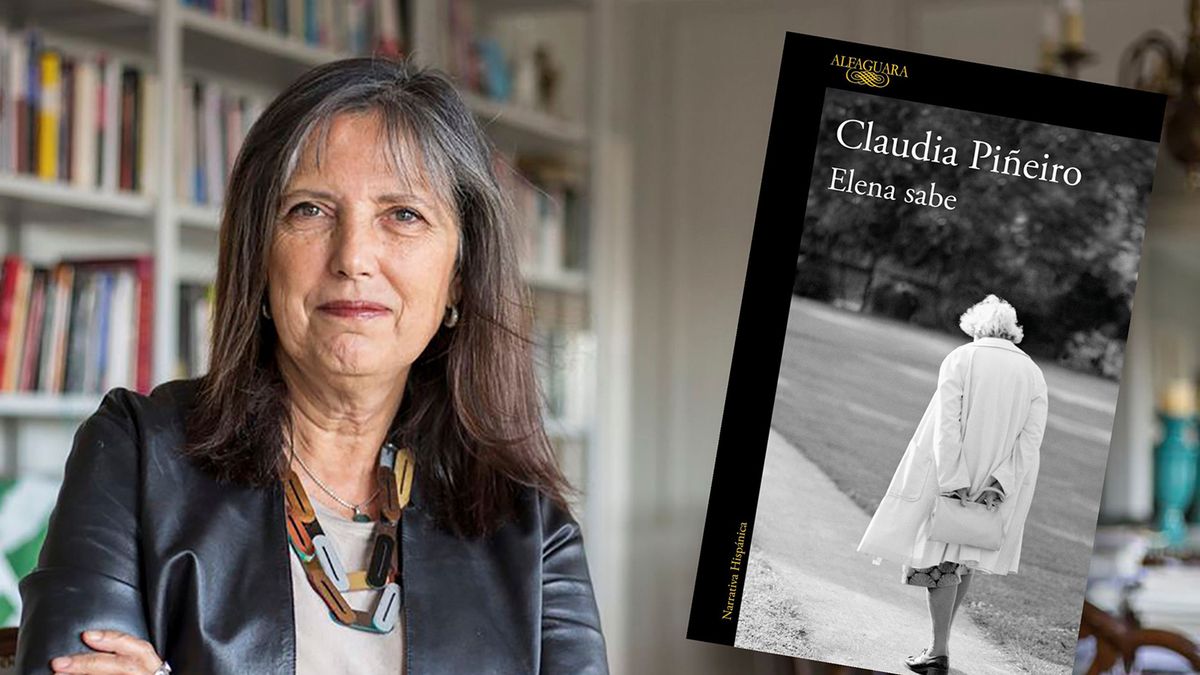
As an author and scriptwriter for television, Piñeiro has already won numerous national and international prizes, among them the renowned German LiBeraturpreis for Elena Knows and the prestigious Sor Juana Inés de la Cruz Prize for Las grietas de Jara (A Crack in the Wall).
Her 8 episode series The Kingdom (2021) currently showing on Netflix, sparked controversy in 2021 for its portrayal of the Evangelical church in Argentina.
More recently, Piñeiro has become a very active figure in the fight for the legalisation of abortion in Argentina and for the legal recognition of writers as workers. Her fiction stems from the detective novel but has recently turned increasingly political, taking a broader, more critical gaze at corruption, injustice, community divisions and other dysfunctions of contemporary society.
Further Reading
What’s On My Bookshelf: Claudia Piñeiro talks of books that inspired her career including The Little Virtues by Natalia Ginzburg, Fierce Attachments by Vivian Gornick, The Story of a Shipwrecked Sailor by Gabriel García Márquez, To the End of the Land by David Grossman, A Room of One’s Own by Virginia Woolf and The Buenos Aires Affair by Manuel Puig.
International Booker Prize Interview: Claudia Piñeiro, ‘I’ve always been very rebellious’
“I always begin writing my books with an image that acts like a trigger. I allow this image to steep in my mind, the characters then begin to speak, to reveal their conflicts. It’s like a tangled ball of wool that I unwind bit by bit. In the case of Elena Knows this image was a woman, a woman in her kitchen at home, sitting bent over in a chair waiting for the pill she’s taken to take effect so she can get up. This was the trigger image. I should also acknowledge that this diseased body of the character Elena is inspired by the body of my mother, who suffered from the same illness, Parkinson’s.” Claudia Piñeiro

 Word by Word
I enjoyed her novel The Thursday Night Widows and this one sounds excellent too.
Happy WIT month!
LikeLiked by 1 person
Thanks Emma, I’m looking forward to more #WIT in August, but I like to read it all year round. I’ll look up your review of Night Widows, thanks. 🙂
LikeLike
I didn’t love this novel. I found it a little heavy handed at times, but I loved this review! I hadn’t thought about the claims the narrator makes to “knowing” more about her daughter simply because she’s her mother.
LikeLike
I loved the way Pineiro uses the techniques of the thriller to tell this story, and how differently we see things at the end from the beginning. I’ve just got a copy of A Little Luck and I’m looking forward to reading it.
LikeLike
Pingback: A Little Luck by Claudia Piñeiro tr. Frances Riddle – Word by Word
Pingback: Top Reads of 2023 – Part 1 – Word by Word
Pingback: Time of the Flies by Claudia Piñeiro tr. Frances Riddle – Word by Word