
I was intrigued to read this debut novel Hagstone having enjoyed Sinéad Gleeson’s voice in her nonfiction narrative essay collection Constellations (reviewed here).
Island Culture and Art
On a wild and rugged island, artist Nell feels at home. It is the source of inspiration for her art, rooted in the landscape, local superstitions and the feminine.
The island has a way of tethering people to the soil, despite high watermarks of loss. Even when people leave, stories survive.
The mysterious Inions, a commune of women who have travelled there from all over the world, consider it a place of refuge and safety, of solace in nature. They have barely any contact with anyone outside of the convent where they reside.
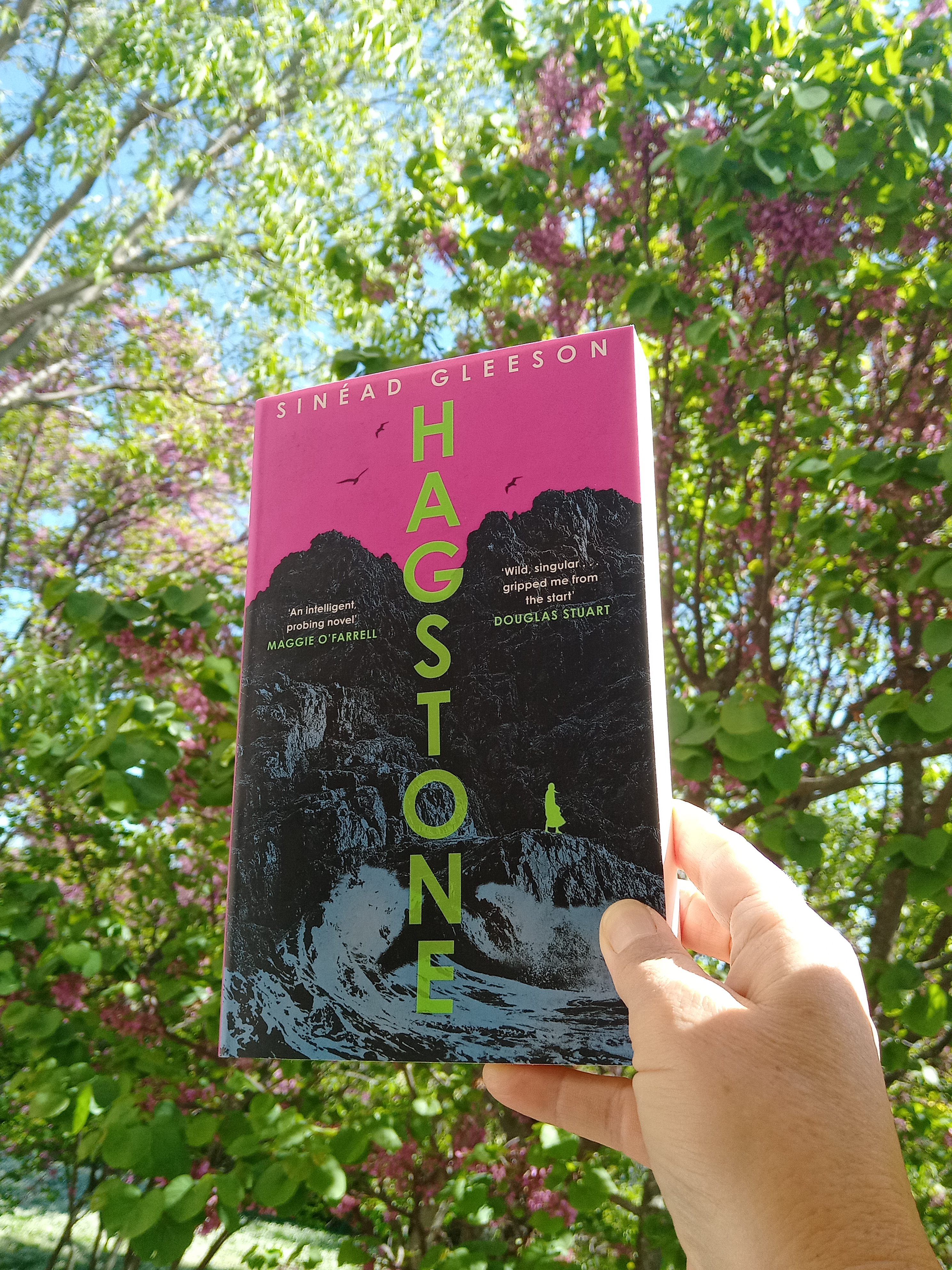
Hagstone centres around the life of Nell, living alone in a cottage on the island (putting me in mind of Sophie White’s Where I End) where she tries to eek out a living doing tours of the island and changeovers in holiday rentals, to support her preferred activity, making ‘durational art’.
Up on a hill lies an old convent named Rathglas, inhabited by the group of women (not nuns, though they live in a very nun-like fashion) who have opted out of society, headed by a woman they refer to as Maman.
Given its gynocratic nature, Rathglas attracted activists and agitators, though you couldn’t help but wonder if some were drawn there by the sound.
A clever use of the French word for Mother and the title of French artist Louise Bourgeois’s most famous sculpture, an enormous bronze, stainless steel, and marble sculpture of a spider, found in several locations, representative of the protective and nurturing nature of her mother.
A Commission For Samhain, Rogue Elements

One day Nell receives a letter, an invitation to create an artwork for the thirtieth anniversary since the Inions arrived, to coincide with the festival of Samhain.
Then there is Cleary, a man recently returned to the island, a subject of intrigue and attraction, the two of them seeking to fill some void, craving each other’s company while avoiding attachment.
And the rich actor, Nick, a man everyone recognises but no one knows. Nell takes him on a tour and his inquisitive questioning unsettles her.
Haunting Sounds That Not All Can Hear

There is a strange sound that emits from the island, that only women can hear and not only hear, but it has a strange effect on them. Birds fall out of the sky.
It was impossible to exactly predict the arrival of the sound. The canonball rumble of it. It paid no heed to scientific forecasts.Storm warnings in traffic light colours. Some felt it in advance, like a tingle on the skin. Others said the air felt heavier. Last night it arrived along with a new moon. The result was something never seen before.
I never quite understood what this was, was it an element of magic realism or something else. It was one of the threads left to the reader’s imagination, a missed opportunity or perhaps I missed something?
It all leads up to the night of Samhain, after which nothing will be the same.
Hagstone started out really well and drew me in and had a strong first half, introducing the different characters, elements of intrigue and clever satirical humour, that wasn’t sustained in the latter half where it lost opportunities to delve deeper into the intentions behind some of its characters and tie up some unfinished threads.
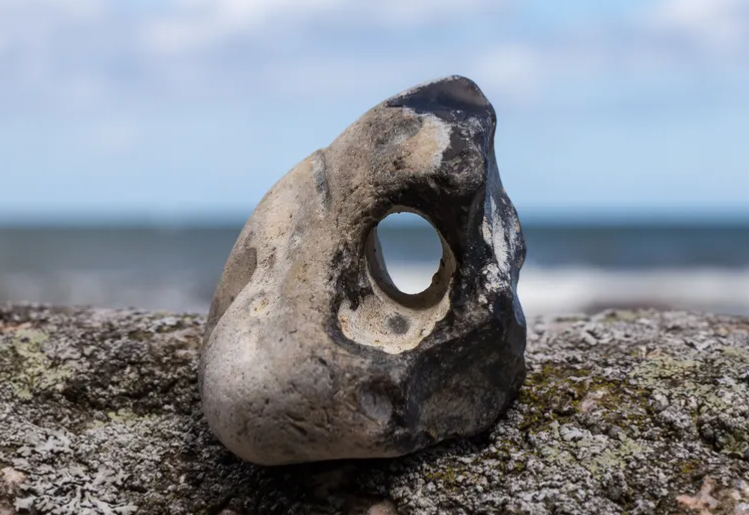
– A hagstone – I have a thing for them! Thank you.
– For years I just thought they were battered stones with holes in them, until Sile set me right. About the fact they’re lucky, and fishermen tie them to their boats to ward off evil.
– And that if you look through the hole, you’re meant to see a different view of the world. I think that’s why I collect them.Looking, seeing, an artist thing.
Further Reading
The Guardian: Hagstone by Sinéad Gleeson review – portrait of an artist by Jessie Greengrass
Author, Sinéad Gleeson
Sinéad Gleeson is an Irish author and artist.
Her essay collection, Constellations: Reflections from Life, won Non-Fiction Book of the Year at 2019 Irish Book Awards and the Dalkey Literary Award for Emerging Writer. It was shortlisted for the Rathbones Folio Prize and the James Tait Black Memorial Prize and the Michel Déon Prize.
 An excellent collection of essays, of life writing with a particular connection to the body and how women negotiate life when part(s) of it malform and interrupt the ordinary course of a life, making it something extraordinary.
 Word by Word