
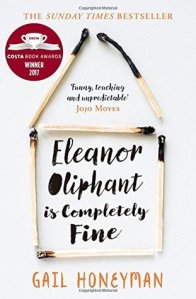
A popular book in 2017, it won the Costa Book Award and has gone on to become a bestseller and will become a film starring Reese Witherspoon (who acquired the film rights), an incredible success for the debut novel of Gail Honeyman. To be honest, it hadn’t been on my radar, however when a friend lent me her copy, insisting I read it and a rainy day beckoned, I turned the page…
The book begins with an interesting quote from Olivia Laing’s book The Lonely City:
“…loneliness is hallmarked by an intense desire to bring the experience to a close; something which cannot be achieved by getting out more, but only by developing intimate connections. This is far easier said than done, especially for people whose loneliness arises from a state of loss or exile or prejudice, who have reason to fear or mistrust as well as long for the society of others.”
Eleanor Oliphant has been in the same office job in Glasgow, Scotland for almost eight years, she’s in her late twenties, intelligent, observant and diligent, she likes and needs routine and copes fine with her lack of social engagement, lack of friends, lack of family – with the exception of a weekly conversation with her mother on Wednesdays – and seems not to feel anything even when she overhears her colleagues speaking unkindly behind her back.
 So used to her self imposed isolation and predictable life is she, that she seems shocked when a new employee Raymond from IT, whom she calls when her computer freezes one morning, initiates conversation with her outside the office, speaking to her as if she might be just like the others.
In this introduction to Eleanor, we aren’t sure of her, though her obvious intelligence and comfort in routine, he slight air of superiority despite the comments of her colleagues, suggest some kind of cognitive difference and her lack of a filter or self-censoring ability make her abject honesty a cause of surprise to some. Her habit of consuming vast amounts of vodka at home alone at the weekend, suggest something more dire lurks in her past.
Over the course of the novel, more of her early life is revealed and we learn that she has been through some kind of childhood trauma, which might explain some of her behaviours. This really sets up what for me was the main question, was this a case of nature, nurture (lack of) or trauma or a combination of them all. Honeyman leaves it to the reader to decide, but regardless of what influences made Eleanor the way she is, she is ripe for transformation. And she seems to have realised it herself, albeit, lead by a new obsession.
For, at the same time, and from the opening pages, she believes she may have met the perfect man, or is about to meet him, she obsesses about this man and builds him into her image of perfection, as had been defined by her absent mother, and prepares to improve herself physically in preparation of meeting him.
Meanwhile, through Raymond, her actual social connections begin to widen and they awaken something familiar in her, feelings that go with being invited to be part of a community, small acts of kindness, of inclusiveness, and Raymond helps her navigate these interactions, as might a friend.
It is a well written, engaging and thought provoking read, partly because of what is not known and slowly revealed, but the dialogue gives the story pace and there are plenty of new activities and social interactions Eleanor participates in, providing the space for her to grow and develop within.
“I wondered how it would feel to perform such simple deeds for other people. I couldn’t remember. I had done such things in the past, tried to be kind, tried to take care, I knew I had, but that was before. I tried, and I had failed, and all was lost to me afterwards. I had no one to blame but myself.”
 I did find the character of Eleanor a little difficult to believe in, the long years of solitude followed by a relatively sudden transformation seem to occur too easily and quickly, however if I were to suspend judgement on the authenticity of the character and the speed of her life change, which wasn’t hard to do, then it becomes a kind of coming-of-age novel about a young woman overcoming a traumatic past and demonstrates (a little too conveniently) the healing that can come from genuine friendship and being part of a family and community and a functional workplace (if there is such a thing).
The introduction of a therapist also allows for the conversations that explore the difference between the fulfillment of physical needs and emotional needs, neatly tying things up and rounding off Eleanor’s late education and self development.
And while it’s not exactly a romance, there are elements of the ambiguity of her friendship with Raymond that certainly are likely to make this a popular film.
An entertaining, light read, that leaves you with more than a few questions.
 It feels like I have been watching Lauren Groff from the sidelines for a long time. One of my favourite bloggers Cassie*, wrote a passionate review about Groff’s book of short stories Delicate, Edible Birds which she gave the byline
  I even took her novel The Monsters of Templeton out from the library, yes, they had a copy on the few English shelves of the French library, it sounded like a fun read, sort of Lochness monster-ish – however I didn’t get around to reading, I returned it and I visit it often when I get the inclination to go to the library, not because I need any more books, but because it’s one of the best places to view books – you know like shoppers go window shopping – book nerds visit libraries and book shops just to be around them, without always needing to consume.
 Then there was Arcadia, I have it on kindle and have been meaning to read that too – a hippy story from the 1960’s – that too languishes unread.
 first half is about Lotto (nickname for Lancelot), a man cruising through life without looking back, the very few times he does, he realises how alone he really is. It is not a pleasant feeling, it is one he wishes to drown in whatever is to hand – in his boarding school that feeling nearly did kill him, but then he discovered girls, a never-ending supply of them, that worked – then he met Mathilde and she provoked in him such a strong feeling, he made her his wife, she was all the girl he wanted and needed and she appeared to need him as much as he needed her. She was hungry for him too.
 also chose a book about marriage, one I think might be more my cup of tea, it was the poet Elizabeth Alexander’s memoir The Light of the World, a woman writing about being at the existential crossroads after the death of her husband.
 Word by Word