
Seeking Refuge On the World’s Deadliest Migration Route
Sally Hayden is a correspondent for the Irish Times, who has reported stories across Africa and the Middle East for a wide range of media, including the Guardian, CNN, Al Jazeera, Channel 4 News, the Washington Post and the New York Times.
Earlier this year, I read River Spirit by Sudanese/Scottish author Leila Aboulela and as I was interested to understand a little more of the history of Khartoum, Sudan, I started reading some informative news articles by the Irish correspondent Sally Hayden.
I then discovered she had recently written a book, a very powerful and important book.
A Non-Fiction Tour de Force

Her book My Fourth Time, We Drowned was the winner of the 2022 Orwell Prize for Political Writing, Irish Book Awards Book of the Year 2022, it was shortlisted for the Bailee Gifford Prize for Non-Fiction 2022.
In 2018, Sally was contacted by refugees incarcerated in Libyan migrant detention centres, who were using hidden phones to appeal for help.
“Sister Sally,” a man WhatsApped her in 2018 from a Libyan detention centre for refugees, “we need your help.”
“I had stumbled, inadvertently, on a human rights disaster of epic proportions,” Hayden remembers.
From that day, she became a kind of lifeline to many, staying in contact, travelling across the region verifying facts and keeping a vigilant eye on those she had come to know travelling along the Central Mediterranean migration route, between Libya or Tunisia and Italy or Malta. The UN has called it the deadliest migration route in the world.
A 21st Century Human Rights Scandal
Since 2014, more than 28,200 men, women and children have died or gone missing on the Mediterranean Sea while trying to reach Europe – more than 22,400 of them along this route.
In her book, she documents the messages and traces what happens to some of these people, and referring to a map, focuses on every detention centre and shares the conditions and some of the events that occurred in each of those places. It is a compilation of evidence and an act of ‘seeing’ those individuals whose lives have been demeaned and exposes the reality of unwholesome alliances forged between European leaders with warlords, militias and rebels who profit from the movement of human beings through political funding and extortion.
Returning people to Libya traps them in a cycle that also involves human smugglers. The smugglers work in league with both the coastguard and the detention centre management – this has been documented by an independent UN fact-finding mission, as well as by me. Videos of captives being tortured are even circulated by their families on social media, in a desperate bid to raise ransom money through crowdfunding. Eritrean journalist Meron Estefanos says around one billion euros in ransoms could have been paid to smugglers in Libya by now.
The main reason for her focus on the Central Mediterranean route was because of the role and impact of the European Union (EU). A law graduate with a Master’s in International Politics, she would investigate and report on the circumstances that lead to this becoming a major humanitarian crisis, as a result of EU policy, that funded and facilitated thousands of people being captured and forced back to a militia-run state where they were often locked up indefinitely in detention centres.
Each chapter focuses on a different location, sharing the messages from people being held, the dire conditions, the punishments, the ransom demands, the deaths. The ineffectiveness of the UNHCR (United Nations High Commissioner for Refugees), the suggestion of Rwanda as a new route for safety, the trial of known smugglers at Addis Ababa, where Hayden is the only foreign correspondent present. The humanitarian lawyers who made a submission to the International Criminal Court calling for the EU to be charged with crimes against humanity.
She also travels to parts of Africa where some have returned home to, to find out how they are faring, and then the few who made it to a safe country, who ares starting new lives – how it is now for them.
It is difficult to encapsulate the extent of this testament to the experience and situation of a large group of people made to live and die in terrible, inhumane conditions here, but it is an opportunity to avail ourselves of the knowledge of the repercussions of these funding policies and to understand what is behind these so-called solutions to a humanitarian crisis.
“The world will not be destroyed by those who do evil,” wrote one detained Eritrean refugee, “but by those who watch them without doing anything.”
An extraordinary, detailed and condemnatory read. Highly Recommended.
Journalist of the Year, Irish Journalism Awards 2023
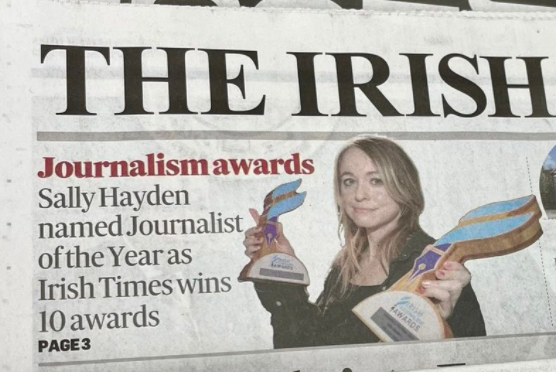
Just this week (Nov 15, 2023) Sally Hayden was named journalist of the year at the 2023 Irish Journalism Awards. Hayden also received the award for best foreign coverage for Irish Times articles on famine risks in Somalia, Sudan’s pro-democracy movement and unrest in Sierra Leone over its cost of living crisis.
Further Reading
A Speech Sally Hayden Gave to the European Parliament, 9 Nov, 2023 – on Why People Want to Come to Europe
Irish Times Article: Sally Hayden: ‘You have to be careful not to let your empathy or your humour be torn away’
Interview, Women In Foreign Policy: Sally Hayden on her career as a journalist and reporting on the migration crisis
Sally Hayden, Author

Sally Hayden is an award-winning journalist and photographer focused on migration, conflict and humanitarian crises. She is currently the Africa correspondent for the Irish Times and in 2023 won journalist of the year at the Irish Journalism Awards.
Her writing has been translated into nine languages and she has appeared on national and international media.
David Edgerton, the Chair of Judges for The Orwell Prize for Political Writing 2022, commented:
Hayden’s reporting is an extraordinary exploration of a modern reality using modern means: truly a book of our times. While many people seeking refuge from the terrible logics of repression, war and poverty cannot easily cross frontiers, phone and Facebook messages can. They allow contact with home but are also the means by which ransoms are gruesomely demanded by traffickers. But they are also the way in which Hayden explores the lives of people stuck under the control of traffickers, militias, the UN, and lets them speak to us as full human beings: hungry, ill, and often doomed in their quest for safety. She gets the terrible truth out to a world that has been far too indifferent.
 Word by Word