
The Seven Moons of Maali Almeida by Sri Lankan author Shehan Karunatilaka won the Booker Prize in 2022. It wasn’t on my radar, probably because it seemed to me like it was trying to be too many things, but when I saw a hardcover copy on sale at the annual Ansouis vide grenier last September, I decided to delve into it and see for myself.
Outstanding Sri Lankan Literature

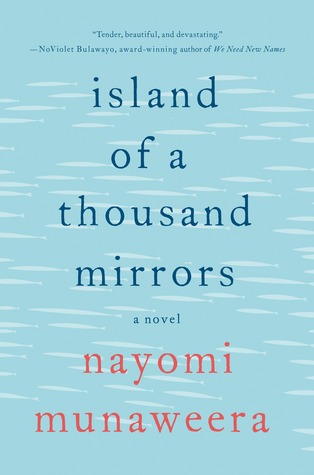
I knew that it was about the civil war era in Sri Lanka and I have read some excellent novels that are set in those difficult times, most recently the novel that won the Women’s Prize for Fiction in 2024 Brotherless Night by V.V. Ganeshananthan (see my review here), but my favourite novel set in that country is Naomi Munaweera’s Island of a Thousand Mirrors (my review here), winner of the Commonwealth Writer’s Prize in 2013.
Munaweera writes exquisitely of the island of Sri Lanka, in lyrical prose that takes the reader inside the family experiences, evoking all the senses, the aroma of the cuisine, the fear and excitement of young, forbidden love, the pain of heartbreak, the palpable tension as sisters walk to school, sometimes witnessing images that will stain their minds and revisit their dreams for years.
Mystery, Satire, Historical Fiction and Magical Realism in One

Seven Moons is a literary mystery about the life and death of Maali Almeida, who from the opening pages, in a second person narrative, turns up dead and from the In Between, that place between life and the afterlife that he now inhabits, proceeds to uncover the mystery of his death.
Set in 1990 Colombo, Maali was a war photographer, a promiscuous gay man, sometimes gambler and seeker of the next photograph that will show the dark and gruesome elements of those in power, a witness to crimes he believes can bring down governments, stop wars.
The In Between, Down Below and The Light
When he arrives at the In Between, he and others like him are told they have seven moons, seven nights to meet the criteria to enter The Light. As they queue and ask questions about their deaths, Maali hopes he is about to wake up from a dream.
The swarm of souls presses closer, berating and badgering the woman in white. You gaze upon the pallid faces, sunken eyes in broken heads, squinted in rage and pain and confusion. The pupils are in shades of bruises and scabs. Scrambled browns, blues and greens – all of which disregard you. You have lived in refugee camps, visited street markets at noon, and fallen asleep at packed casinos. The heave of humanity has never been picturesque. This heave throngs towards you and heaves you away from the counter.

Every soul has those seven moons to wander around the In Between, to recall past lives, and to forget.
While he should be completing the tasks to get to The Light, instead he shifts from The In Between back to the present, the Down Below and observes the aftermath of his death.
He tries to direct those close to him towards his most incriminating photographs in order to achieve which he was not able during life. He doesn’t understand quite how these shifts happen, and neither does the reader, making it somewhat confusing to keep up with this trippy journey.
Here’s what you remember from two nights ago: (a) visiting the Leo casino, (b) drinking at the bar, (c) eating the buffet, (d) fooling around with the bartender. here’s what you don’t remember: (a) sitting with a suddha (b) being thrown to your death.
Conversations With the Dead
As well as investigating his own murder, along the way he has conversations with a dead athiest, a dead revolutionary, lawyer, bodyguard, priest, dogs and more. He observes the number of spirits hanging on to the living whispering their ears.
You’ve always thought the voice in your head belonged to someone else. Telling you the story of your life as if it had already happened. The omniscient narrator adding a voiceover to your day. The coach telling you to stop feeling sorry and do what you’re good at. Which was winning at blackjack, seducing young peasants and photographing scary places.
Moons, Chapters and Beats
On his motivation for writing this novel, the author had this to say:
‘I began thinking about [Seven Moons] in 2009, after the end of our civil war, when there was a raging debate over how many civilians died and whose fault it was. A ghost story where the dead could offer their perspective seemed a bizarre enough idea to pursue, but I wasn’t brave enough to write about the present, so I went back 20 years, to the dark days of 1989.’
Not just an author of fiction, Shehan Karunatilaka has also written rock songs and speaks of his work in terms of beats and rhythm, infused with supernatural folklore, ghost stories and history.
It’s a long novel that for me held my interest in parts and then lost me as it shifted, but each time that began to annoy me and slow me down, the narrative would shift back to something of interest and so I persevered, however, I did find it overly long in its digressions, drifting in and out of reality. It’s an undeniably clever, erudite novel, unique in its conception that reminded me a little of the surreal experience of reading David Mitchell’s Cloud Atlas.
The Judges on A Metaphysical Thriller Winner
In addition to praising its ambitious scope and hilarious audacity of narrative techniques, the Booker judges had this to say of the metaphysical thriller:
‘Life after death in Sri Lanka: an afterlife noir, with nods to Dante and Buddha and yet unpretentious. Fizzes with energy, imagery and ideas against a broad, surreal vision of the Sri Lankan civil wars. Slyly, angrily comic.’
‘This is a metaphysical thriller, an afterlife noir that dissolves the boundaries not just of different genres, but of life and death, body and spirit, east and west. It is an entirely serious philosophical romp that takes the reader to ’the world’s dark heart’ — the murderous horrors of civil war Sri Lanka. And once there, the reader also discovers the tenderness and beauty, the love and loyalty, and the pursuit of an ideal that justify every human life.’
Have you read The Seven Moons of Maali Almeida? Share your thoughts in the comments below.
Further Information
Read an Interview With the author Shehan Karunatilka
Click here to read an extract from the first section of the novel – Read an Extract from The Seven Moons of Maali Almeida


 Thus a struggle arises between two ways of seeing, of being, one that requires natural behaviour to be modified, medicated, suppressed, so that the child will appear and behave in the family and society as “normal”, while the other allows for that natural “but judged and condemned” way of being to exist.
 Word by Word