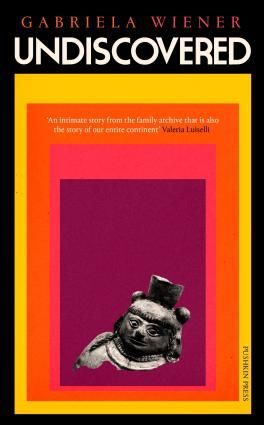
Undiscovered by Gabriela Wiener tr. Julia Sanches

Undiscovered was longlisted for the International Booker Prize 2024. I decided to read it because I did the quiz on their website which asked about 15 or so questions and then told you which book to read. Undiscovered was the result.

I was totally captivated from start to finish. Loved it.

Ancestral Threads
International Booker Prize longlist 2024 Peruvian literature autofiction

Gabriela Wiener is a Peruvian poet, journalist, writer who has lived in Spain for the last 20 years and her books to date (none of which I have read) seem to about body politics. This novel is about a search to unravel and understand her identity as a Peruvian woman now living in Spain, who has ties to both the coloniser and the colonised.

I was very intrigued to read this book for a few reasons, of course because it is written by a woman in translation, so that already interests me, because it is coming from outside the mainstream cultures that traditionally dominate publishing and also because of the interest in identity, in the influence of ancestry, of family mysteries uncovered.

The strangest thing about being alone here in Paris, in an anthropology museum gallery more or less beneath the Eiffel Tower, is the thought that all these statuettes that look like me were wrenched from my country by a man whose last name I inherited.

A Temporary Explorer

Gabriela is both fascinated and repelled by a ‘maybe ancestor’ Charles Wiener, an Austrian-Jew whose parents immigrated to France when he was sixteen. He became a German teacher in a French lycée, would convert to Catholicism and desired French nationality. He published an essay on the “communist empire” of the Incas;

a reign based on social equality and therefore, per his thesis, antithetical to freedom. In his writing he defended the delirious hypotheses that Louis XIV had been inspired by the Incas when he said “L’état, c’est moi.”

That publication resulted in the French government agreeing to send him on an expedition to South America in 1876. The studies he conducted and specimens collected would eventually be displayed in a large scale exhibit at the Paris Exposition Universelle in 1878. He wrote a book Peru and Bolivia.

On his return to France he was naturalised, retired from exploration and became a diplomat. In the less than two years he was in Peru, he fathered a child to a young widow, Maria Rodriguez. Her son, the author’s great-grandfather, Carlos Wiener Rodriguez, was born in May 1877, by which time Charles Wiener, was already in Bolivia. And most likely oblivious to what he had left behind.

We know everything about him and nothing about her. He left us a book, she left us the possibility of imagination.

The Unfaithful Father

In Undiscovered Gabriela explores the writings of her ancestor and has conflicting feelings about him, as she has conflicting feelings about herself, and her own father. The first half of the book takes place while she is on a return trip to Lima for her father’s funeral. He had a second life and family that he lived simultaneously, one she tries to make sense of by meeting his mistress and asking her mother personal questions.

But really she is interrogating those outside of her to understand something within her. She is of a different generation and even within that she lives an unconventional life. Is she how she is because that is how she is, or is there something of the past that runs through her veins which makes it harder to be anything other than that? Even in her unconventionality, she continues to cross her own boundaries and disappoint herself. She seeks to understand why.

The irritation I feel at the cruel, colonial, and racist passages in the book Wiener wrote about my culture gives way to a sudden compassion for his unwittingly anti-academic, self-aggrandizing self.

A Polyamorous Woman

On an existential quest tracing a legacy of abandonment, jealousy and colonial exploitation, she considers the effect on her own struggles with desire, love and race in a polyamorous relationship. At the same time uncovering physical traces of her ancestor and searching for the small boy Juan he brought back to France with him.

Juan isn’t a ceramic piece rescued from the rubble, nor is he made of gold or silver; he isn’t even a shrivelled child mummy destined for a museum far away from the volcanoes. Yet he crosses the pond as the adventurer’s property. Juan is just another of Wiener’s small contributions to the transformation of the European concept of history. He is part of Wiener’s “expedition,” which is not like that of conquistadors or pioneers but like those of other scientific travellers who sought to “reignite the Incan sun, brutally extinguished by the Spanish cross.”
Photo S.Hazelwood Pexels.com

I was totally captivated by this narrative from start to finish. Each sentence and paragraph so carefully constructed, I often went back and reread them, because they often articulated something that asked to be considered.

I had read a few reviews that criticised the attention she gave to herself, but I didn’t feel as if this was done without context. It is a work of autofiction and the author puts herself as much under the spotlight as her ancestor, she is self aware and critical of her own behaviours, she exposes them and puts them on public display to be judged.

Wiener really is a fluid narrator, a chronicler of minor details and excesses, the kind of storyteller who knows when to set aside principles and literary convention for the sake of hooking his readers, who doesn’t think twice before using whatever’s within reach to spice up his adventures, changing the rules of the game in a context where he really shouldn’t be taking it that far. He is also, without a doubt, the creator of the story’s hero: himself. Had he lived in the twenty-first century, he might have been accused of the worst possible crime an author can be accused of today: writing autofiction.

Broken Memories, Finding Reparation

Towards the end she seeks help or healing and her solution is to join a group called ‘Decolonizing My Desire’. She reaches out to a researcher for help about the ancestor, but finds that invalidating.

Ultimately it is her imagination and poetry that perhaps provides her with answers, the blank page that she is capable of filling, the stories she is able to create, the endings she can provide herself. She controls the narrative, no one else does.

Undiscovered is a well researched inquisition of family and colonial history, ancestral threads and both modern and ancient cultural connections that reflects one woman’s attempt to better understand herself for the benefit of her close relationships. It is about looking at personal and cultural wounds and creating solutions that help a person to move forward.

Further Reading

Read An Extract From the Book: Undiscovered by Gabriela Wiener

New York Times: Gabriela Wiener Does Not Care if You Don’t See Her Writing as Literature By María Sánchez Díez Oct 2023

Electric Lit: Gabriela Wiener Challenges the White Man in Her Head an interview by JR Ramakrishnan Oct 2023

In the interview, Wiener is asked about her surname growing up:

In countries that suffered colonization, both racism and classism from white creole elites towards people of Andean descent is virulent and normalized. Brown or “huaco” faces are penalized but so are brown surnames. And if you already have both you’re screwed. I used to be terrified of going on class trips to archeology museums because we would always pass by a huaco display and the kids would make fun of me, comparing my face to the huaco portraits. But at the same time my last name whitened me, protected me, it was my link to whiteness.

2018 Exposition Musée Quai Branly: « Le Pérou avant les Incas » au musée du Quai Branly

My Review of Ancestor Trouble; A Reckoning and A Reconciliation by Maud Newton

Author, Gabriela Wiener

Gabriela Wiener is a Peruvian writer and journalist based in Madrid, Spain. Her books include Nine Moons, a memoir on pregnancy and reproduction, and Sexographies, a collection of first person gonzo journalism essays on contemporary sex culture, swingers clubs and ayahuascha.

Her work has appeared in numerous publications and has been translated into six languages. She is a regular contributor to El Público (Spain), Vice and New York Times en Español. Wiener won Peru’s National Journalism Award for her investigative report on violence against women.

Boulder by Eva Baltasar tr. Julia Sanches

Boulder is another portrait of a woman, the second of a triptych.

The narrator of Permafrost never quite cut the strings of family, choosing the path(s) of least resistance, while lamenting not having made more independent choices in her formative years.

Assured Prose Who Art in Metaphor

If the narrator of Permafrost is somewhat unsure, that of Boulder is more certain. The prose is assured, the narrative has pace, the protagonist moves towards what suits her, to freedom – until things change.

The avid descriptions and bold metaphors have me rereading and highlighting passages, like the creation of foam as a wave crashes on itself, they are as natural to the text as the paragraphs within which they roll.

An itinerant cook, she moves from place to place, island to ship, working in the kitchen. Life on the cargo ship suits her, she’s at home in turbulent seas, around those that neither desire nor reject her, a place where there was no need to pretend life had a structure. Rootless, drifting and free.

Freedom In Its Many Forms

I think I’ve discovered what happiness is: whistling the moment you wake up, not getting in anyone’s way, owing no explanations, and falling into bed at daybreak, body addled from exhaustion, and mind free of every last trace of bitterness and dust.

The boat sails up and down the coast of Chile, she rarely disembarks, the only temptation in Chaitén, for a hot shower, fresh linen, and a lurking lust for a lover. That’s where she meets Samsa.

I look at her and she fills every corner of me. My gaze is a rope that catches her and draws her in. She looks up, sees me. She knows.

They begin to see each other, though it is often months between visits. Her lover renames her Boulder.

Photo by Bren Pintelos on Pexels.com
She doesn’t like my name and gives me a new one. She says I’m like one of those large, solitary rocks in southern Patagonia, pieces of world left over after creation, isolated and exposed to every element. No one knows where they came from. Not even they understand why they are still standing and why they never break down. I tell her I’ve seen rocks like those in the middle of the ocean.

Compromise, Commitment, Cohabitation

Samsa leaves for Iceland and asks Boulder to join her, she says yes. Samsa makes decisions and Boulder adapts to them. She observes the island, the islanders, the things she doesn’t like, she finds work that gives her an escape. She observes the different way they love each other, the pull of the boats when she walks the dock alone at night.

There’s a restlessness. She starts her own business, a food truck, no boss, no employees, a small but significant and necessary freedom. Something of her own. A coping mechanism.

It’s Not An Elephant in the Room

Photo by Sindre Fs on Pexels.com

Then it happens. Samsa wants to have a baby, Boulder knows that refusing her will mean the end, so asks for more time.

The novel charts this turning point in the relationship, where one woman will become pregnant and give birth while the other tries to support and be part of something she does not feel.

It is an alternative navigation of an age old dilemma, seen through the lens of a queer relationship, a couple struggling with avoidance issues.

It’s not difficult to imagine where it is headed, or what might happen, when one person isn’t quite committed to the idea and desires freedom so strongly. Is the love of another enough sufficient when events propel their lives forward faster than the communication of important feelings around them?

Boulder’s observations and experience are like that of an outsider who can’t quite enter the familiar, of trying to overcome an obstacle of the mind, when the heart is resisting, when self destructive tendencies threaten to communicate what the voice has been unwilling or unable to.

Boulder was shortlisted for the International Booker Prize 2023.

Further Reading

Read an Extract from ‘Boulder’

Eva Baltasar International Booker Prize interview: ‘I wrote three versions of Boulder and deleted two’

“My protagonists are mirror images of myself, only more precise and always veiled. I try to discover who they are by writing, travelling to their darkest, most uncomfortable corners, which is like travelling to the darkest corners of myself, corners that are often repressed and at times denied wholesale. Being able to embark on this journey aboard a novel is as exciting as it is unsettling. It’s as if the novel had transformed into a caravel and the seas were vast but finite, teeming with monsters on the edge of the earth.” Eva Baltasar

Permafrost by Eva Baltasar tr. Julia Sanches

A Poet’s Prose

On the back page in the first sentence that describes the author, it says Eva Baltasar has published ten volumes of poetry. Permafrost is her debut novel, the first in a triptych which aims to explore the universes of three different women in the first person. It clear from the beginning this is the prose of an assured poet.

Julia Sanches triptic #1 catalan translation

I love the title, Permafrost. That deep, but necessary layer in the earth, cold and hard, it creates a foundation layer and stability, as long as conditions remain the same. Kathleen Jamie writes about it in her excellent essay collection Surfacing.

The narrator of Permafrost destabilises the reader on the opening page, with these opening lines…

It’s nice, up here. Finally. That’s the thing about heights: a hundred metres of vertical glass. I’ve settled on an edge, I live on this edge and wait for the moment when I’ll leave the edge, my temporary home.

Not only thinking about heights, but observing all the minutae that surrounds her. It seems like a suicide attempt, a theme that recurs throughout the 122 page novella, only she appears to be distracted by an ever present curiosity around the details of the new experience, something that seems incongruent with wishing to take a life.

I’ve settled on an edge, I live on this edge and wait for the moment when I’ll leave the edge, my temporary home.

Living On the Edge Creates Curiosity

The Thomas Bernhard epigram warns us ‘To be born is to be unhappy, he said, and as long as we live we reproduce this unhappiness.’

So I am surprised by the humour. Despite her melancholy nature and existential awareness, the living in the shadow of family, she makes us laugh.

She tells us her family all self-medicate. Not her, she prefers the edge.

Not for me though – best to keep moving wildly to the edge, and then decide. After a while, you’ll find that the edge gives you room to live, vertical as ever, brushing up against the void. Not only can you live on it, but there are even different ways of growing there. If surviving is what’s it all about, maybe resistance is the only way to live intensely. Now, on this edge, I feel alive, more alive than ever.

A promising child, her first crisis is graduation, after five years, there’s nowhere to go, few clues as to how to put this learning to use. So she lives in her Aunt’s apartment and rents out rooms to different women, providing herself an income and an effortless source of lovers. She spends her days reading, observing, pondering death, too curious to pursue it.

Birth and Children are Grounding

Photo by Pixabay on Pexels.com

Her meandering is interrupted by her pregnant sister and her mother, their insistence to stay close, involved, drawing her back in, keeping her that person she was. The Aunt’s phone call, she’s selling the apartment.

An au pair in Scotland, a marriage proposal in Belgium, childhood memories, fantasies, churning through relationships, occasionally one that lasts a chapter, dialogue with the sister, the mother.

A mole grows and changes form, she makes a doctor’s appointment then cancels it for a year, then follows up.

Life Can Be Insistent

Each chapter is less than two pages, sometimes the narrative skips a chapter and picks up the thread again later on. It’s an inner voyage of discovery and an outer journey of experiences to unravel what was formed by others and discover the essence of, to know who she is. As that realisation occurs, life throws an even greater challenge and responsibility her way.

I’ve realised I know myself by heart…

It is a unique work, recognisably the work of a poet, unruly, impulsive, it makes light of heavy subjects, never quite proselytising, both giving into and resisting convention, forging a way through, trying different things on, breaking out and being pulled back in. One is left wondering if she is floating with the tide or pushing through it.

Permafrost received the 2018 Premi Llibreter from Catalan booksellers and was shortlisted for the Prix Médici for Best Foreign Book in France (2020).

Next up, book 2 in the triptych, Boulder, which was recently shortlisted for the International Booker Prize 2023.