By the Sea (2001) by Abdulrazak Gurnah

By the Sea begins as a compelling narrative and mystery of a man who arrives at Gatwick airport from Zanzibar without a visa and refuses to speak English, until the crucial moment where he is about to be deported and he utters the words that will change his trajectory.

Refugee. Asylum.

Old Scores Revisited

Nobel Prize for Literature 2021 Zanzibar Tanzania witing about immigration culture refugees requesting asylum

In trying to locate someone to translate for him, Latif is contacted and the two men realise there is a connection, a history that has perpetuated with major gaps on either side of their understanding, voids often filled by those wishing them ill.

Their story began by the sea and concerned a fragrance Ud-al-qamari, and would be retold far away where few understood the nature of their feuds and punishment, of corruption and power, petty rivalries over debts, possessions, and influences that could drive a man to flee for his life.

The man I obtained the ud-al-qamari from was a Persian trader from Bahrain who had come to our part of the world with the musim, the winds of the monsoons, he and thousands of other traders from Arabia, the Gulf, India and Sind, and the Horn of Africa. They had been doing this every year for at least a thousand years. In the last months of the year, the winds blow steadily across the Indian Ocean towards the coast of Africa, where the currents obligingly provide a channel to harbour. Then in the early months of the new year, the winds turn around and blow in the opposite direction, ready to speed the traders home.

Time Dismembers, Perceptions Unremembered

Told in three parts, the first two focus on each of these characters and their early life in Zanibar and something of their present, while the third part is a kind of oral storytelling as the two meet and their intertwined story is retold from start to finish until a different connection emerges, as they find themselves newly isolated in this place around people uninterested in their journey.

So time dismembers the images of our time. Or to put it in an archaeological way, it is as if the details of our lives have accumulated in layers, and now some layers have been displaced by the friction of other events, and bits of contingent pieces still remain, accidentally tumbled about.

A drama of disappointment, self-deception and renewal, the novel explores both the double bind of the known culture that entraps, and the unknown culture that frees but isolates the individual, for their betterment, yet never quite attaining an imagined, desired status.

Like Admiring Silence, an excellent, astute read by an accomplished author.

Further reading

My review of Admiring Silence (1996)

Nobel Prize Interview with Abdulrazak Gurnah

Article Guardian on Winning the Nobel Prize

New York Times: Abdulrazak Gurnah Refuses to Be Boxed In: ‘I Represent Me’

Abdulrazak Gurnah, Author

Abdulrazak Gurnah was the Winner of the Nobel Prize for Literature in 2021 for

‘his uncompromising and compassionate penetration of the effects of colonialism and the fate of the refugee in the gulf between cultures and continents’,

He was born in 1948 and grew up on the island of Zanzibar in the Indian Ocean, arriving in England as a refugee at the end of the 1960s. After the liberation from British colonial rule in December 1963 Zanzibar went through a revolution which led to oppression and persecution of citizens of Arab origin; massacres occurred. Gurnah belonged to the victimised ethnic group and after finishing school was forced to leave his family and flee the country, by then the newly formed Republic of Tanzania. He was eighteen years old. Not until 1984 was it possible for him to return to Zanzibar, allowing him to see his family shortly before the father’s death.

Themes of Refugee Disruption

Gurnah’s writing is from his time in exile but pertains to his relationship with the place he had left, which means that memory is of vital importance for the genesis of his work. 

The theme of the refugee’s disruption runs throughout his work. His novels depict a culturally diversified East Africa. His dedication to truth and aversion to simplification are striking. It can make the work bleak and uncompromising, however he follows the fates of characters with great compassion and unbending commitment.

His novels include Paradise (1994), which was shortlisted for both the Booker and the Whitbread Prize; By the Sea (2001), which was longlisted for the Booker and shortlisted for the Los Angeles Times Book Prize; and Desertion (2005), shortlisted for the Commonwealth Writers’ Prize. His most recent novel Theft (2025) is the story of the intertwined lives of three young people coming-of-age in postcolonial East Africa, selected as a book to look out for in 2025 by the GuardianObserverIrish Times and BBC.

Until his retirement he had been Professor of English and Postcolonial Literatures at the University of Kent in Canterbury, focusing principally on writers such as Wole Soyinka, Ngũgĩ wa Thiong’o and Salman Rushdie.
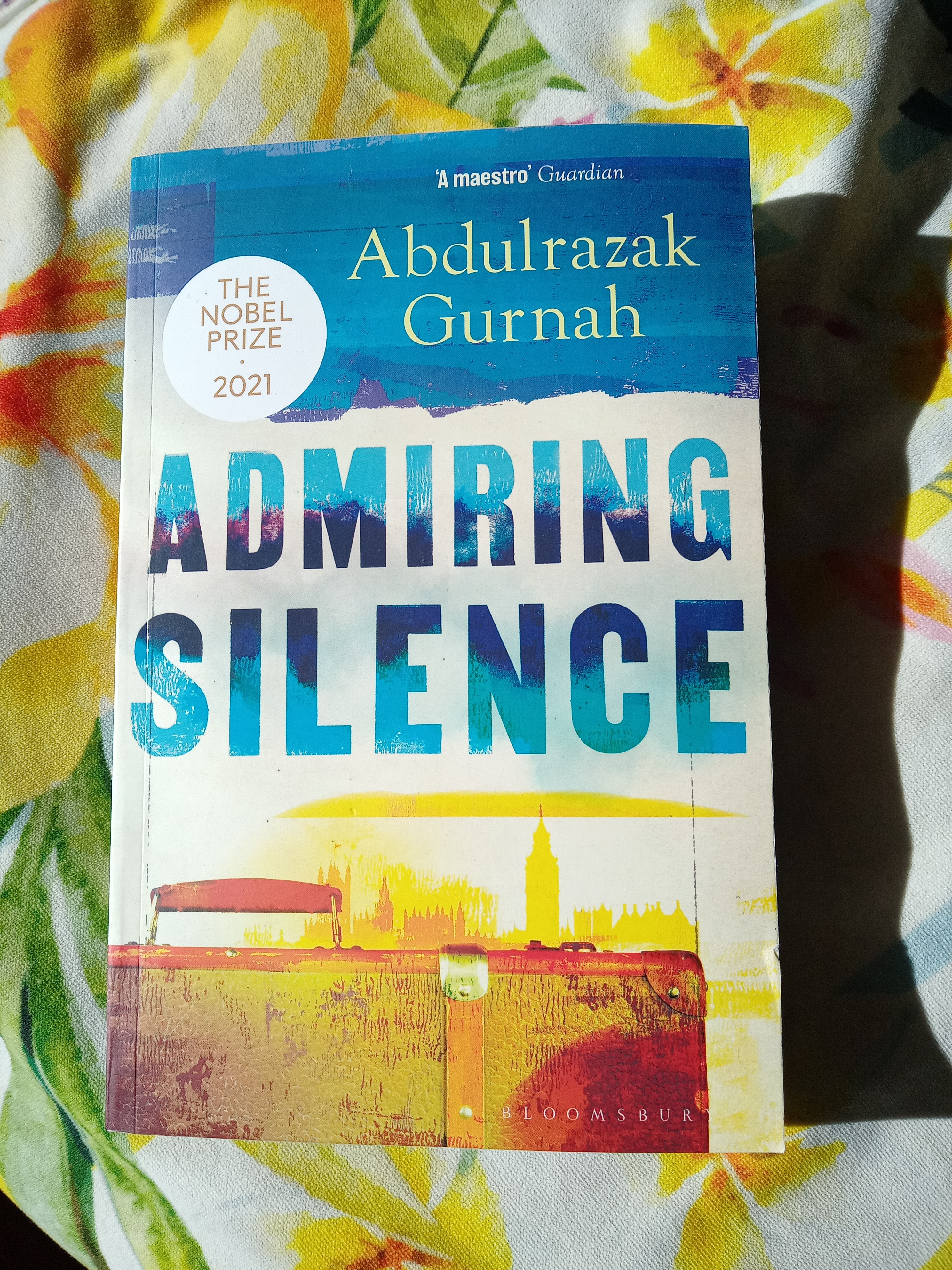
Admiring Silence by Abdulrazak Gurnah

 A young man grows up with his mother on the island of Zanzibar, without knowing his father.

Nobel Prize Literature 2021 fictionSome years later he is given a chance to study in England, by a family friend who is a strict disciplinarian, ensuring he succeeds in his studies. He discovers how much more difficult life can be when he becomes independent and no longer has the encouragement of his fellow countryman to push him.

“I began to understand how Ahmed had protected me, and how frightening England really was…In no time at all after I moved, I was overcome by the enormity of my abandonment, like someone weeping in a crowd. 

I was astonished by the sudden surge of loneliness and terror I felt when I realized how stranded I was in this hostile place, that I did not know how to speak to people and win them over to me,that the bank, the canteen, the supermarket,  the dark streets seemed so intimidating, and that I could not return from where I came – that, as I then thought, I had lost everything.Then Emma came and filled my life. I can’t describe that.”

The novel opens with the following lines that say much about our protagonist and are a reference to twin themes of memory and identity that thread throughout the narrative and an ever present silence, his accomplice.

“I have found myself leaning heavily on this pain. At first I tried to silence it, thinking it would go and leave me to my agitated content. That it would linger for a season, a firm reminder of the disquiet that lurks and coils below the surface of the stubbornly self-gratifying vision of our lives. Far from going, it became more clear, more precisely located, concrete, an object that occupied space within me, cockroachy, dark and intimate, emitting thick, stinking fumes that reeked of loneliness and terror. When I woke up in the morning, I groped for it, then sighed with plunging recognition as I felt it stirring inside me, alive and well.”

We meet him in middle age, when he is sensing this pain; the doctor will tell him his heart is buggered, informing him of the susceptibility of Afro-Caribbean’s to numerous complaints. And so to the first of his many silences, to the proliferation of thoughts never spoken, used as a tool to protect himself from racism and prejudice.

“Of course, after all this drama I did not have the heart to tell him that I was not Afro-Caribbean, or any kind of Caribbean, not even anything to do with the Atlantic – strictly an Indian ocean lad, Muslim, orthodox Sunni by upbringing, Wahhabi by association and still unable to escape the consequences of those early constructions.”

He had been surprised by Emma’s interest in him. They had become a couple and a had a child together. Amelia, now a teenager whom he is barely able to relate to. He has become a disappointment to her without understanding why.

Due to Emma’s rebelliousness against her middle class, conventional parents, they had never married. Our unnamed narrator never complained about this situation, he was beyond the reproach of his own culture, a place she had never visited, a culture his daughter knew nothing of.

Encounters with Emma’s parents predictably demonstrated racism, ignorance and insensitivity, as might be expected from an older generation when one culture or race encountered another, having had little or nothing to do them in the past – or worse – having lived and worked in a way where they had deemed themselves superior, as if it were an accepted fact. 

“Murmur audibly, smile brightly, say nothing. In general that did not seem to me at the time to be a contemptible philosophy, and there were many occasions when I rebuked myself for failing to live by it more consistently. I felt Emma watching me, waiting for me to take offence about something. I had been well primed for this, to expect to be offended by something her parents were bound to say, or imply, or disguise in an apparently innocent commonplace.”

Our narrator observes everything with a mild sense of detachment, he is curious but not judgmental. He often thinks of things he could have said, should have said, but didn’t. His silence will have consequences. He uses them as a pause or space between the past and present, a void that sets him on a collision course with reality, resulting in disappointment and self-deception.

The narrative voice comes across like he is explaining things to to the uninitiated, to others also not from England, to the outsider; perhaps as a warning, not to do as he has done.

“So I went to see my doctor in the end. I became afraid for my pitiful life and went to see my doctor. You can say that in England. My doctor. Here everyone has a doctor all to themselves.”

His observations of the nuances of the cross-cultural, inter-racial relationship are bittersweet. Following fond memories of a holiday in the lake district where they read poetry and take long walks, he ponders the moment things changed with his daughter.

I have photographs of that time and I know I don’t imagine the impossible contentment they portray.

Then she grew up, I suppose. She spoke to her mother about things that she must have thought I would not be able to help her with.It was predictable, but it was also oddly painful. She wanted to do things differently, in ways that seemed strange to me, and when I said this to her I felt a distance growing between us. I suppose I was slow to realize that she did not want to be treated as a beloved child any more, who would listen avidly to my wise thoughts and advice and then change her plans accordingly. So the first time she shouted angrily at me, I cried. I remember her distress then, but perhaps there was nothing either of us knew how to do to prevent the distance growing. Maybe it was more my fault then hers, because I was slow to learn to make room for her, to withdraw gracefully and with affection. And the distance grew into a habit, with only moments of fondness breaking into the hurtful watchfulness.

Admiring Silence Abdulrazak Gurnah

Photo by Charl Durand on Pexels.com

Due to the political situation in Zanzibar, it is 20 years before he returns. He has not told his family about his personal life in England. His relationship with Emma is increasingly difficult, as they fall into patterns they seem not to be able to extract themselves from.

When he returns home, he finds that little has changed. His family set about doing what they have always done, intervening. Though he knows he probably won’t go along with anything they are arranging for him, he allows situations to progress further than they should, given his circumstance. It will require him to be more present and to do more than just observe what is happening around him, he ought to take action he tells himself, before things get out of control.

It is a recognition of heightened awareness, the consequence of which is a loss, an understanding, whose price is to live in the ‘in-between’, to make one continually ponder who they really are, to where they belong.

Brilliantly told, observed and felt. Gurnah’s portrayal of the unnamed narrator is insightful, and realistic, capturing what it might feel like to be trapped between two cultures, with a foot in each camp, neither quite belonging to one or other, seeing through them both, existing in a kind of no man’s land, a threshold that many occupy, though rarely under the exact same circumstance.

The way the novel ends feels realistic, it leaves some of the story to the reader’s imagination, it reminds us of how many different combinations of circumstances exist with people being born and/or raised in cultures not of their parents, or marrying across cultures. 

“Gurnah’s dedication to truth and his aversion to simplification are striking. This can make him bleak and uncompromising, at the same time as he follows the fates of individuals with great compassion and unbending commitment. His novels recoil from stereotypical descriptions and open our gaze to a culturally diversified East Africa unfamiliar to many in other parts of the world. In Gurnah’s literary universe, everything is shifting – memories, names, identities.” Anders Olsson, Chairman of the Nobel Committee

I loved the novel, it was a 5 star read for me, highly recommended, I hope to read By The Sea  next.

Abdulrazak Gurnah, Author

Abdulrazak-Gurnah-Nobel-Prize-LiteratureAbdulrazak Gurnah is a Tanzanian-born British novelist and academic. He was born in the Sultanate of Zanzibar and moved to the UK in the 1960s as a refugee during the Zanzibar Revolution. 

After liberation from British colonial rule in December 1963, Zanzibar went through a revolution which led to oppression and persecution of citizens of Arab origin; massacres occurred. Gurnah belonged to the victimised ethnic group and after finishing school was forced to leave his family and flee the country, by then the newly formed Republic of Tanzania. He was eighteen years old. He did not return until 1984. 

Gurnah has published ten novels and a number of short stories. He was awarded the Nobel Prize for Literature in 2021 “for his uncompromising and compassionate penetration of the effects of colonialism and the fate of the refugee in the gulf between cultures and continents”.

The theme of the refugee’s disruption runs throughout his work. He began writing as a 21-year-old in English exile, and even though Swahili was his first language, English became his literary tool. In his work, he consciously breaks with convention, upending the colonial perspective to highlight that of the indigenous populations. 

Memory of Departure (1987) Pilgrims Way (1988) Dottie (1990) Paradise (1994) Admiring Silence (1996) By the Sea (2001) Desertion (2005) The Last Gift (2011) Gravel Heart (2017) Afterlives (2020)

Further Reading

Biography + Bibliography of Gurnah’s WorksNobel Prize for Literature Committee

Interview with Abdulrazak Gurnah