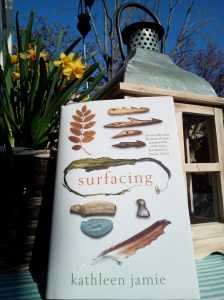
Surfacing I by Kathleen Jamie

Kathleen Jamie writes creative nonfiction. Some people call it nature writing, some travel writing, others describe it as lyrical prose.
In her first book of essays Findings, she talks about her attempts to observe better, to stop naming things, to really see. She wants to move away from labelling and identifying, towards painting a picture with words.

Surfacing is her third collection and it’s brilliant, practiced in the art of observation she takes us with her on a voyage, helps us see with the eye of a naturalist, sharing her experience with respect for the environment, acknowledging the privilege.

A poet and bird watcher from Scotland, her essays are compelling and engaging, they draw you in as if you were there.

I’m writing about Surfacing in two parts, because the third essay, the longest, is 86 pages and deserves it’s own post, the majority are short vignettes of 3-6 pages. There are three essays of significant length and I’ll write about the reminder in Surfacing II.

The Reindeer Cave

Photo by Pixabay on Pexels.com

In the first essay, written in the second person ‘You‘, the author has hiked up a glen to the cave, thinking about the Ice Age and the preciousness of life, as she observes six red deer on the hillside opposite, equally startled no doubt.

Not half an hour ago you were walking beside the burn in a narrow ravine further up the glen. You heard something, glanced up to see a large rock bounce then plummet into the burn twenty five yards in front of you. The echo faded but your heart was still hammering as you backed away.

Deep within the hillside, in the passage of an underground stream, the bones of a bear were found by cave-divers. Carbon dated, they were found to be forty-five thousand years old.

A long sleep, even for a bear: sixteen million days and nights had passed in the upper world. Long enough for the ice to return, then yield again, then return in one last snap, then leave for good – or at least for now.

At the cave mouth she wonders whether the ice will ever return, a natural cycle, or if we’re too far gone with our Anthropocene.

Next to the last page is a black and white photograph of a valley, mist in the distance; as I look closely I see something  appear out of the mist. This is a book you must read the printed version, or you will miss the apparition.

A Reflection

Photo by Johannes Plenio on Pexels.com

The second essay begins as Jamie is taking a train north (in Scotland), sitting on the landward side she watches wintry fields pass by, passengers on the opposite side have a sea view. Drifting in and out of daydreaming she notices the sea superimposed over fields of brown earth. Then disappear.

A moment later it flashed back again, a stretch of sea, silvery over the land, but only for a few seconds. By now I was sitting up, interested in this phenomenon. The fields on the left gave way to pinewoods, the train tilted a little and, yes, the sea’s reflection flashed on again, this time above the trees. If I narrowed my eyes I could see both sea and trees at once. And now there was a ship! A ghostly tanker was sailing over the pine trees.

She continues to Aberdeen and visits a museum. Interested in Arctic artefacts, it is at the Aberdeen University museum she first hears about archaeologist Rick Knecht and his work in Alaska, the subject of the next essay.

In Quinhagak

Jamie takes a six-seater plane from a small airport in Alaska, where pilots enter the waiting area, call out the name of their village then lead passengers across the tarmac. Nervous because the name is so unfamiliar, she hears the call for Quinhagak and follows two other passengers behind the pilot to the plane.

The pilot had long red hair tied in a loose bun with a biro stuck through it. In the plane she readied herself, then half turned in her seat.

‘You guys definitely going to Quinhagak? Just checking! Okay. There’s emergency supplies in the back.’

Photo by Pixabay on Pexels.com

The village is the home of the Yup’ik, indigenous people of the circumpolar north; an archaeological site Nunallaq (meaning old village) sits at the edge of the tundra, a couple of miles away near the beach. As the sea erodes the land, it is slowly revealing the 500 year old village and its cultural heritage, its resilience.

The dig is in it’s fifth season, at the end of every season all the finds are air freighted to Aberdeen to be cleaned, preserved and catalogued.

At the end of the excavation, however, there would be a great return. All the thousands of artefacts would go home to the Yup’ik land where they belonged, legally and morally.

The dig is revitalising traditional skills that had been lost, local people interested in the items found are beginning to make replicas, relearning old techniques.

They are people who have learned to adapt. Their houses stand on stilts due to thawing of permafrost. Nothing can be buried. Any warm structure on the ground would cause the ground to melt and heave, collapsing the structure.

Between walks with her binoculars and helping out at the dig, sometimes facing seaward, other times landward, she observes life. At the end of each day people gather at the shed to view the days finds; on the last day of the season there will be a grand ‘show and tell’.

I noticed that people notice. George had noticed me looking.  They notice the bog cotton and its passing, an influx of owls, that there are bears around. The whole place must be in constant conversation with itself, holding knowledge collectively.

Near the end of her stay, she is invited to a birthday party with a couple of others. They arrive, there are introductions, they gave their names.

As we did so, Sarah looked at us from head to toe appraisingly, and then bestowed on each of us a Yup’ik name several syllables long. It seemed to delight her, matching us to these names by I don’t know what qualities.

I understood that these names, which we now bore as well as our own, were the names of family members who had died. So it was as revenants, rather than strangers that we were welcomed into Sarah’s home.

Later when they are introduced to one particular elder with their new Yup’ik names, the mention of those lost people affects the old lady deeply, she hugs them each warmly.

I so enjoy and value how Jamie’s essays draw you in to her experience, she achieves just the right balance of nature and humanity, of observation and interaction, of imagination and reality.

This could well be her best collection yet.

Further Reading

My Review Of: her 1st collection Findings, her 2nd collection Sightlines

Article: Why Thawing Permafrost Matters
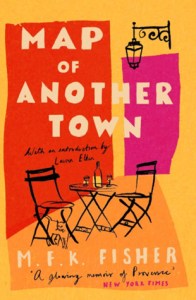
Map of Another Town by M.F.K. Fisher

Essays on Aix en Provence

While I usually steer clear of memoirs set in France, M.F.K.Fisher (1908-1992) is a writer I’ve long intended to read. She was an American nonfiction writer whose wrote about food, considering it from many aspects: preparation, natural history, culture, and philosophy.

Since no-one can visit Aix-en-Provence right now, here is another way to visit the town, through the imagination and evocative style of this talented writer, a specialist in evoking the senses.

Fisher lived in Dijon for a few years as a young bride, but now it is 1954 and she is a widow with two young daughters spending a year in Aix-en-Provence at a time when France is still reeling from the effect of the second world war. Fisher too is recovering from raw emotional wounds.

While being in Aix makes her feel alive, a sense of frustration seeps through the pages as she describes feeling largely invisible and worse, looked down upon.

She is keenly aware that the grand dames consider her an ‘outlander’, an emissary from a graceless, culture-less people.

Living here has given her a thick skin, a confidence and an extra sense with which to navigate the world.

Over the years I have taught myself, and have been taught, to be a stranger. A stranger usually has the normal five senses, perhaps especially so, ready to protect and nourish him.

Then there are the extra senses that function only in the subconsciousness. These are perhaps a stranger’s best allies, the ones that stay on and grow stronger as time passes and immediacy dwindles.

It is with these senses that she creates her map of the town, Aix-en-Provence.

Le Cours Mirabeau

She finds just the right words to describe the near indescribable, whether it’s the cafes, the main street or the people, and though all of the characters she writes about have long gone, the edifices remain and it is easy to imagine how this place we live in was back when she inhabited it. In reality, little has changed, except that today it is a ghost town.

After reading the initial chapters, I stopped reading for a couple of months just after the chapters The Gypsy Way and The Foreigner, which were somewhat xenophobic. Then I picked this up again and was relieved to find the next essays as delightful as the debut and way more humorous. I found that Fisher was more entertaining when observing herself than she was observing others.

My favourite essay ‘A Familiar’ didn’t even take place in Aix, it’s a stream-of-consciousness narrative of six hours spent in the train station of Lucerne after being sold a ticket for a non-existent train. Refusing to allow herself to venture outside, she orders a vermouth-gin in the station restaurant to ease her awkwardness.

I would have liked to order at least two more,  but although I had to laugh at myself I was afraid that the maid, already somewhat alarmed at my ordering such a potion … a woman alone … would report me to the police who must be somewhere handy in the enormous station.

And in the essay ‘The Unwritten Books’, she visits a cake shop, asking the pastry chef to make a cake, one drawn by her young daughter, a cross cultural hilarity, not to mention the proprietors constant refusal to hear her other request, to provide her with a calendar of culinary events, for which there is only ever one reply, an(other) invitation to visit the calisson factory? Priceless!

A must read certainly if you know and love Aix-en-Provence, this is an outsiders insight into the old city, one who has fallen for its charm, cursed by her inability to meld completely into it. Humorous in some parts, cringworthy in others, overall a delight and superbly descriptive.

This new edition with an introduction by Lauren Elkin, was re-released in 2019 by Daunt Books. Thank you to the publisher for sending me a review copy.

The Situation and the Story by Vivian Gornick

The Art of Personal Narrative

A deliberate slow read for me as I wished to absorb the teaching, while researching and writing my own work, something definitely clicked in my understanding which I hope translates across into my writing.

On The Essay
In the first half Gornick dissects a few essays, citing them as evidence of her theory of the narrative that really demands attention and works, because it has been structured, attention being given to understanding the difference between the situation and the story.

A theory that came to her like an epiphany while attending a funeral, where one person in particular moved her more than the others.

Her words had deepened the atmosphere and penetrated my heart. Why? I wondered even as I brushed away the tears. Why had these words made a difference?

She concludes that because the narrator knew who was speaking, she always knew why she was speaking. She had created a ‘persona’ of herself in order to eulogize the deceased. An instrument of illumination.

The unsurrogated narrator has the monumental task of transforming low-level self interest into the kind of detached empathy required of a piece of writing that is to be of value to the disinterested reader.

But getting from the understanding of a theory to being able to apply it in one’s writing was something that eluded her until she analysed her own attempt of personal journalism (part personal essay and part social criticism) when she was invited to go to Egypt and write about the middle class existence in Cairo. Overwhelmed by the energy of the city, the drama of its citizens, the work mimicked Egypt itself. It would take years before she was able to control the material with sufficient composure to see the situation and narrate the kind of story she wished to share.

Every work of literature has both a situation and a story. The situation is the context or circumstance, sometimes the plot; the story is the emotional experience that preoccupies the writer: the insight, the wisdom, the thing one has come to say.

Using examples from different essays and memoirs, she shares extracts to demonstrate the theory in it’s most eminent form e.g. Augustine’s Confessions, Edmund Gosse’s Father and Son, George Orwell’s Shooting an Elephant, Ackerley’s My Father and Myself.

She compares a trilogy of essays that exhibit the way self-implication can shape a piece of nonfiction writing: Joan Didion’s essay on the companionship of a migraine, ‘In Bed’, Harry Crews’s divided feelings about home in ‘Why I Live Where I Live’ and Edward Hoagland’s disturbing urban nature essay, ‘The Courage of Turtles’.

We are in the presence, in each instance, of a mind puzzling its way out of its own shadows – moving from unearned certainty to thoughtful reconsideration to clarified self-knowledge. The act of clarifying on the page is an intimate part of the metaphor.

Joan Didion, perhaps the most practiced of them all, excavated her subconscious regularly, stayed in touch with the times, and wrote right down to the core of her self-examined existence.

“I have tried in most of the available ways to escape my own migrainous heredity … but I still have migraine. And I have learned now to live with it, learned when to expect it, how to outwit it, even how to regard it, when it does come, as more friend than lodger.”

Joan Didion, ‘In Bed’, 1968

On The Memoir

Truth in a memoir is achieved not through a recital of actual events; it is achieved when the reader comes to believe that the writer is working hard to engage with the experience at hand. What happened to the writer is not what matters; what matters is the large sense that the writer is able to make of what happened. For that, the power of the writing imagination is required.

She posits that modern memoir is of value to the reader only if it is able to dramatise and reflect on the experience of transformation or ‘becoming’ as the writer moves away from that person one has been told they should be towards the more authentic version that might be revealed beneath.

Quoting the example of Gosse’s, Father and Son she observes:

That this son must come into his own by making war not on a parent who is willful and self-involved (which he is) but on one filled with the tender regard that alone gives a growing creature the ability to declare itself (which he also is). This is the thing the reader is meant to register; this is the narrator’s wisdom. It is the betrayal of love that is required in order that one become.

These memoirs that succeed are works that record a steadily changing idea of the emergent self.

For each of them a flash of insight illuminating the idea grew out of the struggle to clarify one’s own formative experience; and in each case the strength and beauty of the writing lie in the power of concentration with which this insight is pursued, and made to become the writer’s organising principle. That principle at work is what makes a memoir literature rather than testament.

Ultimately the advice she gives is to aspiring writer’s is to ask oneself certain questions, both in reading and in writing:

What, we would ask of the manuscript,was the larger preoccupation here? the true experience? the real subject? Not that such questions could be answered, only that it seemed vital to me that they be asked.

That exploration of the subconscious might precipitate insights to rise to the surface and spill over onto the page, by digging deeper, one may stumble across the inner context that makes a piece of writing larger than its immediate circumstance.

“who is speaking, what is being said, and what is the relation between the two” had become my single-minded practice”

She ends with an observation about timing, the thing that a writer can rarely predict.

Writing enters into us when it gives us information about ourselves we are in need of at a time that we are reading.

This explains why a worthy book might be overly criticized while one of fleeting value is highly praised, the former, great though it may be, misses the mark because what it has to say can not be absorbed at the moment, while the latter

is well received because what it is addressing is alive – now, right now – in the shared psyche.Which is perhaps as it should be. The inner life is nourished only if it gets what it needs when it needs it.

The Chalice and the Blade by Riane Eisler

Our History, Our Future

This is a book I’ve been fascinated by and slow reading over the past couple of months. Today, somewhat reluctantly, as it’s a large and in-depth work that can’t really be summarised, I decided I needed to write about it, especially as the sequel is due out and I’ve pre-ordered it, so I wanted to share my thoughts on this first. And because it’s brilliant and deserves a much wider readership.

Riane Eisler was born in Vienna, Austria. When she was a child she and her parents fled for their lives from the Nazis, first to Cuba and finally to the United States, thus she experienced three different cultures, each with their own version of truth and reality.

Very early in my life I saw that what people in different cultures consider given – just the way things are – is not the same everywhere. I also very early developed a passionate concern about the human situation.

She began to ask herself many questions:

Why do we hunt and persecute each other? Why is our world so full of man’s infamous inhumanity to man – and woman? How can humans be so brutal to their own kind? What is it that chronically tilts us toward cruelty rather than kindness, toward war rather than peace, toward destruction rather than actualization?

These and other questions lead her to re-examine the past, present and future, captured here in The Chalice and the Blade, looking at human history and pre-history and at both male and female aspects of humanity and in particular, those societies where the feminine aspect was revered.
This work gave rise to what she termed:
– the dominator model (popularly referred to as patriarchy or matriarchy) – the ranking of one half of humanity over another and
– the partnership model  – based on the principle of linking, affiliation and cooperation

Her work further suggested that:

the original direction in the mainstream of our cultural evolution was toward partnership but that, following a period of chaos and almost total cultural disruption, there occurred a fundamental shift.

Hence the title The Chalice (the life-generating and nurturing powers of the universe – in our time symbolized by the ancient chalice or grail) and the Blade the power to take rather than give life that is the ultimate power to establish and enforce domination.

She reevaluates the past and present, sharing insights from research that has often been ignored or misinterpreted.

The chapters tell a story that begins thousands of years before our recorded (or written history). Of how the original partnership direction of Western culture veered off into a bloody 5,000 year dominator detour.

showing that our mounting global problems are in large part the logical consequences of a dominator model of social organisation and that there is another course which, as co-creators of our own future experience, is still ours to choose.

Both the mythical and archaeological evidence indicate that perhaps the most notable quality of the pre-dominator mind was its recognition of our oneness with all of nature,which lies at the heart of both Neolithic and the Cretan worship of the Goddess. Increasingly, the work of modern ecologists indicates that this earlier quality of mind, in our time often associated with some types of Eastern spirituality, was far advanced beyond today’s environmentally destructive ideology.

From the paleolithic, the neolithic, Old Europe, Goddess worship and the unique long lasting civilization of Crete to the invaders, the colonizers, warfare, slavery and sacrifice, we see the world and our reality through a different lens and yet once you’ve seen it, you recognize it, without realizing how it acts on us, in our homes, our workplaces, ours schools, institutions, governments.

It is so interesting to read this, originally written in 1987, over 30 years ago, in the context of our reality today. It provides a unique perspective on our history and analyzes it rigorously and yet in an easily understandable and accessible way, synthesizing information from a varieties of sources and disciplines to give us this helpful view of the influences that have been directing our progress (or lack of) suggesting the greater role that a more feminine (yin) collaborative, partnership approach might bring.

It is a seminal work in understanding the impact of repressing the positive characteristics of the feminine and demonstrating that a more partnership oriented model can reap rewards that benefit not just the individual, but the community. Despite the fact that our media is full of much doom and gloom, it is possible to look a little closer to home and see examples of people working in partnership and collaboration, of people leaving behind corporations and institutions and choosing ways of living and working that allow for greater creative expression.

She continues to ask questions, and these two that she mentions, seem fitting to what will follow:

Is a shift from a system leading to chronic wars,  social injustice, and ecological imbalance to one of peace, social justice and ecological balance a realistic possibility? Most important, what changes in social structure would make such a transformation possible?

Though this was written 30 years ago, there is a sequel due to be published in August 2019, in collaboration with peace anthropologist Douglas P. Fry Nurturing Our Humanity: How Domination and Partnership Shape Our Brains, Lives, and Future exploring how behaviors, values, and socio-economic institutions develop differently in these two environments, revealing connections between disturbing trends like climate change denial and regressions to strongman rule. It combines Eisler’s partnership-domination social scale with extensive evidence from neuroscience and other fields.
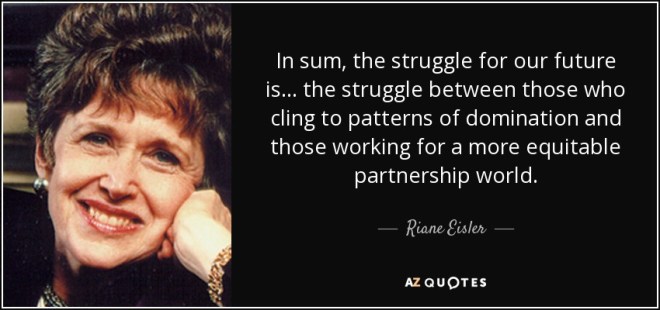
It shows that, contrary to popular beliefs about “selfish genes” driving human behavior, how people think and feel is heavily influenced by whether they grow up in partnership or domination oriented environments. It also documents that in reality humans in the course of evolution developed a propensity for empathy, caring, and creativity, which is, however, inhibited in domination systems. It further points to interventions that can accelerate the contemporary movement toward partnership and prevent further regressions to domination.

About the Author
Riane Eisler, JD, PhD (hon), is President of the Center for Partnership Studies, Editor-in-Chief of the Interdisciplinary Journal of Partnership Studies, internationally known as a systems scientist, cultural historian, pioneering attorney working for women’s and children’s human rights, and recipient of many awards. Her groundbreaking books include The Chalice and the Blade, Tomorrow’s Children, and The Real Wealth of Nations. She lectures worldwide, keynoting conferences, addressing the U.N. General Assembly, U.S. State Department, corporations, and universities. Her website is https://rianeeisler.com/.

Never Stop Walking by Christina Rickardsson tr. Tara F. Chace

A Memoir of Finding Home Across the World

Living in Sweden and remembering nothing of her native language Portugese that she spoke until she was adopted at the age of eight, Christina Rickardsson, now 32-years-old is about to embark on her first trip back to the country of her birth to reconnect with elements of that initial period in her life, vividly recalled.

Recurring nightmares of her childhood awaken something in her sub-conscious, creating an emotional/ spiritual crisis that she addresses by revisiting .

I watched my eyes fill with tears as I realized that the little girl who had run for her life had just kept on running. I needed to stop running and once and for all, for my own sake, process what had happened.

A dual narrative flips between the present as she returns to Sao Paulo with her friend Rivia, who will act as her translator and the past where she shares the vivid memories and equally strong emotions of her early childhood years.

She reviews the adoption papers that have been locked in a safe for the past 24 years.

I’ve never felt the need to find out who I am, where I come from, or why I was abandoned. I know who I am, where I come from; most of all I know that I wasn’t abandoned. Kidnapping might be too strong a word to use for how our adoption transpired, but sometimes that’s what it felt like.

Some of the things she reads disturb her because they don’t ring true, she retains strong and tender feelings of love towards her biological mother and recalls the trauma of their separation but has never understood why. Her story is written in a desire to restore her mother’s name and tell their truth as she remembers it, to fill in the gaps in her knowledge and find out if her mother is still alive.

She recalls details of living in a forest cave in the Brazilian wilderness with her mother, of surviving on the streets of Sao Paulo and her time in an orphanage before she and her almost 2-year-old brother are adopted by a Swedish couple and begin a new life there.

Map from traditional symbols of culture and the nature of Brazil

She recalls her friendships with other children when they live in the streets, special moments, terrifying incidents and the strong emotions they evoke are equally remembered, her instinct for self-preservation is strong and her reactions to things spill over into her new life in Sweden, where they are often deemed inappropriate.

On some level, I began to understand that people, especially grown-ups, weren’t interested in the truth but rather in a truth that suited them. They only wanted to know about things that made stuff easier for them. It didn’t matter that I was walling off part of myself, that I was turning into someone else.

The relationship she remembers with her mother from childhood is tender, the bond strong, she defends it, and holds tight to the memories. There is a respectful appreciation for her Swedish family and clearly a difference between her feelings and those of her brother, who recalls little of his life in Brazil before their adoption.

There’s an undercurrent of sadness in this accomplished memoir, of a woman who is neither one thing nor the other, who can never let got of who she is, but must continue to live as that whom she has become.

She repeats often a kind of mantra, that life for her is not about finding herself, but about creating herself. And yet the two go hand in hand, as her story so adeptly shows, though she was separated from her mother, her country and culture, she lived in it long enough for something of it to have sunk deep into her psyche, which is not the case for children adopted at birth, or as toddlers. Many search to find out what she already knew, before they can freely go on to ‘create’ themselves anew, or to realise that they can be who they are, because they can make peace with the mystery of their unknown heritage.

I felt so much rage growing up that it frightened me. It filled me and destroyed me. I felt it, but I didn’t know how to handle it, so I smiled and laughed even more and did well in school…I had walled off my true self.

Eventually she finds a way to navigate the two selves by turning the focus outward, towards helping others, addressing the ache of having had to suppress her true self for so long.

She shares one of the more troubling stories of her childhood in a 15 minute TED Talk below and the inspiration behind the words in the title, Never Stop Walking.

Further Reading/Listening

Christina’s TEDTalk : The Lottery of Life

Article, 25 Oct 2018 Humaniam.org : Children, the main victims of violence and crime in Brazil

Buy a Copy of Never Stop Stop Walking via Book Depository

Without a Map, a Memoir by Meredith Hall

In 1965, in a New Hampshire town, Meredy, the 16-year-old daughter of a family raised by a mother trying to keep up appearances after her self-obsessed husband abandons them, (and later berates them for not being happy at his subsequent new marriage) discovers she is pregnant.

It is a threshold era, both locally, (Hampton Beach riots) in the US, (war in Vietnam) and in her life, it is a time when everyone in her family is moving on, leaving her open and vulnerable to the events that lead to her predicament.

I feel the swelling energy, the inexplicable, restless hunger, rising in my own innocent life. I don’t care at all about the music or the drinking or the gathering together of teenagers for fun and the thrill of belonging. But my father is gone. He has a new life, a new wife and daughter, and never calls or visits. I miss him badly. My mother is inaccessible. My older brother and sister have moved on to their own lives, leaving me alone at home and on the beach while my mother works and plays with Peter.

Immediately removed from everything familiar, home, school, church and community, she is sent in disgrace to her father’s new household and ordered to never go outside or if there was company, to remain in silence upstairs.

It is true that my shunning was a message from our community to my mother. Her rejection of me was a measure of the humiliation she felt. She believed until her death that I caused her to lose her friends and her stature in the town.

Passing the long weeks of her pregnancy confined in this way, she eventually gives birth, her baby boy is removed from her, adopted out and she is sent to a boarding school for young people perceived as misfits (where she is forbidden to speak of the reason she has been sent there) to finish her education.

“We must protect the girls,” Mrs. Kroehne said. “You understand.” I do understand. I am a contaminant and must be kept silent. It has been three months since my baby was born, three months since I walked away from my baby with milk dripping from my breasts. I will not say this to any of these young people during my time among them. I will construct careful lies and memorize them to explain myself, my dark inward life, my hunger for love, my tough resistance to trust.

Meredith goes through the many stages of grief, for the loss of her baby, her adolescence and so much more, initially doing what is expected, then rejecting everyone, traumatized by the experience to the point of becoming reckless with her own life.

Mourning with no end, and a sense that I had lost everything – my child, my mother’s love and protection, my father’s love and protection, the life I had once imagined for myself – hollowed me out. I floated every day alone and disconnected, and could not find comfort or release. I understood clearly that my history had harmed me, had cut me off from the normal connections between people. Every day for five years I had been afraid of this disconnection, feeling the possibility of perfect detachment within my reach, like a river running alongside, inviting me to step into its current.

Incredibly, if not quite overcoming it, she does survive her own casting out to return and among other things pen this moving, honest, brave memoir.  It is an important story and chance to be heard, of a young mother forced to abandon her baby, like so many who are rarely given any kind of emotional support, who have been shunned, shamed and silenced.

Meredith Hall will eventually rise up out of her own misery, gift herself the development of her creative writing skills, ultimately to be able to help others write their stories and to publish this important one, her own.

This is the first time I’ve read an account of a birth mother’s story, so many of these stories never get told due to the shame they have endured and the distance they have put between their past, their attempt to live a new life which buried those experiences deep and the fear of confronting any of it.

It is courageous that Meredith Hall has pushed through that to share the reality of this traumatic experience from her perspective. There are gaps in the story, there are those who have been spared the lens of scrutiny, but there is enough here to to allow readers to feel empathy for the situation and understand the fear some have in overcoming the same, the conditions under which they must live out their entire lives, often never revealing the secret, never able to connect with the innocent child who grows up understanding nothing of the loss they too feel, until an age when they’re often told to be grateful for what they’ve been supposedly gifted.

It has just been discovered that women carry fetal cells from all the babies they have carried. Crossing the defensive boundaries of our immune system and mixing with our own cells, the fetal cells circulate in the mother’s bloodstream for decades after each birth. The body does not tolerate foreign cells, which trigger illness and rejection. But a mother’s body incorporates into her own the cells of her children as if they recognize each other, belong to each other. This fantastic melding of two selves, mother and child, is called human microchimerism. My three children are carried in my bloodstream still….

How did we not know this? How can this be a surprise?

Click here to Buy a Copy of Without a Map via Book Depository

Related Reviews

An Affair With My Mother by Catriona Palmer

A Long Way Home (Lion) by Saroo Brierley

Becoming by Michelle Obama

I recently was invited to join a bookclub and this was the first gathering I was able to attend. Around half the members are native French speakers and the rest of us are English speakers from various different countries of origin. The first book they read was Jean-Claude Izzo’s Total Kheops (Total Chaos) in English (which I’d already read and reviewed here), it’s crime fiction set in the nearby town of Marseille. We choose books that are available in both English and French. The second read was going to be a bestseller and Michelle Obama’s memoir Becoming was chosen.

A book that needs no introduction, a woman unanimously loved from where I sit and yet one who was exposed to the full spectrum of opinions about her, requiring an inordinate amount of resilience. Interestingly, there had not been universal admiration for her by some prior to reading the book, a reflection of how much influence the media has on our perceptions of people, both positive and negative.

Divided into three sections, Becoming Me, Becoming Us and Becoming More, I actually found the first two sections of the book the most engaging. Here she shares the influences of her early life and development of her character prior to meeting Barack Obama, followed by the early years of their lives together. These sections are the most insightful and endearing, probably because they are the most real.

“My parents talked to us like we were adults. They didn’t lecture, but rather indulged every question we asked, no matter how juvenile. They never hurried a discussion for the sake of convenience.”

They also corrected their speech, causing an awkward moment when a cousin asked why she talked like a white girl.

“The question was pointed, meant as an insult or at least a challenge, but it also came from an earnest place.  It held a kernel of something that was confusing for both of us. We seemed to be related but of two different worlds.”

A consequence of parents and close family being attentive to pronunciation, encouraged to enunciate correctly, having had drilled into them the importance of correct diction.

“The idea was we were to transcend, to get ourselves further. They’d planned for it.  They encouraged it. We were expected not just to be smart but to own our smartness – to inhabit it with pride – and this filtered down to how we spoke.”

She refers to her younger self as a box checker, at all times focused on the agenda, on achievement.

“My to-do list lived in my head and went with me everywhere. I assessed my goals, , analyzed my outcomes, counted my wins. If there was a challenge to vault,  I’d vault it. One proving ground only opened on to the next. Such is the life of a girl who can’t stop wondering, Am I good enough? and is still trying to show herself the answer.”

It is at this time that she observes a boyfriend who swerved. Did something unexpected, didn’t follow the straight and narrow path, something she didn’t understand at the time, being a devout follower of the established path, someone conscious of what other people think. That observation would stay with her and later she would see the merit in it, and the stiflement of the established path – and make her own swerve.

In the second section she meets Barack and the self awareness increases, life gets interesting and challenging in different ways. She observes him going to community meetings, showing up and talking to people who appeared skeptical of him. He was trying to build trust in communities where it was seriously lacking. She observed his differences, how he made them work for him. For me, this is where it becomes unputdownable.

“But skepticism didn’t bother him, the same way long odds didn’t seem to bother him. Barack was a unicorn after all –  shaped by his unusual name,  his odd heritage, his hard-to-pin-down ethnicity, his missing Dad, his unique mind. He was used to having to prove himself, pretty much anywhere he went.”

I particularly enjoyed their paths as young adults and how they were able to overcome their differences in upbringing and character, bringing tolerance first to their own lives as a couple, before going on to use it in their respective careers and ultimately as parents and as America’s role model couple in the White House.  He trusted things would work out, she worried, ‘We’ll figure it out’ he’d say. And they would.

Though the words are never mentioned in the text, in spiritual terms it’s clear they are soul mates, not so much because of a great love, but due to what they appear to have come into each others lives to learn. I loved that this comes across so clearly, that she developed the awareness to look at the expectations she had put upon herself as a result of her upbringing and her character and found another way.

But what a sacrifice really, despite the perception of it being glamorous and of course privileged. What a relief to get some semblance of a life back, I hope so anyway. Their celebrity status will likely never change, but as she shares in the opening pages, she is at least able to do some things unobserved, to open a window, listen to birdsong and dogs barking, feel more like a human being again.
She has done a wonderful job of demonstrating how she was formed by her upbringing, of how dependent she was almost without realising it initially – on being near and around her extended family, and while she grew up in a working class part of Chicago, South Side, her privilege was to have had that foundation of a strong, supportive, self-sacrificing family.

And though she attained great heights in her education and career, she too would have to draw on those self-sacrificing roots of her parents and ancestors, ironically, while slipping into the shoes of one of the most self-sacrificing unpaid jobs in America, that of the First Lady of the United States FLOTUS.

The Turquoise Ledge (2010) by Leslie Marmon Silko

I loved this book. I chose it because I wanted to visit the natural landscape of Tucson through the eyes and insights of a lyrical nature writer.  I was also looking for the perfect birthday present for someone who knows that landscape well, to transport them back there, reignite something without having to travel.

And of course, being curious I had to read it first, it was far too big a temptation and we are the kind of friends you can do that with, indulge the gift before giving it – and I know I give something of myself by doing this, the pages ear-marked where I was stopped, moved, given pause for thought. I know how those traces of the previous reader intrigue, they add mystery where usually there is none.

Leslie Marmon Silko was born in Albuquerque in 1948 into a family of Laguna, Cherokee, Mexican and Anglo ancestry.

She wanted to be a visual artist, but rebelled against perspective and realism, so pursued an English major initially,  published a bestselling novel Ceremony, and after a misdiagnosed ectopic pregnancy, experienced a life-changing moment, leaving her old life, marriage, teaching behind and moved to Tucson in 1978 just two months after surgery.

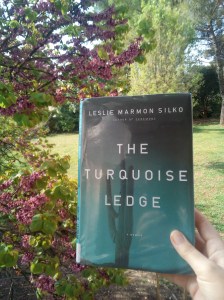
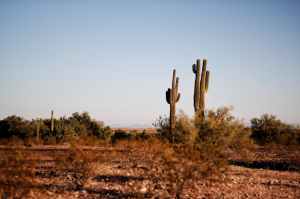
In The Turquoise Ledge, she pieces together this colourful, magical yet natural, narrative of thirty years living in the Tucson Mountains, on the edge of Saguaro National Park, in a ramshackle house, equally inhabited by creatures of the desert, a pandemonium of parrots and her pack of mastiffs, who like her, develop immunity to certain venomous dangers and survive the extreme climate. The desert terrain and all its wonderful beings, including the weather won her heart and it shows on every page.

The book is divided into five parts entitled Ancestors, Rattlesnakes, Star Beings, Turquoise and Lord Chapulin although there are elements of all those things throughout the text, as they are all integrated and woven into the life she lives, the habitat she dwells within and the landscape she walks over, studies and is a part of.

Though it is memoir, the author recognises that some aspects of memory are remembered vividly and others, even recent memories involve and invoke imagination. She has learned to tap into her subconscious, searching for truths not facts; she is a writer, a poet and an artist. Though she uses words, she is creating a self-portrait.

“We learn to ignore the discrepancies between our memory of an event and a sister’s memory. We can’t be certain of anything.
Fortunately my subconscious remembers everything I need. Whatever I can’t recall, later comes back to me as I write fiction. I make myself a fictional character so I can write about myself.”

She recalls interactions with family members and elders from her childhood, those often defining moments when a child observes more than just an event but is absorbing a cultural influence, hearing a people’s myths and songs, observing family superstitions.

Though she never spoke the Laguna language after the age of five that her great-grandmother A’mooh had spoken and wonders why that was, her great Aunts would ensure she knew of the hummah-hah stories, traditional Laguna stories that reveal the Laguna spiritual outlook toward animals, plants and spirit beings, a viewpoint that had become at odds with her great grandmother’s staunch conversion to the Presbyterian church.

I never felt alone or afraid up there in the hills. The hummah-hah stories described the conversations coyotes, crows and buzzards used to have with human beings. I was fascinated with the notion that long ago humans and animals used to freely converse. As I got older I realised the clouds and winds and rivers also have their ways of communication; I became interested in what these entities had to say. My imagination became engaged in discovering what can be known without words.

In these now forty years that have passed since she came to live here, the effect of bulldozers and the urban sprawl of Tucson have destroyed acres and acres of pristine desert habitat and left some species in danger of extinction and others to seek refuge elsewhere.

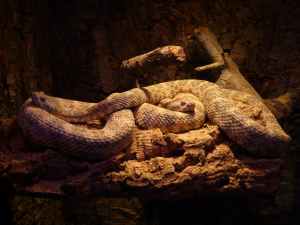
The old ranch house and the sheds and outbuildings are home to pack rats and deer mice accompanied by gopher snakes, racer snakes and rattlesnakes that eat them. So in the beginning, I got to know the snakes and pack rats because we were neighbours. I began to keep notes on my encounters.

Photo by Pixabay on Pexels.com

So many encounters, that by the time you finish reading this section, you too may be converted to considering if not accepting that we should all live in closer proximity to our reptilian brethren. Silko and the snakes become familiar, she learns how to be around them and they learn that she is not a danger. In one of the most symbiotic relationships I have ever read about, this woman and these creatures live in this space together, her in the house, them under it and many anecdotes of those fascinating encounters that she handles with such poise and reverence.

Over time the rattlesnakes will get to know you and your pets. They learn human and dog behaviour and seem to understand the timing of our daily routines; they try to avoid encounters with us at all cost. A few times I’ve been very early or very late with my outdoor chores and I’ve surprised snakes that didn’t expect me at that time of day.

And then there is the heat, I learn that as the heat expands the air molecules they are thinner and less buoyant, no longer able to carry the particles of dust. The seasons are rain and no rain. When the temperature exceeds 112°F/44°C, the air smells of wood and bark just before they burst into flame.

The heat boils the sky to a deep blue. No traces of clouds, only the deepening blue as the air becomes crystal clear. The angle of the Sun causes the light to have the luminescence of a blue flame. The Sun is seated in the north corner of Time.

Photo by Yigithan Bal on Pexels.com

We learn about the unique geology of the Tucson Mountains that explains the formations, rocks and stones that appear on her walks in the arroyo (dry creek bed) her fascination with turquoise, with the Nahua people, the Nahuatl language and Tlaloc, the Nahua God of Rain, to whom she occasionally chants her own original rain prayer. And Lord Chapulin, who you’ll meet if you decide to read this, a living creature and the subject of one of her portrait paintings.

This book took me on a voyage to a place I’ve never been that seemed like another planet, Earth and yet not like the corners of Earth I’ve known. I wonder how someone can live in the heat of the desert like this (without air conditioning) and keep animals, or live alongside wildlife and observe them the way she does, in tune with the ancestors, the star beings, the rattlesnakes, rain chants and an ancient language she predicts is going to make a comeback.

I was enchanted by her endearing tales, her lyrical observations, nuggets of natural and peoples’ history, her love of the local environment and I hope the man with the machine desecrating the arroyo reads her book and stops being such an idiot.

Highly Recommended.

Buy a Copy of The Turquoise Ledge by Leslie Silko

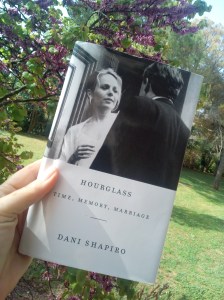
Hourglass – Time, Memory, Marriage by Dani Shapiro

I’ve not read any of Dani Shapiro’s previous works, this short book was passed to me by a friend and read in an afternoon. I enjoyed reading it, though I couldn’t say I related to it. It’s a very personal observation of a marriage, of the passage of time, a woman observing herself change, reflecting on her inclinations and trying to understand herself, her husband and their evolving relationship. As the title indicates, it’s a reflection on time passing, on memory and on marriage. It’s full of nostalgia for moments passed, brought back to life as she picks up journals from girlhood and her earlier life and quotes from them, in particular, from her honeymoon spent in France. She wonders about the woman she was then. She worries about the lack of a plan, despite being in her fifties and her husband almost sixty. She shares these anxious moments, as she begins to lose a little faith in the words her husband has uttered in the past, words that gave her reassurance “I’ll take care of it”. Anyone who has lived with that kind of comfort will likely relate, but inherent within it lies a deep vulnerability, a fissure, a unassuageable fear of loss. It is here her words pierce the fabric of living, when they illuminate the cracks in the facade, opening a small window into that anxiety-inducing perception of reality that sees itself as separate. It is that undercurrent of misplaced fear that disconcerts me, for there is no hint of resolution, little evidence of a desire to go within and face the abyss, to heal it. She remains focused on that which is external and therein perhaps lies the problem. Maybe that is a memoir still to come, when she will embark on the inner journey and learn to listen to her own guidance, to the whispers of her soul that are capable of reassuring her more than anyone or anything on the outside. Something that marriage appears to protect us from, at least until menopause, a subject she doesn’t mention but one that can also unravel our perceptions of the life structures we’ve created in our minds.

Photo by Tom Fisk on Pexels.com

It is a work of quietly observed transformation, the writer is trying to observe herself from both without and within, she has a long experience of observing from a distance and now she feels the pull to go within, yet it’s as if she has only just begun to put her toe in the river. She is aware of the pull of the river and quotes from Virginia Woolf:
The past only comes back when the present runs so smoothly that it is like the sliding surface of a deep river. Then one sees through the surface to the depths…But to feel the present sliding over the depths of the past, peace is necessary. The present must be smooth, habitual. For this reason – that it destroys the fullness of life – any break… causes me great distress; it breaks; it shallows; it turns the depths into hard splinters. As I say to L[eonard]: “What’s there real about this? Shall we ever live a real life again?
She recalls that she used to tell her students that to write good memoir, the kind that would be of interest to the disinterested reader, the writer had to have some distance from the material, not to write from feelings but from the wisdom and insight of retrospect.
But like every fixed idea, this one has lost its hold on me as years have passed and the onrushing present – the only place from which the writer can tell the story – continues to shift along with the sands of time. Our recollections alter as we attempt to gather  them. Even retrospect is mutable. Perspective, a momentary fragment of consciousness. Memoir freezes a moment like an insect trapped in amber. Me now, me then. This woman, that girl. It all keeps changing. And so: If retrospect is an illusion, why not attempt to tell the story as I’m inside of it?  Which is to say: before the story has become a story?

Photo by Jordan Benton on Pexels.com

And so as her reflections come to an end, they indicate that she may be at another beginning.
Somewhere, a clock ticks. Sand pours through the hourglass.  I am no longer interested in the stories but rather, what is underneath the stories: the soft, pulsing thing that is true. Why now?  What is this insistence?  All of me – the whole crowd – wants to know.
I am left intrigued to know what she will write next, where her inner journey will take her, when she lets go of looking through the lens of marriage, time and memory and observes life through a newly expanded awareness.

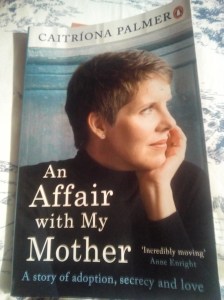
An Affair with My Mother by Caitriona Palmer

It seems a strange title for a book, until we understand it is a memoir of adoption, of secrecy, of a love denied, forbidden. And the woman writing it, comes to realise, how very similar the continued secrecy surrounding spending time with her birth mother is, to conducting an illicit affair. So she calls it that. It’s like an unwritten 13th commandment: Thou shalt not have any relation whatsoever with thy illegitimate child.

It’s set in Ireland, a country reluctant to let go of old ways, still in throe to a traditional family culture that shamed, blamed and punished young women for being the life-bearers they are – insisting they follow a code of moral behaviour documented by a system of domination, upheld by the church, supported by the state – a system that bore no consequence on men – young or old – who were equally responsible for the predicament of women.

“If there is anger in this book it is anger at the profound and despicable sexual double standard in Ireland. Men walked away without ever having to confront their role in these relationships.”

Eventually women in Ireland were given access to a means of preventing unwanted pregnancy, though not until Feb 20, 1985 when the Irish government defied the powerful Catholic Church, seen until this day as lacking compassion, in approving the sale of contraception, and more recently in a 2018 referendum, repealing its abortion ban (outlawed in 1861 with possible life imprisonment), acknowledged as a dramatic reversal of the Catholic church’s domination of Irish society.

For years, Ireland created and implemented what is referred to as an architecture of containment, institutions such as the Magdalen laundries (also referred to as asylums) removed morally questionable women from their homes (young women who became pregnant outside of marriage, or whose male family members complained about their behavior). They removed their children if they were pregnant then put them to work, washing ‘the nation’s dirty laundry’, thanks to lucrative state contracts provided to the institutions to fulfill. The last Magdalene laundries closed in Dublin in 1996 and the truth of what happened to those unmarried mothers continues to be investigated through the CLANN project.

Book Review

Caitriona Palmer was born in Dublin, raised in a caring family with two children of their own, the parents adopting after a miscarriage and recommendation Mary (the mother) should have a hysterectomy. If they wanted another child, adoption would be the only path.

She had a happy childhood and grew up in a very happy home, defiantly happy in fact, she would tell people early on she was adopted, almost proud of it she said, in her mind it had had no impact on her life, it didn’t change her or make her who she was, however she was constantly shadowed by a consistent ache, something she refused to confront or admit had anything to do with being separated from her biological mother at birth.

The book opens as Caitriona is about to meet her birth mother Sarah (not her real name) for the first time, a highly anticipated event, and yet as it unfolds, and she hears someone walk up the steps, about to fulfill a desire she has initiated, she becomes filled with dread and as the woman rushes towards her, repeating her name:

I said nothing. I felt nothing.

‘I’ll leave you both to it then,’ I heard Catherine say.

‘Don’t go’, I wanted to scream at her. ‘Please don’t go. Stay. Stay here with me, please. Don’t leave me alone with this woman.’

It is the beginning of the many conflicted feelings she will encounter within herself as that aspect of herself she was born into awakens as an emotional itch deep inside her she can neither locate or explain, at a time in her life when outwardly, living life as the person she was raised to be, she couldn’t have been happier. She was 26 years old, working in a dream job for Physicians for Human Rights in the US, in love and happy.  She put her anxiety down to problems with her expiring student visa, though when her employer found a solution by transferring her to Bosnia, it didn’t heal the anxiety, if anything it made it worse.

There, a small team of forensic scientists was overseeing the exhumation of hundreds of mass graves left after the war and attempting to determine the fate of over 7,500 missing men and boys from the UN safe haven of Srebrenica, which had been overrun by Serb forces four years earlier.

After a day when she and a small team broke into an abandoned hospital in search of records, the source of her own anxiety presented itself to her.

In that moment, filling our arms with the dusty paperwork, I felt a sliver of illumination. Driving back to Tuzla later that afternoon, our pilfered medical dossiers on our laps, the mood in the car jovial, I returned again to that moment, massaging the memory, trying to knead to the surface the revelation lurking beneath. What was I doing helping to search for the files of dead strangers when it was plainly obvious that I needed to search for own?

Though there could be no comparison between her loss and that of these families, it was this extreme situation that revealed her own source of anxiety and set her on a path to do something she had denied she would ever do.

She embarks on her search and despite the difficulties many encounter in Ireland, where Irish adoptees have no automatic right to access their adoption files, birth certificate, health, heritage or history information she manages to access information about her birth relatively easily. The agency traces her birth mother and facilitates that first and many subsequent meetings.

Despite the initial shock, they develop a close relationship, but with one significant and ultimately destructive condition, that she remain a secret, for her birth mother continued to harbour great shame and was terrified of the impact this knowledge might have on her current life.

By the close of that year, I had come to detest the power imbalance in our relationship, seeing myself as the cause of Sarah’s shame and paranoia, her sadness and regret. I hated being invisible to her husband, evidently a good man who adored her, and to her three children, half-siblings that I longed to meet.

Palmer digs deep into the history of adoption in Ireland, armed with journalistic skills (now a freelance journalist in Washington DC) she researches archives and interviews her parents and birth mother as if subjects of a news story, to get to the heart of this institution that wrenched families apart and caused such fear and trauma in young Irish women, leaving emotional scars many of them would have all their lives.

Feminism might have been on the march, but the women in Sarah’s world … had conspired to punish her for stepping out of line. ‘If you want to get people to behave, show what happens to those who don’t,’ an Irish historian once said to me about Ireland’s culture of female surveillance and the institutionalization of unmarried mothers. ‘Make them feel part of that punishment.’ Her Aunt’s verdict – “Nobody will ever look at you again. You’re finished.” – echoed constantly in Sarah’s mind.

One couple she researched, were married with more children, but didn’t want to know the child they had parented and given away before marriage.

“What is that? How can this legacy of shame even prevent a couple from accepting their own biological child? Why can they not open the door?

“This book was meant to answer that. But I don’t know why Ireland has let so many people down. I was meant to grow up and be grateful and never want to look at my past. Because things worked out well; I was given a wonderful family and have done well; that’s meant to be enough.”

For an adoptee or a birth mother, it’s both insightful and an extremely painful read, especially given the author’s own awakening from that happy dreamy childhood and early adult life that held no place for her unknown genetic history, or for any other familial bond or connection. She couldn’t recognise what she hadn’t known or experienced and because her adoption was something known, it seemed as if this life could be lived without consequence. In a recent interview post publication, Palmer describes this:

What I didn’t understand was that that primary loss impacted me, it did change me, I’m still grieving her. Despite my wonderful happy life, amazing husband and children… I’m internally grieving, this woman, this ghost, that’s a love that I’ll never regain in a way, memoir is an attempt to grasp at that.

I wanted people to know you can grow up happily adopted and still have this hole, I always feel like there is a hole deep down inside of me that I can’t quite fill, in spite of the abundance of love that surrounds me, this primary loss is profound.

It’s a story that doesn’t end on the last page, and will leave readers like me, curious to know what impact this book had on the relationship. The podcast below, brings us up to date with where things are at since the book was published, including mention of the hundreds of letters that Caitriona has received, the many people who have had similar experiences, heartened to learn that their experience brought solace to some, in their ability to share with her their stories.

Asked, given what has transpired, would she still do what she did, she responds:

I would have done the same, as it was approached ethically and with love – but I wouldn’t allow it to remain a secret so long, the weight of a secret… every human being wants this sense of belonging and yet we are expected to express gratitude and get along, we are a part of each of those things and that’s a beautiful thing…

The big gap in all this, and for this entire process, is the lack of facility for healing, for giving adoptive parents, birth parents and the children affected by adoption, resources to help them understand what they might go through and if they do, how to manage that, how to heal from that, live with that, recognise the characteristics that come with having lived though such trauma.

The world we live in today is a long way from being accomplished at providing that, and some countries are no doubt better than others, hopefully it is coming, it doesn’t take too much digging if one can find tools of well-being that might bring about individual change and healing.

Further Reading/Listening

Caitríona – I’m Still Grieving Her – Podcast – on building a relationship with her birth mother, the heartbreak of being kept a secret and the high cost she’s paid for sharing her story

The State has a duty to tell adoptees the truth Caitríona Palmer: Shadowy adoption system is the last obstacle to a modern Ireland – June 2018

CLANN: IRELAND’S UNMARRIED MOTHERS AND THEIR CHILDREN – establishing the truth of what happened to unmarried mothers and their children in 20th century Ireland, providing free legal assistance