
True Crime in Australia

On Father’s Day in 2005, driving his three young children back to their mother’s house, a recently separated husband drives off the road plunging down a bank and into a dam. The man manages to escape and the three children drown.
Everything that happens just before the couple’s separation, on that day and in the period afterwards becomes part of the story presented as evidence to either support the man’s grief or accuse him of the children’s murder.
Sitting In on Courtroom Drama
Helen Garner, author and freelance journalist, sits through the initial court case, the appeal and retrial, presenting to the reader a version of what she witnesses from the courtroom.

Unlike a jury that must weigh evidence against a charge, she speculates, confers and tries to understand the truth. She swings from one opinion to another, grappling with the thought of whether or not it is possible in a moment of impulsivity, that a man who clearly loved his children, could commit this act deliberately.
The man’s ex-wife doesn’t believe he did it intentionally.
Ultimately it is for a jury to decide and a judge to sentence.
As the American writer Janet Malcolm says in her magisterial work ‘The Journalist and the Murderer,’ “Jurors sit there presumably weighing evidence but in actuality they are studying character.”
Whose Perspective Matters?
The case shows how complex justice can become, often with strategic purpose, how fatiguing it can be on everyone involved, how very different perceptions of the same information can be, how loyal family can be, how spiteful people in relationships can act, and how strong denial and self-delusional are.
Garner doesn’t just follow the evidence and observe all the attendants in the room – noting their expressions, responses, who looks at who, capturing side comments, little notes passed to and from people, eavesdropping conversations – she also follows up with people on the outside, who have spent their careers in courtrooms, testing out some of her observations and theories.
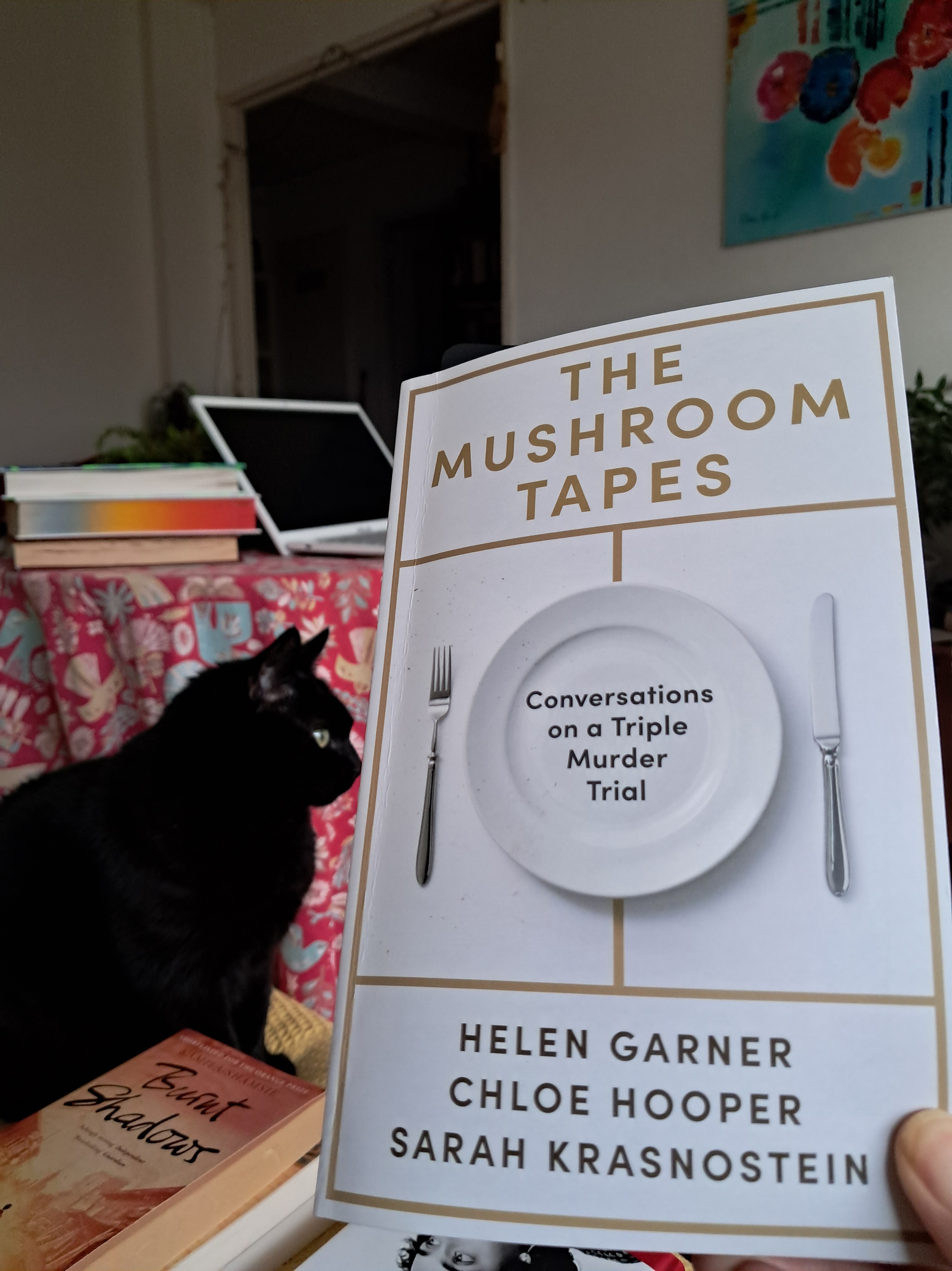
In her recent collaborative book The Mushroom Tapes, she attended a murder trial with two literary authors. They provided a counter to own thinking, enabling perspectives to be tested, refined, looked at from different angles.
In this earlier work, Garner is accompanied by her curious and attentive 16-year-old niece Louise. Though at certain points she questions the parents openness in allowing her to be present (she considers this on a day she was absent, with frank relief), each time she shares one of Louise’s insightful comments, it is revelatory.
There is something to be said for the cross generational team observation, good for the author and also a reminder to the reader that this is one person’s observation and it is a majority that decide.
On a day when the trial was slow going, when confusion and boredom filled the room and she noted that everyone had been affected by it, she contacted an old friend, a now retired barrister.
‘Farquharson’s counsel,’ I texted, ‘is killing us with boredom.’
He replied at once: ‘A time-honoured approach, when no feather to fly with. Still, one has heard it said that the fear of boring oneself or one’s listeners is a great enemy of truth.’
Time Heals and Time Destroys
The trial dissects not just the events of that one devastating Father’s Day, but the relationship of the couple, and things said to others while they were going through the painful process of separating. Things that in hindsight might be construed as intention, not mere jest. Throughout the first trial Cindy Gambino is supportive of her ex-husband, she refuses to believe that this man she knows loved his children, could ever intentionally carry out such an act.
Police wire-tap friends and try and get them to lead conversations where they need them to go. But all of these relationships are averse to betrayal, their histories are too long, connections too deep and their fear of reprisal too great.
Be Careful What You Say in Public
A couple of months before the retrial Garner was invited to give a talk about non-fiction in a State library. Someone in the audience asked her about her opinion on the trial, a subject she did not wish to get drawn into.
I confined myself to the observation that the only person who knew the truth wasn’t talking, and changed the subject.
One day a month or so later during a lunch break of a pretrial preliminary sitting, the defence lawyer pulled Garner aside for a word. He told her he had been sent a video of her talk at the library; Fear that she had said something inappropriate ripped through her.
My heart went boom. ‘Did I drop a clanger?’
‘You did. You said, “Only one person knows what happened in the car that night, and he’s not talking.” He leaned forward on both elbows and subjected me to a power-darkened look. ‘Our case is that my client doesn’t know what happened in the car that night. Because he was unconscious. By offering that opinion in a public forum, you were undermining my client’s right to silence. I think you might be in contempr of court.’
‘Contempt of court? Me?’ I broke into a cold sweat.
Discrediting a Witness
By the time of the retrial, five years after the event, the experience of repetition was disagreeable for many who took the stand. Significantly, Cindy no longer took the same position she had held. The defence sought to undermine that too.
It was exactly what Morrissey was after, a deeply ‘feminine’ shift, inspired not by reason but by wifely grievance and the bitter desire to settle a score.
Audiences attend to unravel a mystery, to understand a truth, but what they find in the courtroom is something a game or a debate, presentations of evidence on one side and efforts to discredit them on the other. The law is the rule book.
I tried to describe how I thought cross-examination worked.
‘The whole point of it is to make the witness’s story look shaky, to pepper the jury with doubt. So you get a grip on her basic observations, and you chop away and chop away, and squeeze and shout and pull her here and push her there, you cast aspersions on her memory and her good faith and her intelligence till you make her hesitate or stumble. She starts to feel self-conscious, then she gets an urge to add things and buttress and emphasise and maybe embroider, because she knows what she saw and she wants to be believed; but she’s not allowed to tell it her way. You’re in charge. All she can do is answer your questions.’
An Unjust System?

There are most certainly issues in the legal system that are problematic. The re-traumatising of victims is one and the unconscious bias against certain people is another. Recently I listened to an interview with Australian lawyer Suzie Miller, who ironically, has turned to theatre to communicate the inherent biases in the legal system.
Her play Prima Facie to be shown at the Gaiety theatre in Dublin 27-31 January sold out in less than a minute. It is the story of a proud barrister, who becomes a victim and finds herself on the other side of the justice system, and has a rude awakening, on discovering that the law was not written with victims in mind and that she is the one on trial.
I am planning to read the play soon, because of the incredible story of how Suzie Miller came to be in a position to be able to present this story, after all her education and experience and the fact that judges immediately set about implementing change after seeing it. Watch this space.
Though it is at times a laboured read and a tragic one, I did enjoy following the lengthy process through Helen Garner’s eyes. It did not leave me with any definitive answers though, except how difficult it must be to be a jury member in one of these crimes, when there is a system that facilitates the process that seems more like a chess game that an attempt to deliver justice. A system in need of its own reform.
Have you read This House of Grief or seen Suzie Miller’s play?
 Word by Word
No, but both sound fascinating
LikeLiked by 1 person
Excellent post. I loved This House of Grief and am off to see Jodie Comer in Prima Facie in Dublin next weekend!
LikeLiked by 1 person
Oh wow, you got tickets! I’m still waiting for the play to arrive to read. I hope you write about it, please!
LikeLiked by 1 person
I will! Can’t wait to see it.
LikeLiked by 1 person
I haven’t read this, but I remember the actual crime very clearly – as for ‘The Mushroom Tapes’, well, when the verdict came in, there was virtually no room for other news for days!
LikeLike